Make AI Accessible Across Your Org
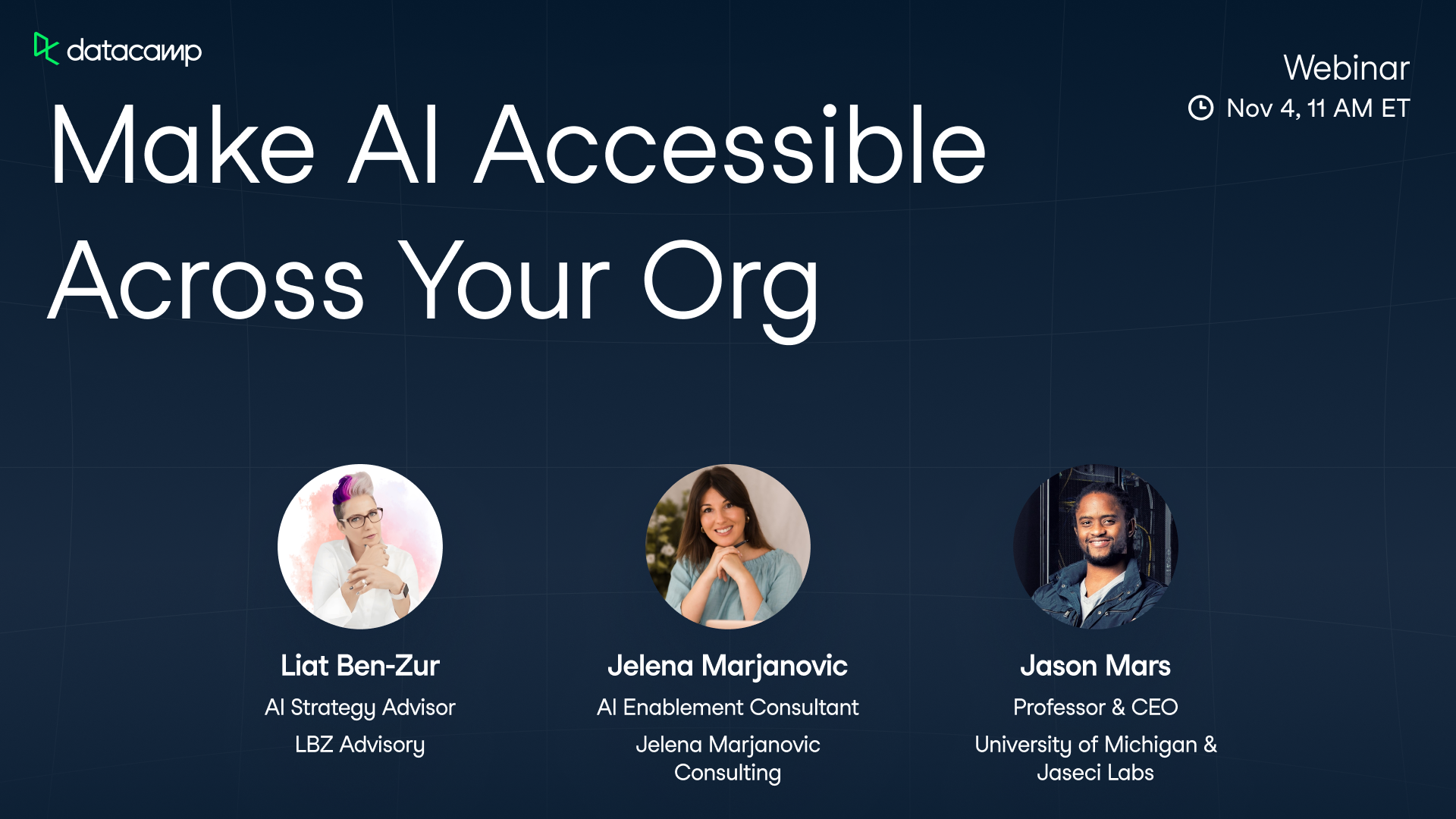
Pembawa Acara Anda

Liat Ben-Zur
AI Strategy Advisor at LBZ Advisory
Liat Ben-Zur helps boards and CEOs turn AI strategy into real results. She spent over 30 years leading product and AI work at Microsoft, Philips, and Qualcomm, including launching the first GPT-4 product at scale. Today she runs LBZ Advisory, where she helps leadership teams cut through complexity and ship AI that shows up in the bottom line. She is also the author of The Bias Advantage, a leadership book for the AI era.

Jelena Marjanovic
AI Enablement Consultant at Jelena Marjanovic Consulting
Jelena Marjanovic helps teams and organizations get practical value from AI, without code or hype. She holds a PhD in Technology-Enhanced Education and has spent a decade designing learning programs for Fortune 500 companies. Through Jelena Marjanovic Consulting, she works with non-technical teams to build real AI workflows that save time from week one. Her approach blends adult learning science, coaching psychology, and hands-on AI fluency to turn AI adoption into lasting habit change.

Jason Mars
Professor at University of Michigan and CEO at Jaseci Labs

Jason Mars is a computer science professor at the University of Michigan and CEO of Jaseci Labs. He directs the Clarity Lab, a leading AI research group, and created Jaseci and the Jac programming language, tools that help developers build generative AI software faster. He previously founded Clinc, an AI company that reached over 20 million users across banking, healthcare, and automotive. He raised over $62 million in venture capital and is the author of Breaking Bots.
Summary
Non-technical teams can get real value from AI today, and their knowledge of the work matters more than any coding skill.
In this webinar, part of DataCamp's AI for Knowledge Workers week, host Richie Cotton spoke with Liat Ben-Zur, AI Strategy Advisor at LBZ Advisory, Jelena Marjanovic, AI Enablement Consultant at Jelena Marjanovic Consulting, and Jason Mars, Professor at the University of Michigan and CEO at Jaseci Labs, about AI adoption in sales, marketing, finance, legal and other non-technical functions.
The panel agreed that domain experts hold the advantage, because they know where the bottlenecks and broken handoffs sit. They argued for simple tools over advanced ones, and for keeping people accountable for the decisions AI informs. Ben-Zur made the case that employee hesitancy is often a rational response to unanswered questions about jobs, and that fixing it is a leadership task, not a training one. Mars described how one public company stopped fighting low adoption by rebuilding its process around AI. Marjanovic explained why people ignore workflows they did not help build.
The audience questions turned to skill loss and junior staff. The panelists offered concrete practices: deliberate work without AI, roles that teach people to grade machine output, and tracking how often employees reject or edit what AI produces.
Watch the full recording for the panel's examples, from Hilton's AI-generated hotel ads to a founder who went from sending no sales messages to 50 a week.
Key Takeaways
- Deep knowledge of your own processes, stakeholders and customers does most of the work in getting value from AI, so non-technical staff can lead AI projects.
- Pick the simplest AI tool your team will use every day; skills built in one generative AI tool carry over to the others.
- Polished AI output tempts people to skip review, so organizations need explicit checks on who owns each decision.
- Employees resist AI when nobody explains who benefits from the productivity gains, and training alone will not fix that lack of trust.
- Adoption improves when AI becomes a required step in a redesigned process rather than an optional add-on to the old one.
- People adopt workflows they helped build and that solve a personal pain point, such as the dread of starting a task from scratch.
- Junior staff build judgment by practicing without AI and by learning to critique and grade AI output.
- Tracking override rates shows which employees accept AI answers without question.
Deep Dives
Why domain expertise matters more than coding for AI adoption
The panel opened with a message for anyone without a technical background. Liat Ben-Zur said that "technical skills are not the entry fee" and added that "some of the strongest AI users have never written a line of code in their life."
Her argument rests on what makes AI useful inside a company. A marketer building campaigns, a finance analyst preparing forecasts or a salesperson handling upset customers knows where the bottlenecks are, where handoffs break and what a good result looks like. Ben-Zur estimated that this understanding accounts for "80% of how you extract value from AI." People still need to give clear instructions, check answers, recognize a tool's limits and supply the right data. She also sees an advantage in coming to AI without a technical frame, because non-technical users ask what a tool is for rather than how it works.
Jelena Marjanovic, who comes from learning and development, put the same idea in terms of tacit knowledge: the judgment experts carry but rarely write down. When AI output is wrong, an expert notices, even without a ready explanation. "You may not be able to put that into words, but you know it," she said. Her advice is to build a habit of surfacing that knowledge, because it becomes the quality criteria you give your AI tools. It also explains why use cases do not copy well from one company to another. In her words, "your use cases begin from your mind," shaped by a company's needs, habits and beliefs about AI.
Jason Mars, who has built programming languages and AI developer tools, admitted that his own process is low-tech. "I have a spreadsheet, and I have my prompt sequence," he said, describing how he stores and tweaks prompts there. He framed prompting as two levers: the examples you show a model and the process you encode in your instructions, including what not to do. Coaching a model works much like coaching a colleague. "If you can engage with a human, you can engage with a model," he said. His closing advice was to stay curious, tinker and play with the models until the time spent starts paying off.
Richie Cotton compared tacit knowledge to gut feeling: experience tells you whether an AI answer is right, and that experience is what non-technical staff bring to the table.
Choosing simple AI tools for non-technical teams
Asked which tools non-technical workers need, Marjanovic gave an answer she called boring. The most success she has seen comes from "using the simplest tool that you can use" and that the team will keep using. A general assistant such as Claude, with connectors to tools like Notion and Google, already opens up many workflows. A tool that feels too complex gets abandoned.
She also argued that switching tools costs less than people fear. "Most of the Gen AI tools work in the same way," she said, so the skills you build in one carry over to another. Models differ in capability and output quality, and people may prefer one over another, but not enough to change which workflows a team can build. Most organizations, she said, need value from available generative AI tools and the connections between them, so their own processes get codified in those interactions.
Her own example shows how far a simple setup can go. With a client, she built a second brain that runs on Claude with connectors to Notion and Google plus some Zapier integrations. It collects insights from internal and external conversations, notes and research into a knowledge base that stays current. That knowledge base feeds tasks such as a Monday morning search for new leads. The difficulty, she said, lay in the thinking about what the system needed, not in the technology.
Ben-Zur offered a commercial case. Hilton worked with Shuttlerock and Meta to turn existing hotel photos into video ads with AI. The creative partner reported 13% more bookings, and the company avoided reshooting more than 700 properties. Ben-Zur urged leaders to look at their own archives of photos and content as raw material for new campaigns.
Mars raised a cost issue. Vendors are starting to monetize usage, and "the tokens are getting super expensive," which limits how much teams experiment. He expects local models to change that in 2027. Open models now run on laptops and desktops with a decent GPU, and apps such as LM Studio make them as easy to use as a chatbot website. He said these models perform close to paid frontier models from four to six months ago, which could give people access to unlimited tokens for most everyday problems. Cotton, who runs LM Studio at home, said local models are slower and less capable, but free and private.
Human judgment and accountability in AI decisions
When Cotton asked where humans still add value, Ben-Zur pushed back on splitting work into AI tasks and human tasks. She cited a Boston Consulting Group experiment in which 758 consultants got access to generative AI. On some tasks their work improved sharply. On others, the same highly educated people performed much worse with AI. The lesson, she said, is that you cannot judge whether AI fits a task by how sophisticated its output looks. An impressive analysis can miss one assumption and end up "directionally correct, but specifically wrong."
She sees AI as strong at surfacing patterns, comparing alternatives and challenging first instincts. But she drew a line between "generating recommendations and owning decisions." If AI recommends closing a factory on the numbers, someone has to weigh the effect on the community, ask whether the data reflects a temporary problem such as tariffs, and decide whether the company accepts the consequences. That is the work she wants from people: "Not spending three days assembling the spreadsheet," but taking responsibility for what it means.
Marjanovic described why that responsibility slips in practice. People prefer cognitive shortcuts, and polished output lowers our guard. When AI produces something that looks good, she said, "if it looks really good and you're impressed by it, you likely won't do the review." In large rollouts she sees many agentic workflows run with no real human in the loop, even when one was planned. She does not think agents are ready to run unsupervised. She pointed to a recent Anthropic study showing the company hiring more people for work that needs judgment and critical thinking.
Mars gave a technical reason for keeping people in charge: "these models, they don't have judgment," and they cannot innovate. A model asked to invent an alien produces aliens that resemble ones it has seen. A model asked whether to run ten businesses at once would say no, yet some entrepreneurs do exactly that. "They help us repeat the mundane," he said. Even for routine work, organizations do not let humans go unsupervised, so people will keep supervising models. For new ideas, he uses the model like a keyboard and takes small steps himself.
Cotton agreed that accountability is the slow part. Analysis can be outsourced to AI, but understanding the results and owning the decision cannot.
How leaders can overcome employee hesitancy about AI
Ben-Zur asked leaders to take hesitancy seriously. Some employees fear looking incompetent or being seen as cheating. Others have watched reorgs and layoffs and wonder whether learning the tools means training their replacement. She called these rational concerns, and said reluctant employees have often spotted problems leadership has missed.
Her example: a manager asks a customer service team to help train an AI tool on its best past responses and promises it will make them faster. Nobody explains what happens to the jobs when the company needs fewer people for the same volume. The question leaders must answer, she said, is "who gets the value of that improvement?" More autonomy, higher pay, better opportunities or more interesting work are all possible answers. She believes "AI is not replacing jobs" but tasks, and that work shifts elsewhere, as with the testing and validation work that grows when AI writes most of the code. Her advice is to be explicit about what will change, involve employees in redesigning the work and let them challenge the technology. "AI training alone is not gonna solve a trust problem," she said.
Mars approached adoption through process. He is helping a public company move its software development life cycle to an AI-first model. The company had rolled out Claude, skill files and internal tools, but adoption stalled. His advice: "Don't build tools to adopt in the current process. Invent a new process." In the new process, AI code review and AI-driven QA are required steps, and QA staff review and fill the gaps in what the AI did. "AI is not gonna accelerate you through bad processes," he said.
Marjanovic added the people side. "Just because something can be automated doesn't mean that it should be automated," she said, and she starts every project with a needs analysis of workflows. Teams often tell her they bought tools and built automations nobody uses. One reason is that employees "didn't build them themselves," so they do not see the why. Another is that the workflow does not meet a personal need. Her client's founder disliked writing sales outreach. A scheduled workflow now drafts messages and matches leads, so he opens a task that is already started. He now sends 50 messages a week, where before he sometimes sent none.
Preventing skill loss and training junior employees with AI
The first audience question asked how to stop skills from degrading when AI does more of the work. Mars took what he called a controversial position: lean into it. He compared the change to calligraphy in China, which once shaped a book's value and lost that role after printing arrived, while surviving as an art form. Coders may write less code by hand, he said, but they gain skill in using AI to build software. "It's okay to lean into the fact that some things will atrophy," he said, as long as you build new muscles.
Marjanovic, who has spent her career researching learning and skill adoption, shared a pattern from three to four years of working with generative AI users. She calls it "the overreliance curve." Beginners get excited, lean on AI too much and offload thinking, which she described as a natural human preference for shortcuts. Some then realize that not all output is good and that they want to keep developing. They move into a learning stage, where they use AI to sharpen their own skills.
Writing is her most common example. People who run emails and posts through AI start to recognize the patterns in its edits, such as cutting redundancy or improving coherence, and begin making those changes themselves in the first draft. She advised people to "hone your autonomous learning skills," and argued that with critical thinking and judgment, AI gives people more chances to build skills, not fewer.
A second question asked how to make sure young employees can do their jobs and check AI output. Ben-Zur urged junior staff to "practice deliberately without the tool" on a weekly or monthly basis, treating it like a fire drill. She asked leaders to redesign junior roles so new staff learn to critique AI drafts, find errors and ask what data and context the AI used. Teaching people to grade machine output, she said, teaches judgment and taste, and they need room to make mistakes along the way.
She also asked managers to make people show their reasoning on high-stakes work. "If you can't defend the AI's recommendation, then you are not prepared to provide the AI's recommendation," she said. Finally, she recommended tracking override rates, the share of AI answers people reject or refine. Employees who almost never reject or edit AI output are, in her view, a red flag.