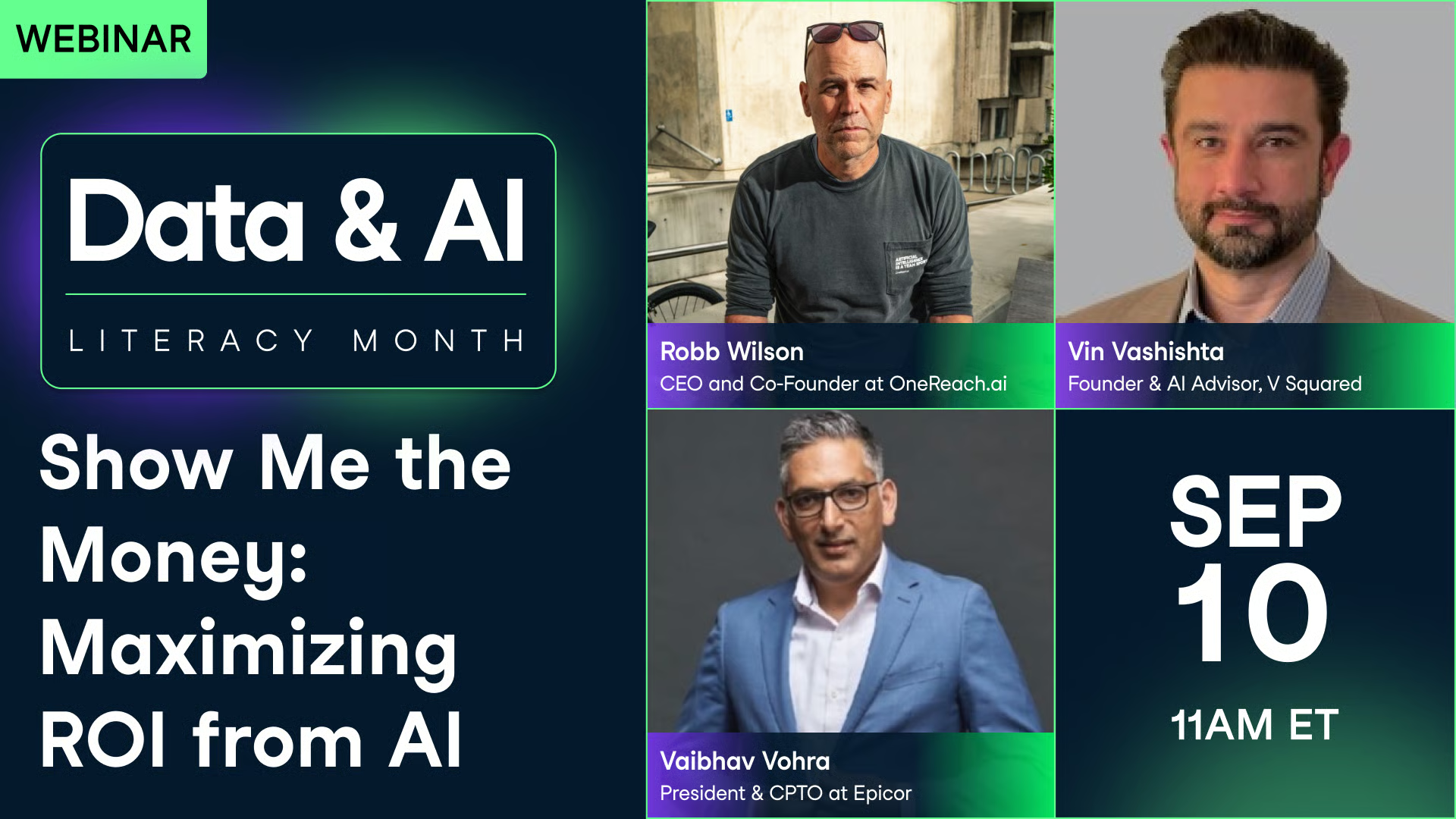
Show Me the Money: Maximizing ROI from AI
Pembawa Acara Anda

Robb Wilson
CEO and Co-Founder at OneReach.ai, Bestselling Author of Age of Invisible Machines
Robb Wilson is a pioneer in UX and AI, having led innovation initiatives for Apple, Microsoft, and Adobe. He is CEO and co-founder of OneReach.ai, the first-of-breed AI agent runtime and orchestration platform featured in 50+ Gartner reports in 2025, and author of the bestselling book Age of Invisible Machines. A Harvard Business Review contributor, he recently headlined Celonis’ global flagship event at the World Trade Center and serves as resident expert on the Invisible Machines podcast with UX Magazine

Vin Vashishta
Founder & AI Advisor at V Squared
Vin Vashishta is the author of ‘From Data to Profit’ (Wiley), the playbook for monetizing data and AI. He built V-Squared from client 1 to one of the oldest data and AI consulting firms. For the last eight years, he has been recognized as a data and AI thought leader. Vin is a LinkedIn Top Voice and Gartner Ambassador. His background spans over 25 years in strategy, leadership, software engineering, and applied machine learning.

Vijay Mehta
EVP of Global Solutions & Analytics at Experian
Vijay is a seasoned analytics, product and technology executive. He runs the department that creates Experian's Ascend financial AI platform. He has built and run data, engineering, and IT teams, and created market-leading products.
Session Resources
Summary
Maximizing ROI from AI is vital for businesses looking to use artificial intelligence for financial benefits. This session explores strategies for achieving a return on investment from AI, concentrating on cost reduction, revenue growth, and productivity enhancements. The discussion offers insights from AI experts Vin Vashishta, Robb Wilson, and Vijay Mehta, who stress the importance of aligning AI initiatives with business objectives, understanding the diverse applications of AI, and the necessity of strategic planning. The conversation also discusses the challenges of measuring ROI, the evolving aspects of AI pricing, and the importance of comprehensive changes over small improvements.
Key Takeaways:
- AI should be aligned with business goals to ensure value creation.
- Focus on high-value opportunities rather than small improvements.
- AI pricing models are shifting from per-seat to per-agent and per-outcome.
- Measuring ROI requires a focus on outcomes rather than traditional metrics.
- Comprehensive change in AI implementation can lead to significant business transformation.
Detailed Insights
Aligning AI with Business Goals
Aligning AI initiatives with business objectives is essential for maximizing ROI. AI should not be viewed as a standalone technology but as a tool to solve specific business problems. Vin Vashishta emphasizes the importance of starting with business goals and strategy to ensure that AI projects deliver value. This involves identifying high-value opportunities and prioritizing them over smaller improvements. By focusing on strategic alignment, businesses can ensure that AI initiatives contribute to growth and revenue generation rather than just operational efficiency.
AI Pricing Models
The traditional per-seat pricing model for AI is becoming outdated. Vin highlights the shift towards per-agent and per-outcome pricing, which better reflects the value AI delivers. This approach allows companies to charge based on the specific outcomes AI achieves, such as improved customer service or increased sales, rather than the number of users. This model aligns pricing with the value created, ensuring sustainable business models and profitability. Companies must consider their competitive advantage and data access to determine their pricing strategy effectively.
Measuring ROI in AI
Measuring ROI for AI initiatives requires a focus on outcomes rather than traditional metrics like hours saved. Vin suggests looking at the value of the outcomes delivered by AI, such as improved customer experiences or new capabilities that were previously impossible. This approach requires reengineering workflows to leverage AI's full potential, rather than simply automating existing processes. By focusing on the new value AI creates, businesses can better assess the return on their AI investments.
Comprehensive Change vs. Incremental Improvements
Robb Wilson discusses the importance of comprehensive change in AI implementation, as opposed to incremental improvements. Comprehensive change involves rethinking entire workflows and business models to fully integrate AI capabilities. This approach can lead to significant business transformation and long-term success. Incremental improvements, while beneficial, often fail to capture the full potential of AI. By focusing on comprehensive change, businesses can unlock new opportunities and drive substantial growth, positioning themselves for success in an AI-driven future.