Understand the Google Cloud Associate Cloud Engineer Certification
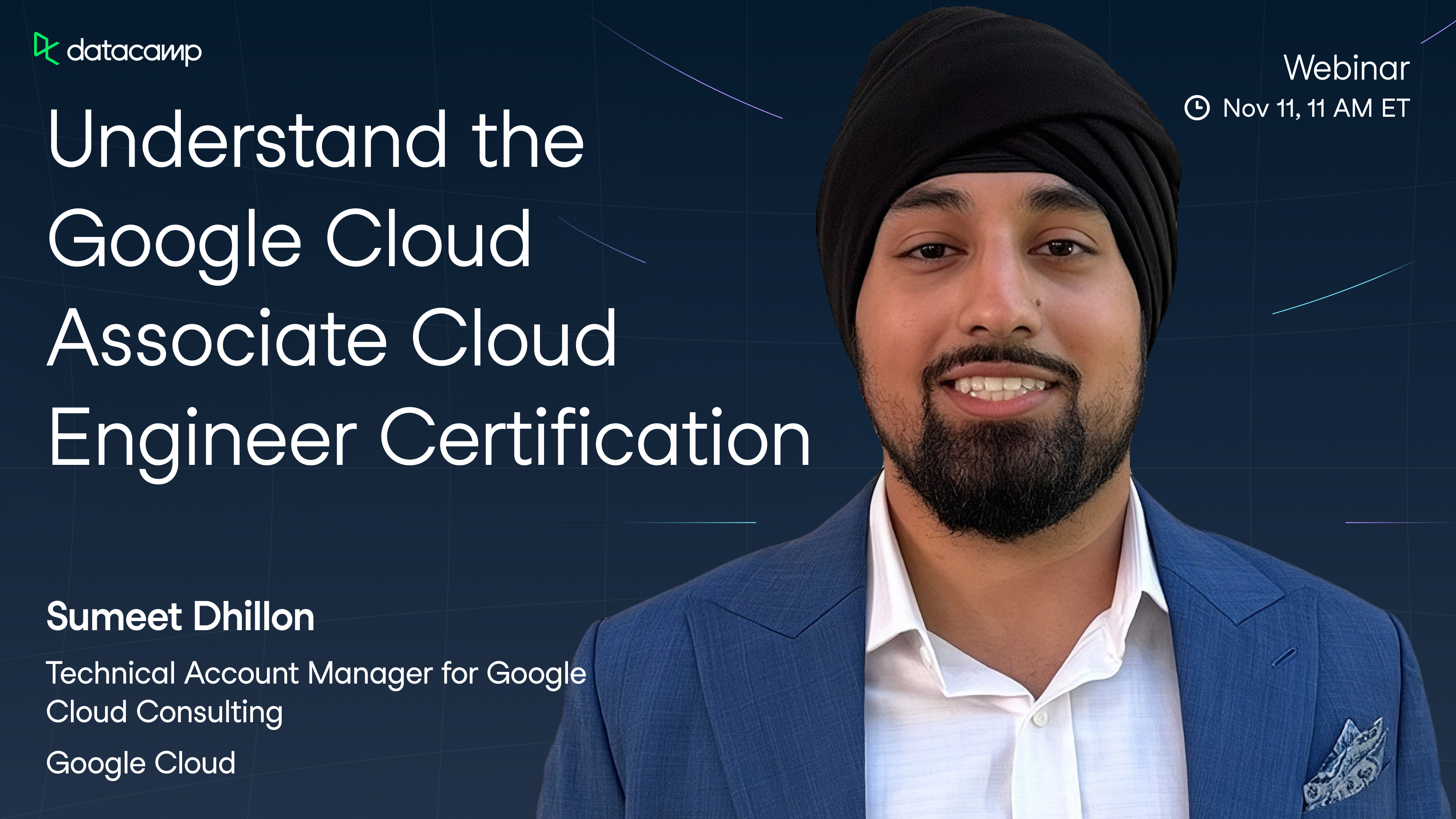
Pembawa Acara Anda

Sumeet Dhillon
Technical Account Manager for Google Cloud Consulting at Google Cloud

Sumeet partners with enterprise organizations to guide infrastructure modernization, resilience planning, and cloud architecture. With a strong background in distributed systems and cloud engineering, Sumeet helps teams design, optimize, and scale robust solutions on Google Cloud. He is passionate about empowering aspiring cloud professionals through practical, hands-on education.
Summary
The Google Cloud Associate Cloud Engineer certification is a two-hour, 50-to-60-question exam that Sumeet Dhillon of Google Cloud calls the right first step for almost anyone who works on the platform.
In this DataCamp webinar, Dhillon, a Technical Account Manager at Google Cloud, joins host Richie Cotton to explain who the Associate Cloud Engineer (ACE) exam is for, what it costs, how to register and how to study for it. He covers the exam format, the three-year validity period, the shorter renewal exam, and the trade-offs between sitting the test at a center or online from home.
The middle of the session is a live practice round. Dhillon works through three sample questions on GKE, BigQuery quota errors and real-time compliance checks, showing how he eliminates wrong answers by reading the last sentence of each question closely. Cotton, who says he has no cloud engineering background, plays along and does better than he expected.
The webinar ends with audience questions on study time, career value, renewals and retakes, and which backgrounds benefit most. Dhillon estimates 30 to 40 hours of preparation, split between learning the services and hands-on practice. Watch the recording for the full worked answers and Dhillon's advice on using Gemini as a study partner.
Key Takeaways
- The ACE exam lasts two hours, costs $125 plus tax, and has 50 to 60 multiple-choice questions, some with more than one correct answer.
- Google recommends about six months of hands-on Google Cloud experience before sitting the exam, though there are no formal prerequisites.
- The certification is valid for three years, and the renewal exam is shorter: about one hour, 20 questions and $75.
- Dhillon estimates 30 to 40 hours of preparation, with roughly half spent learning services and half building things with the Google Cloud free tier credits.
- The exam focuses on core services such as Compute Engine, Cloud Run, Cloud Storage, BigQuery, Cloud Logging and Cloud Monitoring, plus gcloud command-line usage.
- For exam questions, read the last sentence first; phrases like real time or minimal setup usually decide the answer.
- Online proctored exams require an empty desk, a full room scan and lockdown browser software that work laptops often block.
- Register for the exam with a personal email address so you do not lose access to your certification records if you change jobs.
- Dhillon recommends getting more hands-on experience before moving from the ACE to a professional-level exam such as Professional Cloud Architect.
Deep Dives
Who the Google Cloud Associate Cloud Engineer Certification Is For
Dhillon began with the case for getting certified. "So Google Cloud certifications are amongst the highest paid professional certs in the industry currently," he said, adding that Google Cloud is one of the fastest growing cloud platforms and that demand for engineers who know it is rising with it. Industry benchmarks, he said, put ACE holders at around $85,000 to $100,000 or more.
He was clear about the level. The ACE tests hands-on ability to deploy, monitor and maintain cloud workloads, so "it is not a super entry level exam." Someone who has never used the cloud should start with a foundational certificate. The ACE suits cloud engineers, system administrators, DevOps engineers, site reliability engineers and application developers, especially those with about six months of Google Cloud experience or those moving from another cloud provider. Unlike some other Google exams, it includes gcloud command-line questions, which pushes candidates to practice at the terminal.
Cotton asked whether the certification matters for people outside core infrastructure roles, the way an analytics certification can be useful for a marketing analyst. Dhillon's answer was broad: "I would recommend the ACE for anyone who is working with Google Cloud no matter what you're doing." Data analysts, database administrators and networking staff all benefit, he said, because the exam covers the full scope of services they touch and often shows them more efficient ways to work. At Google, he sees customer success teams, support staff and even product managers take it to understand how their product fits into the wider platform.
On career value, Dhillon said the ACE works as a hiring signal: "it serves as a strong hiring signal for technical recruiters verifying that you can jump onto a project with a minimal ramp." He declined to promise a pay rise, since that depends on each employer, but argued the knowledge carries over. "All clouds pretty much operate in the same fashion," he said, so what you learn applies to other providers and even on-premises systems. "That knowledge will not go to waste."
The ACE is also a starting point. Dhillon took it first, then the Professional Cloud Architect exam, and is now working toward the Professional Machine Learning Engineer certification. He advised against moving straight to a professional exam, since those go deeper on each product and reward more hands-on time.
ACE Exam Format, Cost, Renewal and Retakes
Dhillon laid out the logistics. The standard ACE exam takes two hours and costs $125 plus applicable taxes. It contains about 50 to 60 multiple-choice questions, and some questions have more than one right answer. It is offered in English, Japanese, Spanish and Portuguese. "There's no prereqs, and it's recommended to have at least six months experience."
Results come immediately. You learn whether you passed or failed when you finish, though the exam does not report a score. The digital badge for LinkedIn or Credly arrives a few days later after validation. Once earned, the certification lasts three years. "Every three years, you will need to do a renewal."
The renewal exam is a shorter version: about one hour, $75 and roughly 20 questions instead of 50 to 60. It is offered in English and Japanese, through the same online or on-site options. To qualify, you need an active certification and must be within the renewal window. Dhillon believed that window opens about 60 days before expiry but said he was not fully sure, so candidates should confirm it on the Google Cloud certification site.
On retakes, Dhillon said you can sit the exam again after failing, with a waiting period between attempts that grows with each retake. He was not certain of the exact intervals or whether a retake needs a new fee, and suggested checking with Google before booking. Cotton summarized the practical point: you cannot sit the exam repeatedly in quick succession, so a failed attempt should lead to more study rather than an immediate retry.
Registration runs through Google's certification portal. Candidates create an account, then schedule the exam through Pearson, choosing a format, language and either a nearby testing center or a time slot for online delivery. A voucher code can be applied before payment. Dhillon added one piece of advice that is easy to miss: use a personal email address, not a work or school one, because the account holds all your certifications and renewal notices. If you lose access to a work email after changing jobs, you may lose access to your records too.
Dhillon also covered how to judge readiness. The exam follows a normal bell curve in difficulty, and timing works out to about two minutes per question. He suggested aiming to get through about 25 questions in the first hour, which leaves time to revisit harder ones.
Testing Center vs Online Proctored Exam
Candidates can take the ACE at a testing center or online with a remote proctor, and Dhillon compared the two. At a testing center, you walk in and start. There are no distractions and the exam can be rescheduled. The downside is demand. Many people prefer in-person testing, so slots fill quickly and you have to book early and plan your commute. He was not sure whether testing centers offer round-the-clock availability.
Online exams offer more flexibility. You can take them from home, with slots available around the clock, and they can also be rescheduled. The trade-off is the environment check before the exam starts. No second screen can be on the desk; if one is there, it has to be unplugged. "Your desk has to be completely empty, and they want a full three sixty of your room." Dhillon recommended setting aside extra time for the check the first time you test online.
Hardware can also cause trouble. The online exam runs inside a lockdown browser that needs special software, and company-managed laptops often block it. Before booking, Dhillon advised downloading the small test utility that checks whether your machine qualifies. That step can prevent a failed start on exam day.
For in-person testing outside the United States, Cotton asked how to tell if centers exist in a given country. Dhillon said the booking flow answers the question. When you choose a testing center and enter your address, the system lists the nearest centers. If none appear, in-person testing is not available where you live. Asked whether you could combine the exam with travel and sit it abroad, Dhillon said yes, if you want to.
Whichever format you pick, the scheduling steps are the same: log in to the certification portal, choose the delivery method, select a language, agree to the policies, then pick a center or a time zone and date. You should receive a confirmation email with instructions for the Pearson testing software. Dhillon suggested logging on about 30 minutes before the exam starts for online delivery.
The choice comes down to what you can control. A testing center removes the risk of an equipment or room check failing at home. Online testing removes travel and fits around work. For candidates on a company laptop, Dhillon's tips point toward either testing on a personal machine or booking a center.
How to Study for the ACE: Gap Analysis, Hands-On Labs and Gemini
Dhillon estimated six to ten weeks of preparation, depending on how much cloud experience you already have. In hours, he put it at 30 to 40 in total: about 12 to 15 hours learning what each service does, and another 12 to 15 hours of hands-on work, with the rest depending on how quickly you move through labs.
His method starts with the official exam guide, which lists the skills tested. He uses it as a gap analysis. "Whatever I do know, I don't study. Whatever I don't know, I'll prioritize that first." Sample questions, including a Google Form on the certification page that gives instant feedback, help test progress along the way.
Hands-on practice matters because the ACE focuses on how to do things, alongside scenarios about why, when and where to use a service. New Google Cloud accounts come with free credits. Dhillon suggested using them to spin up resources right after learning about them, such as creating Compute Engine instances after studying that service. For a first project, "I'd recommend building a basic web app" hosted on Compute Engine or Cloud Run. A simple hello world app gives you an instance to explore and settings to change, which leads naturally into the rest of the syllabus.
Cotton asked how much of Google Cloud's catalog of several hundred services candidates need to know. Not much of it, Dhillon said. The ACE concentrates on fundamentals: Compute Engine, Cloud Run, Cloud Storage, BigQuery, Cloud Logging and Cloud Monitoring. He framed every application as needing three things, a web front end, a database and networking, and said those are what the exam covers. Other services belong to the professional exams.
Dhillon also recommended Gemini, Google's large language model, as a study aid. Candidates can ask it to write study guides, generate practice questions or build practice exams. For people who learn by listening, it can turn material into audio through NotebookLM. He said he has used it for every exam he has taken in the past two years. "And it's definitely a game changer."
For structured preparation, Cotton described DataCamp's nine courses built with the Google Cloud team for this certification. Dhillon noted that the courses combine learning material with hands-on labs and follow-along instructions, so candidates can cover both halves of preparation in one place before taking extra practice exams.
Practice Questions: How to Answer Google Cloud Exam Scenarios
The live practice round showed Dhillon's test-taking method. His first piece of advice: "look at the last couple of sentences. They usually have majority of the detail you need to answer." The opening lines set the scene; the closing ones carry the constraint that decides the answer.
Question one asked how to migrate Kubernetes workloads from on premises to Google Cloud while minimizing migration, operational and infrastructure costs. Dhillon worked by elimination. GKE Standard adds operational burden. GKE Enterprise costs extra. GKE fleet management is for multiple clusters, which the question never mentioned. That left GKE Autopilot, which is cost effective and quick to adopt. Most of the audience chose it too.
Question two described a BigQuery query failing with a quota exceeded error and asked which two steps would diagnose it. Dhillon ruled out BigQuery BI Engine, which is for dashboards and fast queries; Cloud Trace, which traces requests rather than quota errors; and Cloud Monitoring, which tracks resource usage such as CPU and memory. That left the error logs and Cloud Audit Logs, which show which quota was exceeded, and the INFORMATION_SCHEMA views, which explain why. "So the why comes with the information schema views." BigQuery logs which tables a query touched and how many slots it used, and a common cause is running many large queries at once. Cotton had dismissed INFORMATION_SCHEMA as a list of tables and said he had not known BigQuery recorded so much.
Question three asked for real-time monitoring of configuration changes to Cloud Storage and Firestore, with a security script run on each change, using minimal setup. Here, Dhillon said, every single sentence matters, and the words real time appear twice. When a question says real time, "they put it in there for a reason." A logging sink exported to BigQuery and run on a Cloud Scheduler job is not real time. A custom Python script and an App Engine application both need too much setup. Cloud Storage and Firestore triggers invoking a script in Cloud Run functions meet every requirement, and that was the correct answer.
The pattern across all three was the same. Identify the deciding constraint, such as cost, diagnosis or real time with minimal setup, then remove every option that breaks it. Dhillon said this approach, along with understanding Google Cloud architectural best practices and managing your time, is how he handles hard questions on the exam.