Chia sẻ hội thảo trực tuyến này
Thu hẹp khoảng cách kỹ năng về dữ liệu và AI của bạn
Chúng tôi là nền tảng duy nhất được thiết kế đặc biệt để nâng cao kỹ năng dữ liệu và AI trên toàn bộ tổ chức của bạn. Hãy cùng khám phá một chương trình được thiết kế riêng.
Đặt Lịch Demo Doanh Nghiệp[RADAR 11x] AI Upskilling for Everyone
October 2026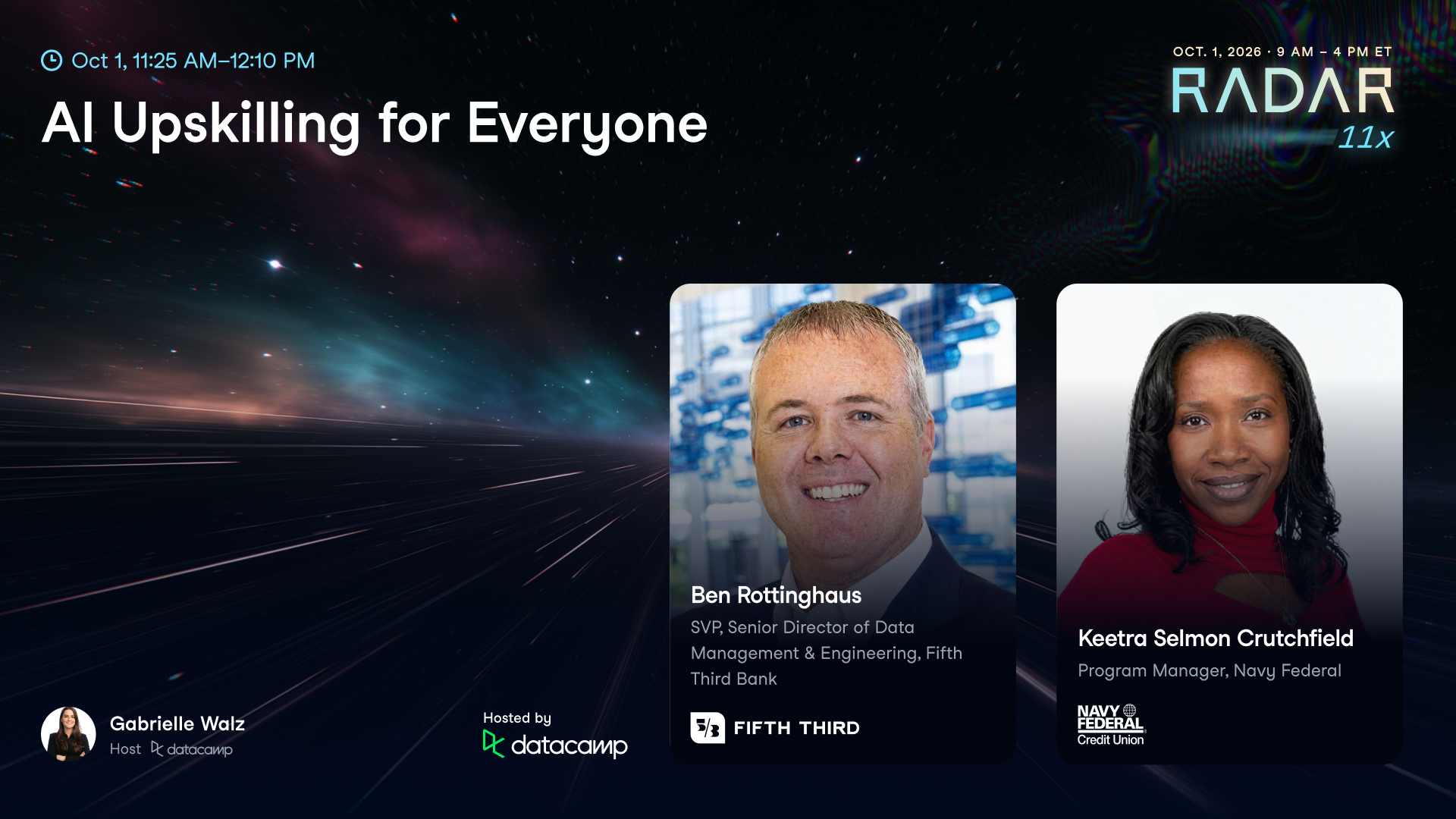
Người trình bày của bạn

Keetra Crutchfield
Program Manager at Navy Federal

Keetra Selmon Crutchfield is a Program Manager III at Navy Federal Credit Union. She has been with the organization for over 25 years. She works with leaders across the business to find gaps in employee training and design solutions to fill them. Keetra partners with HR and talent development teams to create learning content that helps people grow. She studied at Howard University.

Ben Rottinghaus
SVP & Senior Director of Data Management & Engineering at Fifth Third Bank

Ben Rottinghaus is SVP and Senior Director of Data Management and Engineering at Fifth Third Bank. He leads a team of data professionals who help the bank gain insights and deliver high-quality reporting. With over 23 years of industry experience, he has previously worked at Hewlett Packard Enterprise and Procter and Gamble. He has spoken at the CDO Magazine Global Data Leadership Summit and led Fifth Third's data modernization journey.
Summary
Two banks built AI upskilling programs from the ground up, and their program leads say the hardest part wasn't getting people excited about AI, it was holding them back long enough to do it safely.
At Navy Federal Credit Union and Fifth Third Bank, both heavily regulated financial institutions, AI training grew out of years of data literacy work that started well before generative AI arrived. Keetra Crutchfield, a program manager at Navy Federal, and Ben Rottinghaus, senior director of data management and engineering at Fifth Third, walked through how they won leadership buy-in, rolled out training in phases instead of all at once, and kept thousands of employees engaged as tools changed month to month. Both leaders described a shift in what employees worry about: fear of job replacement has given way to fear of skills going stale. They also addressed how to measure success beyond course completions, from usage data to the stories employees tell about work they got done faster. And they tackled a harder problem: teaching people to recognize when AI gets it wrong, in industries where a bad answer can reach a customer.
Key Takeaways
- Both banks built their AI programs on top of existing data literacy efforts, not from scratch, because employees needed a baseline before AI-specific training could stick.
- Training rolled out in phases, starting with basic compliance acknowledgments, then general AI literacy, then tool-specific productivity training like Microsoft Copilot, and finally role-specific pathways for functions like software engineering.
- Gaining leadership buy-in was often easier than pacing the rollout, since demand for AI tools outpaced the organizations' ability to deliver training responsibly.
- Employee sentiment shifted from fear of being replaced by AI to fear of skills becoming outdated, a change both leaders treat as a sign of progress.
- Sandbox environments where employees can practice prompts without real-world consequences removed one of the biggest psychological barriers to adoption.
- Peer-to-peer demos and a fear of missing out among colleagues drove more engagement than top-down mandates.
- Success metrics evolved from simple usage and adoption numbers toward skill progression and measurable business outcomes, including cycle time on existing work.
- Teaching employees to catch AI's mistakes required reinforcing distinctly human skills, including judgment, context, and the willingness to question an answer that looks right.
Deep Dives
Why two regulated banks built AI training on an older foundation
Neither program started with AI. At Navy Federal Credit Union, the groundwork goes back to 2019, when executive leadership committed to a large-scale transformation of the credit union's data and analytics capabilities. Crutchfield said the organization spent years getting the basics right before layering anything else on top. "You need good solid foundation and data to actually be able to accelerate the type of programming and things that we're doing now," she said, adding that she thinks of it as good in, good out, the flip side of the familiar garbage in, garbage out problem. That early investment meant different parts of the credit union arrived at AI readiness at different speeds. The IT organization, which had been building its data foundation the longest, was further along than business units that were only beginning that work.
Rottinghaus described a similar sequence at Fifth Third Bank, where AI training grew directly out of an existing push on data literacy. "A lot of this actually started with data literacy, even kind of ahead of AI specifically," he said. The bank's early efforts, basic SQL training, partnerships with universities for in-person sessions, and self-service courses through platforms including DataCamp, were aimed at helping more employees work with data at all, regardless of technical background. When generative AI tools arrived, the bank didn't start a separate initiative. "As AI became more of a thing, it was really about layering AI into that existing framework that we had," Rottinghaus said.
Both leaders pointed to regulation as the reason training couldn't move as fast as demand. Rottinghaus said the caution that comes with operating in banking shaped the entire approach: training had to cover not just the employees using AI tools, but the risk and audit teams responsible for overseeing how those tools get used. "It wasn't just training for the users," he said. "It was really training across all those different functions to ensure that we could do it compliantly, that we have the right oversight, that we have the right mechanisms to manage and control."
Winning buy-in was easier than slowing the rollout down
Crutchfield said Navy Federal's approach to securing leadership support leaned on lessons from its earlier data literacy rollout: tie the program to measurable business outcomes from the start, rather than asking for trust on faith. The credit union broke the work into a manageable, test-and-learn approach borrowed from its agile transformation, drawing on early adopters to prove value before expanding further. That groundwork paid off in visible top-down support. "We went from our president, CEO, who speaks to it, who supports it, who absolutely acknowledges it in all conversations, all the way down to our non-executive leadership team," she said.
At Fifth Third, the challenge ran the other way. "Buy-in maybe wasn't the hardest part," Rottinghaus said. "Some of it was actually slowing it down, because the demand was there. Everyone knew it was coming. Everyone was asking, how do we do more?" The bank's task wasn't persuading people AI mattered, it was sequencing which capabilities to release first and resisting pressure to hand every tool to every employee at once. That meant starting with the less exciting work, compliance training and foundational literacy, before any of the tools employees actually wanted to use. "We had to do it in a responsible way," he said. "So if anything, at times it was actually trying to slow it down and saying, no, we can't go train everyone."
Crutchfield described the work behind that pacing as heavily dependent on change management, acknowledging that both banks were effectively building their training plans while already running them, since the underlying technology kept shifting week to week. "AI changes by the day," she said, crediting Navy Federal's enterprise change and communications teams with helping the organization adapt without losing momentum or trust.
A funnel, not a flood: phasing training from compliance to job-specific tools
Rottinghaus described Fifth Third's rollout as a funnel built to reach the widest group of people first, then narrow toward more specialized training as needs became clearer. "If you think about it as kind of like a funnel, you wanna hit the most people you can at the beginning," he said. The first phase sat close to the floor: a mandatory acknowledgment, built into annual compliance training, covering what AI is meant to be used for and when. "That was really the most basic foundation to try to help just cover our basis from a risk standpoint," he said.
From there, training moved into general AI literacy, covering what generative AI is and how it works, delivered through university-led lunch and learns and internal sessions. The next layer focused on productivity tools already embedded in daily work, starting with Microsoft Copilot and its integration into Word and Excel, on the logic that meeting employees inside tools they already used would drive faster adoption than asking them to learn something new. Only after that did training get specific to job families, giving software engineers and data engineers tools suited to their actual work. "That funnel just starts to bend its way down into what those users need at the time they need it," Rottinghaus said, noting the full sequence took one to two years to build out, even as employees pushed for faster access throughout.
Crutchfield described a similar structure at Navy Federal, built around the idea of "getting people to slow down to speed up." Once enterprise-wide foundations were in place, her team shifted into a more consultative role with individual business units, assessing specific skill gaps rather than applying one plan everywhere. She also pointed to a practical step that reduced hesitation: giving employees low-stakes spaces to experiment before using AI on real work. "Finding safe places for people to practice" mattered, she said, describing sandbox environments where employees could try prompts without consequence, framing it as a chance to "learn how to succeed better quicker" rather than simply fail fast.
Keeping learners engaged as the tools keep changing
Both leaders said relevance, not mandates, kept employees coming back to training. "I think the more relevant the training is, the easier it is for folks to stay engaged," Rottinghaus said. Fifth Third leaned on peer-to-peer sharing, including lunch and learns where employees demoed problems they had solved with AI, which did double duty: presenters got feedback that improved their own work, and the audience saw what was possible. Rottinghaus said a bit of social pressure helped too. "There's some power in the fear of missing out," he said, noting that watching a colleague build something fast was often enough to push someone else to start.
Crutchfield said the range of roles at Navy Federal, from frontline employees with little time away from their desks to staff who could attend multi-day certification programs, meant meeting people where they were rather than running one program for everyone. Self-paced learning covered some of that gap, but she pointed to skill assessments as the bigger shift. "What has been astronomical and game changing is the ability to do skill assessments," she said, describing the value of letting employees benchmark where they stand and later show measurable progress. Navy Federal also built out code-alongs, hackathons, and prompt-alongs to get people practicing in a group setting, and expanded community-driven engagement, including an internal Microsoft 365 community of practice that has grown past a thousand members.
Leadership involvement reinforced all of it. Crutchfield said equipping managers to have regular, individual conversations about AI skills mattered as much as any formal course, since one employee's need to build foundational AI knowledge can look completely different from a colleague's need to strengthen judgment and communication. "Someone's need to upskill in a very AI foundational space may be very different than another team member's need on the human skill side," she said.
Measuring success, and teaching people to catch AI when it's wrong
Crutchfield said Navy Federal tracks a layered set of measures, starting with usage and adoption, then learner experience, which she described less in terms of satisfaction than simple accessibility. The bigger surprise wasn't a shortage of training content. "Our challenge wasn't having content," she said. "We actually had an overwhelming amount of resources to provide for them, but it was figuring out where to help people start." From there, the team tracks skill progression and, ultimately, business outcomes: time saved, service improvements, and employee engagement, all reported against a formal set of objectives and key results.
Rottinghaus offered a different lens. Without a formal learning organization background, he said his read on success comes largely from unprompted stories employees share about work AI helped them finish. "My success is actually just as much about the stories that I hear," he said, describing employees who show up wanting to demo something they built. One example stuck with him: a project the team expected to take six to eight weeks instead took a little over a week with AI's help. For teams with an existing performance baseline, he pointed to cycle time as a more concrete metric than usage alone, since the real value isn't fewer people or less work, it's getting more done in the same time with the same team.
Both leaders agreed the harder problem is teaching employees to catch AI when it's wrong. Crutchfield said everyone has seen a response, copied straight from a chatbot, that's out of context or contains a clear error. "It goes back to the importance of us never acquiescing those things that are human about us," she said, "the ability to read and to discern, to add context when necessary, to add empathy, to change the tone." Rottinghaus added that the stakes rise sharply once AI output reaches a customer, which is why Fifth Third also trains its risk and audit teams, the people responsible for monitoring how AI gets used across the bank, not just the employees using it day to day.
Liên quan
webinar
[RADAR AI x Human] AI Upskilling with Purpose: Customer Success Stories
Run AI training that makes a difference.webinar
How TD Bank Is Building AI Talent
Shahd Alkhashashna and Jon Spence share how TD Bank designed and deployed its AI upskilling program.webinar
Architect a 90-Day AI Upskilling Program For Your Team
Nerupa Kidnapillai, a Senior Customer Success Manager at DataCamp, walks you through how to design and implement a focused AI upskilling initiative for your organization.webinar
Building AI Skills with DataCamp
Discover how DataCamp can help you future-proof your career and business with new AI-focused courses.webinar
AI Upskilling: Lessons from the Frontlines
Experts discuss their experiences running AI upskilling programs at scale. You’ll learn how to define training personas, boost adoption and engagement, and measure the ROI of your efforts.webinar