Fine-Tuning Your Own Llama 3 Model
Maxime, one of the world's leading thinkers in generative AI research, shows you how to fine-tune the Llama 3 LLM using Python and the Hugging Face platform.

Maxime Labonne
Buat Akun Gratis Anda
Berlatih dan lacak kemajuan Anda.
Lanjutkan dengan GoogleDengan melanjutkan, Anda menyetujui Ketentuan Penggunaan, Kebijakan Privasi dan bahwa data Anda disimpan di AS.Terkait

Tutorials
Fine-Tuning Llama 3 and Using It Locally: A Step-by-Step Guide
We'll fine-tune Llama 3 on a dataset of patient-doctor conversations, creating a model tailored for medical dialogue. After merging, converting, and quantizing the model, it will be ready for private local use via the Jan application.
 Abid Ali Awan · 12 min
Tutorials
Fine-tuning Llama 3.2 and Using It Locally: A Step-by-Step Guide
Learn how to access Llama 3.2 lightweight and vision models on Kaggle, fine-tune the model on a custom dataset using free GPUs, merge and export the model to the Hugging Face Hub, and convert the fine-tuned model to GGUF format so it can be used locally with the Jan application.
Abid Ali Awan · 14 min
Tutorials
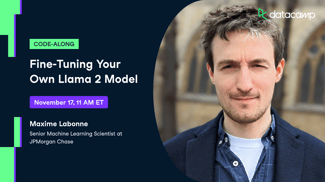
Fine-Tuning Llama 3.1 for Text Classification
Get started with the new Llama models and customize Llama-3.1-8B-It to predict various mental health disorders from the text.
Abid Ali Awan · 13 min

Meta's Llama 3 is one of the most powerful open weights LLMs, and forms the basis of many commercial generative AI applications. Fine-tuning is a technique to get better performance from LLMs for specific use cases, and is fast becoming an essential skill for organizations making AI applications.
In this session, Maxime, one of the world's leading thinkers in generative AI research, shows you how to fine-tune the Llama 3 LLM using Python and the Hugging Face platform. You'll take a stock Llama 3 LLM, process data for training, then fine-tune the model, and evaluate its performance for an industry use case.
Key Takeaways:
Resources (including link to notebook)