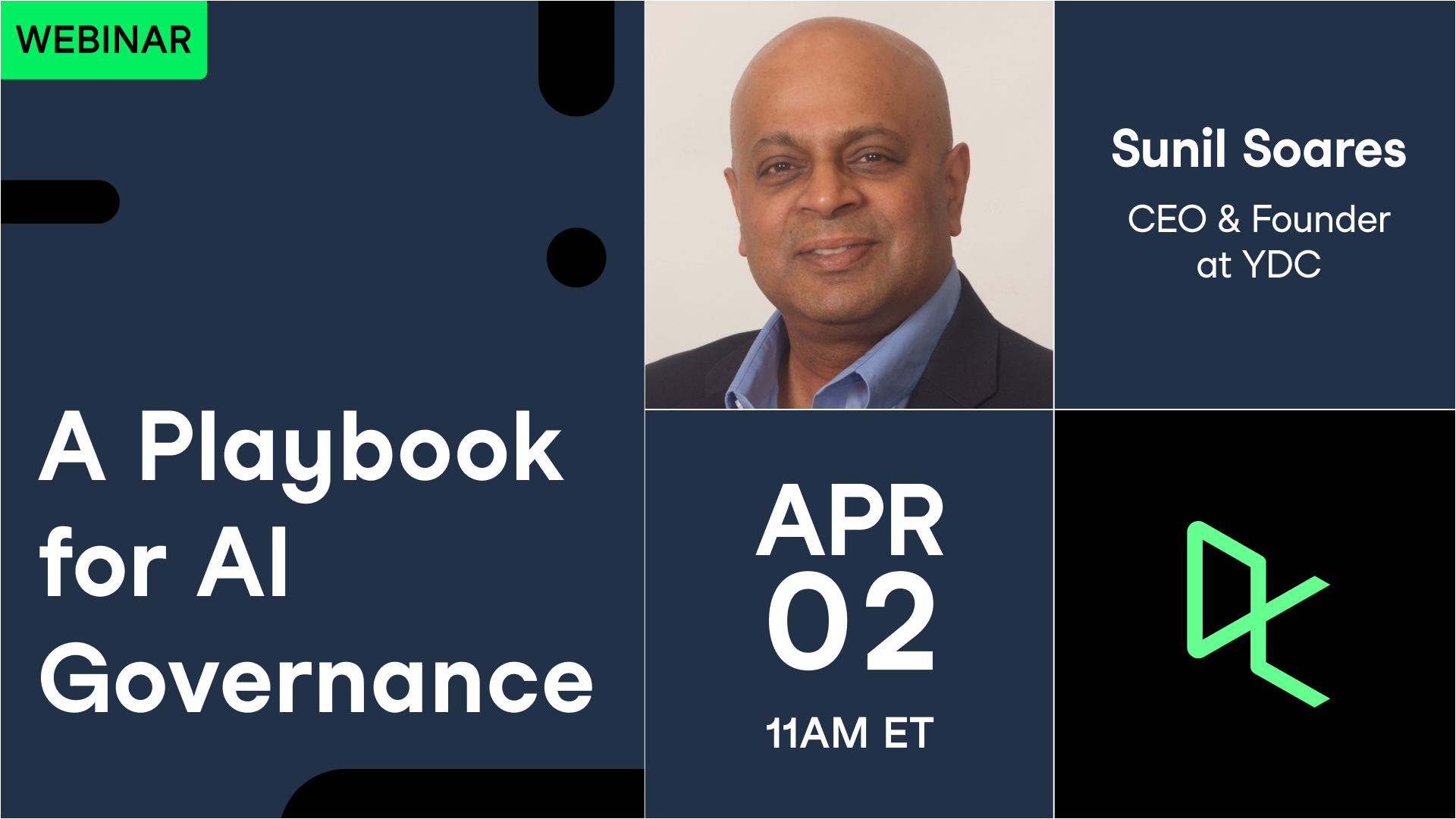
A Playbook for AI Governance
발표자

Sunil Soares
CEO & Founder at YDC
Sunil founded and runs the AI Governance solutions firm YDC. Previously, he was founder and CEO of data governance consultancy Information Asset, which he sold to private equity. He was also the Director of Information Governance at IBM, and Co-chair of Data ROI at the EDM Council. Sunil is the author of 13 books on data, AI, and information governance. His latest book is "Agentic AI Governance".
Session Resources (including slides)
Summary
AI governance is now an essential component for organizations leveraging artificial intelligence, as it ensures the responsible and ethical use of AI technologies. The complex nature of AI governance involves understanding regulations, selecting appropriate tools and vendors, and implementing effective processes. Sunil Soares, an expert in AI governance, outlines a comprehensive playbook for establishing a strong AI governance program, highlighting the importance of accountability, regulatory compliance, and lifecycle management. He also emphasizes the need for transparency, explainability, and human oversight to mitigate potential risks associated with AI deployment. With a growing number of regulations worldwide, organizations must be proactive in understanding and adhering to these requirements to avoid legal repercussions and maintain brand reputation.
Key Takeaways
- Establish a comprehensive inventory of AI use cases as a foundational step in AI governance.
- AI governance requires a multidisciplinary approach involving legal, business, and technical expertise.
- Understanding and complying with global AI regulations is critical to avoid legal issues.
- Transparency and explainability in AI systems are essential for gaining stakeholder trust.
- Human oversight remains essential, especially with the rise of autonomous AI agents.
Detailed Insights
Regulatory Compliance in AI Governance
Understanding the complex field of AI regulations is a fundamental aspect of AI governance. Organizations must familiarize themselves with various global regulations, such as the EU AI Act, which offers a comprehensive framework for AI accountability, data governance, and cybersecurity. Sunil Soares suggests that companies should select a primary regulation that covers most aspects relevant to their operations and use it as a benchmark for compliance, while remaining mindful of industry-specific regulations. He highlights the importance of staying abreast of regulatory changes and the possibility of geopolitical factors influencing the evolution and enforcement of these laws. By understanding these regulations, companies can better prepare for compliance, reducing the risk of legal challenges and enhancing their credibility in the market.
Transparency and Explainability in AI Systems
Transparency and explainability are vital elements of AI governance, enabling organizations to build trust with stakeholders and ensure responsible AI use. Sunil Soares highlights the importance of being able to identify AI-generated content, especially with the rise of deepfakes. He illustrates this with a practical example using Google's SyntID to detect AI-generated images. Explainability goes beyond identifying AI content; it involves understanding the rationale behind AI decisions. Techniques like shapely values and causal AI help elucidate the significance of different features in predictive models, enabling organizations to better understand and communicate AI decisions. By prioritizing transparency and explainability, companies can build trust and mitigate potential biases in AI systems.
Human Oversight and AI Agents
Despite the growing capabilities of AI agents, human oversight remains essential to ensure ethical and responsible AI deployment. Sunil Soares explains that AI governance frameworks must incorporate mechanisms for human intervention, especially in high-stakes applications like autonomous vehicles and medical diagnostics. He provides examples where human oversight is essential, such as radiologists interpreting AI-generated scans and pilots being accountable for autopilot systems. The challenge with AI agents is balancing automation with human oversight, as agents are designed to minimize human involvement. Organizations must develop strategies to integrate human oversight at critical points to prevent misuse and ensure AI systems align with ethical guidelines.
Implementing an AI Governance Playbook
A structured AI governance playbook is essential for organizations to systematically manage and mitigate AI-related risks. Sunil Soares outlines a 13-component framework that addresses key aspects of AI governance, including accountability, risk management, data governance, and lifecycle management. The playbook should cover an inventory of AI use cases, a risk classification methodology, and a tiered approval process. It should also define roles and responsibilities, ensuring that legal, technical, and business stakeholders collaborate effectively. By implementing a comprehensive playbook, organizations can establish a clear governance structure, enabling them to proactively address potential challenges and maximize the value of their AI investments.