Making Decisions with Data & AI
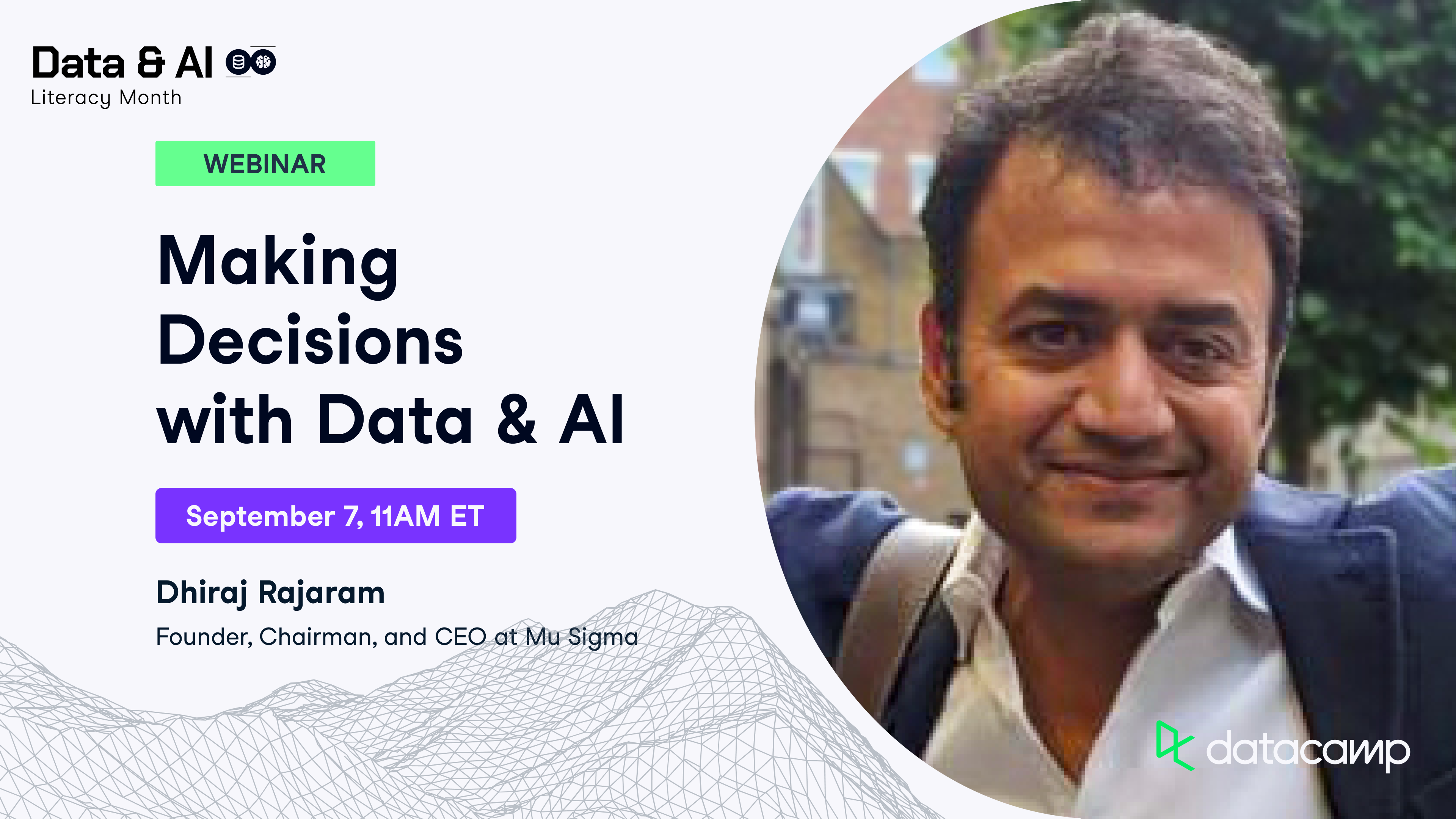
Người trình bày của bạn

Dhiraj Rajaram
Founder, Chairman, and CEO at Mu Sigma
Dhiraj is an entrepreneur. He founded Mu Sigma in 2004 to help companies make better decisions with data. He was twice ranked in Fortune magazine's "40 under 40" list of influential leaders, and was awarded the Ernst & Young "Entrepreneur Of The Year India" award in 2012.
Summary
Data-driven decision-making is vital in today's information era, where data is captured for virtually everything. Dheeraj Rajaram, CEO of Mu Sigma, emphasizes the importance of integrating both data-driven insights and intuition in decision-making processes. He highlights the role of decision sciences, which extend beyond simple data analysis to include actionable steps and feedback loops within organizations. The discussion explores the challenges of building a data-driven culture, stressing the need for structural changes and the creation of an "industrial kitchen" to support scalable decision-making. The webinar also examines the concepts of decision sciences versus data sciences, advocating for an integrated approach to problem-solving that considers the complexity and interconnectedness of modern business issues.
Key Takeaways:
- Data-driven decision-making requires a balance between data analysis and intuition.
- Decision science involves using data insights to make actionable business decisions.
- A structured approach, or "industrial kitchen," is essential for scalable decision-making.
- Understanding the interaction between complexity science and decision-making is vital.
- Organizations should aim for continuous improvement rather than fixed destinations.
Deep Dives
Data-Driven Decision-Making
In the current information era, data is everywhere, and utilizing it effectively for decision-making is both an art and a science. Dheeraj Rajaram stresses the significance of integrating intuition alongside data, explaining that while data provides factual insights, intuition helps in asking the right questions. He categorizes data into three types: easily accessible data, data that requires external access, and data that needs to be created. The ultimate goal is to transform data into decisions, with decisions being the focal point. Rajaram notes, "The big D is not for data, but it's actually for decisions." He emphasizes the importance of creating a path from data to dialogue to decisions, highlighting the role of productive conversations in deriving valuable insights.
Decision Science vs. Data Science
Decision science extends beyond data science by focusing on applying insights to make real-world decisions. While data science involves collecting and analyzing data to predict outcomes, decision science is about taking those insights and making them actionable. Rajaram explains that decision science involves engaging business stakeholders, creating feedback loops, and building learning ecosystems. He highlights the necessity of understanding both the inputs (data, algorithms, technology) and the outputs (descriptive, predictive, prescriptive analytics) to achieve meaningful outcomes, such as reducing churn or increasing profitability. The integration of these elements ensures that decision science is not only about analysis but about driving business impact.
Building a Data-Driven Culture
Creating a culture that supports data-driven decision-making requires significant changes to tools, processes, and organizational culture. Rajaram introduces the concept of an "industrial kitchen," a structured environment that supports scalable decision-making. This structure is essential for operating efficiently and sustainably, allowing organizations to tackle both anticipated and unexpected challenges. He advocates for a federated approach, where decision-making happens at the edge, enabling faster operations. Rajaram emphasizes the need for flexibility, stating, "In the future, everyone will be a decision scientist." This shift requires a balance between centralized control and decentralized execution to promote innovation and agility within organizations.
Complexity and Interactions in Problem-Solving
Understanding complexity is vital in modern problem-solving. Rajaram discusses the need for organizations to view problems not as isolated issues but as interconnected networks or constellations. This perspective allows for an integrated understanding of the problem space, enabling better decision-making. He introduces the idea of examining complexity through structured ontologies and graph theory, which help visualize the relationships between different elements. By acknowledging the intricacies of interactions, organizations can move from project-based analytics to programmatic decision sciences, ensuring that solutions are comprehensive and sustainable. Rajaram highlights, "All work in the future is going to be networked," emphasizing the importance of collaboration and transparency in addressing complex challenges.
- [COURSE] Introduction to Data Culture
- [COURSE] Data-Driven Decision Making for Business
- [TUTORIAL] What is Data Culture? A Comprehensive Guide to Being A More Data-Driven Organization
- [BLOG] 13 Use Cases for Data-Driven Digital Transformation in Finance
- [WEBINAR] Unlocking Data Cultures: Empowering People Through Data Literacy Programs


