본문으로 바로가기

세부 정보를 입력하여 웨비나에 참여하세요.

계속 진행하시면 당사의 이용약관, 개인정보처리방침 및 귀하의 데이터가 미국에 저장되는 것에 동의하시는 것입니다.

스피커

비즈니스용

2명 이상을 교육하시나요?

팀원들이 중앙 집중식 보고, 과제, 프로젝트 등을 포함한 DataCamp 라이브러리 전체에 액세스할 수 있도록 하세요.
DataCamp for Business를 사용해 보세요.맞춤형 솔루션을 원하시면 데모를 예약하세요.

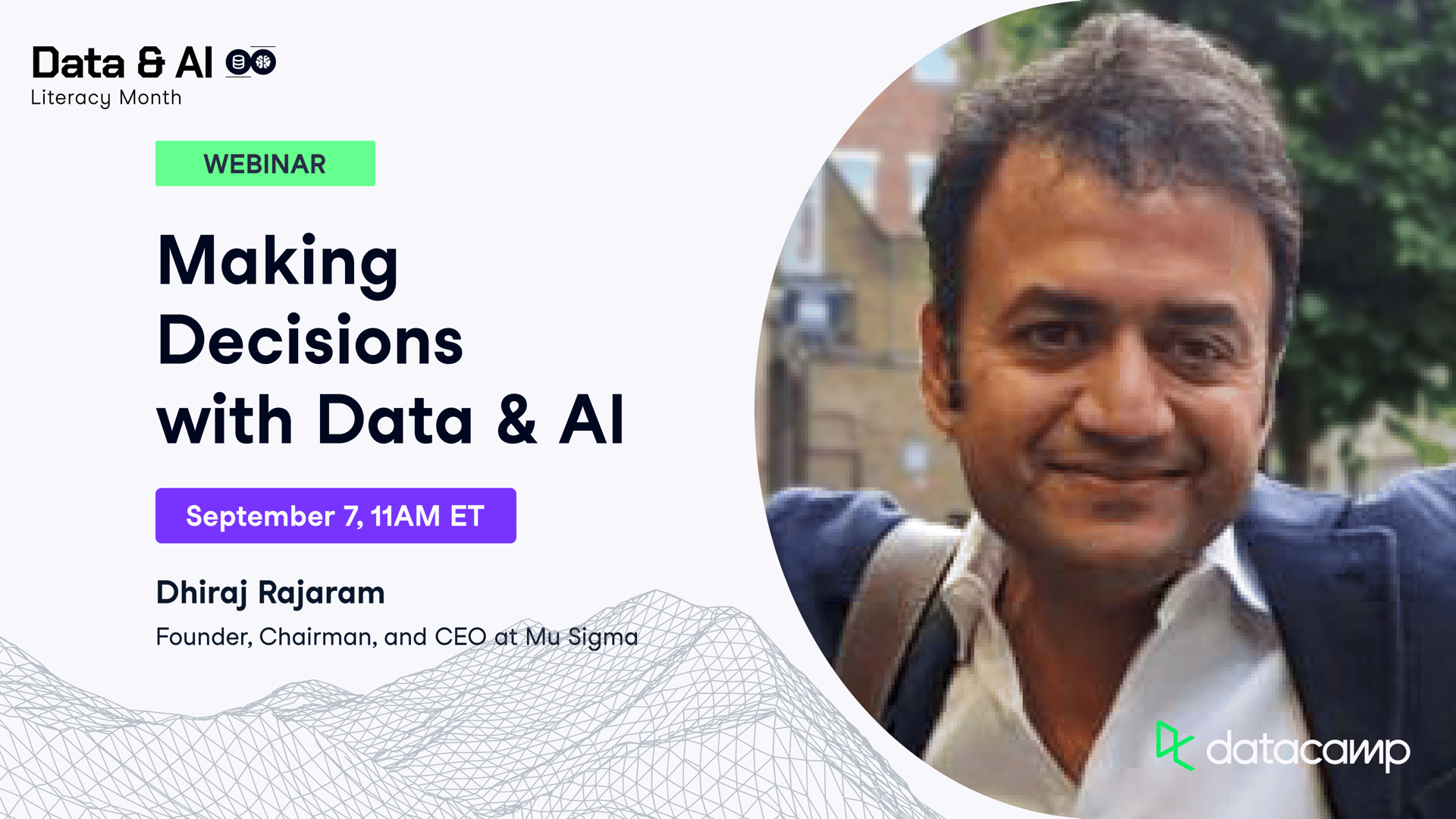
Making Decisions with Data & AI

September 2023
Webinar Preview

Summary

Data-driven decision-making is vital in today's information era, where data is captured for virtually everything. Dheeraj Rajaram, CEO of Mu Sigma, emphasizes the importance of integrating both data-driven insights and intuition in decision-making processes. He highlights the role of decision sciences, which extend beyond simple data analysis to include actionable steps and feedback loops within organizations. The discussion explores the challenges of building a data-driven culture, stressing the need for structural changes and the creation of an "industrial kitchen" to support scalable decision-making. The webinar also examines the concepts of decision sciences versus data sciences, advocating for an integrated approach to problem-solving that considers the complexity and interconnectedness of modern business issues.

Key Takeaways:

  • Data-driven decision-making requires a balance between data analysis and intuition.
  • Decision science involves using data insights to make actionable business decisions.
  • A structured approach, or "industrial kitchen," is essential for scalable decision-making.
  • Understanding the interaction between complexity science and decision-making is vital.
  • Organizations should aim for continuous improvement rather than fixed destinations.

Deep Dives

Data-Driven Decision-Making

In the current information era, data is everywhere, and utilizing it effectively for decision-making is both an art and a science. Dheeraj Rajaram stresses the significance of integrating intuition alongside data, explaining that while data provides factual insights, intuition helps in asking t ...
더 읽어보기

he right questions. He categorizes data into three types: easily accessible data, data that requires external access, and data that needs to be created. The ultimate goal is to transform data into decisions, with decisions being the focal point. Rajaram notes, "The big D is not for data, but it's actually for decisions." He emphasizes the importance of creating a path from data to dialogue to decisions, highlighting the role of productive conversations in deriving valuable insights.

Decision Science vs. Data Science

Decision science extends beyond data science by focusing on applying insights to make real-world decisions. While data science involves collecting and analyzing data to predict outcomes, decision science is about taking those insights and making them actionable. Rajaram explains that decision science involves engaging business stakeholders, creating feedback loops, and building learning ecosystems. He highlights the necessity of understanding both the inputs (data, algorithms, technology) and the outputs (descriptive, predictive, prescriptive analytics) to achieve meaningful outcomes, such as reducing churn or increasing profitability. The integration of these elements ensures that decision science is not only about analysis but about driving business impact.

Building a Data-Driven Culture

Creating a culture that supports data-driven decision-making requires significant changes to tools, processes, and organizational culture. Rajaram introduces the concept of an "industrial kitchen," a structured environment that supports scalable decision-making. This structure is essential for operating efficiently and sustainably, allowing organizations to tackle both anticipated and unexpected challenges. He advocates for a federated approach, where decision-making happens at the edge, enabling faster operations. Rajaram emphasizes the need for flexibility, stating, "In the future, everyone will be a decision scientist." This shift requires a balance between centralized control and decentralized execution to promote innovation and agility within organizations.

Complexity and Interactions in Problem-Solving

Understanding complexity is vital in modern problem-solving. Rajaram discusses the need for organizations to view problems not as isolated issues but as interconnected networks or constellations. This perspective allows for an integrated understanding of the problem space, enabling better decision-making. He introduces the idea of examining complexity through structured ontologies and graph theory, which help visualize the relationships between different elements. By acknowledging the intricacies of interactions, organizations can move from project-based analytics to programmatic decision sciences, ensuring that solutions are comprehensive and sustainable. Rajaram highlights, "All work in the future is going to be networked," emphasizing the importance of collaboration and transparency in addressing complex challenges.


관련된

webinar

Designing Data & AI Products

In this webinar, you'll learn about the fundamentals of design, how good design can help your data product, and how data and design teams can work together.

webinar

Best Practices for Developing Generative AI Products

In this webinar, you'll learn about the most important business use cases for AI assistants, how to adopt and manage AI assistants, and how to ensure data privacy and security while using AI assistants.

webinar

Getting ROI from AI

In this webinar, Cal shares lessons learned from real-world examples about how to safely implement AI in your organization.

webinar

The State of Data & AI Literacy in 2024

Join this webinar to learn how and which data & AI skills are becoming increasingly pervasive in organizations across industries, how leaders are adapting their teams and workforce to the era of data & AI literacy and more.

webinar

Adding Value in Pharma Through Data & AI Transformation

In this session three pharmaceutical executives, with experience as Chief Data Officers and strategic consultants, discuss techniques to improve your digital capabilities.

webinar

Artificial Intelligence for Business Leaders

We'll answer the questions about AI that you've been too afraid to ask.