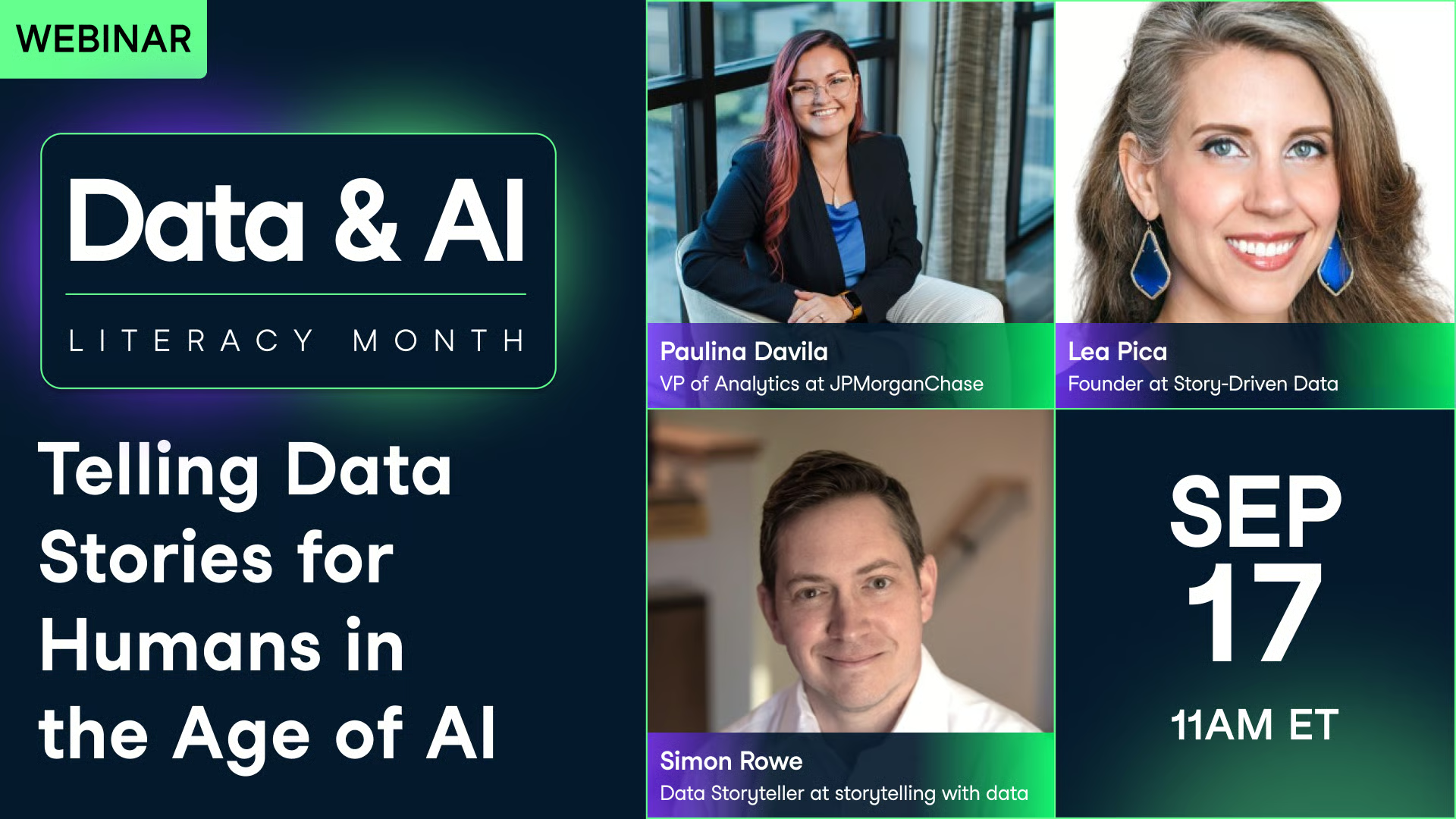
Telling Data Stories for Humans in the Age of AI
I tuoi presentatori

Paulina Davila
Head of Data Visualization & Storytelling for Home Lending Risk at JPMorgan Chase
Paulina runs a team focused on workforce analytics. She has a passion for data storytelling, with a focus on creating clear and impactful data visualizations that help decision-makers in understanding and acting on key insights. Paulina has been nominated 3 times for Tableau Community Awards. Previously, she was a Lead Data Engineer at Saatchi & Saatchi.

Lea Pica
Founder, Story-Driven Data
Lea Pica is a data analyst turned Data Storytelling Advocate, international keynote speaker, author, and workshop facilitator who teaches how to present data and inspire action to thousands of data and marketing practitioners around the world. She is the author of Present Beyond Measure: Design, Visualize, and Deliver Data Stories That Inspire Action, the creator of the PICA Protocol methodology, and the host of the “Present Beyond Measure” podcast. Learn more about her services at LeaPica.com.

Simon Rowe
Data Storyteller at storytelling with data
Simon is a financial analytics executive turned data storyteller. He spent two decades in financial services consulting with clients, and coaching a team to bring business performance insights to life in an engaging way. He's heavily involved in the Tableau community and co-leads the Storytelling With Data Sports Viz Sunday initiative.
Summary
Links Mentioned by Speakers
- https://www.datarevelations.com/books/
- https://www.storytellingwithdata.com/
- Present Beyond Measure: Design, Visualize, and Deliver Data Stories That Inspire Action 1st Edition by Lea Pica
- https://gamma.app/
- ColorBrewer
Telling data stories effectively in the age of AI is essential for engaging audiences and driving business impact. Richie Cotton hosts a session with experts Paulina Davila, Leah Pica, and Simon Rowe, who share insights on transforming data into compelling narratives. They discuss the importance of storytelling in making data accessible, the role of AI as a supportive tool, and strategies for adapting stories to different audiences. The session emphasizes the need for a structured approach, using frameworks and understanding audience psychology to enhance storytelling skills.
Key Takeaways:
- Storytelling transforms data from a static asset to a strategic driver of action.
- AI can assist in editing and brainstorming but requires human insight for effective storytelling.
- Understanding audience context and biases is crucial for adapting data stories.
- Frameworks like PREP and the PICA Protocol provide structured approaches to storytelling.
- Effective data storytelling requires a blend of technical skills and communication abilities.
In-Depth Insights
The Power of Storytelling in Data
Storytelling in data is about transforming raw numbers into narratives that resonate with audiences. Paulina Davila highlights how storytelling can shift data from being a static asset to a strategic driver of action. By making data more accessible, storytelling reduces missed business opportunities and enhances decision-making. Simon Rowe shared a story about fighting cholera and Paulina shared an impactful story about the wage gap in Texas, illustrating how data can evoke strong emotions and inspire action. The key is to present data in a way that is relatable and prompts audiences to engage and act.
AI as a Copilot in Data Storytelling
AI plays a supportive role in data storytelling by assisting with tasks like editing and brainstorming. Simon Rowe explains that AI can help condense information and generate content ideas, but it lacks the human insight needed to fully understand audience needs and business goals. Paulina Davila adds that AI can be used to simulate audience feedback, providing valuable perspectives that might be overlooked. However, the consensus is that AI should be seen as an assistant, not a replacement, in the storytelling process.
Frameworks for Effective Storytelling
Using structured frameworks can greatly enhance the storytelling process. Paulina Davila introduces the PREP method, which focuses on understanding audience preconceptions, relevance, experience, and priority. Leah Pica's PICA Protocol emphasizes purpose, insight, context, and aesthetics, guiding storytellers from initial data exploration to final presentation. These frameworks help storytellers maintain focus, ensure clarity, and effectively communicate insights, making the data more impactful and memorable.
Adapting Stories to Your Audience
Understanding your audience is crucial for effective data storytelling. Adapting stories involves considering the audience's existing knowledge, biases, and what matters to them. The PREP method provides a structured approach to adapting stories, ensuring that the narrative resonates with the audience's needs and priorities. By using relatable examples and simplifying complex data, storytellers can engage audiences more effectively and drive home the intended message.