Udostępnij ten webinar
Zamknij lukę w swoich umiejętnościach z zakresu danych i AI
Jesteśmy jedyną platformą zaprojektowaną specjalnie, by rozwijać umiejętności z zakresu danych i AI w całej Twojej organizacji. Odkryjmy dopasowany program.
Umów Się Na Demo Dla Firm[RADAR 11x] Humans On The Loop
October 2026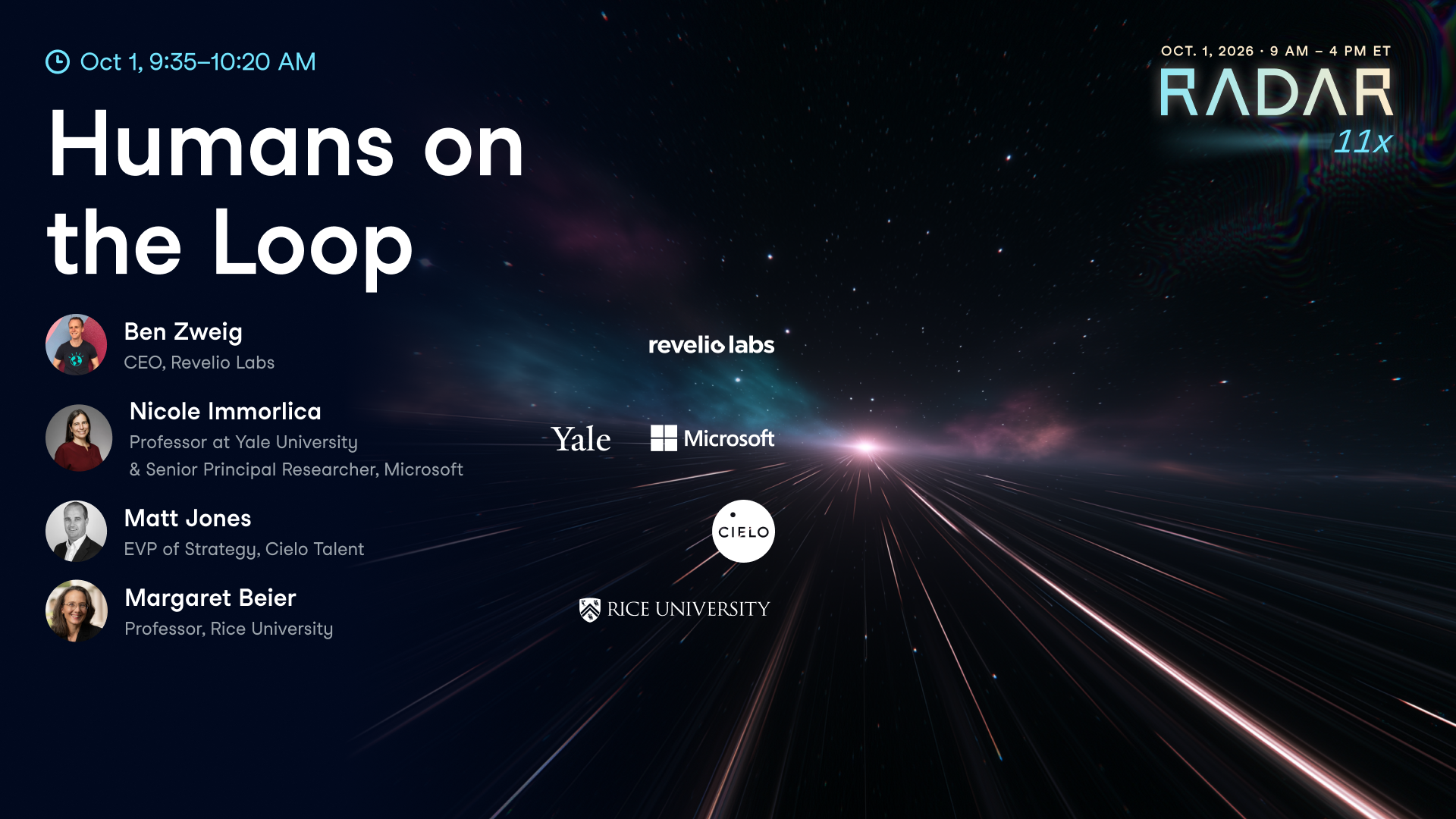
Twój prezenter(zy)

Ben Zweig
CEO at Revelio Labs

Ben Zweig is the CEO and Co-Founder of Revelio Labs, where he leads the development of a universal HR database built on over a billion public employment profiles and more than 5 billion job postings. He holds a PhD in Economics from the CUNY Graduate Center and teaches Data Science and The Future of Work at NYU Stern. Before founding Revelio Labs, he managed Workforce Analytics projects in the IBM Chief Analytics Office and worked as a data scientist at an emerging-markets hedge fund. He is the author of Job Architecture: Building a Workforce Intelligence Taxonomy.

Nicole Immorlica
Senior Principal Researcher at Microsoft

Nicole researches the design of sociotechnical systems at the intersection of computer science and economics. She is a Professor of Computer Science at Yale University and a researcher at Microsoft Research New England. Her work spans algorithmic game theory, market design, auction theory, and social networks. Nicole is an ACM Fellow and has received the Sloan Fellowship, the Microsoft Faculty Fellowship, and the NSF CAREER Award. She earned her BS, MEng, and PhD in theoretical computer science from MIT.

Matt Jones
EVP of Strategy at Cielo

Matt leads strategy at Cielo Talent, where he helps organizations transform their talent acquisition and HR approaches through large-scale outsourced services, consulting, and digital product development. He specializes in AI strategy for HR and TA, drawing on 20 years across technology, operations, and pre-sales leadership. Matt actively participates in global AI communities and advises both startups and multinational enterprises on applying AI to talent acquisition and human resources.

Margaret Beier
Professor at Rice University

Margaret studies lifelong learning and skill development at Rice University, where she is the Autrey Professor of Psychological Sciences and Department Chair. Her research focuses on the ability and motivational factors that shape self-directed learning in workplace and educational settings. She directs the Adult Skills and Knowledge Lab and has contributed to three National Academies consensus studies on learning, including chairing the committee on Adult Learning in the Military Context.
Summary
Four experts told DataCamp's RADAR audience the same thing in different words: AI is not taking your job. It is reshuffling what you do inside it.
At RADAR 11x, host Richie Cotton asked a panel spanning economics, psychology and talent strategy to address the question running through the room: will AI replace you? Nicole Immorlica, a computer scientist at Yale and Microsoft; Ben Zweig, CEO of workforce-data company Revelio Labs; Margaret Beier, a psychology professor at Rice University; and Matt Jones, EVP of strategy at talent firm Cielo Talent, each made a version of the same case. Jobs are bundles of tasks, and AI is automating some of those tasks, not whole occupations. What grows in value is coordination: deciding what to hand to AI, what to keep, and how to manage both AI systems and the people working alongside them. The panel pointed to durable skills, like judgment, communication, leadership and abstract thinking, as the ones that outlast any single technology wave. They also warned that upskilling programs only work when organizations give people real time to learn, and peers who are visibly using the tools themselves. By the end, the advice had turned personal: stop worrying about whether AI replaces you, and start asking whether you're still learning.
Key Takeaways
- AI automates individual tasks inside jobs far more often than it eliminates entire occupations, according to Revelio Labs CEO Ben Zweig.
- About 90% of the economy's task changes happen within existing occupations rather than through whole jobs disappearing or new ones appearing, based on Revelio Labs' research.
- Bank tellers didn't vanish after ATMs arrived. The job's tasks shifted toward customer relationships, and the headcount grew.
- Durable skills, including judgment, abstract thinking, communication and leadership, matter more than any single technical skill because they transfer across jobs and survive technology shifts.
- Managing AI well takes the same skills as managing people: setting incentives, assigning tasks, and deciding what to delegate.
- Peer influence, not formal training, is the strongest driver of whether employees actually adopt AI in their daily work, according to Microsoft research cited by Nicole Immorlica.
- Upskilling programs fail when they assume employees have spare time to learn. Adult learners need organizational and family support to make space for it.
- Using AI to produce an output and actually learning a skill are different things. Learning still requires effortful engagement.
- Demand for AI fluency mirrors the social-media skills wave of the mid-2000s: a baseline expectation, not necessarily a technical specialty.
- Ben Zweig argues AI remains poorly suited to building and validating data science models, where understanding why a model behaves the way it does still requires deep human reasoning.
Deep Dives
Will AI Take Your Job? Jobs Change. They Rarely Disappear.
Ben Zweig, CEO of Revelio Labs, built the panel's central argument on a simple observation from his own workforce data: most change in the economy happens inside occupations, not between them. "My point is that occupations transform all the time," he said, pointing to research showing that roughly 90% of the shift in total economic tasks happens within existing jobs rather than through whole occupations growing or shrinking. His go-to example is the bank teller. ATMs were supposed to make the role obsolete by automating cash handling and deposits. Instead, the number of bank tellers rose, because the job's tasks changed instead of vanishing. As Zweig put it, "what bank tellers were then is not what bank tellers are today." Tellers now sell credit cards and handle requests that machines can't. He extended the logic to the current moment: "when work gets automated, that doesn't mean that jobs get automated." Zweig treats every job as a bundle of tasks, some automatable and some not, with workers increasingly responsible for orchestrating between them rather than executing all of them personally. "People are doing more coordination, more orchestration, and less execution," he said of white-collar work specifically, distinguishing it from blue-collar and robotics-heavy jobs where automation has sometimes made the work worse. Matt Jones, from talent firm Cielo Talent, agreed with the framing and gave it a name: AI "allows humans to retreat up the value chain," moving people away from lower-value tasks and toward supervising the AI and agents doing that work instead. Both panelists pushed back on the idea that any occupation gets automated wholesale. Zweig was direct about where he lands: "we shouldn't be concerned about automation of entire occupations wholesale. That's just not how automation works." Jones added a caveat: the shift isn't painless. Roles get redesigned and refocused. But the net effect, in his telling, is more time spent on relationship-driven and judgment-driven work, not fewer jobs overall.
The Durable Skills Workers Need for an AI Future
Margaret Beier, a psychology professor at Rice University, gave the panel its most repeated phrase: durable skills. Her field, industrial-organizational psychology, is moving away from the term "soft skills" toward something more precise. "Durable skills are those skills that are actually durable across different jobs and occupations," she said, naming things like running meetings, interpersonal skills, leadership and teaching. Her reasoning is that AI is absorbing the rote tasks inside most jobs, but the tasks people find most interesting, and the skills behind them, are proving much harder to automate. Matt Jones picked up the same thread with his own list: abstract thinking, judgment, and the ability to innovate and ask good questions. He used prompt engineering as a cautionary tale. Two years ago, companies paid heavily for prompt engineers. Now, he said, "we don't need prompt engineers anymore because the technology moved on." The lesson he draws is that narrow technical skills risk the same fate, while broader capabilities endure. Nicole Immorlica, who teaches undergraduate algorithms at Yale, described wrestling with exactly this question before a recent course, recalling the moment she was assigned it: "why am I teaching this? Are people gonna need these skills?" Her answer leaned on the same logic Jones and Beier described. Writing a sorting algorithm by hand stopped being a real job requirement decades ago, but the underlying skill, structuring a problem and deciding what question to ask, hasn't lost its value. "There's still this abstract thinking piece about how you're gonna structure the problem," she said, adding that figuring out what to ask is "always gonna be a human job." Ben Zweig added a technical counterpoint for anyone tempted to drop hard skills entirely. As AI shifts from chatbots to agentic systems, using tools like a coding terminal or an AI coding agent is no longer trivial. "Those hard skills are increasingly important," he said, alongside, not instead of, the durable ones Beier and Jones described.
Everyone Is Now a Manager, Including of AI
Nicole Immorlica framed the panel's most structural idea: managing AI is fundamentally a management problem, and that puts everyone in a leadership role whether they asked for it or not. Drawing on economics, she explained, "we have this concept of principal agent problems. So we're all now principals." In her view, using AI well means leading it the way a manager leads a person: setting incentives, giving direction, and checking that the output matches what you actually wanted. "We have to lead the AI through prompting, through incentives," she said, describing a skillset she's developing further in an upcoming chapter for Microsoft's AI Economic Institute book on education and careers. The chapter's core question, she said, is how workers can "systematically both structure the tasks that AI approaches and restructure what tasks your job even consists of as a result." Ben Zweig described the same shift in practical terms. As execution gets cheaper and more automated, deciding what happens first, what depends on what, and who works with whom becomes the valuable part of the job. "We are playing the role of orchestrators and coordinators and kind of managing the chaos," he said, adding that the shift is driving "increasing returns to skills and leadership and management." He pushed back gently on the idea that AI agents can take over that orchestration role themselves any time soon, noting that "at some level of abstraction, that's not happening today." Matt Jones connected the idea to a specific, growing category of work: coordination and relationship management inside large organizations. He pointed to rising demand in "commercial areas, go to market, the uniquely human relationship driven work," as AI absorbs lower-value tasks elsewhere, freeing people to spend more time present with colleagues and clients. Across all three answers, the claim is the same. The less time a job spends executing tasks directly, the more its value depends on coordinating the humans and systems doing that execution, a skill no current AI system fully replaces.
Why Most AI Upskilling Programs Fail
The panel found easy agreement on how organizations actually get employees to use AI well, and the answer surprises no one who has sat through mandatory training: formal courses aren't what moves the needle. Nicole Immorlica cited Microsoft research, including telemetry from Copilot, that found peer influence does more than training to determine whether employees adopt AI effectively. "Peer influence matters a lot," she said, describing a paper from Microsoft colleagues called "Peer influence can make or break your AI rollout." Culture, leadership example and trustworthy colleagues all factor in, but the mechanism is social: "you need to have peers that are using AI that you learn by example, you talk about it over the cooler, during coffee breaks." She argued that formal training alone can't carry a technology this personal. People use AI for email, writing and judgment calls specific to how they work, which makes peer example more useful than a standardized course. Margaret Beier extended the argument from the organization to the household. Her research on adult learning finds that most upskilling strategies assume employees have free time for courses, which, for many, simply isn't true. "Adult learners are super busy," she said, noting that employees with families, multiple jobs or demanding schedules rarely have slack time for self-directed learning, however well-designed the course. She pointed to a deeper problem with how AI gets used for learning in the first place: using AI to produce an output and actually learning something are not the same act. "There's a difference between learning and performance," she said, adding a blunt diagnosis of what happens when that distinction gets ignored: "if you're just using AI to do something, you're not actually probably learning." Her prescription was organizational, not individual. Companies need to build in protected time, peer support and, critically, someone with real domain expertise who can judge whether an AI's output is any good. Without that check, teams can "run into a lot of problems" without realizing it.
Will AI Replace Coders and Data Scientists?
An audience question near the end pushed the panel on the topic closest to DataCamp's own audience: is AI coming for data analysis and coding jobs specifically? Ben Zweig, whose company Revelio Labs tracks workforce data for a living, gave an answer that ran against the optimism he'd shown for most of the session. "I think AI is particularly not well suited for data science," he said, explaining that building a model requires understanding exactly how it behaves, including how it misbehaves, in ways that still demand direct human reasoning. He described watching his own team "let AI rip on some models" with poor results, and drew a sharp line between using AI for small, contained coding tasks, which he considers genuinely useful, and trusting it with model architecture and the judgment calls that go with it. "I don't see a world where building models is primarily... the architecture of that is primarily done by AI," he said. "We are not close to there." Richie Cotton pushed the distinction further, separating writing code with AI assistance from deciding how to frame the underlying business problem, a distinction Zweig agreed with immediately. Matt Jones framed the same dynamic as another example of moving up the value chain: AI changes coding and data analysis work without replacing it, freeing people to do more and different kinds of work rather than less work overall. Nicole Immorlica brought the conversation back to her own teaching. Assigned to teach undergraduate algorithms at Yale, she'd wondered whether the material still mattered when AI can write working code for most routine problems. Her answer mirrors Zweig's: coding itself may become more automated, but structuring a problem, deciding what to ask, and reasoning about what a solution actually means remain human work. The panel's shared conclusion isn't that data and coding jobs are safe by default. It's narrower than that: the parts of those jobs involving boilerplate code are genuinely exposed to automation, while the parts involving judgment, debugging reasoning and defining the problem in the first place are not, at least not yet, and not with current tools.
Powiązane
webinar
AI and the Workforce: How Will AI Reshape Data and Technology Roles?
Industry experts explore how AI is reshaping the skills, responsibilities, and opportunities within the tech industry.webinar
[RADAR AI x Human] The Top Human Skills In An Agentic World
What should you learn to get hired or promoted?webinar
[RADAR 11x] You Are Super Human Now
Kicking off RADAR 11x AI, a short keynotes from co-founder and CEO Jonathan Cornelissen.webinar
Build an AI Assembly Line
Experts explore how C-suite leaders can redesign workflows, define governance structures, and improve decision-making processes.webinar
[RADAR AI x Human] What's Next? Rethinking Analytics for the AI-Human Era
We live in exciting times. What happens next?webinar