The Top Enterprise Use Cases for AI Agents
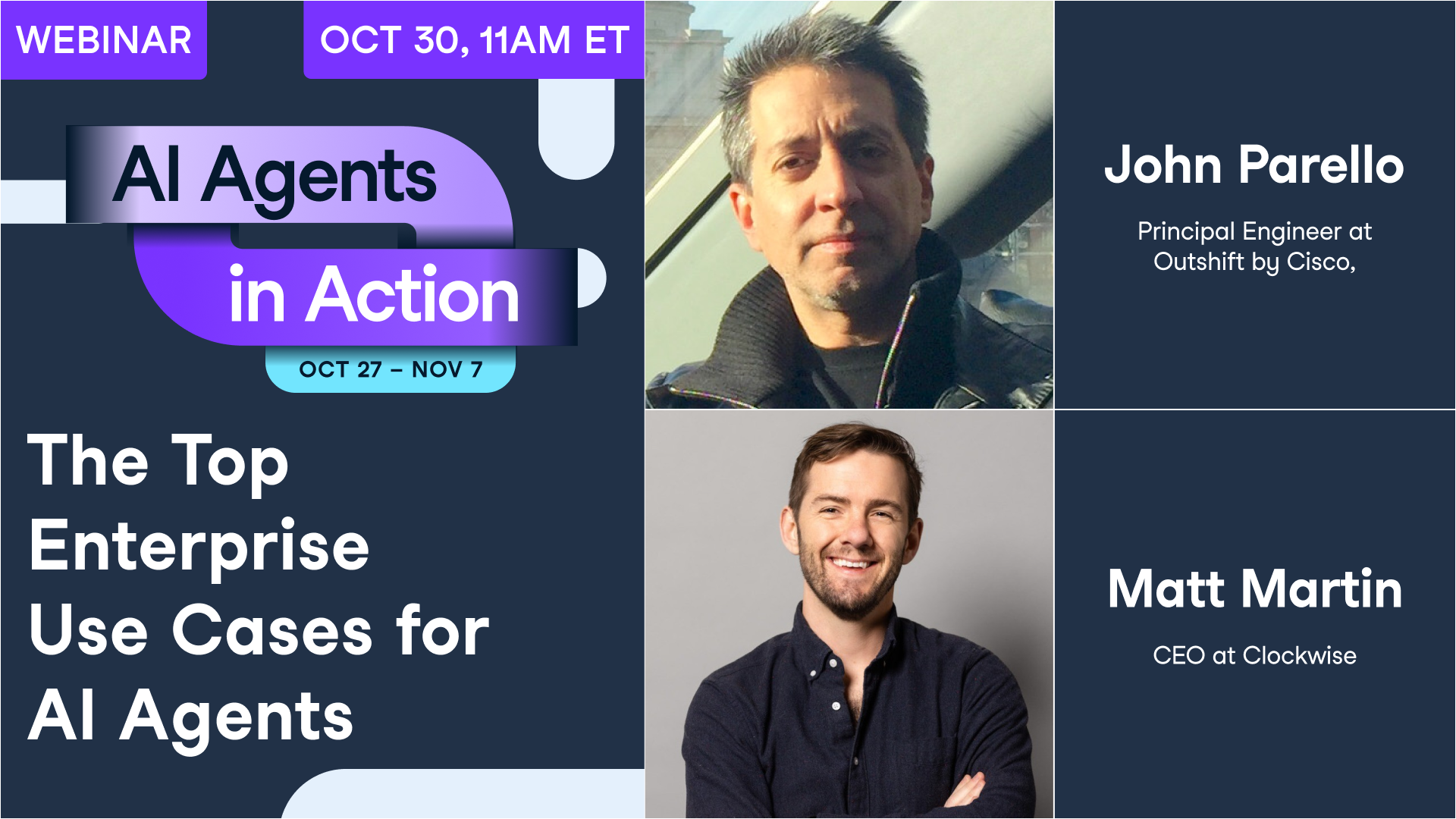
Twój prezenter(zy)

John Parello
Principal Engineer at Outshift by Cisco
John is a Principal Engineer at Cisco Outshift, leading AI strategy and open source development for AGNTCY, the Internet-of-Agents initiative. He previously built and led engineering for Cisco’s global Innovation Labs and developed the company’s first network and wireless controllers, forming the foundation of modern network and energy management.

Matt Martin
CEO at Clockwise
Matt is a lawyer turned software engineer turned startup founder and CEO. He runs the AI calendar management platform, Clockwise. His focus is on using technology to improve the future of work and enhance human abilities.
Session Resources + Chat Messages
Summary
The session on "The Top Enterprise Use Cases for AI Agents" is designed for professionals interested in integrating AI agents into business processes. The discussion explored how AI agents can transform business workflows, focusing on when to buy or build them, the skills needed, and the potential challenges. Richie Cotton hosted the session with guests Matt Martin, CEO of Clockwise, and John Parello, Principal Engineer at Outshift by Cisco. They shared insights on notable AI agents, the most practical agents, and the challenges of deploying AI at scale. The conversation also touched on the impact of AI on employment and the importance of security and internal policies in AI adoption.
Key Takeaways:
- AI agents can significantly enhance productivity, especially in software engineering.
- Simple AI agents, like those for scheduling or briefing, offer substantial value.
- Security and internal policies are essential for successful AI deployment.
- AI is not yet replacing employees but is shifting job roles and reducing new hires.
- Curiosity and experimentation are key skills for leveraging AI technology.
In-Depth Analysis
AI Agents in Software Engineering
AI agents have shown remarkable potential in the software engineering domain. Tools like Cursor and Cloud Code are enhancing productivity by assisting with code reviews and prototyping. Matt Martin highlighted how these agents provide initial insights and catch errors, allowing engineers to focus on more complex tasks. While not yet capable of replacing engineers, these tools reduce the need for additional hires by augmenting existing staff. The benefits gained from these agents are significant, as they handle routine tasks, allowing engineers to concentrate on innovation and problem-solving.
Simple Yet Effective AI Agents
Simple AI agents, such as those providing morning briefs or managing schedules, offer substantial utility. Matt shared how a basic agent that prepares a brief on daily meetings can save time and improve efficiency. John echoed this sentiment, noting that agents handling routine tasks like vacation requests can save thousands of hours across an organization. These agents demonstrate that even straightforward applications of AI can lead to significant productivity gains, emphasizing the value of automation in everyday tasks.
Challenges and Pitfalls of AI Deployment
Deploying AI agents at scale presents challenges, particularly in terms of cost control and error management. John discussed the importance of bounding agent actions to prevent runaway costs and errors. Matt added that while agents can automate many tasks, they still require human oversight to avoid multiplying errors. The session highlighted the need for observability and logging to catch and correct mistakes, emphasizing the importance of maintaining a human-in-the-loop approach during this transitional phase of AI integration.
AI's Impact on Employment
The impact of AI on employment is varied, with AI shifting job roles rather than outright replacing employees. Both Matt and John noted that while AI increases productivity, it may reduce the need for new hires. However, AI also creates opportunities for new roles, particularly for those who can adapt to AI-enhanced workflows. The session emphasized the importance of becoming AI-native, as companies seek employees who can use AI tools effectively. This shift requires continuous learning and adaptation, positioning AI as both a challenge and an opportunity in the job market.