Share this webinar
Close your data and AI skills gap
We're the only platform uniquely engineered to advance data and AI skills across your entire organization. Let's explore a tailored program.
Book an Enterprise DemoThe Generative AI Career Masterplan
July 2026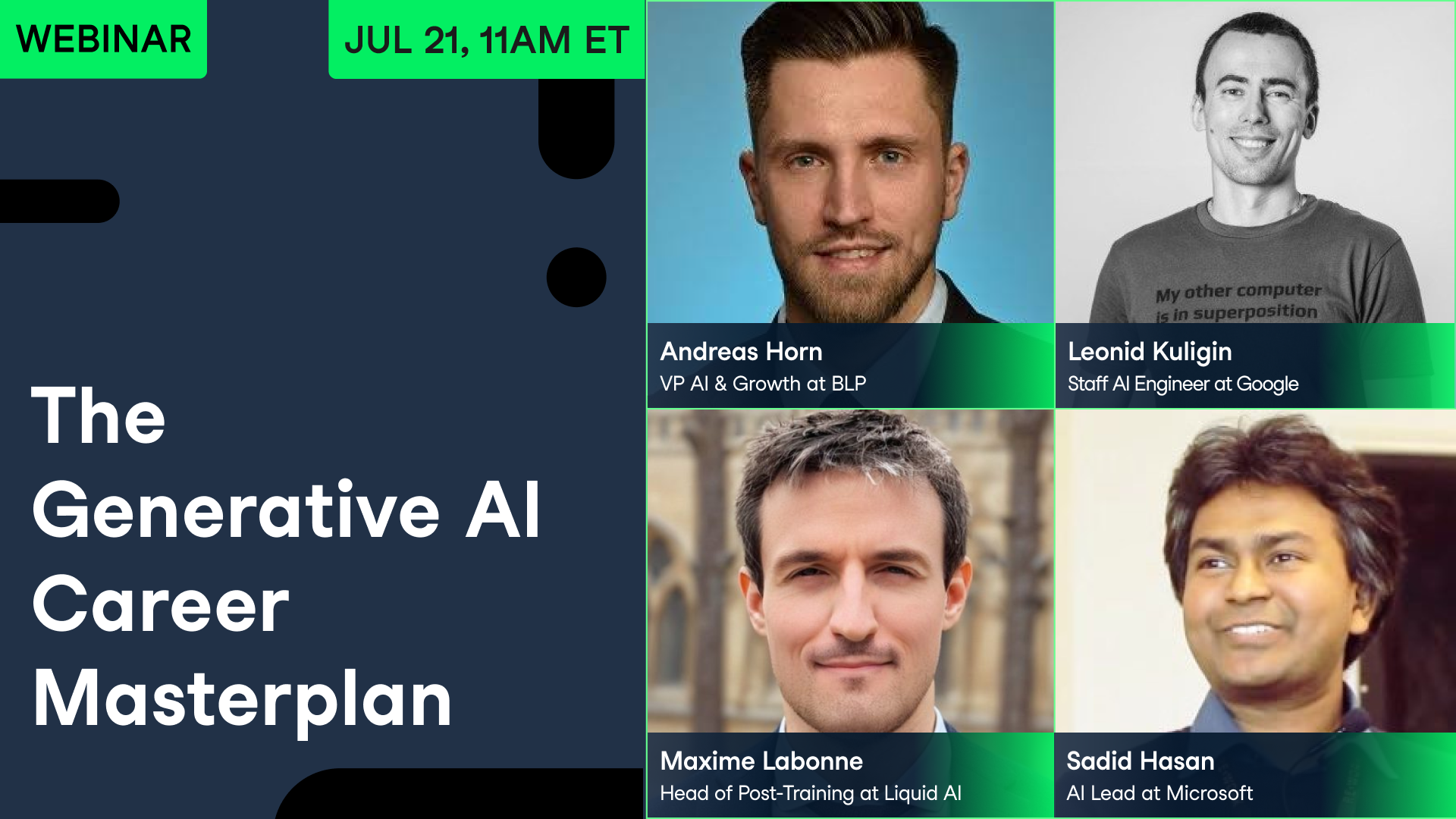
Your Presenter(s)

Andreas Horn
VP AI & Growth at BLP

Andreas is VP of AI & Growth at BLP, bringing deep enterprise AI expertise built over an eight-year career leading a major AIOps service portfolio across EMEA. He has worked at the intersection of AI strategy, IT operations, and generative AI deployment, helping enterprises put AI reliably into production. Andreas is also a university lecturer, teaching in the Master's in Artificial Intelligence program at ZIGURAT Institute of Technology, and is the author of The Generative AI Career Masterplan, sharing practical AI knowledge with the next generation of practitioners.
Leonid Kuligin
Staff AI Engineer at Google

Leonid is a Staff AI Engineer at Google Cloud and a key maintainer of LangChain's Google Cloud integrations, including the first Palm integration to the platform. He specialises in building production-ready generative AI and agentic systems, with a focus on Vertex AI and LLMOps. He is the author of Architecting Generative AI Applications and co-author of Generative AI with LangChain, and serves as a Visiting Lecturer at CDTM (TU Munich / LMU).

Maxime Labonne
Head of Post-Training at Liquid AI

Maxime Labonne is Head of Post-Training at Liquid AI, serving as the head of post-training. He holds a Ph.D. in Machine Learning from the Polytechnic Institute of Paris and is recognized as a Google Developer Expert in AI/ML.
An active blogger, he has made significant contributions to the open-source community, including the LLM Course on GitHub, tools such as LLM AutoEval, and several state-of-the-art models like NeuralBeagle and Phixtral. He is the author of the best-selling book “Hands-On Graph Neural Networks Using Python,” published by Packt.

Sadid Hasan
AI Lead at Microsoft

Sadid leads Applied Science within Microsoft's AI Development Acceleration Program in the Office of the CTO, building advanced AI capabilities across Microsoft 365 and Azure Copilot products. He has spent over 20 years in AI research and development, with 200+ publications and 35 granted patents spanning generative AI, clinical NLP, and question answering.
He serves on the MIT Technology Review Global Panel, the Harvard Business Review Advisory Council, and the Harvard Data Science Initiative, and is a regular program committee member at top-tier NLP and machine learning conferences. Sadid was recently named one of the 100 most influential AI leaders in the USA.
Summary
The four authors of The Generative AI Career Masterplan walked through where the jobs are, what skills they demand, and how to get hired in a field that is still being built.
DataCamp host Richie Cotton convened four practitioners behind the book: Sadid Hasan, an AI lead at Microsoft; Leonid Kuligin, a staff AI engineer at Google; Maxime Labonne, head of post-training at Liquid AI; and Andreas Horn, who joined to frame the bigger picture. Their argument is that generative AI has moved from standalone models to full systems, and that shift is creating roles across five families: builders, shippers, experience and safety specialists, enablers, and adopters. Hasan mapped the hard skills each family needs, from core machine learning to vector databases, multi-agent systems, and LLMOps. Labonne gave a fast technical tour covering attention mechanisms, mixture-of-experts models, retrieval-augmented generation, and the difference between agents and workflows. Kuligin made the case that engineers now get tested on business strategy and production readiness, not just code. Horn pushed back on the doom around the job market, pointing to hiring data and the untapped advantage of domain knowledge. The panel closed with a candid Q&A on where to start, whether data roles survive, and how they each stay current. This article summarizes the main points so you can decide whether to watch the full recording.
Key Takeaways
- Generative AI has shifted from task-specific models to full systems, and the book groups the resulting jobs into five families: builders, shippers, experience and safety roles, enablers, and adopters.
- AI engineering is among the fastest-growing roles on LinkedIn, but each career family asks for a different skill mix, from core machine learning and math to vector databases, multi-agent systems, and LLMOps.
- Prompt engineering matters less than it did, since few-shot examples and manual chain-of-thought are now largely handled inside the models themselves.
- Most tools people call agents are actually workflows with hard-coded steps, and Labonne argues you should hard-code steps whenever you can because it is more reliable.
- Start simple: test complex retrieval patterns like graph RAG against a basic baseline before adopting them.
- Interviews increasingly test business strategy and production thinking, so treat "how would generative AI change this industry" like a system design question.
- Enterprises now care about production, ROI, and reliability more than prototypes, which makes evaluations, monitoring, and deployment central skills.
- The AI job market looks healthier than the headlines suggest, and deep domain expertise in a specific field is one of the strongest advantages a newcomer can bring.
- Most people outside tech are barely using AI, so anyone actively learning it is already ahead of the curve.
- To stay current, the panel relies on curated feeds like X, LinkedIn, TLDR, and AlphaSignal, the Stanford AI Index report, and above all writing or teaching what you learn.
Deep Dives
From models to systems: the shift reshaping generative AI careers
Sadid Hasan, an AI lead at Microsoft, opened by describing a change in how AI gets built. Before generative AI, teams trained task-specific models on labeled data for narrow jobs like summarization, question answering, or text extraction. Foundation models replaced that pattern. They handle many tasks from large amounts of unlabeled data, with post-training steps such as supervised fine-tuning and reinforcement learning from human feedback layered on top. A capable model is only the starting point. "the models are not enough. Model is not equal to product," Hasan said, arguing that value comes from putting models to work inside real production systems.
That is why the field is tilting toward agent-centric systems, and why the roles are multiplying. Citing LinkedIn's report on fast-growing AI jobs, Hasan named AI engineering as one of the fastest climbing, alongside AI scientist, MLOps, retrieval, evaluation, security, and forward-deployed engineering. The book sorts these into five families of generative AI careers. Builders create the models, retrieval systems, and evaluations. Shippers, often product managers, turn raw capability into products people use. Experience roles cover governance, privacy, security, and responsible AI before anything reaches production. Enablers integrate AI into real workflows, the forward-deployed engineers who sit close to enterprise teams. Adopters are the end users who amplify their own domain expertise without building models themselves.
Hasan closed on the human role. Even as models draft answers and complete tasks, people keep the judgment. "we have to be verifiers and evaluators ourselves," he said, which means understanding a model's limits, checking for bias, and deciding whether an output is good enough to ship. He tied that to governance: knowing when to grant agency to an agent, owning oversight, and staying accountable for safety. The lesson for anyone eyeing generative AI careers is that the entry points now span far more than model training, and each family asks for a different mix of skills.
The AI engineer skills that matter: RAG, agents, and knowing when to keep it simple
Maxime Labonne, head of post-training at Liquid AI and author of the LLM Engineer's Handbook, ran through the technical foundations behind current models. He started with attention. Early multi-head attention was expressive but memory hungry, which limits context length. The field moved through multi-query attention to group-query attention, the default in recent models like Qwen, then added optimized kernels such as flash attention for efficiency. Architecture changed too. Mixture-of-experts models split the feed-forward layer into many networks and route each query to a few, so a model can hold a large parameter count while activating only a fraction per query. Mixtral popularized it, DeepSeek pushed it further, and Labonne noted that large labs including OpenAI and Anthropic use the approach internally.
On practical AI engineer skills, he was blunt about prompting. Few-shot examples are mostly unnecessary now, and chain-of-thought has been absorbed into models' thinking modes, but the basics still matter. "no matter how good the model is, if your prompt is really terrible, it's just not going to work," he said. Retrieval-augmented generation got similar treatment. RAG grounds answers in real documents and citations, but Labonne warned against over-building the vector store. "you should always try to use the simplest solution first and see how we perform as a baseline," he advised, testing complex patterns like graph RAG only against that baseline.
His most emphatic point was the line between agents and workflows. Many so-called agents make no decisions at all. "sometimes you realize that the so called agent doesn't take any action. Doesn't take any decision, and everything is hard coded," he said, and that is fine. When code decides the next step, you have a workflow, which is more reliable. "You should always try to hard code the different steps," he said, reserving true agents for open-ended tasks like a research agent that chooses which sources to call. He rounded out the tour with tooling: Hugging Face for open models and datasets; OpenRouter for comparing providers, with a caution that some quantize models and cut quality; vLLM or SGLang for GPU serving; llama.cpp or Ollama for local single-user runs; and fine-tuning frameworks like TRL for low-level control and Unsloth as an easier starting point, with Weights & Biases to track experiments.
AI job interview preparation: strategy and business now count
Leonid Kuligin, a staff AI engineer at Google, focused on two things engineers tend to skip. The first is that raw technical depth is often less decisive than it feels. "tech is overrated in the sense that first simple solutions work," he said. The second is strategy. Companies increasingly expect engineering leaders to drive AI adoption, partner with the business, and shape long-term direction, and that expectation is showing up in interviews.
His advice for AI job interview preparation was direct: treat the business conversation like a system design round. Be ready to discuss how generative AI will change a specific industry, and if you are interviewing at a healthcare or logistics company, think about what is happening there before you walk in. He has little patience for candidates who wave the question away. Recalling people who say they just write code and have not thought about agentic systems, he said, "I don't think that's a great answer for the interview."
To build that fluency, Kuligin recommended a steady reading habit rather than any single source. He scans annual AI trend reports, reads engineering blogs from Anthropic, Google, OpenAI, and Meta, follows product announcements and news on X, and listens to podcasts where founders explain how they think. He singled out the Stanford AI Index as a dense annual read and Benedict Evans's newsletter for tech analysis. On research papers, he made a reassuring point: many generative AI papers are now quick reads. His routine is to keep a ranked list and get through one or two a week.
Underneath the tactics sat a career question he kept returning to. Asked whether beginners should start with predictive machine learning or jump straight to agents, he reframed it. "what are you interested in? And what do you want to do in life?" he asked, noting that the people who last are the ones who do what they love. Follow genuine interest, he argued, go deep, and the technical understanding follows.
Building for production, not demos
Kuligin's second theme was production. He sees the industry leaving the demo phase behind. "I feel like we are slowly moving past the prototyping era," he said, as enterprises stop being impressed by shiny prototypes and start asking harder questions. "people start asking, okay. How you put it in production?" he noted, along with where the impact and the return on investment are.
A generative AI application in production is a different animal from a prototype, and Kuligin listed what that entails. It starts with business impact: how you measure it, how you scope it, how you ship a first minimal version and gather requirements. Then come the classic software engineering concerns, plus the ones specific to these systems. You have to handle the nondeterminism of agents, build evaluations, and develop monitoring and deployment, and deployment often means shipping data alongside code, as with a RAG setup. Reliability, security, and the responsible AI questions all sit inside the same scope.
This connects back to his interview advice. Engineers are now expected to reason across that whole span, not just the model in the middle, so the same production checklist doubles as interview preparation. Labonne's caution about over-engineering fits here too: start with the simplest thing that works, prove it as a baseline, and add complexity only when a measurement says you should.
The practical message is that AI engineer skills now include the unglamorous parts of shipping software. Evaluations, monitoring, and rollback plans matter as much as model choice, partly because models change underneath you. Hasan made the same point earlier, describing regression detection and safe rollback as standard parts of the LLMOps and agent-operations lifecycle, along with routers that send simple queries to cheaper models. Knowing how to keep a live system reliable, Kuligin argued, is what separates a demo builder from someone a company will trust with production.
The job market, the AI bubble, and the domain-knowledge edge
Andreas Horn joined late to zoom out to the macro picture, and he pushed against the gloom around the AI job market. Fresh graduates hear that hiring has stopped and that technical jobs are vanishing. He is not convinced. He pointed to a study using data from the payments company Ramp showing that firms which spent more on AI over the past few years also hired more, with higher AI adoption. Some of the recent contraction, he suggested, is a correction to pandemic-era over-hiring rather than proof that the work is drying up. New roles are being created as he speaks.
His central argument was about where the advantage sits. Citing Ethan Mollick, Horn said "the people who are ... experts at making AI are not the experts at using AI." The labs build a general-purpose machine, and figuring out what to do with it in a specific field is still wide open. Domain knowledge is the multiplier. "if you know one field very well, you have unlimited ... possibilities right now," he said, describing the application layer as a green field.
He also warned the audience against mistaking their own habits for the norm. "we are living to some degree in a bubble," he said, because "for us, everything is AI, AI, AI," while adoption outside tech circles stays thin and mostly limited to basic free tools. Richie Cotton turned that into encouragement for attendees: "everyone who showed up today you're already ahead of the curve," since most people are not yet doing much with AI at all.
The panel closed with how they each stay current. Sadid Hasan named aggregators like Emergent Mind, TLDR, and AlphaSignal, plus a curated LinkedIn feed. Labonne pointed to X as his fastest source and made a sharper case for writing. Explaining a topic to others forces real understanding, he said, "so you go actually quite in-depth." Cotton agreed: "if you wanna learn something properly, you gotta teach it to someone else."
ที่เกี่ยวข้อง
webinar
Generative AI in Practice: 100+ Amazing Ways Generative AI is Changing Business & Society
World-renowned author & futurist Bernard Marr, will outline how Generative AI is being used in practice today.webinar
Generative AI in Practice: 100+ Amazing Ways Generative AI is Changing Business & Society
World-renowned author & futurist Bernard Marr, will outline how Generative AI is being used in practice today.webinar
Charting the Path: What the Future Holds for Generative AI
Explore how generative AI tools & technologies will evolve in the months and years to come and navigate through emerging trends, potential breakthrough applications, and the strategic implications for business.webinar
Charting the Path: What the Future Holds for Generative AI
Explore how generative AI tools & technologies will evolve in the months and years to come and navigate through emerging trends, potential breakthrough applications, and the strategic implications for business.webinar
Building a Learning Culture in the Age of Generative AI
Industry experts explore how organizations can foster continuous learning and adaptability in the age of AI.webinar