Get AI Audit Ready!
您的演示者

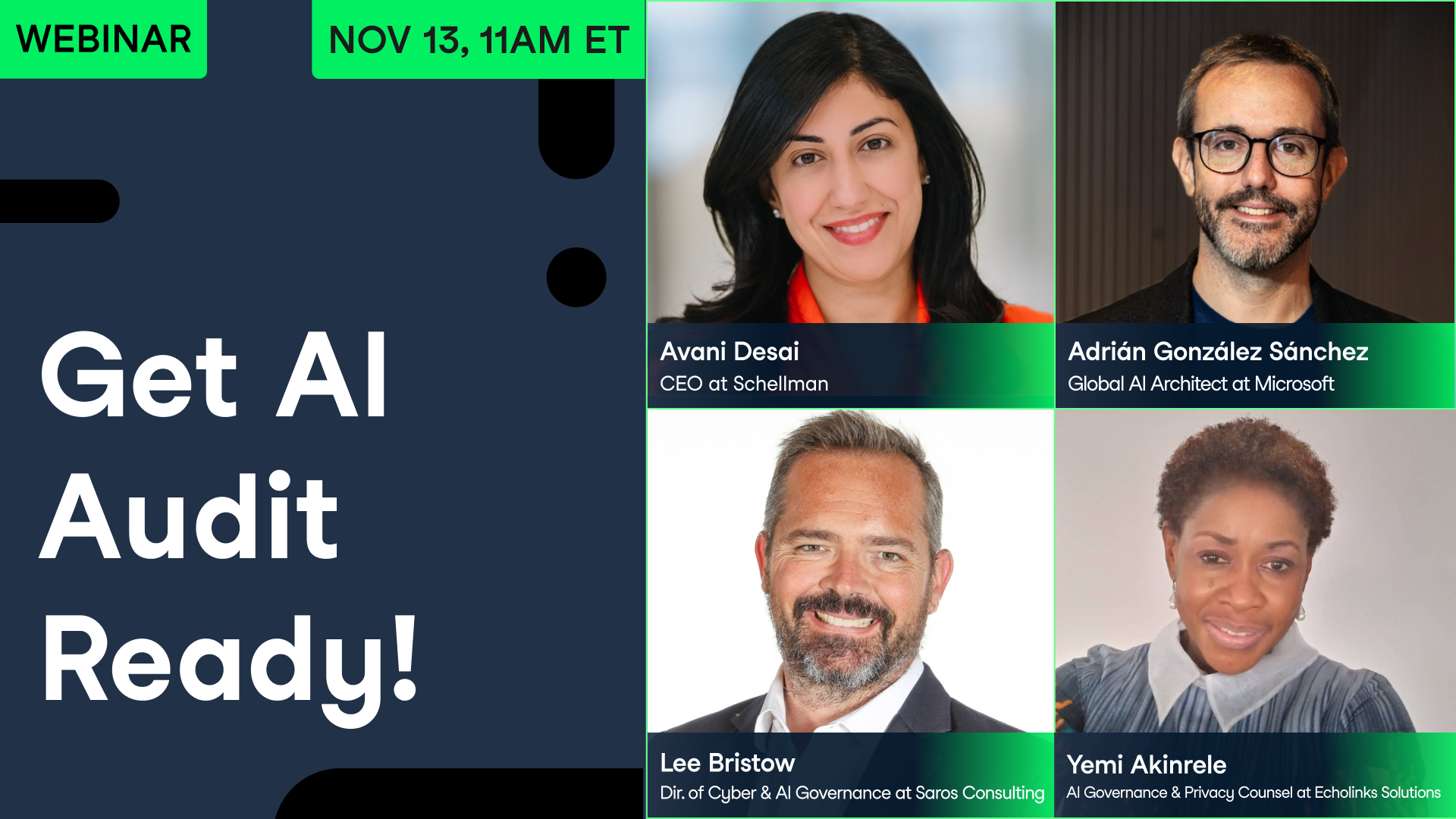
Avani Desai
CEO at Schellman

Avani runs Schellman, a compliance services company, which audits the AI capabilities of OpenAI, Meta, and Walmart. She has two decades of experience as an executive in technology risk, cybersecurity, and compliance assessment.

Lee Bristow
Director of Cyber & AI Governance at Saros Consulting
Lee provides strategic guidance to clients on cybersecurity and AI governance, including gap analysis for ISO 42001 and EU AI Act compliance. He is also CEO at the Dawn Horizon AI strategy consultancy, and CEO at security consultancy Risk Copilot. Lee is the author of "Human AI Alliance", an AI transformation guide for leaders. Previously, Lee was Chief Technology & Information Security Officer at Phinity Risk Solutions.

Yemi Akinrele
AI Governance & Privacy Counsel at Echolink Solutions
Yemi acts as legal counsel for AI governance, privacy, and business issues, with a focus on AI adoption and regulatory compliance. She helps clients implement AI governance frameworks like ISO 42001, the EU AI Act, and NIST AI RMF. Previously, Yemi was a Partner at FA Legal Consultants, where she advised clients on data privacy and ethical AI adoption.

Adrián González Sánchez
Global AI Architect at Microsoft
As a Global AI Architect, Adrián provides AI architecture, security, and compliance support to startups and digital natives. He is also part of the EU AI Act Expert Committee for the Spanish Government, a Responsible AI Lead at OdiseIA, and a certified lead auditor for the ISO 42001 standard.
He is an Academic Director and ML Professor at IE School, and a Lecturer in Executive Education at HEC Montréal. He has written 5 books on AI and cloud computing, including "Azure OpenAI Service for Cloud Native Applications" and “Managing AI Projects”.
Session Resources
Summary
AI governance is essential for ensuring that AI systems are safe, trustworthy, and compliant with laws. The ISO 42,001 standard, the first AI management system standard, is designed to help organizations achieve this. It works alongside frameworks like the EU AI Act and the NIST AI Risk Management Framework. The session featured experts discussing the importance of ISO 42,001, its goals, and how it relates to other frameworks. They also explored who needs to care about this standard, the steps to get started, and the potential benefits and risks of compliance.
Key Takeaways:
- ISO 42,001 is the first AI management system standard, essential for AI governance.
- It complements frameworks like the EU AI Act and NIST AI Risk Management Framework.
- Product managers, legal teams, and executives play key roles in compliance.
- Compliance can enhance trust, operational discipline, and open new markets.
- Non-compliance risks include reputational damage and significant fines.
Insights
The Role of ISO 42,001 in AI Governance
ISO 42,001 serves as a comprehensive framework for AI governance, akin to what ISO 27,001 does for cybersecurity. It provides a repeatable management system for AI, focusing on setting policies, assigning ownership, managing risk, and improving AI processes over time. Avani Desai, CEO at Shellman, emphasized that ISO 42,001 is more than a checklist but a foundation for ensuring AI systems are secure and reliable. It addresses AI-specific risks that traditional frameworks do not cover, answering the key question: "Can I trust how your AI behaves?"
Integration with the EU AI Act
The EU AI Act is a regulatory framework that outlines what organizations must do to comply with AI laws within the European Union. ISO 42,001 complements this by providing a structured way to demonstrate compliance. Adrián González Sánchez, a global AI architect at Microsoft, explained that while the EU AI Act specifies the "what," ISO 42,001 details the "how," offering a roadmap to certification. This integration helps organizations manage compliance more efficiently, reducing the cost and complexity of adhering to multiple regulations.
Who Needs to Care About ISO 42,001?
ISO 42,001 is relevant across various industries, especially those deploying AI products in the EU. Product managers are pivotal as they link the gap between business and development teams. Lee Bristow, director of cyber and AI governance at Saros Consulting, highlighted that product managers must understand AI's impact and ensure compliance throughout the product lifecycle. Legal teams also play a key role in mitigating liability and ensuring regulatory adherence. Yemi Akinrele, AI governance and privacy counsel at Echolink Solutions, stressed that AI governance is a cross-functional responsibility involving leadership, legal, product, HR, and technical teams.
Getting Started with ISO 42,001
Beginning ISO 42,001 certification involves several steps. Avani Desai outlined a roadmap: define the scope, create an AI inventory, establish an AI governance committee, conduct a gap assessment, and pilot high-value use cases. The process requires executive buy-in and cross-functional collaboration. For startups, focusing on a flagship product can be a strategic starting point. Adrián González Sánchez noted that aligning with existing management systems can simplify the path to compliance, making the process more manageable for organizations of all sizes.