courses
An LLM Wiki compiles your sources into a persistent, cross-linked knowledge base during ingestion, then answers from that base instead of re-retrieving raw chunks each time. This way, knowledge accumulates as you add sources rather than getting rebuilt from scratch on every question.
I'll walk you through where the LLM Wiki idea came from, how it compares to Retrieval-Augmented Generation (RAG), and whether it makes a real shift in how AI systems manage knowledge.
The Origins of the LLM Wiki Concept
The LLM Wiki idea took shape in 2026, presented by Andrej Karpathy and picked up by a couple of open-source projects that turned it into something you can actually run.
The idea is simple. AI systems in 2026 spend much of their time re-reading the same documents. You upload a PDF, the model retrieves chunks, answers a question, and moves on. Next week, you upload another PDF on the same topic, and the model does the exact same thing. Nothing carries over.
The biggest shift is that retrieval and compilation are different jobs.
For example:
- Retrieval-first systems find relevant text fragments at query time and hand them to the model as context. The model works with whatever the retriever pulled up.
- Compilation-first systems read each source once at ingestion, extract what matters, and write it into a structured knowledge base. The model then answers from that base.
An LLM Wiki is in the second category. When you add a new source, the model reads it, updates existing pages, creates new ones where needed, and flags contradictions with what's already been filed. The knowledge base grows with every source you add, and the model gets a better foundation to answer from every time.
This is the first concrete break from the retrieval-first paradigm that has dominated since RAG became standard. RAG treats each query as a fresh lookup against raw documents. An LLM Wiki treats ingestion as the moment where work takes place, and query time as reading from a base that's already been thought through.
What Is an LLM Wiki?
An LLM Wiki is a persistent, AI-maintained knowledge base that continuously synthesizes information from source documents into structured, interconnected pages.
Three things separate it from a folder of files or a vector store.
- Persistent: Pages are created once and updated as new sources arrive. Nothing has to be re-derived at query time because the synthesis is already written down.
- Continuously updated: Every ingested source triggers edits across the wiki, for example new pages for new entities, revisions to existing summaries, notes where fresh data contradicts older claims.
- Dual-audience: Pages are readable by humans and structured enough for AI agents to reason over. Markdown, cross-links, and a consistent layout do double duty.
The key move is that the wiki becomes the primary knowledge layer. Original documents stay in raw storage as an audit trail, but nobody queries them directly. Chat systems, agents, and research assistants read the wiki because that's where the compiled, cross-referenced version of the knowledge is placed.
The LLM Wiki Architecture
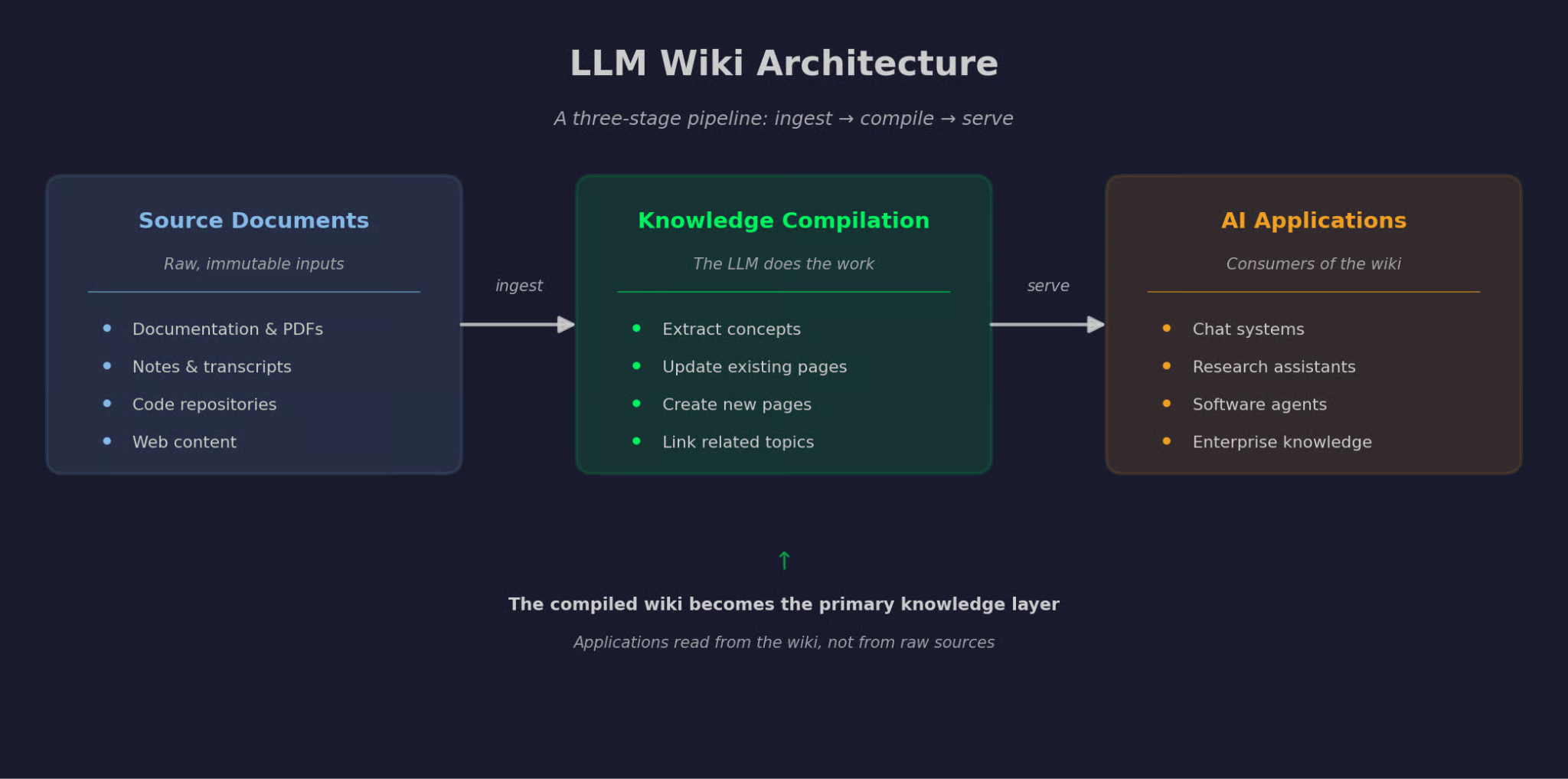
The architecture is more of a three-stage pipeline. Sources come in, the model compiles them into wiki pages, and AI applications read from those pages.

LLM Wiki architecture
Let me walk you through all stages.
Source documents
Anything text-based can be ingested. For example:
- Documentation and PDFs
- Personal notes and meeting transcripts
- Code repositories
- Web content clipped from articles or scraped from sites
Raw sources are placed in immutable storage. Once ingested, the model reads from them but never modifies them, which gives you a clean audit trail from any wiki claim back to its source.
Knowledge compilation
Wiki is created in this step. When a new source arrives, the model runs a set of operations:
- Extracting concepts: Entities, topics, definitions, and claims are pulled out of the source text.
- Updating existing pages: If an entity or concept already has a page, the model revises it with the new information and flags contradictions.
- Creating new pages: Anything that doesn't fit an existing page gets its own.
- Linking related topics: Cross-references are added in both directions so pages stay connected as the wiki grows.
A single ingested source might "update" 10 to 15 pages in this pass. That's the point - the work of connecting new material to existing knowledge happens once, at ingestion, not on every query like with RAG.
AI applications
The wiki is designed to be read by more than one kind of consumer. For example:
- Chat systems that answer questions against the compiled knowledge instead of raw documents.
- Research assistants that follow cross-references to build up a picture of a topic.
- Software agents that use the wiki as durable memory across long-running tasks.
- Enterprise knowledge systems that expose the wiki to internal tools, dashboards, or MCP servers.
The wiki is in the middle. Sources feed in on one side, applications read from it on the other, and the compilation layer keeps both ends in sync.
LLM Wiki vs Traditional RAG
The main difference between traditional RAG and an LLM Wiki is when the work happens.
Traditional RAG
RAG retrieves document chunks at query time. You ask a question, an embedding search pulls the top-k most relevant chunks from a vector store, and those chunks are added into the model's context along with your question. The model generates an answer from that temporary context and forgets everything when the response is done.
The context is disposable.
The chunks that answered your last question are gone from context the moment the model finishes replying. If you ask a related question tomorrow, the retriever runs again, pulls chunks again, and the model synthesizes again. Nothing is built up between queries.
LLM Wiki
An LLM Wiki compiles information during ingestion. When you add a source, the model reads it once, writes what matters into structured pages, updates cross-references, and stores the result as durable markdown. Query time then becomes a matter of reading from the compiled base rather than re-synthesizing from raw chunks.
The knowledge is persistent, and it evolves.
Every new source triggers edits across the wiki, so contradictions get flagged, older summaries get revised, and the connections between topics get denser over time.
Tradeoffs
Neither approach is universally better. They optimize for different things.
Here are a few things to keep in mind:
- Freshness: RAG has an advantage here because it reads directly from source documents at query time. If you update the underlying documents, the next query will see the change immediately. An LLM Wiki has to re-ingest sources to update its pages, so there's a lag between raw truth and compiled knowledge.
- Accuracy: An LLM Wiki wins when questions require synthesis across many sources because the synthesis is already done and reviewed. RAG can miss connections when the relevant fragments span more chunks than fit in the context window, because it never sees the full picture in one pass.
- Maintenance: RAG is close to zero-maintenance once the vector store is set up because indexing is mechanical. An LLM Wiki needs active upkeep, for example lint passes to catch stale claims, contradiction checks, and occasional reviews to prune orphan pages. The tradeoff is that a maintained wiki gets richer over time while a RAG index stays flat.
- Scalability: RAG scales predictably with document count because retrieval is a search problem. An LLM Wiki scales with the model's ability to keep the compiled knowledge coherent as it grows. Past a certain size, wikis need their own index files, search tools, or embedding layers to stay navigable.
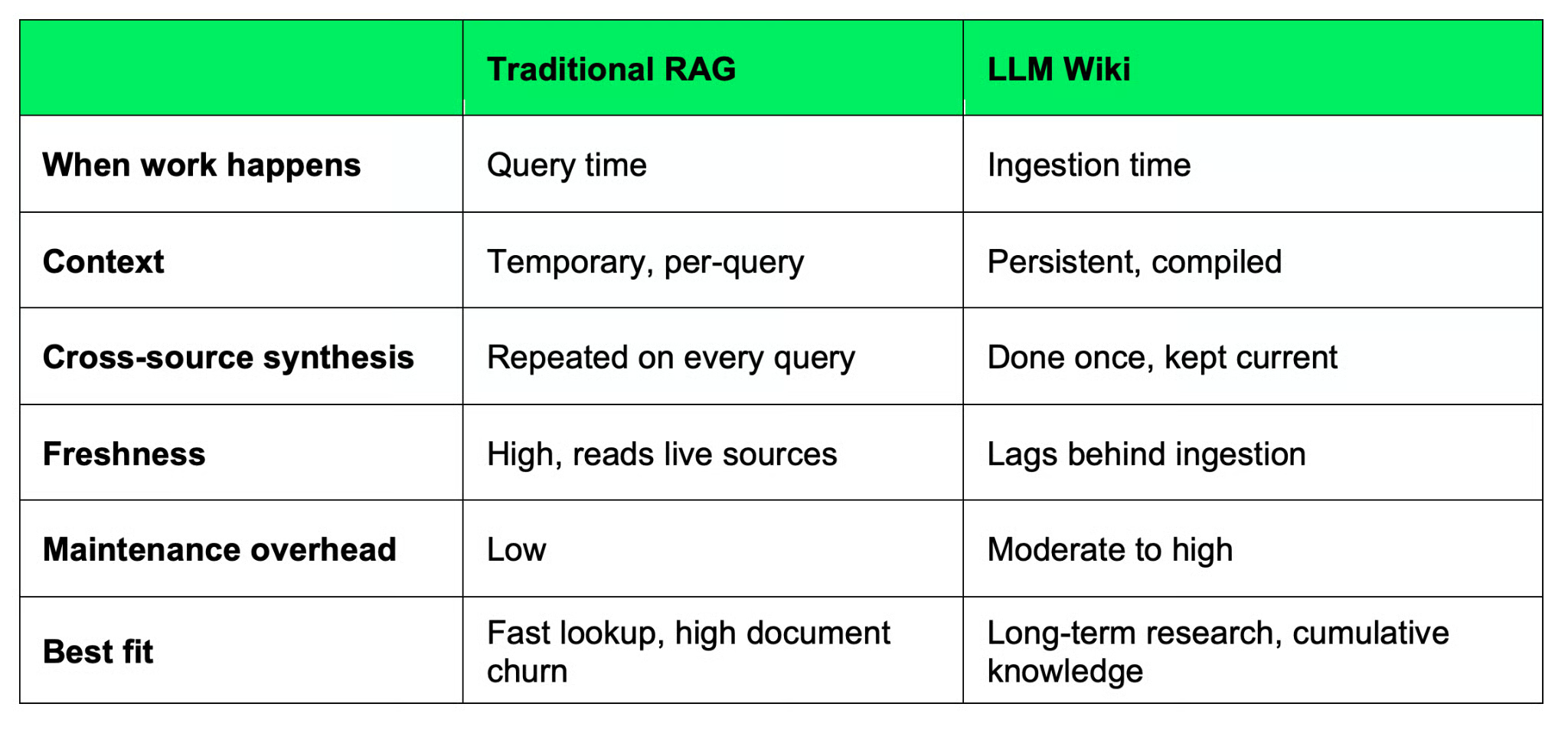
Here's a side-by-side summary:

LLM Wiki versus RAG
RAG and LLM Wikis are also complementary in practice. Some implementations run RAG over the wiki itself once it grows past what an index file can handle.
Why AI Agents Benefit from an LLM Wiki
AI agents suffer more than chat systems from the no-memory problem. A single conversation might tolerate re-retrieval, but agents can run for hours or days and rediscover the same facts across dozens of tasks. An LLM Wiki gives them a place to put what they learn so they don't have to learn it again.
Here's are a couple of areas where persistent knowledge shows the most potential:
- Software development: A coding agent working on a codebase over weeks builds up knowledge about modules, conventions, past bugs, and design decisions. Without a wiki, that context is rebuilt on every session. With one, the agent reads the compiled pages and picks up where the last session ended.
- Long-running research: An agent tasked with tracking a topic across hundreds of papers can't hold everything in context. A wiki gives it a place to file summaries and revisit the evolving picture without re-reading the whole corpus.
- Enterprise assistants: Assistants deployed inside a company face the same questions from different employees every day. A wiki lets the assistant answer from compiled internal knowledge instead of searching the same set of pages on every request.
- Organizational memory: Teams lose context when people leave or meetings end. An LLM Wiki fed by transcripts, tickets, and documents keeps that context connected.
When implemented correctly, you'll see LLM Wiki paying off in three places:
- Fewer repeated searches: An agent that reads from a compiled page doesn't need to run the same web search or vector query it ran yesterday.
- Richer context: Wiki pages already contain synthesized information, so the agent starts each task with a denser, better-connected base than raw chunks would give it.
- Cumulative learning: Every session adds to the wiki, and the next session benefits from what the last one figured out. This is how you get an agent that actually gets better at its job over time instead of resetting on every prompt.
Building an LLM Wiki
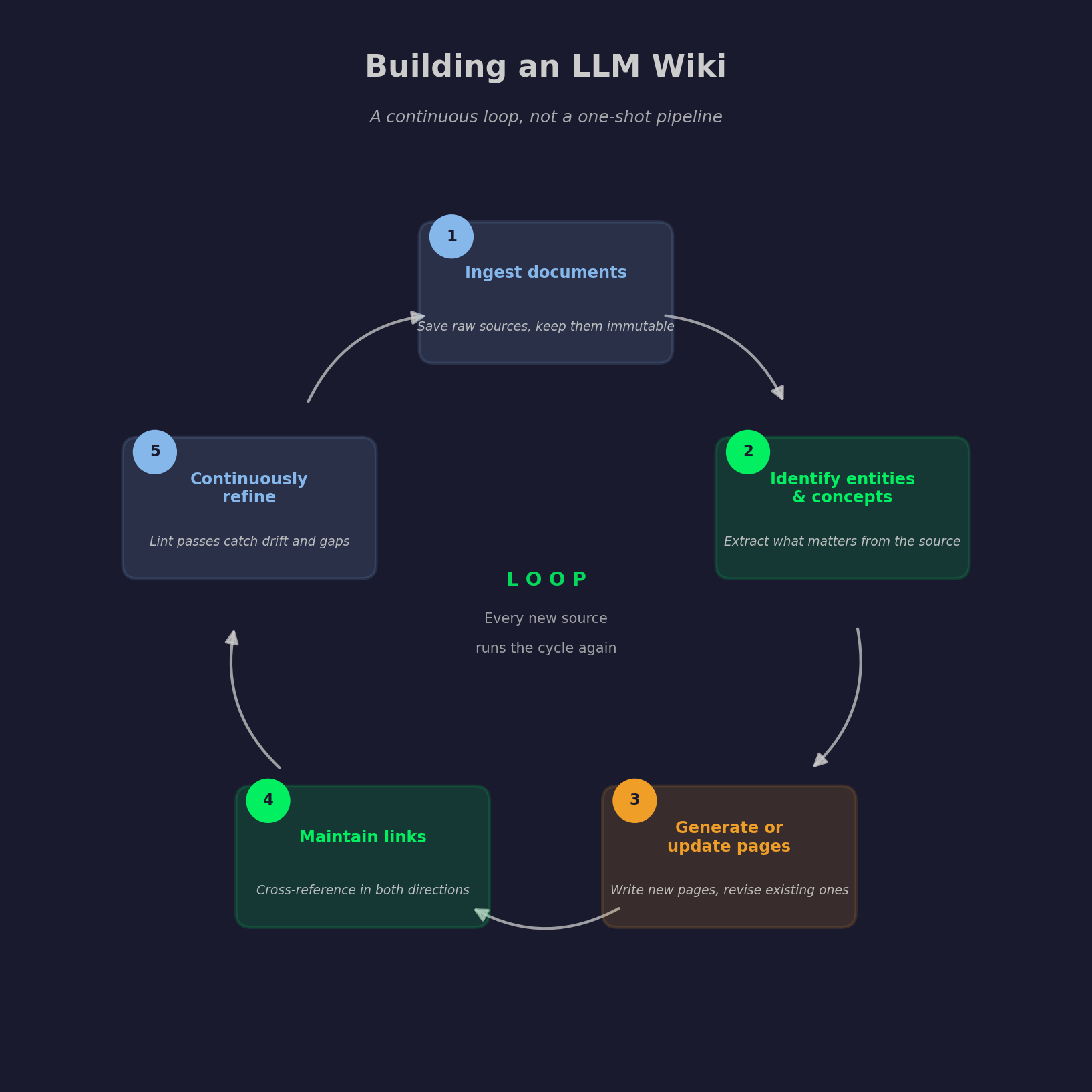
The workflow for building a wiki is a loop. Sources go in, pages get written and rewritten, and the whole thing refines itself as the corpus grows.

LLM Wiki building loop
- Ingest documents. The first step is getting sources into raw storage. Documents are read once and kept immutable so every downstream claim traces back to a specific source. Ingestion can be a single file, a batch, or a stream from a folder the model watches.
- Identify entities and concepts. For each new source, the model extracts what matters - named entities, key concepts, claims, definitions, relationships. This is the moment where unstructured text becomes something the wiki can file. The extraction pass also checks the existing wiki to see what's already covered and what's new.
- Generate or update pages. New entities get new pages. Existing pages get revised with the new information. If the new source contradicts an existing claim, the model flags it on the page instead of overwriting. A single ingested source often modifies 10 to 15 pages because sources usually talk about more than one thing.
- Maintain links. Cross-references are added in both directions so pages stay connected. If a new page on
RAGmentions vector databases, and avector databasespage already exists, both pages get linked. - Continuously refine knowledge. Periodic lint passes catch problems that accumulate over time. For example, contradictions between pages, stale claims that newer sources have superseded, orphan pages nobody links to, and important concepts mentioned in passing but lacking their own page. This step keeps the wiki healthy as it scales.
The specifics depend on your stack, but the shape is the same across implementations. Ingest, extract, write, link, refine - and then loop.
Common Features of LLM Wiki Systems
Most LLM Wiki implementations have the same set of features. The specifics differ, but the building blocks are shared across projects.
Automatic knowledge compilation
The wiki writes itself. When a source is ingested, the model extracts what matters and files it into pages without human intervention. Manual maintenance kills traditional wikis, as humans get bored of updating cross-references and summaries. Models don't, so this is the feature that makes the whole pattern work.
Linked pages
Every page connects to related pages through cross-references. When a page on transformers mentions attention mechanisms, both pages link to each other. The result is a navigable graph you can walk through by following references, which is how you find connections you didn't know existed.
Source attribution
Every claim in every page traces back to a specific source. The raw documents stay immutable so you can always verify where the information came from. This matters for two reasons - it gives you an audit trail when you need to check accuracy, and it lets the model retract claims cleanly when a source is removed.
Knowledge graphs
The linked structure of the wiki is itself a knowledge graph. Nodes are pages, edges are cross-references, and the shape of the graph tells you what the corpus is really about. Hub pages will automatically show up around important concepts, orphan pages will signal gaps, and dense clusters show the areas the wiki knows the best.
Persistent memory
The wiki is available across sessions. Chat context disappears when the conversation ends, but wiki pages sit on disk as markdown. This is what turns a chat model into something that can carry knowledge forward across days, projects, and agent runs.
Continuous updates
New sources trigger revisions to existing pages, not just appends. If a paper published last month contradicts what was written six months ago, the wiki flags it and updates the affected pages. The knowledge base gets closer to correct over time instead of accumulating stale claims.
These features aren't independent. This means that a wiki without source attribution can't be trusted. Similarly, a wiki without continuous updates goes stale, and a wiki without linked pages is just a folder of summaries. The value comes from having all of them working together.
Real-World Applications of LLM Wikis
The pattern I discussed so far is general, so I'll now go over some real-world applications where LLM Wiki can be useful, even more useful than RAG.
Research literature
Anyone tracking a topic across dozens or hundreds of papers deals with the same issue - the papers pile up faster than you can process them. An LLM Wiki reads each paper as it arrives, extracts the claims, files them under the relevant concepts, and flags contradictions with what's already been read. The result is a running synthesis that is current with the field instead of a folder of PDFs you'll never read.
Engineering documentation
Codebases have documentation debt that usually grows every sprint. Typically, design decisions get made in Slack threads, and architecture notes live in someone's Notion. The actual code is the only source that's guaranteed to be current. A wiki fed by the codebase, comments, pull requests, and internal docs can compile a picture of the system that is connected to the code. Engineers can ask questions against the wiki instead of asking the person who wrote the module three years ago.
Enterprise knowledge bases
Companies accumulate knowledge across tickets, meeting transcripts, product specs, and internal wikis. An LLM Wiki can ingest from all of these and compile a single knowledge layer that stays current. Employees can query it once instead of searching four different tools.
Personal knowledge management
Note-taking apps have solved the storage problem but not the synthesis problem. You still have hundreds of notes, articles, and highlights, and you won't revisit most of them. A wiki fed by your Obsidian vault, for example, can put the pile of notes into a compiled body of knowledge you can actually query.
AI agent memory
Agents that run for hours or days need somewhere to put what they learn. The wiki gives them durable memory that can be used across sessions - what worked, what didn't, which files they've already read, which paths they've tried. This is especially useful for agents built on top of Claude Code or similar tools, where the same codebase gets worked on across many sessions and the context from previous runs is what makes the current run efficient.
Current LLM Wiki Implementations
The LLM Wiki space in 2026 is early. Most of what exists is open-source and built by individuals or small teams. It's far from where the RAG currently is.
Karpathy's original gist is where a lot of implementers started. It describes the pattern in enough detail that anyone with an LLM agent can build their own version by pasting the doc into Claude Code or a similar tool. Most of the current wikis start as personal projects built on top of a shared idea.
Open-source efforts are where the idea is being worked out. Projects like llm-wiki.net publish their code under permissive licenses so others can fork, extend, or adapt them to their own workflows. The advantage is that you can see exactly what the wiki is doing and change it when your needs don't match the default.
Local-first approaches run entirely on your machine. Sources are saved on disk, the wiki is a folder of markdown files, and the model reads and writes through a local agent. Obsidian is the most common front-end because it's already built for markdown and cross-references. This gives you the most control, since the sources don't leave your machine, and you can inspect every page the model writes.
Hosted implementations are starting to appear but they're less common. The pattern doesn't fit the SaaS model as well as RAG does because the wiki is meant to be yours - your sources, your pages, your decisions about what to file. Hosted versions tend to work best for team wikis where the value of shared knowledge outweighs the cost of hosting sources on someone else's infrastructure.
But as of July 2026, none of these are finished. Things are still being figured out, and most of the projects that exist today are just prototypes.
Advantages and Limitations
The LLM Wiki pattern has strengths and costs. Both are worth knowing before you decide to build one.
Advantages
- Persistent knowledge: The wiki is still available past the end of any single session. What the model figured out last month is still on the page today, and new work builds on it instead of starting fresh.
- Reusable synthesis: The work of connecting sources happens once, at ingestion. Every query after that reads from the compiled result instead of re-synthesizing from raw text. This saves compute and produces better answers because the model has already done the thinking part.
- Fewer repeat retrievals: A wiki that already has a page on a topic doesn't need to search the raw corpus every time the topic comes up. This matters for agents that run for hours and would otherwise run the same searches over and over.
- Structured organization: Pages and cross-references give you something you can browse and reason about, especially when compared to a folder of PDFs.
Limitations
- Keeping information current: The wiki has to be re-ingested when sources change. If a document is updated and you don't re-run ingestion, the wiki keeps referencing the old version. RAG doesn't have this problem because it reads live sources at query time.
- Verification challenges: Every claim on a wiki page was written by a model. Source attribution helps, but you still have to trust that the model summarized the source correctly.
- Maintenance: Contradiction checks and re-ingestion aren't free. A wiki that isn't maintained goes stale, and maintenance takes time and compute even when the model is doing the work.
- Possible knowledge drift: Every ingestion is a chance for the model to introduce small errors. Over hundreds of ingestions, these can compound. A page that started accurate can end up subtly wrong after enough revisions.
Common Misconceptions About LLM Wikis
Even though LLM Wiki is a new concept, there are already some misconceptions about it. Here's what they get wrong.
An LLM Wiki replaces RAG
It doesn't. The two solve different problems. RAG is for fast lookup against a corpus that changes often. An LLM Wiki is for building up a body of knowledge over time. Many real systems use both - RAG for freshness against raw sources, a wiki for compiled synthesis on top.
It's just another vector database
Vector databases index text for retrieval. An LLM Wiki writes text that has been read, understood, and reorganized by a model. A vector database gives you back the chunks you put in. A wiki gives you back pages that didn't exist before you ingested the source. The output is entirely different.
The knowledge base never needs updating
Not true. Sources change, new sources arrive, and the model makes mistakes that need catching. A wiki that isn't maintained goes stale in the same way any documentation does. The difference is that the model handles most of the maintenance, not that maintenance disappears.
It only benefits AI agents
Agents are the clearest use case because they run long and benefit most from durable memory, but humans get value from wikis too. Think of a researcher tracking a topic or an engineer working on a codebase. Or really anyone who's building up a personal knowledge base gets the same compounding synthesis.
Will LLM Wikis Become a New AI Architecture?
It's too early to tell, but the likely path is clear: persistent knowledge won't replace retrieval-first systems, it'll sit alongside them, with RAG handling live lookups and wikis handling compiled, long-running context. The bigger open questions are around validation and scale — nobody's fully solved how to catch model errors written into wiki pages, and nobody's stress-tested the pattern on very large wikis yet. MCP looks like a natural fit for exposing wikis to agents, though enterprise adoption is further out given the added trust requirements.
The pattern isn't established yet. Whether it moves forward depends on whether the maintenance and validation problems get solved. More questions on this are answered in the FAQs below.
Conclusion
The LLM Wiki is one of the more interesting ideas to come out of 2026 so far because it changes what an AI system is doing when you hand it a source. Instead of reading the same documents on every query, the model reads them once and files them into a knowledge base that only gets better with time.
The concept is still emerging and the current implementations are early, but the idea is promising and it points to a bigger overall. AI systems are moving from disposable context to persistent knowledge, and LLM Wikis are one of the first serious attempts at what that actually looks like in practice.
If you want to stay current with the new developments but find it confusing, enroll in our AI Fundamentals track. You'll learn the jargon and will be able to use AI effectively for work.
FAQs
What is LLM Wiki?
An LLM Wiki is a persistent, AI-maintained knowledge base that reads source documents once and compiles them into structured, cross-linked pages. So instead of retrieving raw text on every query like RAG does, the wiki stores a synthesized version that the model reads from. The pattern was introduced in 2026 as a way to move beyond the limits of retrieval-first AI systems.
How is an LLM Wiki different from RAG?
RAG retrieves document chunks at query time and forgets them once the response is done. An LLM Wiki does the synthesis during ingestion, writes it into markdown pages, and keeps that synthesis around for every future query. The main difference is when the work happens (at query time for RAG, at ingestion time for a wiki) and whether the result persists.
Why do AI agents benefit from LLM Wikis?
Agents that run for hours or days rediscover the same facts across tasks if they don't have somewhere to put what they learn. An LLM Wiki gives them durable memory that persists across sessions, which means fewer repeated searches and better context on every run.
Can an LLM Wiki stay current when source documents change?
Yes, but only if you re-ingest sources as they update. The wiki doesn't read live documents at query time, so any change to the source has to be pulled in through ingestion for the wiki to reflect it. This is one of the tradeoffs against RAG, which sees source changes immediately because it reads them at query time.
How does an LLM Wiki integrate with MCP and enterprise systems?
The wiki can be exposed through an MCP server so agents and other tools query it the same way they query any external knowledge source. This means one wiki can serve chat systems, coding agents, and research assistants without custom integration for each. Enterprise adoption is further out because the validation and trust questions are harder at that scale, but the technical integration path is already there.
Will persistent knowledge replace retrieval-first systems?
Probably not fully. RAG still wins when sources change fast or synthesis isn't needed. Expect the two to coexist, each used for what it's good at.
How should wiki knowledge be validated?
This is unsolved. Source attribution gives you a trail, but catching model errors at scale is still an open problem — human review helps but doesn't scale.
Can compiled knowledge stay current?
Yes, with re-ingestion and periodic lint passes — but this gets harder as the wiki grows. A 10,000-page wiki is much harder to keep coherent than a 100-page one, and that hasn't been tested yet.
How do LLM Wikis fit with MCP and enterprise systems?
MCP lets a wiki act as a standard tool any agent can query, so one wiki can serve chat, coding, and research use cases. Enterprise adoption lags because trust and validation are harder at that scale.