随时掌握这份速查表
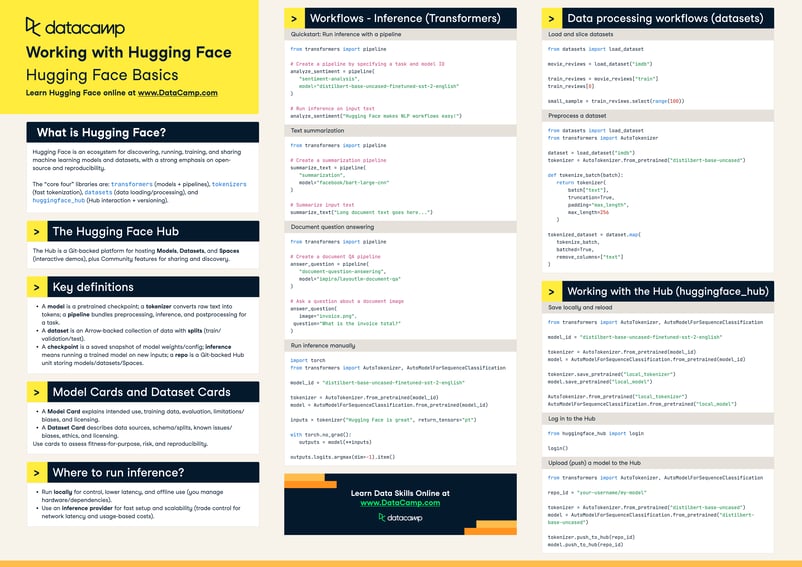
下载 PDFHugging Face is an ecosystem for discovering, running, training, and sharing machine learning models and datasets, with a strong emphasis on open-source and reproducibility.
The “core four” libraries are: transformers (models + pipelines), tokenizers (fast tokenization), datasets (data loading/processing), and huggingface_hub (Hub interaction + versioning).
The Hugging Face Hub
The Hub is a Git-backed platform for hosting Models, Datasets, and Spaces (interactive demos), plus Community features for sharing and discovery.
Key definitions
- A model is a pretrained checkpoint; a tokenizer converts raw text into tokens; a pipeline bundles preprocessing, inference, and postprocessing for a task.
- A dataset is an Arrow-backed collection of data with splits (train/validation/test).
- A checkpoint is a saved snapshot of model weights/config; inference means running a trained model on new inputs; a repo is a Git-backed Hub unit storing models/datasets/Spaces.
Model Cards and Dataset Cards
- A Model Card explains intended use, training data, evaluation, limitations/biases, and licensing.
- A Dataset Card describes data sources, schema/splits, known issues/biases, ethics, and licensing.
Use cards to assess fitness-for-purpose, risk, and reproducibility.
Where to run inference?
- Run locally for control, lower latency, and offline use (you manage hardware/dependencies).
- Use an inference provider for fast setup and scalability (trade control for network latency and usage-based costs).
Workflows
Inference workflows (transformers)
Quickstart: Run inference with a pipeline
from transformers import pipeline
# Create a pipeline by specifying a task and model ID
analyze_sentiment = pipeline(
"sentiment-analysis",
model="distilbert-base-uncased-finetuned-sst-2-english"
)
# Run inference on input text
analyze_sentiment("Hugging Face makes NLP workflows easy!")Text summarization
from transformers import pipeline
# Create a summarization pipeline
summarize_text = pipeline(
"summarization",
model="facebook/bart-large-cnn"
)
# Summarize input text
summarize_text("Long document text goes here...")Document question answering
from transformers import pipeline
# Create a document QA pipeline
answer_question = pipeline(
"document-question-answering",
model="impira/layoutlm-document-qa"
)
# Ask a question about a document image
answer_question(
image="invoice.png",
question="What is the invoice total?"
)
Run inference manually
import torch
from transformers import AutoTokenizer, AutoModelForSequenceClassification
model_id = "distilbert-base-uncased-finetuned-sst-2-english"
tokenizer = AutoTokenizer.from_pretrained(model_id)
model = AutoModelForSequenceClassification.from_pretrained(model_id)
inputs = tokenizer("Hugging Face is great", return_tensors="pt")
with torch.no_grad():
outputs = model(**inputs)
outputs.logits.argmax(dim=-1).item()Data processing workflows (datasets)
Load and slice datasets
from datasets import load_dataset
movie_reviews = load_dataset("imdb")
train_reviews = movie_reviews["train"]
train_reviews[0]
small_sample = train_reviews.select(range(100))Preprocess a dataset
from datasets import load_dataset
from transformers import AutoTokenizer
dataset = load_dataset("imdb")
tokenizer = AutoTokenizer.from_pretrained("distilbert-base-uncased")
def tokenize_batch(batch):
return tokenizer(
batch["text"],
truncation=True,
padding="max_length",
max_length=256
)
tokenized_dataset = dataset.map(
tokenize_batch,
batched=True,
remove_columns=["text"]
)
Working with the Hub (huggingface_hub)
Save locally and reload
from transformers import AutoTokenizer, AutoModelForSequenceClassification
model_id = "distilbert-base-uncased-finetuned-sst-2-english"
tokenizer = AutoTokenizer.from_pretrained(model_id)
model = AutoModelForSequenceClassification.from_pretrained(model_id)
tokenizer.save_pretrained("local_tokenizer")
model.save_pretrained("local_model")
AutoTokenizer.from_pretrained("local_tokenizer")
AutoModelForSequenceClassification.from_pretrained("local_model")Log in to the Hub
from huggingface_hub import login
login()
Upload (push) a model to the Hub
from transformers import AutoTokenizer, AutoModelForSequenceClassification
repo_id = "your-username/my-model"
tokenizer = AutoTokenizer.from_pretrained("distilbert-base-uncased")
model = AutoModelForSequenceClassification.from_pretrained("distilbert-base-uncased")
tokenizer.push_to_hub(repo_id)
model.push_to_hub(repo_id)