Using Data and AI for Social Good
您的演示者

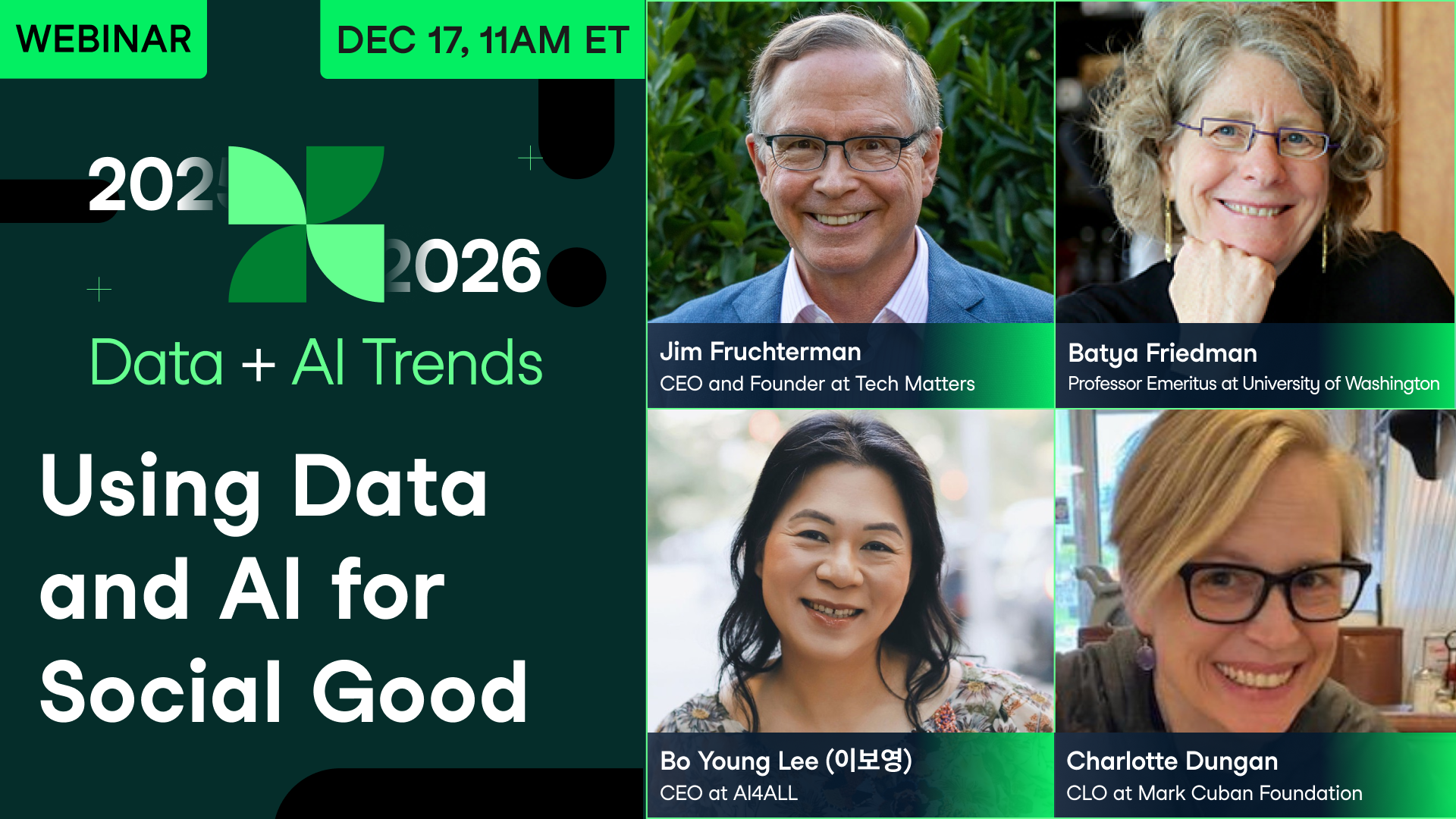
Jim Fruchterman
CEO and Founder at Tech Matters
Jim is a social entrepreneur who has spent the last thirty six years running nonprofits to harness technology for social good. He runs the Tech Matters social investment organization and previously was Founder and CEO at accessible education company Benetech. Jim was the recipient of a MacArthur Fellowship for his work with Benetech, and the Skoll Award for Social Entrepreneurship.

Batya Friedman
Professor Emeritus at University of Washington
Batya is Professor Emeritus in UW's Information School, and is Co-director of the UW Tech Policy Lab and the Value Sensitive Design Lab. Batya is also Adjunct Professor in three other schools at UW. She is a pioneer of the value sensitive design approach for including human values in the design of technical systems, and the author of the corresponding "Value Sensitive Design" book.

Bo Young Lee (이보영)
CEO at AI4ALL
Bo Young Lee runs the AI education nonprofit AI4ALL. She is a globally recognized Workplace and AI Ethics leader. Previously, Bo was President of Research & Advisory for tech careers community AnitaB.org, and was Uber's first Chief DEI Officer.

Charlotte Dungan
Chief Learning Officer at Mark Cuban Foundation
Charlotte is a computer science teacher turned AI education leader. At Mark Cuban Foundation, she leads a team delivering AI education to high school students and their teachers. Previously, Charlotte was Director of Content Development at TeachAI.org, serves on the working group of AI4K12, and was an MIT AI Teaching Systems Fellow.
Session Resources
Summary
Using Data and AI for Social Good is a session for data enthusiasts and professionals interested in utilizing technology for societal benefit. The session explores how AI and data can be used to address social issues, featuring stories from experts like Batya Friedman, Jim Fruchterman, Bo Young Lee, and Charlotte Dungan. Topics include value-sensitive design, technology for social enterprises, AI education, and empowering the next generation with AI skills. The speakers emphasize the importance of integrating ethical considerations into technology development and education, highlighting real-world applications and initiatives that are making a difference.
Key Takeaways:
- Value-sensitive design integrates human values into technology development.
- Social enterprises can effectively use technology to address unmet societal needs.
- AI education should include ethical and responsible AI principles.
- Empowering students with AI skills can drive future innovation and problem-solving.
- Collaboration across sectors is vital for impactful AI education and application.
In-Depth Insights
Value-Sensitive Design
Value-sensitive design, pioneered by Batya Friedman, focuses on incorporating human values into the design of technical systems. This approach shifts the language from "users" to "stakeholders," considering both direct and indirect stakeholders in the design process. Friedman illustrates this with examples like privacy-preserving cell phone architectures and secure medical devices. She emphasizes the importance of designing technologies that align with societal values and long-term impacts, urging developers to consider the broader implications of their technical decisions. "Think longer term," she advises, highlighting the need for systems that support societal healing and memory.
Technology for Social Enterprises
Jim Fruchterman, CEO of Tech Matters, shares his journey from Silicon Valley tech entrepreneur to social innovator. He highlights the gap between profitable tech ventures and those that serve social good, advocating for the latter. Fruchterman discusses projects like Aselo, a platform for crisis response helplines, and Terraso, software for climate crisis front-liners. His work emphasizes using tech methodologies to design products for underserved populations, aiming to solve problems that traditional markets overlook. "If it involves existing technology and a social problem, call me up," he encourages, inviting collaboration on tech for good initiatives.
AI Education and Ethics
Bo Young Lee, CEO of AI4All, highlights the importance of diversity in AI development. Her organization offers free education to students, focusing on both technical skills and ethical AI principles. Lee stresses the need for responsible AI education, addressing biases and the social implications of AI technologies. AI for All aims to create a workforce that reflects humanity, ensuring AI solutions are inclusive and equitable. "We need to graduate responsible technologists," she asserts, highlighting the role of education in shaping the future of AI.
Empowering Students with AI Skills
Charlotte Dungan from the Mark Cuban Foundation discusses the importance of AI education for high school students. Her programs focus on AI agency, teaching students to use AI tools with intention and critical thinking. Dungan emphasizes the need for students to understand when and how to use AI, fostering a sense of empowerment and responsibility. The foundation's initiatives include boot camps and ongoing mentorship, encouraging students to explore AI's potential in various fields. "Students are the leaders in embracing AI," she notes, advocating for educational systems that adapt to technological advancements.