Direkt zum Inhalt

Bitte das Formular ausfüllen, um das Webinar freizuschalten

Durch Klick auf die Schaltfläche akzeptierst du unsere Nutzungsbedingungen, unsere Datenschutzrichtlinie und die Speicherung deiner Daten in den USA.

Vortragende

Für Unternehmen

Training für 2 oder mehr Personen?

Dein Team erhält Zugang zur vollständigen DataCamp-Bibliothek mit zentralisiertem Berichtswesen, Übungsaufgaben, Projekten und mehr.
DataCamp für Unternehmen testenUm eine maßgeschneiderte Lösung zu erhalten, buche eine Demovorführung.

Using Data and AI for Social Good

December 2025
Webinar Preview

Session Resources

Summary

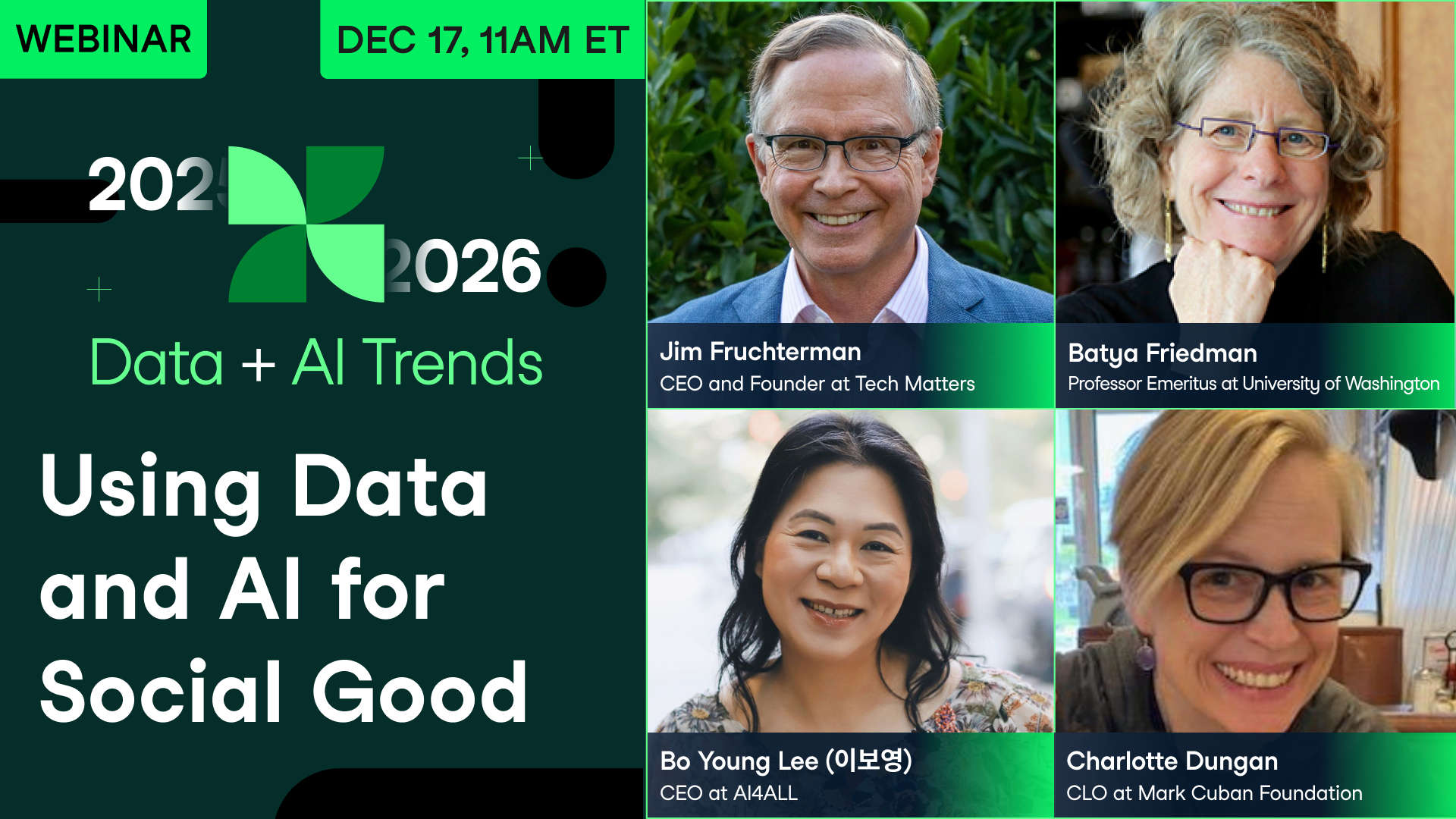
Using Data and AI for Social Good is a session for data enthusiasts and professionals interested in utilizing technology for societal benefit. The session explores how AI and data can be used to address social issues, featuring stories from experts like Batya Friedman, Jim Fruchterman, Bo Young Lee, and Charlotte Dungan. Topics include value-sensitive design, technology for social enterprises, AI education, and empowering the next generation with AI skills. The speakers emphasize the importance of integrating ethical considerations into technology development and education, highlighting real-world applications and initiatives that are making a difference.

Key Takeaways:

  • Value-sensitive design integrates human values into technology development.
  • Social enterprises can effectively use technology to address unmet societal needs.
  • AI education should include ethical and responsible AI principles.
  • Empowering students with AI skills can drive future innovation and problem-solving.
  • Collaboration across sectors is vital for impactful AI education and application.

In-Depth Insights

Value-Sensitive Design

Value-sensitive design, pioneered by Batya Friedman, focuses on incorporating human values into the design of technical systems. This approach shifts the language from "users" to "stakeholders," considering both direct and indirect stakeholders in the design process. Friedman illustrates this with examples like privacy-preserving cell phone architectures and secure medical devices. She emphasizes the import ...
Mehr Lesen

ance of designing technologies that align with societal values and long-term impacts, urging developers to consider the broader implications of their technical decisions. "Think longer term," she advises, highlighting the need for systems that support societal healing and memory.

Technology for Social Enterprises

Jim Fruchterman, CEO of Tech Matters, shares his journey from Silicon Valley tech entrepreneur to social innovator. He highlights the gap between profitable tech ventures and those that serve social good, advocating for the latter. Fruchterman discusses projects like Aselo, a platform for crisis response helplines, and Terraso, software for climate crisis front-liners. His work emphasizes using tech methodologies to design products for underserved populations, aiming to solve problems that traditional markets overlook. "If it involves existing technology and a social problem, call me up," he encourages, inviting collaboration on tech for good initiatives.

AI Education and Ethics

Bo Young Lee, CEO of AI4All, highlights the importance of diversity in AI development. Her organization offers free education to students, focusing on both technical skills and ethical AI principles. Lee stresses the need for responsible AI education, addressing biases and the social implications of AI technologies. AI for All aims to create a workforce that reflects humanity, ensuring AI solutions are inclusive and equitable. "We need to graduate responsible technologists," she asserts, highlighting the role of education in shaping the future of AI.

Empowering Students with AI Skills

Charlotte Dungan from the Mark Cuban Foundation discusses the importance of AI education for high school students. Her programs focus on AI agency, teaching students to use AI tools with intention and critical thinking. Dungan emphasizes the need for students to understand when and how to use AI, fostering a sense of empowerment and responsibility. The foundation's initiatives include boot camps and ongoing mentorship, encouraging students to explore AI's potential in various fields. "Students are the leaders in embracing AI," she notes, advocating for educational systems that adapt to technological advancements.


Verwandt

webinar

Spreading Data & AI Literacy Across Your Organization

Learn how to devise a data and AI strategy that aligns with your business strategy, and how to combine technology and training to increase the data and AI literacy across your company for business success.

webinar

Spreading Data & AI Literacy Across Your Organization

Learn how to devise a data and AI strategy that aligns with your business strategy, and how to combine technology and training to increase the data and AI literacy across your company for business success.

webinar

The State of Data & AI Literacy in 2025

Explore the latest trends shaping how organizations are building data and AI skills across their workforce.

webinar

The Executive Guide to Data & AI Literacy

Experts share how to design and implement a literacy strategy that works. Hear practical lessons on training at scale, increasing data and AI maturity, and identifying the highest-impact use cases.

webinar

The State of Data & AI Literacy in 2024

Join this webinar to learn how and which data & AI skills are becoming increasingly pervasive in organizations across industries, how leaders are adapting their teams and workforce to the era of data & AI literacy and more.

webinar

Empowering Government with Data & AI Literacy

Richard Davis, CDO at Ofcom, discusses how government agencies can cultivate a culture that puts data-driven decision making and the responsible use of technology at the center.