Share this webinar
Close your data and AI skills gap
We're the only platform uniquely engineered to advance data and AI skills across your entire organization. Let's explore a tailored program.
Book an Enterprise DemoAI-Powered Art and Storytelling
September 2026
Your Presenter(s)
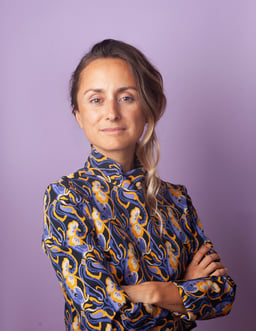
Lauren Ducrey
Chief Enchantment Officer at Inword
Lauren Ducrey is Chief Enchantment Officer at Inword and a Franco-American poet and AI consultant. She spent seven years shaping the personalities of Google Assistant and Gemini at Google. Lauren helps organizations use generative AI and poetic thinking to build creative resilience. She has spoken at Adopt AI, Summit at Sea, and Human + Tech, and worked with leaders at AXA, PepsiCo, and Renault. Her work has been featured by Bloomberg, The Huffington Post, and Le Monde.

Amir Bahadori
Founder and Creative Director at Confetti Labs

Amir Bahadori is the founder and creative director of Confetti Labs, a design and innovation practice working across digital products, brand expression, and AI-powered creative experiences. Over his career, he has held design leadership roles at TIAA, Microsoft, and Walmart Global Tech, translating complex technologies into experiences that feel clear, useful, and human. With roots in visual storytelling and entertainment, Amir now helps organizations explore how generative AI can expand creative possibilities while keeping human judgment, taste, and storytelling at the center.
Summary
AI can now write, draw, and compose well enough that the question for creative people has shifted from whether to use it to where it belongs in their process.
In a DataCamp webinar on AI-generated art and storytelling, host Richie Cotton spoke with Lauren Ducrey, chief poetic officer at Inward and a former Google generative AI lead, and Amir Bahadori, founder and creative director at UX and design agency Confetti Lab. Both use AI daily but draw sharp lines around it. Ducrey writes poetry by hand and brings AI in only for research and the business side of her practice. Bahadori uses AI heavily during early-stage exploration, then hands final decisions back to human judgment. They agreed the biggest opportunity isn't AI imitating existing art forms faster, but AI enabling forms that didn't exist before, like a camera that prints a poem instead of a photo. They also named real risks: creative sameness from over-reliance on default outputs, unresolved copyright questions, the environmental cost of large models, and what happens to a generation that grows up editing AI text before it has read enough to know good writing from bad. The conversation covers specific tools, including ElevenLabs, Cursor, Midjourney, Stable Diffusion, and Runway, along with the skills that matter most as AI absorbs more of the mechanical work: adaptability, discernment, and the willingness to sit with a hard question before answering it.
Key Takeaways
- The most interesting use of AI in art isn't making existing forms faster, it's creating forms that didn't exist before, like a camera that prints a poem instead of a photo.
- AI adds the most value during the early, exploratory phase of a creative project, not at the point of final production.
- Reusable workflows that combine several tools matter more than any single AI-generated output, especially for advertising and multi-market content.
- Asking an AI to review AI-generated creative work still doesn't work well; both guests said human judgment remains the more reliable check.
- Chasing "AI tells" such as em dashes distracts from the real problem: writers turn to generic output when they don't have time or confidence to write thoughtfully.
- People without decades of editing experience can build creative judgment by working offline first, sketching or writing by hand before bringing in AI, and treating friction as useful rather than something to remove.
- Teams that skip explicit AI-use policies run into a predictable problem: no one is willing to take responsibility when an AI-assisted deliverable turns out wrong.
Deep Dives
New Forms, Not Just Faster Old Ones
Asked for their favorite piece of AI-generated creative work, both guests picked examples that didn't try to replace an existing medium. Ducrey pointed to the Poetry Camera, an object built by designer Carolyn Zang that looks and works like a Polaroid: point it at something, and instead of a photo it prints a poem. "One thing that excites me about AI is not using AI to imitate art forms that we already have, but to create new art forms," she said, calling the camera's mix of image and language "that synesthetic multimedia use of AI" that excites her most.
Bahadori named the Montreal studio Vallée Duhamel, known for AI-driven cinematic film, including the short The Unraveling. What stood out to him wasn't the technology but the direction behind it. "I'm most interested in work where you notice the creative point of view before the tools," he said, adding that the studio "created this coherent world" and "actually take hallucinations and made it into art." For Bahadori, that's the standard: audiences shouldn't need to know or care that AI was involved, only whether the result has a clear point of view.
Cotton drew out the contrast between speed and originality that ran through the rest of the conversation: most AI applications make something people already do a bit cheaper or faster, while the more interesting cases open up work that wasn't previously possible at all. Ducrey's Poetry Camera and Bahadori's cinematic studio both fall into that second category, using AI's pattern-matching not to copy a known format but to build a delivery mechanism, camera-as-poem-printer, hallucination-as-visual-style, that has no pre-AI equivalent.
The distinction carries into how each guest evaluates new work. Bahadori said he looks for "a really strong visual language" and a "clear sense of art direction" before he considers what tools were used. Ducrey's framing is similar in spirit: she's less interested in whether AI can write a good poem than in what a new tool makes possible that pen and paper couldn't. That question, more than any specific output, is what she and Bahadori kept returning to across the rest of the discussion.
Where AI Actually Earns Its Place in a Workflow
Bahadori was direct about where AI fits into his agency's work: the divergent, exploratory phase, not final production. "I find that AI tools are the most useful in business context during the divergence phase of projects, when teams are exploring multiple creative directions," he said, listing research synthesis, rapid prototyping, and building alignment artifacts for stakeholders as the practical uses. He also flagged reusable, repeatable workflows as more valuable than any one output: "there's real value in creating reusable workflows... thinking about things scaling, not just doing them once." His examples ranged from cinematic brand advertising, where AI lets a single person run something close to a full production studio, to multi-market adaptation, adjusting language, aspect ratio, and format across regions with a few clicks once the workflow exists. Across all of it, he said, "AI is just dramatically shortening the distance between ideas and production."
Ducrey draws a firmer line for her own art. "When it comes to just writing poetry, I'm very farm to table. I have my pen and paper and that's always where I start," she said. AI enters her practice on the business side, helping her prepare for client work and keynotes, and in a tool she built herself called Coria, which responds to a poem with unexpected questions rather than generating text for her. The back-and-forth, she said, produces "a poem that was published where there's this back-and-forth of questioning" that "starts to blur the lines between what's human and what's automated." She also uses Perplexity for research, citing a recent case where she needed a crash course on data concepts before writing a poetic introduction for a technical panel: "I 100% use Perplexity as a kind of university, research TA to give me an overview."
Both guests treat research and early-stage synthesis as the clearest win. Cotton noted that AI research tools have improved sharply over the past year or two, moving from bloated, low-value reports to genuinely useful summaries, a shift both guests said matches their own experience using AI to gather information rather than generate finished work.
The Real Costs: Copyright, Sameness, and the Environment
Neither guest treated concerns about AI and creativity as overblown. Bahadori named creative sameness as a direct risk of relying on default outputs: "over-relying on these tools makes work just look and sound the same." His answer isn't to avoid the tools but to insist on a distinct voice within them: "creatives have to actively shape the new era, rather than simply resist it."
Ducrey raised copyright as the issue with the most immediate financial weight, pointing to Anthropic's recent copyright settlement, reportedly around $1.5 billion, as evidence of how unresolved the underlying business model still is for artists whose work trained these systems. She sees an opening for new licensing structures that put artists back in the loop, rather than treating the current arrangement as fixed. She also raised the environmental cost of large-model training and inference as a genuine tension for people who got into art partly because of "an intimacy" and "a long belonging" with the physical world, calling the conflict a form of "moral injury" that many creatives she talks to haven't resolved.
On the question of literacy and cognitive offloading, Ducrey was more curious than alarmed. She can edit AI output with confidence because of "thirty plus years" of reading and writing, but she wondered aloud what form of literacy might emerge in a generation that grows up alongside these tools, drawing a comparison to DJing: "some people might say, like, oh, the DJ never learned to play any of the instruments they're sampling. Does that make it not music?" She said she'd genuinely like to see research on whether an equivalent new literacy could develop around language and AI.
Cotton connected the copyright and environmental concerns to the extractive nature of large models: training data comes from work made by people who, in most cases, aren't compensated when a model reproduces something close to their style. Both guests treated that as an open problem rather than a settled one, with new business models, not new guardrails alone, as the likely fix.
Quality Control Without an AI Editor
Asked how to avoid generating "slop" at scale, Ducrey started with accountability rather than technique. Teams need explicit conversations, and ideally written policies, about how AI gets used, she said, because the ability to blame the model doesn't hold up: "if you shipped it, your responsibility. So if somebody comes back and is like, this makes no sense, you are on the spot." She pushed back specifically on the trend of hunting for AI "tells" like em dashes to shame other writers, arguing it misses the point: "if you are using the em dash, keep using the em dash." The more useful question, she said, is why people reach for generic output in the first place, usually tight deadlines and not enough time to write with care.
Bahadori agreed that human ownership doesn't go away just because AI did more of the work. "We still have to apply that judgment in context," he said, adding plainly that "AI is not sentient yet." His framing of the split: AI is strong at execution and assistance, producing options quickly and speeding up research, but "we can do more faster, but we can't reliably replace human judgment and taste." The final calls, in his process, stay with people.
On whether AI can review AI-generated creative work, both were skeptical it works yet. Bahadori: "I haven't had a lot of success there, to be honest," noting particular discomfort with AI substituting for human user research, since "it's our minds and our experiences that help interpret what users are saying." Ducrey has used AI as an editor for her poetry, but not because its feedback is especially sharp. "What I find most helpful is not necessarily how good its feedback is, but that it'll say something that will spark a thought or a piece of information," she said. Cotton summed it up as a fancier version of talking through a problem with a rubber duck: the value isn't in what comes back, it's in having verbalized the question at all.
Building Judgment When You Don't Have Thirty Years
An audience question got at a real tension in the conversation: Ducrey can edit AI output confidently because of decades of reading and writing, but what does a younger person without that experience do? Bahadori's answer focused on staying grounded outside the screen. He uses AI to "mix paint colors with mathematical precision" and to explore interior design and architecture, deliberately pulling ideas from digital tools back into physical practice rather than keeping everything generated. "Don't keep everything in the digital world," he said.
Ducrey pointed to education directly, noting that some schools and cities are restricting AI use so students still build first-hand reading and writing experience. Her deeper concern is cultural, not just technical: "how do you make everybody love language so much that there's just a big desire to read and to write?" Her answer is to treat AI as something added to that practice, not a replacement for it, whether as an editor, a research assistant, or a tool that reflects a writer's own words back to them.
Both guests named specific soft skills as more durable than any current tool. Bahadori's shorthand was adaptability, given how quickly the tools and their capabilities change. Ducrey listed several: "the capacity for wonder," which she places between awe and curiosity, divergent thinking, trust-building within a team, and discernment, the ability to judge what's actually good, which she said "comes from years of embodied experience that a machine simply can't have."
On the tools side, both were specific rather than dogmatic. Ducrey uses ElevenLabs to hear her poems read aloud in an unfamiliar voice, which surfaces rhythm problems she can't catch reading in her own head, and built a private tool she calls the Reflection Lab, which analyzes her freewriting to surface metaphors, repeated words, and images already present in her own draft rather than generating new text. Bahadori's list covers coding (Cursor and Claude Code), image generation (Midjourney for individual images, Stable Diffusion when he needs more consistency and control), and video and spatial work (Magnific Spaces for node-based workflows, Runway for cinematic output). His closing point doubled as advice for anyone building a creative AI stack: "different creative disciplines require specialized tools to achieve that consistency and high quality storytelling," and the right tool changes often enough that testing beats loyalty to any one platform.
Relacionado
webinar
Telling Data Stories for Humans in the Age of AI
Paulina Davila, VP of Analytics, Insights & Storytelling at JPMorganChase, Lea Pica, Founder at Story-Driven Data, Simon Rowe, Data Storyteller at storytelling with data, will explore how to craft compelling data narratives in an AI-powered world.webinar
Leading an AI Literacy Transformation
Experts explore the principles behind successful, sustainable AI transformation.webinar
AI In The Enterprise: AI Strategies That Create Value
Lexi Reese, CEO & Co-founder at Lanai and Krunal Patel, Chief Product Officer & Co-Founder at Bordo AI explore what makes an AI strategy successful.webinar
The Art of Data Storytelling: Driving Impact with Analytics
In this session, three industry leaders will shed light on the art of blending analytics with storytelling, a key to making data-driven insights both understandable and influential within any organization.webinar
AI In The Enterprise: From Prototype to Production
Aishwarya Naresh Reganti, Supreet Kaur, and Luke Jinu Kim discuss how to navigate the journey from AI prototypes to production-ready applications.webinar