AI Use Cases for Law
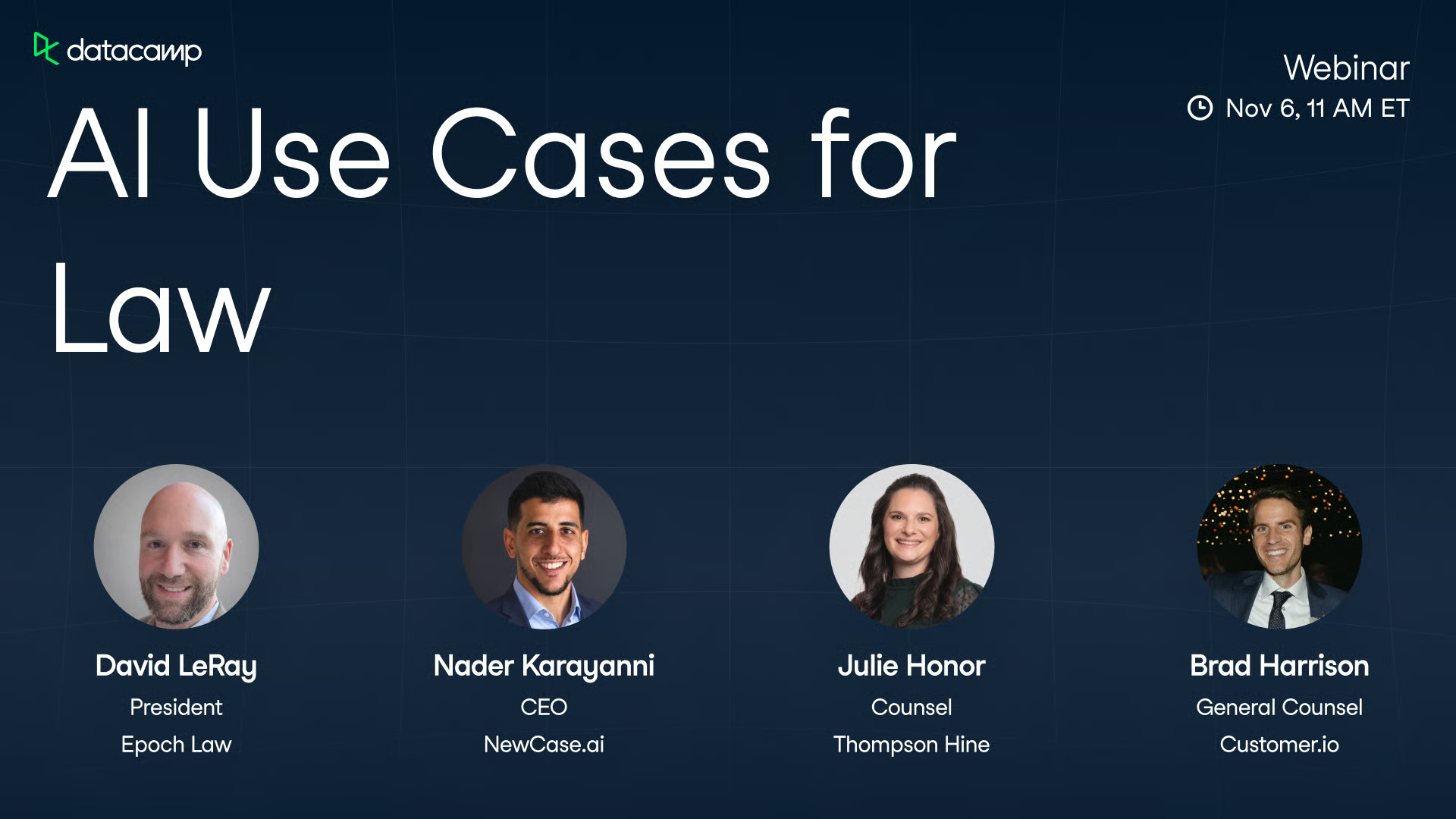
Tu(s) presentador(es)

Julie Honor
Counsel at Thompson Hine
Julie is former general counsel with a focus on technology, commercial transactions, and change management. Her work focuses on advising clients on the use of artificial intelligence (AI) and generative AI within their businesses, including drafting corporate policies and developing internal training programs, and advising development teams on compliance considerations when building AI technology. Julie is also an advisory board member to movement analytics company Hx Innovations. Previously Julie was General Counsel at 3Q.

Brad Harrison
General Counsel at Customer.io

Brad is General Counsel at Customer.io, a customer engagement platform, where he joined as the company’s first in-house lawyer and built the legal and compliance function from scratch. He has put AI agents into his team’s day-to-day work, including one that reviews and negotiates routine contracts and escalates to a lawyer only when it needs to.
Before Customer.io, Brad was Deputy General Counsel at DigitalOcean, where he supported the company during and after its 2021 IPO and built its product, commercial, privacy, and litigation legal functions. Earlier, he spent seven years at AWS, where he built and led product legal teams. He holds a JD from Vanderbilt University Law School.

David LeRay
President at Epoch Law
David co-founded Epoch Law to bring AI and advanced technology to litigation. He serves as President and leads the firm's mission to build one of the first truly AI-native law practices. Before Epoch, David was a partner at Quinn Emanuel for thirteen years, where he built deep expertise in dispute resolution and litigation. He is also an active builder in the legal tech community, known for open-source tools like a legal research AI agent.

Nader Karayanni
CEO at NewCase.ai
Nader is the CEO and co-founder of NewCase.ai, an AI-native litigation intelligence platform for insurance defense. He built the company to help attorneys cut through thousands of pages of deposition transcripts in hours, not weeks. Nader is a repeat founder, a former software engineer at Microsoft, and a published AI researcher. He holds a master's degree from Columbia Engineering and a bachelor's degree from the Technion, Israel Institute of Technology.
Summary
Four legal practitioners agree that AI will not replace lawyers, but they disagree on how fast it will change what lawyers do.
In this panel on AI use cases for law, DataCamp General Counsel Thad Pitney talks with Julie Honor, Counsel at Thompson Hine; Brad Harrison, General Counsel at Customer.io; David LeRay, President at Epoch Law; and Nader Karayanni, CEO at NewCase.ai. Between them they cover litigation, in-house practice, commercial contracts, AI governance and building legal AI tools.
The panel gets specific. LeRay describes AI agents working through roughly 200 depositions in an antitrust class action, a job he estimates would have cost about $5 million in lawyer time. Harrison explains how an in-house contract agent cut review of simple event agreements from ten days to one. Honor says AI trims a six to eight hour contract review to three or four hours.
They are just as direct about the limits. AI treats whatever it reads as fact, struggles with layered redlines, and cannot make the risk calls that clients pay lawyers for. For non-lawyers, the bigger risk is privilege: chatbot conversations about legal problems are usually discoverable in court.
The session closes with advice on AI governance policies, access to justice, and why the best way to learn these tools is to use them.
Key Takeaways
- AI is taking over high-volume legal work such as document review, deposition analysis and first-pass contract review, which pushes lawyers toward judgment, strategy and advocacy.
- Legal work resists full automation because it rests on ambiguity: two sides tell competing stories and a human judge or jury decides.
- AI tends to accept its inputs as true, including bad OCR, contradictory documents and persuasive comments from the other side's AI.
- For legal research, use tools grounded in legal databases that show their sources, and keep an expert, not just any human, in the loop.
- Non-lawyers who run legal questions through a chatbot usually lose attorney-client privilege, and those transcripts can be requested in discovery.
- Pasting a lawyer's privileged draft into a third-party AI tool can waive the protection the client paid for.
- AI governance policies last longer when they are technology agnostic, risk based and tied to a strong data governance program.
Deep Dives
Will AI Replace Lawyers?
Pitney opened with the question every legal team hears, and the answer was a unanimous no, with conditions. Honor set the tone: "I don't think it will replace us, but it's going to transform how we think and how we work." Harrison agreed and went further, arguing that AI changes what a good lawyer looks like. The profession is moving from pure legal thinking toward a mix he called "legal builder, operational thinking," where lawyers design workflows and tools as well as give advice.
LeRay framed the shift in economic terms. "What AI is doing is really moving lawyers up the value chain," he said. The tedious work that junior litigators grew up on, such as labeling and clicking through thousands of documents, is going away. What remains is the work most lawyers wanted to do in the first place: arguing in court and going to trial.
Karayanni, the one non-lawyer on the panel, gave the client's view. Professional accountability matters to him because he wants a person who takes responsibility for the advice. He also pointed to a structural difference between law and his old field. "Software engineering is significantly more binary," he said, while legal work needs deep knowledge of the client's business and strong communication skills.
LeRay offered the sharpest version of the argument. He tells people that "legal's moat with respect to AI is, like, ambiguity." His example was a bar fight: one side calls it assault, the other calls it self defense, and no model can produce the correct answer because there isn't one until a judge or jury weighs the competing stories. He contrasted this with mathematics, where proofs start from premises and reach a single logical answer, which makes that field far easier for AI to attack.
Harrison added that law is not formulaic, even if outsiders expect it to be. His CEO once focused on a specific regulation when the real exposure came from plaintiffs' attorneys suing on an entirely different issue. That kind of insight, he noted, does not appear in any rule book. Honor extended the point to the bench, saying she does not expect AI to replace judges or juries, since the right to a jury trial is built into the US Constitution and every case turns on how the law applies to its specific facts.
Where AI Already Delivers: Depositions, Discovery and Contracts
Pitney asked the panel to skip the fantastical demos and describe real results. LeRay went first with an antitrust class action covering around 200 million people. The discovery record included about 200 depositions, each a recorded interview with a witness that can run seven hours or more. Reviewing them by hand at law firm hourly rates would have cost, by his estimate, around $5 million. Instead, his team used AI to fan out teams of agents across the record, pull what mattered from each deposition and assemble a road map of the case. He admitted that "my mind was blown with how powerful AI was on that case."
Karayanni described a similar win in a medical malpractice defense. Plaintiffs in those cases must bring an expert witness, so his client used the NewCase platform to collect more than 300 earlier depositions and testimonies from the opposing expert. The team then found contradictions across that testimony, which became a major strength as the case headed to trial.
On the transactional side, the gains are smaller per document but they add up. Honor said, "I use AI as my first pass on every commercial contract I'm looking at," which can take a six to eight hour review down to three or four. Whether firms will pass those savings on, or add technology fees to cover the tools, is still an open question across the industry.
Harrison runs several in-house agents at Customer.io. One handles first passes on simple, low-risk agreements such as restaurant, hotel and event contracts that run one or two pages. "It's taken, I think, our review time from, like, ten days to, like, one day," he said, and the marketing team loves it. The agent now does first passes on sales contracts too, and his goal is two or three passes without human help. His team also uses AI agents to answer GDPR data subject access requests faster, while still checking that nothing sensitive goes out.
Harrison noted that this kind of high-volume review used to be how junior lawyers built billable hours, billed in six-minute increments. It paid well but was rarely a good use of anyone's time, which is exactly why AI fits it so well. Honor's own example was searching equipment manuals for the word asbestos.
Where AI Falls Short: Judgment, Facts and Sources
The limits came up as often as the wins. Harrison said his contract agent starts to struggle with larger agreements and multiple rounds of redlines, the tracked changes lawyers use to mark edits. Negotiation needs trade-offs. Without judgment, he said, "you can just kinda keep talking past each other," with each side insisting on its own clause. The agent can be too rigid or too lenient, and teaching it when to concede two harmless changes to close a deal has been harder than he expected.
Honor showed why that is so hard to encode. A quick concession may be fine in most cases, but if the only change in an NDA is an indemnification clause, accepting it means taking on large risk before the parties even know each other. Training an AI to know when something is material, and when to hand it to a human, is the real work.
Karayanni focused on a technical weakness: how "blindly the AI takes instructions." Models treat their input as truth, which rarely holds in litigation, where documents often contradict each other. The same problem shows up in unstructured data. If OCR misreads unclear handwriting, the model accepts the error as fact. His answer is to keep users in the loop when information is captured, not only in later tasks, so bad data never enters the system.
Harrison described a version of this in live negotiations. Early on, a counterparty used its own AI to add persuasive comments to a contract, and those comments convinced his agent that a risky change was acceptable. His team had to retrain it to resist that kind of pressure.
Pitney observed that AI does well at the two extremes: tightly defined tasks with clear rules, and broad open-ended research. The middle, where much legal work lives, is still a work in progress. Honor's response was to watch the source. For research she uses the AI built into Lexis and Westlaw, which draw on full databases of court decisions and regulations, rather than general chatbots. LeRay summed it up with the engineer's rule: "garbage in, garbage out."
Honor also gave the panel's best phrase for oversight. Verifying accuracy and spotting bias needs an "expert in the loop, not just a human in the loop," someone trained to recognize when an output is wrong.
Non-Lawyers, Chatbots and Attorney-Client Privilege
Pitney turned to the audience, many of whom lead data or learning teams rather than legal departments. Non-lawyers using general AI tools for legal work face two risks. The answer may be confidently wrong, and even a correct answer usually lacks the protection of attorney-client privilege.
Honor, a former general counsel who trained employees on confidentiality, explained the stakes. If you research whether something is legal and your company is later sued over it, that research can become the first exhibit in opening arguments. Her rule is simple: if you would not want your question on the front page of a newspaper or shown in court, "Don't put it in writing." Pick up the phone and ask your lawyer instead.
She also warned about public tools. Doing company work in the consumer version of a chatbot, without an enterprise agreement, puts confidential information at risk, and she has seen intellectual property and confidentiality protections lost that way. On quality, she called AI "the best liar you're gonna interact with," because it is wrong with total confidence.
LeRay answered Pitney's question about discovery from a litigator's side. Informal sources such as Slack chats, text messages and chatbot transcripts often hold the hottest documents in a case, and courts have granted requests for them. The difference lies in who uses the tool. When a client asks an attorney and the attorney uses AI, the result is protected work product. When a business person uses it alone, "it is discoverable. The bad guys on the other side can get it."
Honor added a trap many clients miss. When a client pastes a lawyer's draft into their own AI tool, "that eliminates the privilege and the protections that they got by working with me in the first place," because the tool is a third party.
Harrison, who spent years at AWS, said his biggest fear was a Slack message asking whether the company was doing something illegal. AI makes this worse, since people share full facts with a chatbot as if the conversation were private. His advice to his AI-forward CEO is to talk first: "let's talk about the facts, like, in a privileged safe space," then go back to the AI to learn more. He also reframes legal as a safe place for hard conversations, not as the police, which brings people to his team earlier.
Lower Legal Costs, More Litigation and AI Governance
On cost, Harrison spoke as a buyer of legal services. Customer.io still uses outside counsel, but more selectively. For a question about employment rules across the many countries where its remote staff live, his team now does the initial research and asks outside counsel to go deep on only the two or three tricky jurisdictions. No AI, he said, can help him hold a meaningful conversation with the Department of Justice.
Honor described the other side. Some clients use AI well and come to her with narrow, focused questions. Others send her a ten-page AI memo full of legal errors and ask her to confirm it, which costs them more than asking her the question would have. She now asks where such documents came from first.
An audience question asked whether easier access to legal information will mean more litigation. Karayanni said it already does, citing an increase of more than 30% in claims over the last two years while the number of attorneys stays the same. He called AI a force multiplier in both directions: experienced attorneys get faster and better, while inexperienced users can produce catastrophic results, which US courts are seeing more often.
Harrison, a former federal clerk, saw a positive side for people representing themselves. Hard-to-follow handwritten complaints are giving way to well-written claims, and he is excited that more people "actually get the full access to justice," even though his company also sees more aggressive AI-drafted employment claims.
On AI governance, Honor drafts these policies for clients. Her advice is to write them in a way that is "somewhat technology agnostic and more risk based," naming the risks to mitigate and the behaviors to encourage, with clear statements of what employees can and cannot do. Because AI risk follows the data that flows into each tool, she ties AI governance to a strong data governance program so policies hold up as the technology changes.
The closing advice brought these threads together. LeRay urged people to keep a lawyer in the loop. Honor told the audience to trust their gut and keep the skills they had before AI. Karayanni said "the best way to learn AI is to get your hands dirty," with pilots and a clear policy. Harrison reminded the audience that "it's okay to expect your attorney to be supercharged by AI and move faster and not cost you as much."