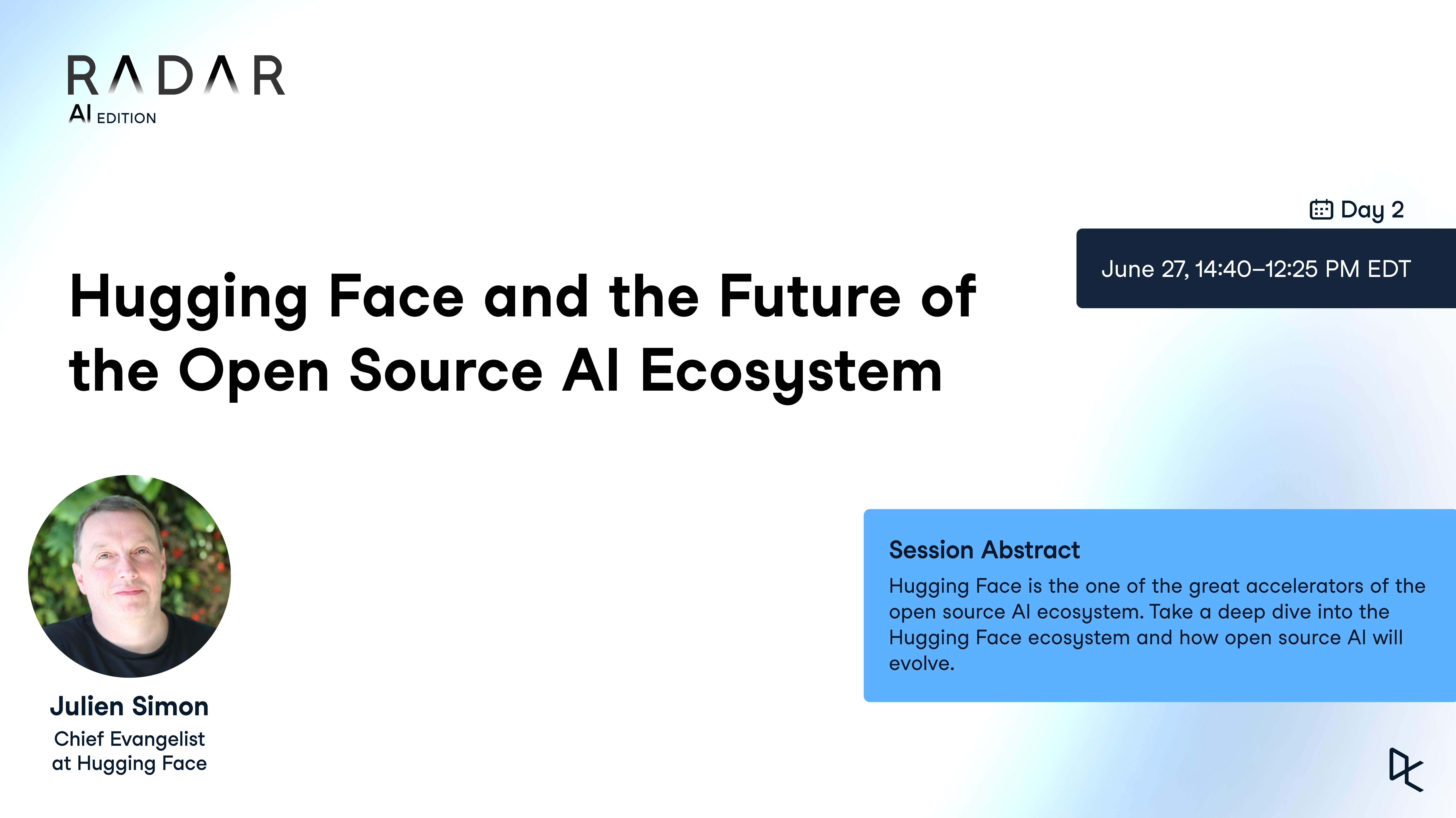
Hugging Face & the Future of the Open Source AI Ecosystem
Tu(s) presentador(es)

Julien Simon
Chief Evangelist at Hugging Face
Julien is currently Chief Evangelist at Hugging Face. He's recently spent 6 years at Amazon Web Services where he was the Global Technical Evangelist for AI & Machine Learning. Prior to joining AWS, Julien served for 10 years as CTO/VP Engineering in large-scale startups.
Summary
In an in-depth analysis of the ever-changing open source AI environment, Hugging Face emerges as a key player, significantly improving the accessibility and performance of AI models. The conversation highlighted the wide collection of models and datasets hosted on the Hugging Face platform, underlining its role in making AI accessible to all. Main points included the quick development and deployment of models, with Hugging Face providing tools such as leaderboards to assist in selecting the best fit for various use cases. The significance of high-quality datasets was highlighted, with a call to focus more on data than the constantly evolving range of models. The session also examined techniques like fine-tuning and retrieval-augmented generation (RAG), advocating for a balanced approach between model size and application efficiency. The session was enriched by insights into infrastructure choices, cost management, and the strategic use of smaller models for effective inference, all key for businesses looking to efficiently utilize AI.
Key Takeaways:
- Hugging Face hosts a wide collection of open source models, key for the AI ecosystem.
- High-quality datasets are more valuable than the latest model iterations.
- Models should be the right size for each use case to optimize cost and performance.
- Fine-tuning and RAG are complementary, not competing, techniques.
- Infrastructure and cost management are key in AI deployment and scalability.
Deep Dives
The Role of Hugging Face in Open Source AI
Hugging Face has established itself as a key part of the open source AI movement, offering a platform that hosts a wide range of models and datasets. This accessibility has made AI available to all, allowing developers and businesses to experiment and deploy solutions without the barriers traditionally associated with AI development. With over 750,000 models and 160,000 datasets, Hugging Face provides not only the resources but also the tools necessary for evaluating and benchmarking these models. The company's emphasis on community-driven innovation ensures that the latest advancements are quickly integrated into the ecosystem, promoting quick development cycles. As Junien Simon, chief evangelist at Hugging Face, noted, "The pace of innovation is crazy… you will iterate on models much more than you think." This statement encapsulates the fast-paced and continuously changing nature of the AI environment.
Importance of Data Over Models
While the allure of new models is strong, the conversation highlighted that data remains the key to successful AI applications. The models are evolving rapidly, but it is the data that determines their true applicability and effectiveness. Building and maintaining high-quality datasets allows for more precise fine-tuning and better model performance. Junien Simon emphasized, "The most important thing you can do is build your evaluation datasets." This approach not only ensures that models are optimized for specific tasks but also future-proofs applications against the fast-paced model development cycles. Investing in structured, high-quality data is seen as a strategic move that yields long-term benefits, particularly as models continue to evolve and improve.
Fine-Tuning and Retrieval-Augmented Generation (RAG)
Fine-tuning and Retrieval-Augmented Generation (RAG) were presented as key techniques for enhancing model performance and relevance in specific domains. Fine-tuning involves adjusting a model with specific data to improve its accuracy and applicability in particular tasks, such as summarizing legal documents. RAG, on the other hand, allows for the injection of fresh, external data into the text generation process, which is key for maintaining up-to-date information flow without extensive retraining. Simon advised, "Fine-tuning is a very efficient way to improve models for a particular task." The combination of these techniques allows for a flexible, adaptive AI strategy that can meet varying business needs, ensuring models remain both current and contextually relevant.
Strategic Infrastructure and Cost Management
In the context of AI deployment, infrastructure and cost management are key. The discussion stressed the importance of choosing the right infrastructure to optimize inference costs, which often constitute the bulk of AI project expenses. Smaller models, such as those with 7 billion parameters, are recommended for their balance of performance and cost-efficiency. Simon noted, "Inference is the overwhelming cost in your AI projects… small models, smaller accelerators." By focusing on the right-sizing models and selecting appropriate deployment platforms, organizations can achieve significant cost savings. The session also explored various hardware options, including alternatives to NVIDIA GPUs, such as AMD and AWS's AI accelerators, which offer competitive performance at lower costs. This strategic approach ensures that AI initiatives are not only effective but also economically sustainable.


