Ir al contenido principal

Completa los detalles para desbloquear el seminario web

Al continuar, aceptas nuestros Términos de uso, nuestra Política de privacidad y que tus datos se almacenen en los EE. UU.

Share this webinar

Close your data and AI skills gap

We're the only platform uniquely engineered to advance data and AI skills across your entire organization. Let's explore a tailored program.

Book an Enterprise Demo
Upskilling a small team?Get started today
Data Analysis

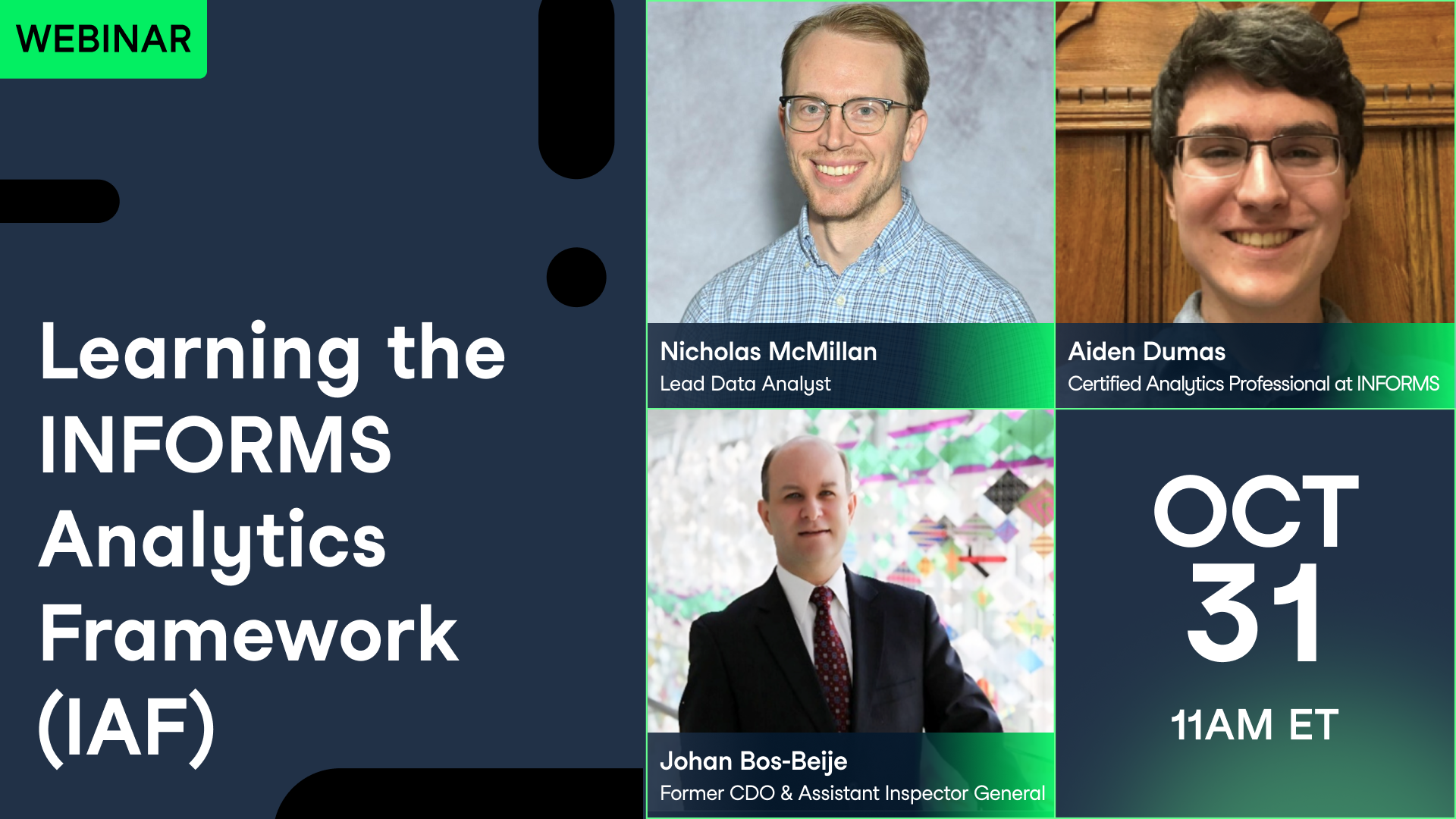
Learning the INFORMS Analytics Framework (IAF): The Proven Guide to Developing Analytics Solutions

October 2025
Webinar Preview

Your Presenter(s)

Foto de Nicholas McMillan

Nicholas McMillan

Lead Data Analyst, Family & Children's Services

Niccholas is a business and data analyst with 5+ years of experience leading data strategy, analytics, and reporting for large-scale social sector programs. Proven ability to translate complex datasets into actionable insights, manage cross-functional projects, and create high-impact dashboards and reports in Power BI. Advanced understanding of SQL database systems, business process improvement, and program evaluation. Excels in stakeholder collaboration, technical execution, and advancing data fluency across teams. Certified Analytics Professional (CAP) committed to building data-informed, decision-making solutions that drive community impact.

Foto de Aiden Dumas

Aiden Dumas

Certified Analytics Professional at INFORMS

Aiden is a Certified Analytics Professional (CAP-E) working with INFORMS to develop the CAP Essentials exam and the rollout strategy of the INFORMS Analytics Framework (IAF). He earned his master's in computer science from Brandeis University and his bachelor's in political science from Trinity College (Hartford).

Foto de Johan Bos-Beijer

Johan Bos-Beijer

CDO & Assistant Inspector General Managed Business Services (retired)

Johan is a highly respected advisor and mentor with decades of senior and executive management experience across both public and private sectors. Retired from federal service a few years ago, he worked with nearly every Cabinet-level agency and numerous federal and state organizations, driving innovation in program integrity, citizen services, data analytics, and security. His leadership has delivered measurable improvements in government services, significant taxpayer savings, and the creation of mentorship programs that continue to produce accomplished graduates. Bos-Beijer was a principal author of multiple audit guides and impact studies, launched government-wide integrated project teams, and led substantial implementations. A pioneer in data analytics, he directed one of the first major federal data warehousing and analytics initiatives in the 1990s and later convened the first specialized government symposium on AI, Cognitive Computing, and Machine Learning.

Presentation Slides, The Framework, Implementation Guide

Make sure you register on this page so that your rewatch counts! Watch the Kickoff session here

Summary

The session on the INFORMS Analytics Framework (IAF) provides a detailed guide for professionals and students in analytics, offering a structured approach to developing effective solutions. The IAF outlines a seven-domain framework that covers the entire lifecycle of analytics implementation, from problem framing to lifecycle management. The session emphasizes the importance of aligning analytics efforts with business objectives and ensuring data integrity and ethical considerations. It also highlights the adaptability of the IAF, allowing for non-linear application in real-world scenarios. The session includes insights from experienced practitioners and provides resources for further learning and certification.

Key Takeaways:

  • The IAF is a comprehensive framework guiding the full lifecycle of analytics projects.
  • Business problem framing is key for aligning analytics with organizational goals.
  • Data integrity and ethical considerations are essential for successful analytics solutions.
  • The IAF is flexible and can be applied non-linearly in real-world scenarios.
  • Certification through the Certified Analytics Professional (CAP) program validates expertise.

In-Depth Exploration

Business Problem Framing

Business problem framing is essential in the IAF, ensuring that analytics efforts align with organizational goals. This domain involves defining the business problem or question clearly and concisely, without focusing on technical specifics. It requires identifying stakeholders and obtaining their alignment on the business objectives and intended outcomes. As Johan Bos-Beijer noted, "Defining the business problem or question is the most important critical activity in any analytics initiative." This step is key to avoid the common pitfall of analytics efforts failing due to poor alignment or unclear objectives. By establishing a clear business case, organizations can ensure that analytics is applied to solve the right challenge, ultimately leading to successful outcomes.

Analytics Problem Framing

Once the business problem is defined, the next step is to determine if it can be reframed as an analytics problem. This involves assessing whether analytics is the appropriate approach and identifying the type of analytics problem, such as optimization or classification. Nicholas McMillan emphasized the importance of this step, stating, "If the business problem can't be reframed as an analytics problem, your next question is what kind of analytics problem is it?" This domain sets the stage for methodological development and ensures that analytics efforts are focused on problems that can be effectively addressed through data-driven solutions.

Data Management

Data management is a vital domain that requires significant effort and attention. It involves understanding the data environment, including ownership, constraints, and potential privacy concerns. As Johan Bos-Beijer highlighted, "Ultimately, any analytic solution is dependent on data." This domain requires comprehensive data documentation and inventory practices to ensure that the solution is reliable and trustworthy. It also involves assessing data quality and determining any missing data that may be needed. Proper data management is essential for supporting the analytics solution and ensuring its success.

Methodology Selection and Model Development

Methodology selection and model development involve choosing the appropriate analytical techniques and building the solution. This domain requires evaluating and selecting methods based on the nature of the problem, available data, and organizational resources. Aiden Dumas explained, "Creating the actual solution is just one of seven domains that occupy roughly the same amount of time." This step involves building, testing, and refining models to ensure they are valid, scalable, and actionable. Proper documentation and communication are crucial to ensure that the solution is understandable and justifiable to both technical and non-technical stakeholders.


Relacionado

infographic

Your Organization's Guide to Data Maturity

Learn about the levers of data transformation in this handy infographic

webinar

A Framework for Data Transformation

Learn how to systematically transform your organization into a data-driven one

webinar

Scaling Data & AI Literacy with a Persona-Driven Framework

In this session, three experts walk you through the steps of creating a successful data training program.

webinar

Scaling Data & AI Literacy with a Persona-Driven Framework

In this session, three experts walk you through the steps of creating a successful data training program.

webinar

Make the most of your organization’s data with business intelligence

Learn how to scale data insights in your organization with business intelligence

webinar

RADAR: The Analytics Edition - Building a Learning Culture for Analytics Functions

In the session, Russell Johnson, Denisse Groenendaal-Lopez and Mark Stern address the importance of fostering a learning environment for driving success with analytics.