Ir al contenido principal

Completa los detalles para desbloquear el seminario web

Al continuar, aceptas nuestros Términos de uso, nuestra Política de privacidad y que tus datos se almacenen en los EE. UU.

Altavoces

Empresas

¿Formar a 2 o más personas?

Dale a tu equipo acceso a la biblioteca completa de DataCamp, con informes centralizados, tareas, proyectos y mucho más.
Prueba DataCamp para empresasPara obtener una solución a medida, reserva una demostración.

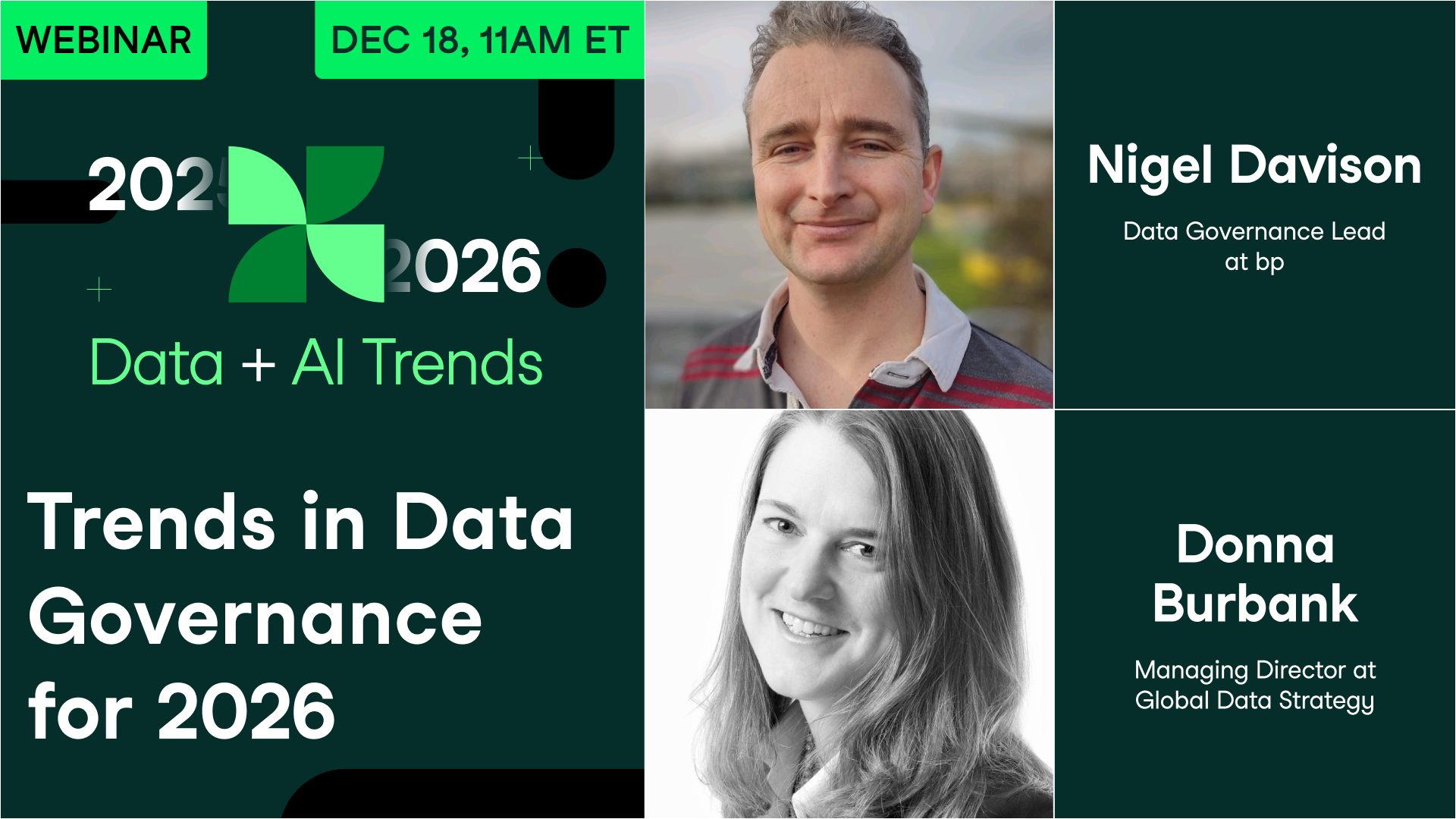
Trends in Data Governance for 2026

December 2025
Webinar Preview

Session Resources

Summary

The session "Trends in Data Governance for 2026" is crucial for professionals interested in the evolving field of data governance. Data governance is gaining traction as an essential business function, driven by the need for accurate data to power AI and other technologies. The discussion highlighted the increasing attention from C-suite executives and the growing investment in data governance. Key themes included the importance of cross-functional collaboration, the role of AI in automating governance tasks, and the challenges posed by AI, such as data quality and process reengineering. Experts Donna Burbank and Nigel Davison shared insights on the current trends, tools, and organizational strategies that can enhance data governance practices.

Key Takeaways:

  • Data governance is becoming a priority for businesses, driven by AI and data quality needs.
  • Cross-functional collaboration is essential for effective data governance.
  • AI can automate many governance tasks but requires careful implementation.
  • Understanding and documenting business rules are essential for leveraging AI effectively.
  • Organizational structure and clear roles are vital for successful governance.

In-Depth Analysis

AI's Role in Data Governance

AI is increasingly seen as a tool to enhance data governance by automating routine tasks such as data quality checks and metadata management. Nigel Davison noted, "AI capabilities might enable data stewards to be more effective." However, both experts cautioned against over-reliance on AI, emp ...
Leer Mas

hasizing the need for human oversight to handle complex business rules and ensure data accuracy. AI can assist in identifying anomalies and patterns, but the final validation often requires human intervention.

Challenges Posed by AI

While AI offers opportunities, it also presents challenges, particularly in ensuring data quality and preventing errors. Nigel highlighted the risk of AI providing inaccurate answers due to a lack of nuanced business logic. Donna Burbank added that AI should not be seen as a "magic solution" but rather as a tool that requires well-documented business rules to function effectively. The need for a balance between automation and human oversight is important to mitigate risks such as data leakage and hallucinations.

Importance of Cross-Functional Collaboration

Effective data governance requires collaboration across different business functions. Donna emphasized that governance is about "collaboration and giving people a voice." Successful governance involves engaging stakeholders from various departments to ensure that data policies align with business needs. This approach helps in identifying and solving data-related issues more efficiently, as demonstrated in real-world examples shared during the session.

Organizational Structure and Governance

The session highlighted the importance of having a structured approach to data governance. Committees or centers of excellence can facilitate cross-functional discussions and decision-making. Donna suggested that roles should be clearly defined, with accountability for specific data areas. This structure helps in breaking down silos and ensuring that data governance is integrated into the organization's overall strategy. Nigel added that pre-work and identifying the right stakeholders are key to making governance forums effective.


Relacionado

white paper

2022 Data Trends and Predictions

Read about 9 trends shaping data science in 2022 and beyond

webinar

Data & AI Trends for 2026

Industry experts from MIT and IBM explore the most important trends shaping data and AI in 2026.

webinar

Trends in Business Intelligence & Analytics for 2026

Experts discuss the major trends shaping BI and data analytics in 2026. You’ll learn how AI is transforming the analyst role, which technical and soft skills will matter most, and how executives can rethink their analytics strategies for the year ahead.

webinar

Using Data Governance to Foster a Data-Driven Culture

Kim Wienzierl, Director of Master Data Management at Newell Brands, and Lauren Maffeo, Assistant Director of Product at Maryland Department of Labor, discuss how data leaders can use data governance to strengthen their organization’s data culture.

webinar

The State of Data & AI Literacy in 2025

Explore the latest trends shaping how organizations are building data and AI skills across their workforce.

webinar

Data Trends and Predictions 2022

9 major data science trends that will impact organizations in 2022 and beyond.