Creating Simple Object-Oriented Programs Using Java
Sani Yusuf breaks down fundamental Java concepts and core Object-Oriented Programming (OOP) ideas into clear, simple steps.

Sani Yusuf
無料アカウントを作成する
練習とトラックであなたの進捗を記録しましょう。
Googleで登録続行すると、次に同意したものとみなされます: 利用規約、 プライバシーポリシー 、およびデータが米国内に保管されることに同意したものとみなされます。関連

チュートリアル
OOP in Java: Classes, Objects, Encapsulation, Inheritance and Abstraction
Learn Object-Oriented Programming in Java with practical examples. Master classes, objects, inheritance, encapsulation, and abstract classes using a restaurant menu system.
 Bexruz (Bex) Tuychiev · 15 min

チュートリアル
Scala Classes and Objects
In this tutorial, you will learn about the fundamental notions of object-oriented programming in Scala: Classes and Objects.
 Aditya Sharma · 8 min

チュートリアル
Objects and Classes in R
Learn about Object-Oriented Programming (OOP) along with R's objects, different classes like S3 and S4, along with its construction, creating its generic function with examples and many more.
 Olivia Smith · 9 min


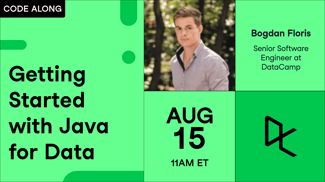


Java remains one of the most important languages for building robust applications, yet many learners find object-oriented programming (OOP) concepts notoriously difficult to grasp. This hands-on code-along session is designed to change that by breaking down fundamental Java concepts and core Object-Oriented Programming (OOP) ideas into clear, simple steps.
Participants will explore the essentials of Java programming, including variables, control flow, classes, objects, attributes, and methods. Along the way, foundational Object-Oriented Programming (OOP) principles, such as encapsulation and abstraction, will be introduced and explained through practical, relatable examples, without delving into complex application building.
The session focuses solely on developing a strong, intuitive understanding of how Java’s fundamental structures interconnect. By the end, attendees will have written multiple small, focused Java programs and developed the confidence to tackle more advanced Object-Oriented Programming (OOP) topics with ease. No prior Java experience required, just curiosity and a desire to finally make sense of object-oriented programming.
Key Takeaways:
Resources (including link to code along notebook)