メインコンテンツへスキップ

ウェビナーのロックを解除するには詳細を入力してください

続行すると、弊社の利用規約プライバシーポリシーに同意し、データが米国に保存されることに同意したことになります。

Share this webinar

Close your data and AI skills gap

We're the only platform uniquely engineered to advance data and AI skills across your entire organization. Let's explore a tailored program.

Book an Enterprise Demo
Upskilling a small team?Get started today
Artificial Intelligence

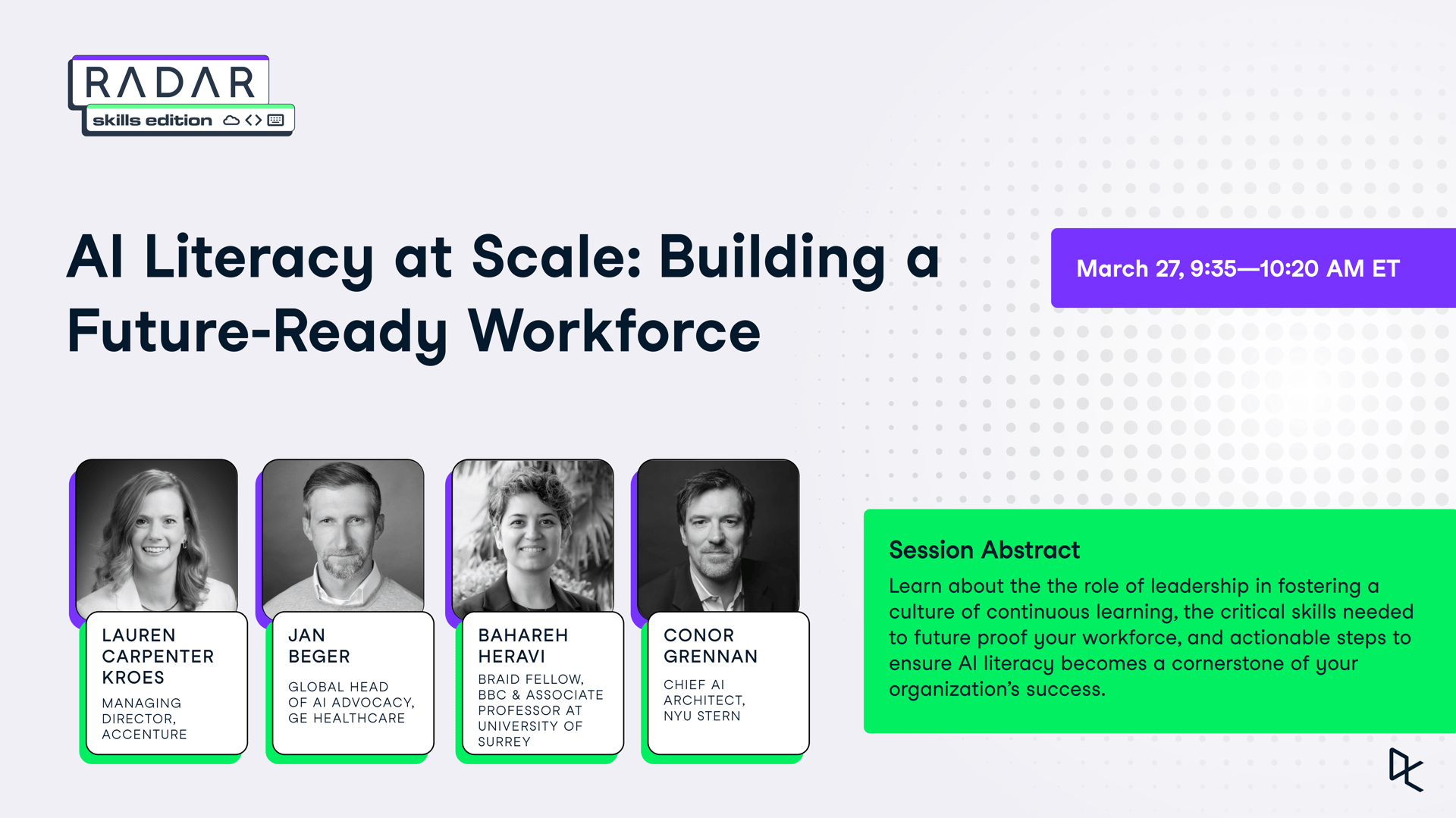
AI Literacy at Scale: Building a Future-Ready Workforce

August 2025
Webinar Preview

Your Presenter(s)

Bahareh Heraviヘッドショット

Bahareh Heravi

Professor of AI & Media at University of Surrey

Bahareh specializes in data and computational Journalism, data storytelling, and the use of AI in journalism and media. As a BRAID Fellow, she works to enhance responsible AI adoption in the BBC newsroom. At the University of Surrey, her research is focused on storytelling structures in data journalism and news databases. She is an expert reviewer for the European Commission, and serves on the Irish Government's Open Data Governance Board and the EDI Advisory Board of the Royal Statistical Society. She is the founding Chair of the European Data & Computational Journalism Conference and a steering committee member of the Computation + Journalism Conference. Previously, she was an Assistant Professor at University College Dublin (UCD), leading the Data Journalism program, and the Head of the Insight News Lab at the University of Galloway.

Lauren Carpenter Kroesヘッドショット

Lauren Carpenter Kroes

Managing Director at Accenture

Lauren leads Accenture's US West Strategy Development Program focused on integrating and upskilling the company's Strategy Analysts and Consultants. She also serves as Global Client Account Lead for one of the world's largest retailers. She has two decade experience as a management consultant, and her work focuses on enterprise analytics and AI transformation.

Jan Begerヘッドショット

Jan Beger

Global Head of AI Advocacy at GE Healthcare

Jan is an experienced healthcare technology leader and one of the top thinkers on AI literacy in healthcare. As Global Head of AI Advocacy at GE HealthCare, his work focuses on promoting AI literacy to increase adoption of AI technologies across the healthcare sector. Jan is also an Executive Director at HelloAI, a healthcare AI literacy education initiative from GE Healthcare and EIT Health. Previously, Jan founded and was head of Edison Accelerator, GE Healthcare's AI start-up acceleration and collaboration program. Additionally, he founded GR4AI.Academy, a non-profit organization focused on educating children about the societal implications of AI.

Conor Grennanヘッドショット

Conor Grennan

Chief AI Architect at NYU Stern

Conor Grennan is Chief AI Architect at NYU Stern School of Business and CEO of AI Mindset, an AI consulting company that trains professionals, leaders, and organizations on an effective framework for generative AI. At Stern, he builds generative AI fluency across the institution. Conor has worked with teams across industries, including OpenAI, McKinsey, NASA, Google, ServiceNow, JP Morgan, DaVita Healthcare, Providence Health, BlueCross/BlueShield, American Securities, and more. He is a NY Times and #1 international bestselling author, published in 15 languages, a sought-after keynote speaker, and serves on the Board of Directors of the SHRM Foundation. His AI insights have been featured in Entrepreneur, the Washington Post, BBC, Forbes, Business Insider, Vox, and other media.

Summary

The rapid widespread adoption of generative AI is reshaping industries by making AI an essential component of modern business operations. As AI becomes more prevalent, having an AI-literate workforce is crucial. Organizations need to ensure that employees across all levels can understand and leverage AI technologies effectively. The webinar explored the importance of AI literacy, strategies to overcome resistance to change, and ways to stay updated with the latest AI technologies. Experts from various fields, including healthcare, journalism, and enterprise management, shared their insights on building AI literacy and the transformative potential of AI. They emphasized the need for educational resources specific to roles and industries, as AI literacy can drive innovation, enhance productivity, and encourage cross-departmental collaboration. The session also highlighted the importance of using AI responsibly, considering both its opportunities and risks, to create a future-ready workforce capable of utilizing AI's full potential.

Key Takeaways:

  • AI literacy is essential for all employees to drive innovation and cross-team collaboration.
  • AI technologies can address significant challenges, such as data overload in healthcare.
  • Successful AI adoption requires a behavioral shift and change management strategies.
  • Concrete, relatable use cases are important for effective AI education and literacy.
  • Organizations must consider AI's risks and implement responsible AI training.

Deep Insights

Importance of AI Literacy

AI literacy is becoming increasingly essential as generative AI integrates into various job functions, making it imperative for employees to understand and converse about AI effectively. Lauren Carpenter Kroes from Accenture highlighted that AI literacy enables hyperautomation, new business models, and enterprise reinvention. With AI literacy, employees can engage in productive conversations focused on what is possible and valuable, driving team collaboration and innovation. Bahareh Heravi from the University of Surrey emphasized that AI will soon be as ubiquitous as basic computer tools, making AI literacy crucial for future workforce competency. Understanding AI's opportunities and risks is necessary to maximize its benefits while minimizing potential negative impacts.

AI in Healthcare

In healthcare, AI is crucial for managing the immense volume of medical data, which doubles every seventy-two days. Jan Beger from GE Healthcare pointed out that AI can help healthcare professionals keep up with the rapidly expanding body of medical literature and address workforce shortages. For example, AI can assist radiologists by summarizing reports and providing initial assessments, thereby reducing burnout and improving patient care. AI also supports democratizing healthcare access through innovations like AI-enhanced mobile ultrasound devices that guide users to acquire high-quality images, even with limited training.

Getting Started with AI Integration

To successfully integrate AI into an organization, it's essential to begin with education and change management. Connor Grennan from NYU Stern School of Business explained that AI adoption is not a typical digital transformation but requires a shift in behavior and mindset. Organizations should focus on team-specific educational resources and best practices to develop AI fluency. Jan Beger recommended using tangible, real-life examples to make AI education relatable to daily work. This approach helps employees see the direct relevance and benefits of AI, encouraging engagement and adoption.

Overcoming Obstacles and Staying Informed

Adopting generative AI comes with challenges, such as misunderstanding its capabilities and over-relying on its outputs. Connor Grennan emphasized the importance of understanding AI as a conversational tool rather than a traditional software replacement. Organizations need to address automation bias and ensure that employees critically evaluate AI outputs. Staying updated with AI developments is challenging due to the rapid pace of innovation, but regular discussions and knowledge sharing within teams can help. Bahareh Heravi suggested show-and-tell sessions where employees share their AI experiences and learn from each other, promoting a culture of continuous learning and adaptation.


関連している

white paper

The Learning Leader's Guide to AI Literacy

Find out how learning leaders should be approaching AI literacy within their organization, focusing on the what, why, and how of fostering organization-wide AI literacy.

webinar

AI Literacy in Action: Driving Workforce Transformation

Find out how to drive workforce transformation through AI literacy. You’ll learn how to increase AI adoption across the enterprise, align AI initiatives with strategic priorities, and redesign workflows to take full advantage of AI capabilities.

webinar

Spreading Data & AI Literacy Across Your Organization

Learn how to devise a data and AI strategy that aligns with your business strategy, and how to combine technology and training to increase the data and AI literacy across your company for business success.

webinar

Spreading Data & AI Literacy Across Your Organization

Learn how to devise a data and AI strategy that aligns with your business strategy, and how to combine technology and training to increase the data and AI literacy across your company for business success.

webinar

Designing An Effective AI Literacy Strategy: A How-to Guide for Leaders

Alex Jaimes, CAIO at Dataminr, and Doug Laney, Innovation Fellow at West Monroe, teach you how to develop a strategy to enable all your employees to become AI literate.

webinar

Designing An Effective AI Literacy Strategy: A How-to Guide for Leaders

Alex Jaimes, CAIO at Dataminr, and Doug Laney, Innovation Fellow at West Monroe, teach you how to develop a strategy to enable all your employees to become AI literate.