メインコンテンツへスキップ

ウェビナーのロックを解除するには詳細を入力してください

続行すると、弊社の利用規約プライバシーポリシーに同意し、データが米国に保存されることに同意したことになります。

Share this webinar

Close your data and AI skills gap

We're the only platform uniquely engineered to advance data and AI skills across your entire organization. Let's explore a tailored program.

Book an Enterprise Demo
Upskilling a small team?Get started today
Artificial Intelligence

AI Literacy in Action: Driving Workforce Transformation

July 2025
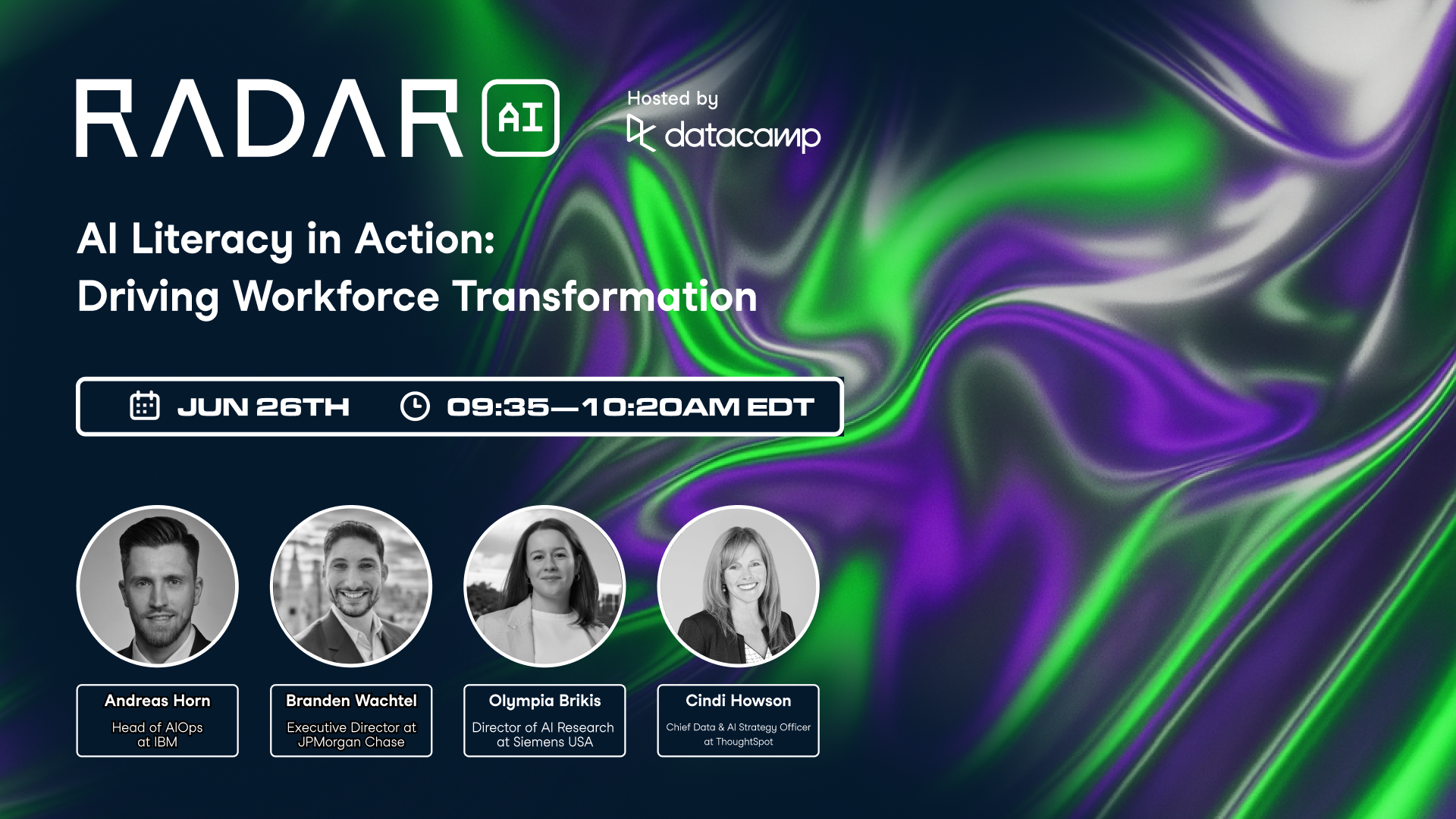
Webinar Preview

Your Presenter(s)

Andreas Hornヘッドショット

Andreas Horn

Head of AIOps at IBM

Andreas Horn leads IBM’s AIOps service portfolio for EMEA, driving AI-powered transformation across enterprises. He specializes in strategic AI deployment for IT Operations, ensuring businesses leverage AI to enhance resilience, efficiency and innovation in this new era of AI. Beyond IBM, Andreas is a university lecturer, educating the next generation on practical AI applications that boost productivity and streamline workflows. His mission: turn AI from hype into real-world impact.

Branden Wachtelヘッドショット

Branden Wachtel

Executive Director at JPMorgan Chase

Branden Wachtel is an Executive Director at JPMorgan Chase, where he leads enterprise-scale AI and automation initiatives. Over more than a decade at the firm, he has developed programs that have enabled over 7,000 citizen developers, eliminated more than 3 million hours of manual work annually, and created over $14 million in new business value.

His work includes launching AI strategy initiatives using tools such as ChatGPT, OpenAI APIs, and retrieval-augmented generation (RAG) architectures. He has built and led teams of data scientists, machine learning engineers, and MLOps specialists, and has developed AI advisory programs for senior executives and clients. Branden has also contributed to business continuity efforts during major integrations and regularly shares his expertise as a speaker and workshop leader on AI literacy and adoption.

Olympia Brikisヘッドショット

Olympia Brikis

Director of Industrial AI Research at Siemens USA

Olympia Brikis is a seasoned technology and business leader with over a decade of experience in AI research. As the Technology and Engineering Director for Siemens' Industrial AI Research in the U.S., she leads AI strategy, technology roadmapping, and R&D for next-gen AI products. Olympia has a strong track record in developing Generative AI products that integrate industrial and digital ecosystems, driving real-world business impact.She is a recognized thought leader with numerous patents and peer-reviewed publications in AI for manufacturing, predictive analytics, and digital twins. Olympia actively engages with executives, policymakers, and AI practitioners on AI's role in enterprise strategy and workforce transformation. With a background in Computer Science from LMU Munich and an MBA from Wharton, she bridges AI research, product strategy, and enterprise adoption, mentoring the next generation of AI leaders.

Cindi Howsonヘッドショット

Cindi Howson

Chief Data & AI Strategy Officer at ThoughtSpot and host of The Data Chief podcast.

Cindi Howson is the Chief Data & AI Strategy Officer at ThoughtSpot and host of The Data Chief podcast.

Cindi is an analytics and BI thought leader and expert with a flair for bridging business needs with technology. As Chief Data Strategy Officer at ThoughtSpot, she advises top clients on data strategy and best practices to become data-driven, speaks internationally on top trends such as AI ethics, and influences ThoughtSpot’s product strategy.

Cindi was previously a Gartner research Vice President, as the lead author for the data and analytics maturity model and analytics and BI Magic Quadrant, and a popular keynote speaker. She introduced new research in data and AI for good, NLP/BI Search, and augmented analytics and brought both the BI bake offs and innovation panels to Gartner globally. She’s frequently quoted in MIT,Harvard Business Review, Information Week and is rated a top 12 influencer in big data and analytics by Analytics Insight, Onalytca, Solutions Review, and Humans of Data.

In 2022, CDO Magazine named her a Leading Data Consultant, and Global Data Power Woman. In 2021 she was named data leader of the year by Women in Data and as a finalist for motivator of the year by Women Leaders in Data and AI.

Prior to joining Gartner, she was founder of BI Scorecard, a resource for in-depth product reviews based on exclusive hands-on testing, contributor to Information Week, and the author of several books including: Successful Business Intelligence: Unlock the Value of BI & Big Data, Analytics Interpreted, and SAP BusinessObjects BI 4.0: The Complete Reference.

She served as The Data Warehousing Institute (TDWI) faculty member for more than a decade. She serves on the board for Drexel University’s LeBow Business Analytics program and is a volunteer for Girls Plus Data, Women in Data, and the Mark Cuban Foundation, AI bootcamps.

Prior to founding BI Scorecard, Howson was a manager at Deloitte & Touche and a global BI standards leader for Dow Chemical. She has an MBA from Rice University.

Summary

The session on AI Literacy in Action focused on the transformative power of AI literacy in driving workforce transformation across industries. The discussion highlighted the importance of creating an AI-first culture within organizations. Leading companies like Shopify and Duolingo are shifting towards becoming AI-first, emphasizing the necessity of AI literacy to remain competitive. The session explored the challenges and strategies for building AI literacy programs, aligning talent, technology, and culture to move from experimentation to impactful results. Industry leaders shared insights on success stories, emphasizing the need for continuous improvement, engaging educational experiences, and creating a psychologically safe environment for AI experimentation. The importance of cross-functional collaboration between domain experts and AI specialists was highlighted as essential for realizing AI's full potential. The session concluded with discussions on leading by example, addressing resistance to change, and ensuring employees understand the personal and organizational benefits of AI adoption.

Key Takeaways:

  • AI literacy is essential for organizations to remain competitive in an AI-first world.
  • Continuous improvement and engagement are key to successful AI literacy programs.
  • Cross-functional collaboration between domain experts and AI specialists is essential.
  • Addressing resistance to change and creating a safe environment for AI experimentation is essential.
  • Leaders should lead by example and demonstrate the personal and organizational benefits of AI.

In-depth Analysis

Importance of AI Literacy

AI literacy is no longer optional for businesses aiming to stay competitive in today's fast-paced technological environment. As Adel Nehme noted, companies across sectors are investing heavily in AI transformation, but the challenge lies in developing an AI-first mindset. Cindi Howson emphasized that AI should be viewed as a tool similar to fire—something to be used and not feared—and that it must align with an organization's business strategy. The ability to use AI effectively is becoming a vital skill for organizations, necessitating a focus on AI literacy to ensure all employees can thrive in an AI-enhanced environment. As Branden Wachtel stated, "AI is the future that's already here," underlining the urgency for businesses to catch up and integrate AI into their operations.

Building Effective AI Literacy Programs

Creating successful AI literacy programs involves several key components. Engaging employees through hands-on experiences and interactive learning is essential, as Branden Wachtel highlighted. Programs should be designed to be fun and empowering, encouraging employees to explore AI's potential. Cindi Howson stressed the importance of starting with a common language and understanding the different levels of proficiency required based on roles. This approach ensures that employees are not only literate but fluent in AI, enabling them to apply AI effectively in their specific contexts. Additionally, Olympia Brikis pointed out the need for collaboration between AI experts and domain specialists to adapt AI solutions to real-world needs.

Overcoming Resistance to Change

Resistance to change is a significant barrier to AI adoption. To address this, organizations must create a psychologically safe environment where employees feel comfortable experimenting with AI. Cindi Howson suggested celebrating successes and creating incentives to encourage AI adoption. Sharing success stories and demonstrating tangible benefits can help alleviate fears and motivate employees to embrace AI. Olympia Brikis shared an example from Siemens, where AI has transformed manufacturing processes without reducing workforce numbers, highlighting the potential for AI to enhance rather than replace jobs. By addressing concerns and emphasizing the positive impact of AI, organizations can foster a culture of innovation and continuous improvement.

Leading by Example

Leadership plays a critical role in driving AI adoption. Leaders must lead by example, not just by advocating for AI but by actively using it themselves. Branden Wachtel noted that many leaders believe in AI's potential but do not use it personally. Encouraging leaders to share their experiences with AI, both professionally and personally, can inspire others to do the same. Cindi Howson provided practical advice on starting small, such as enhancing a single presentation slide with AI insights, to demonstrate AI's value in everyday tasks. By visibly integrating AI into their workflows, leaders can set a precedent for others to follow, promoting a culture of AI fluency throughout the organization.


関連している

white paper

The Learning Leader's Guide to AI Literacy

Find out how learning leaders should be approaching AI literacy within their organization, focusing on the what, why, and how of fostering organization-wide AI literacy.

white paper

The Learning Leader's Guide to AI Literacy

Find out how learning leaders should be approaching AI literacy within their organization, focusing on the what, why, and how of fostering organization-wide AI literacy.

webinar

AI Literacy at Scale: Building a Future-Ready Workforce

Industry experts explore strategies for scaling AI literacy across diverse teams, bridging the gap between technical expertise and business understanding.

webinar

Spreading Data & AI Literacy Across Your Organization

Learn how to devise a data and AI strategy that aligns with your business strategy, and how to combine technology and training to increase the data and AI literacy across your company for business success.

webinar

Spreading Data & AI Literacy Across Your Organization

Learn how to devise a data and AI strategy that aligns with your business strategy, and how to combine technology and training to increase the data and AI literacy across your company for business success.

webinar

Driving AI Literacy in Organizations

Gain insight into the growing importance of AI literacy and its role in driving success for modern organizations.