track

Have this cheat sheet at your fingertips
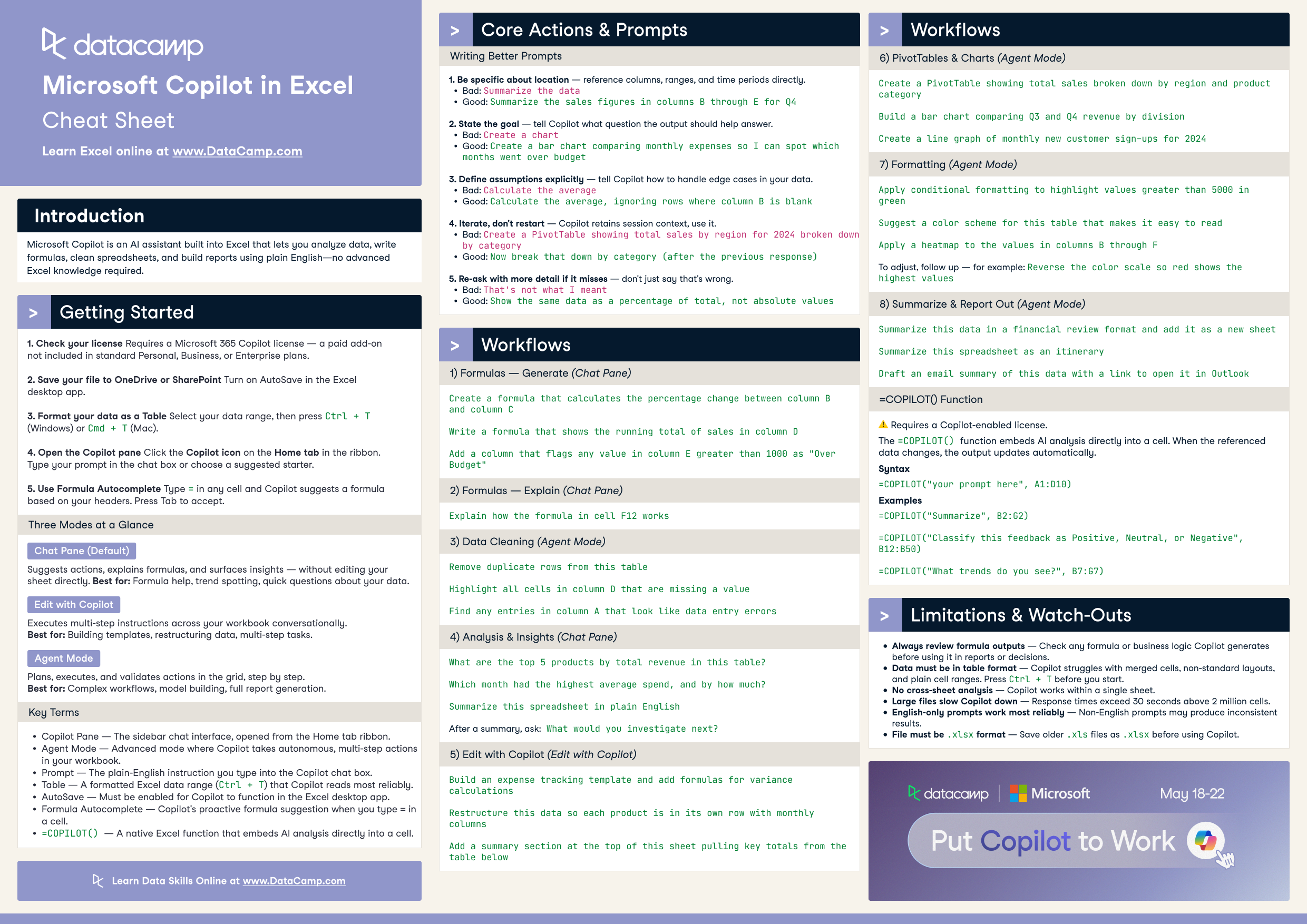
Download PDFMicrosoft Copilot is an AI assistant built into Excel that lets you analyze data, write formulas, clean spreadsheets, and build reports using plain English — no advanced Excel knowledge required. This cheat sheet covers the modes, prompting principles, core actions, and the =COPILOT() function.
Getting started
- Check your license. Requires a Microsoft 365 Copilot license — a paid add-on not included in standard Personal, Business, or Enterprise plans.
- Save your file to OneDrive or SharePoint. Turn on AutoSave in the Excel desktop app.
- Format your data as a Table. Select your data range, then press
Ctrl + T(Windows) orCmd + T(Mac). - Open the Copilot pane. Click the Copilot icon on the Home tab in the ribbon. Type your prompt in the chat box or choose a suggested starter.
- Use Formula Autocomplete. Type
=in any cell and Copilot suggests a formula based on your headers. Press Tab to accept.
Three modes at a glance
- Chat Pane (default) — suggests actions, explains formulas, and surfaces insights without editing your sheet directly. Best for formula help, trend spotting, and quick questions about your data.
- Edit with Copilot — executes multi-step instructions across your workbook in a conversational back-and-forth. Best for building templates, restructuring data, and multi-step tasks.
- Agent Mode — plans, executes, and validates actions directly in the grid, showing each step as it works. Best for complex workflows, model building, and full report generation.
To enable Agent Mode: in the Copilot sidebar, click the Tools icon (two slider controls) → select Agent Mode.
Key terms
- Copilot Pane — the sidebar chat interface, opened from the Home tab ribbon.
- Agent Mode — advanced mode where Copilot takes autonomous, multi-step actions in your workbook.
- Prompt — the plain-English instruction you type into the Copilot chat box.
- Table — a formatted Excel data range (Ctrl + T) that Copilot reads most reliably.
- AutoSave — must be enabled for Copilot to function in the Excel desktop app.
- Formula Autocomplete — Copilot's proactive formula suggestion when you type
=in a cell. - =COPILOT() — a native Excel function that embeds AI analysis directly into a cell.
Writing better prompts
1. Be specific about location
Reference columns, ranges, and time periods directly.
Bad: Summarize the data
Good: Summarize the sales figures in columns B through E for Q4
2. State the goal
Tell Copilot what question the output should help answer.
Bad: Create a chart
Good: Create a bar chart comparing monthly expenses so I can spot which months went over budget
3. Define assumptions explicitly
Tell Copilot how to handle edge cases in your data.
Bad: Calculate the average
Good: Calculate the average, ignoring rows where column B is blank
4. Iterate, don't restart
Copilot retains session context, so use it.
Bad: Create a PivotTable showing total sales by region for 2024 broken down by category
Good: Now break that down by category (after the previous response)
5. Re-ask with more detail if it misses
Don't just say "that's wrong."
Bad: That's not what I meant
Good: Show the same data as a percentage of total, not absolute values
Core actions and prompts
Adjust column names and ranges to match your data.
Formulas — generate (Chat Pane)
Create a formula that calculates the percentage change between column B and column C
Write a formula that shows the running total of sales in column D
Add a column that flags any value in column E greater than 1000 as "Over Budget"
Formulas — explain (Chat Pane)
Explain how the formula in cell F12 works
Data cleaning (Agent Mode)
Remove duplicate rows from this table
Highlight all cells in column D that are missing a value
Find any entries in column A that look like data entry errors
Analysis and insights (Chat Pane)
What are the top 5 products by total revenue in this table?
Which month had the highest average spend, and by how much?
Summarize this spreadsheet in plain English
After a summary, follow up with: What would you investigate next?
Edit with Copilot
Build an expense tracking template and add formulas for variance calculations
Restructure this data so each product is in its own row with monthly columns
Add a summary section at the top of this sheet pulling key totals from the table below
PivotTables and charts (Agent Mode)
Create a PivotTable showing total sales broken down by region and product category
Build a bar chart comparing Q3 and Q4 revenue by division
Create a line graph of monthly new customer sign-ups for 2024
Formatting (Agent Mode)
Apply conditional formatting to highlight values greater than 5000 in green
Suggest a color scheme for this table that makes it easy to read
Apply a heatmap to the values in columns B through F
To adjust, follow up — for example: Reverse the color scale so red shows the highest values
Summarize and report out (Agent Mode)
Summarize this data in a financial review format and add it as a new sheet
Summarize this spreadsheet as an itinerary
Draft an email summary of this data with a link to open it in Outlook
The =COPILOT() function
Requires a Copilot-enabled license.
The =COPILOT() function embeds AI analysis directly into a cell. When the referenced data changes, the output updates automatically.
Syntax
=COPILOT("your prompt here", A1:D10)
Examples
=COPILOT("Summarize", B2:G2)
=COPILOT("Classify this feedback as Positive, Neutral, or Negative", B12:B50)
=COPILOT("What trends do you see?", B7:G7)
Limitations and watch-outs
- Always review formula outputs. Check any formula or business logic Copilot generates before using it in reports or decisions.
- Data must be in table format. Copilot struggles with merged cells, non-standard layouts, and plain cell ranges. Press
Ctrl + Tbefore you start. - No cross-sheet analysis. Copilot works within a single sheet.
- Large files slow Copilot down. Response times exceed 30 seconds above 2 million cells.
- English-only prompts work most reliably. Non-English prompts may produce inconsistent results depending on your version and region.
- File must be .xlsx format. Save older .xls files as .xlsx before using Copilot.