Ana içeriğe atla

Web seminerinin kilidini açmak için ayrıntıları doldurun

Devam ederek Kullanım Şartlarımızı, Gizlilik Politikamızı ve verilerinizin ABD’de saklandığını kabul etmiş olursunuz.

Share this webinar

Close your data and AI skills gap

We're the only platform uniquely engineered to advance data and AI skills across your entire organization. Let's explore a tailored program.

Book an Enterprise Demo
Upskilling a small team?Get started today
Artificial Intelligence

How to Attract & Retain AI Talent

December 2024
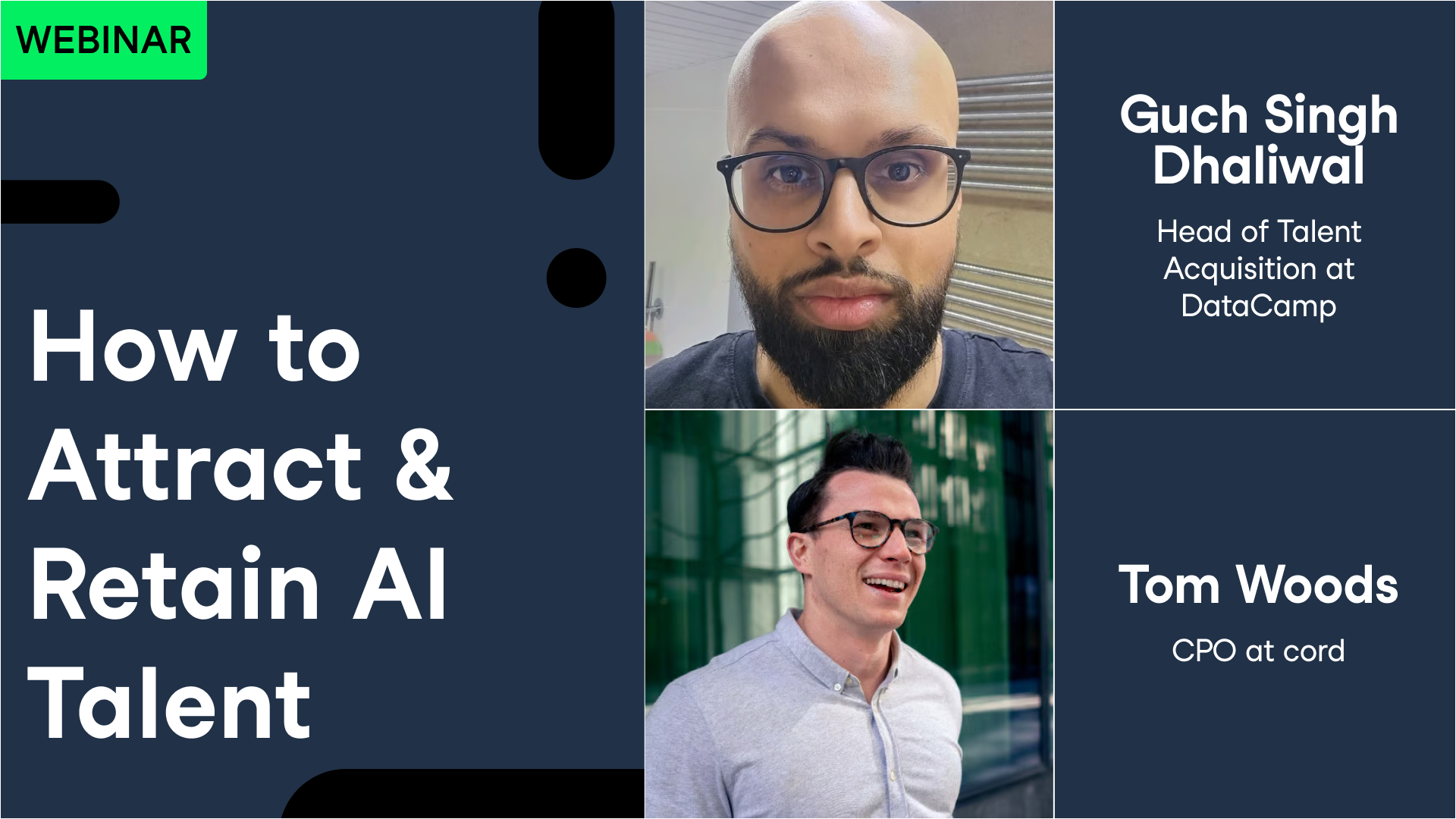
Webinar Preview

Your Presenter(s)

Tom Woods Fotoğrafı

Tom Woods

CPO at cord

Tom Woods is CPO at cord, the hiring tool used by of technology companies in London to make direct hires into their technology teams. Prior to cord, Tom worked as a technical recruiter, helping software and data practitioners find work. After gathering insights from countless jobseekers, Tom helped build a solution to empower people looking for work to speak to future employers directly. Tom's role gives him unique visibility on hundreds of thousands of data points to understand trends and behaviours in the technology recruitment market.

Guch Singh Dhaliwal Fotoğrafı

Guch Singh Dhaliwal

Head of Talent Acquisition at DataCamp

Guch runs the Talent Acquisition team at DataCamp. He's responsible for sourcing and hiring candidates for technical roles across data, AI, product and engineering. Previously he was Lead Recruiter for Engineering and Product at Wayfair, and a Lead Technical Recruiter at DST Systems.

Session Resources

Summary

The discussion explores the evolving nature of AI talent acquisition, focusing on equipping teams with AI literacy and skills. As AI becomes integral across various sectors, including sales, product development, and engineering, organizations need to rethink their hiring strategies to stay competitive. The conversation covers the need for diverse roles, such as AI engineers, data scientists, and NLP specialists, while emphasizing the necessary technical and soft skills for these roles. The importance of continuous learning and staying updated with AI advancements is also highlighted, given the rapid pace of change in the field. Panelists stress the significance of an efficient hiring process to attract top talent, suggesting a focus on both technical qualifications and the passion for AI as indicators of a candidate's potential success. Additionally, the role of a company's value proposition in attracting AI talent is discussed, advocating for a strong narrative that aligns with the candidates' aspirations and interests.

Key Takeaways:

  • AI literacy is becoming essential across various job roles, not just technical positions.
  • AI roles are diversifying, with demand for AI engineers, data scientists, and NLP specialists increasing.
  • Technical skills in AI and machine learning, as well as soft skills like communication, are important.
  • The hiring process should be efficient, ideally with three stages to attract the best candidates.
  • Continuous learning and passion for AI are key indicators of a candidate's potential success.

Insights

The Evolving Nature of AI Roles

AI is reshaping job roles across industries, with a notable shift towards AI engineers and data scientists. Companies are increasingly seeking full-stack developers with AI capabilities, moving away from traditional roles. This shift signifies the growing importance of AI literacy beyond technical positions, with even sales and marketing teams expected to use AI tools to enhance efficiency. The emergence of roles like prompt engineers further illustrates this trend, as organizations strive for automation and innovation. "We're seeing more companies looking for AI engineers, and less for traditional front-end or back-end developers," Woods noted, emphasizing the changing demands in the job market.

Essential Skills for AI Professionals

In the field of AI, both technical and soft skills are essential. Guch Singh emphasized the importance of a strong foundation in AI and machine learning concepts, alongside proficiency in big data technologies like PyTorch and SQL. Beyond technical expertise, candidates should demonstrate excellent communication skills and a genuine passion for AI. This passion often shows in personal projects or a keen interest in industry trends. "Passion and a key interest in this area does help, especially at such an early stage of AI," Dhaliwal remarked, highlighting the value of enthusiasm and continuous learning in this rapidly evolving field.

Optimizing the Hiring Process

An efficient hiring process is essential for attracting top AI talent. Panelists agreed that an ideal recruitment cycle involves three stages: an initial screening, a skills assessment, and a final interview. Lengthy processes can deter candidates, with Tom Woods pointing out that extending beyond three stages could exclude up to 84% of potential candidates. To retain interest and attract the best, companies should aim for concise, relevant assessments that reflect real job tasks. "Your interview process should be three stages," Woods advised, emphasizing efficiency and relevance to ensure a successful hire.

Continuous Learning and Retention

Given the rapid advancements in AI, continuous learning is essential for both new and existing employees. Companies should encourage a culture of learning through training budgets, online courses, and professional development opportunities. Tom Woods shared insights on initiatives like AI hackathons and knowledge-sharing sessions to keep teams engaged and informed. These efforts not only enhance individual skills but also contribute to a more innovative and competitive organization. "The most important thing is the exploration," Woods remarked, highlighting the value of encouraging employees to experiment and stay ahead of industry trends. By prioritizing ongoing education, companies can ensure their teams are equipped to handle the challenges and opportunities presented by AI.


İlgili

white paper

The Learning Leader's Guide to AI Literacy

Find out how learning leaders should be approaching AI literacy within their organization, focusing on the what, why, and how of fostering organization-wide AI literacy.

webinar

Spreading Data & AI Literacy Across Your Organization

Learn how to devise a data and AI strategy that aligns with your business strategy, and how to combine technology and training to increase the data and AI literacy across your company for business success.

webinar

Spreading Data & AI Literacy Across Your Organization

Learn how to devise a data and AI strategy that aligns with your business strategy, and how to combine technology and training to increase the data and AI literacy across your company for business success.

webinar

Designing An Effective AI Literacy Strategy: A How-to Guide for Leaders

Alex Jaimes, CAIO at Dataminr, and Doug Laney, Innovation Fellow at West Monroe, teach you how to develop a strategy to enable all your employees to become AI literate.

webinar

Designing An Effective AI Literacy Strategy: A How-to Guide for Leaders

Alex Jaimes, CAIO at Dataminr, and Doug Laney, Innovation Fellow at West Monroe, teach you how to develop a strategy to enable all your employees to become AI literate.

webinar

Driving AI Literacy in Organizations

Gain insight into the growing importance of AI literacy and its role in driving success for modern organizations.