Ana içeriğe atla

Web seminerinin kilidini açmak için ayrıntıları doldurun

Devam ederek Kullanım Şartlarımızı, Gizlilik Politikamızı ve verilerinizin ABD’de saklandığını kabul etmiş olursunuz.

Bu web seminerini paylaşın

Veri ve yapay zekâ beceri açığınızı kapatın

Tüm kuruluşunuz genelinde veri ve yapay zeka becerilerini geliştirmek için benzersiz şekilde tasarlanmış tek platform biziz. Size özel bir programı birlikte keşfedelim.

Kurumsal Demo Rezervasyonu Yapın
Küçük bir ekibi yetkinleştiriyor musunuz?Bugün başlayın
Artificial Intelligence

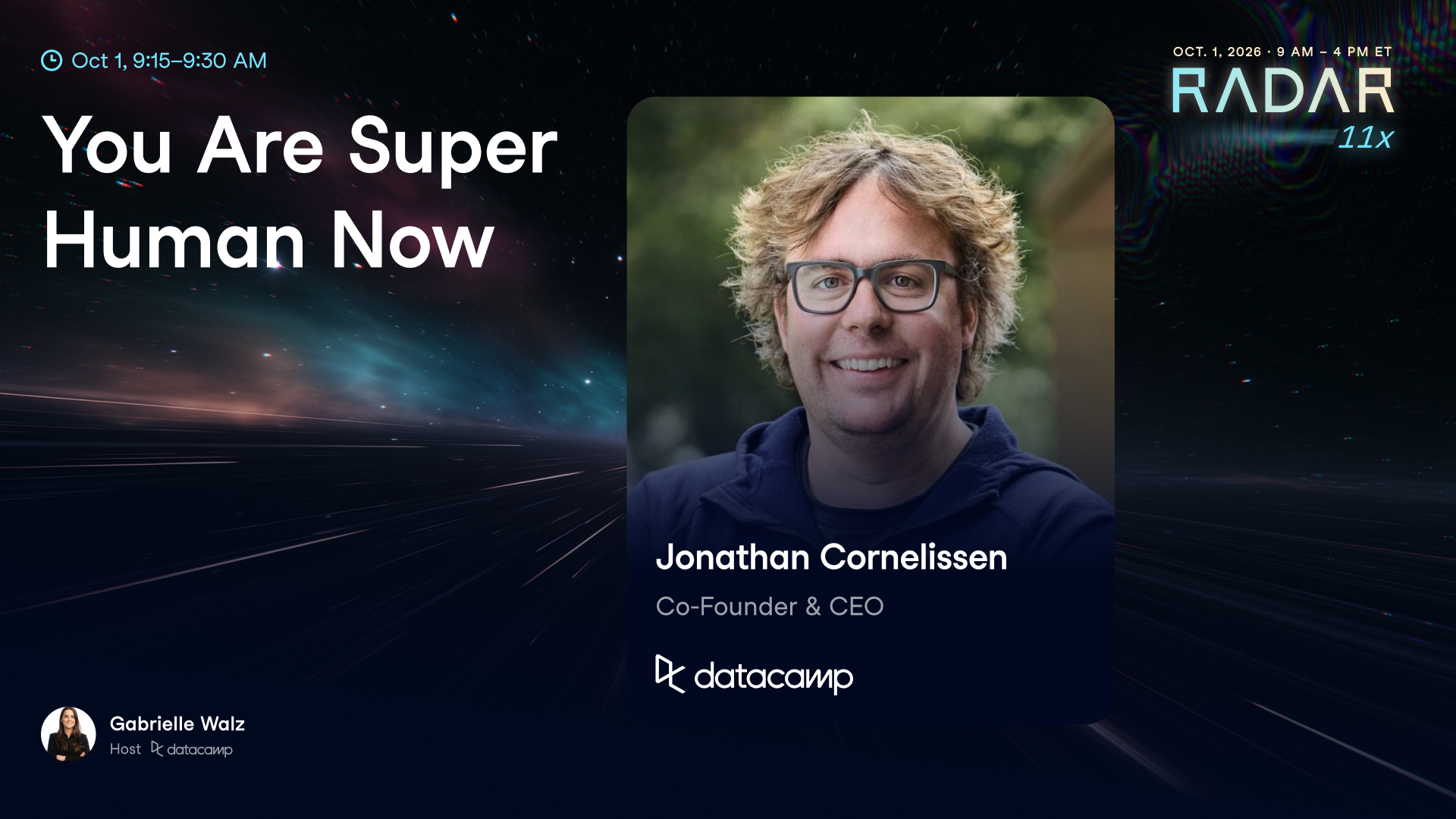
[RADAR 11x] You Are Super Human Now

October 2026
Webinar Preview

Sunucunuz(larınız)

Jonathan Cornelissen Portre

Jonathan Cornelissen

Co-founder and CEO of DataCamp

 logosu

As the Co-founder & CEO of DataCamp, he helped grow DataCamp to upskill over 10M+ learners and 2800+ teams and enterprise clients. He is interested in everything related to data science, education, and entrepreneurship. He holds a Ph.D. in financial econometrics and was the original author of an R package for quantitative finance.

Summary

AI already works. The problem is who gets to use it.

Jonathan Cornelissen, co-founder and CEO of DataCamp, opened RADAR 11x with a ten-minute keynote on the gap splitting today's workforces: some employees already treat AI as a second brain, and others are still stuck doing things the old way. He pointed to a DataCamp survey in which 31% of leaders said their teams struggle to apply AI skills once training ends, and argued that the standard fix, a 12-to-18-month corporate learning rollout, moves too slowly for tools that change by the month. His answer is DataCamp's AI tutor, which teaches inside real tools rather than through generic video courses, adjusting its pace to what each learner already knows. He also introduced two ways for organizations to track where that learning is landing: AI Adoption Insights, live now, which shows anonymized patterns in how employees are using AI without naming names, and an expanded Skill Matrix for mapping team-level skill gaps, due to reach enterprise plans in the coming months. The session set up the rest of RADAR 11x: eight speakers from companies including Google, AWS, Microsoft, Honeywell, and UPS on what it actually takes to get a workforce, not just a few standout employees, operating at 11x.

Key Takeaways

  • AI productivity gains are real, but they're landing unevenly inside the same companies, splitting employees into those pulling ahead and those falling behind.
  • In a DataCamp survey, 31% of leaders said their teams struggle to apply AI skills back on the job, a sign that most corporate AI training doesn't transfer to real work.
  • Standard corporate learning rollouts take 12 to 18 months, a timeline that can't keep pace with how fast AI tools change.
  • Closing the AI skills gap takes two different efforts at once: teaching the skills, and managing the change in how people actually work.
  • DataCamp's AI tutor adjusts to each learner's role and organization, and to what they already know, instead of running everyone through the same material.
  • AI Adoption Insights, live now in DataCamp's Group Hub, gives organizations an anonymized view of where employees are finding value with AI and where they're getting stuck.
  • An expanded Skill Matrix, coming to enterprise plans in the next few months, will track team-level skill gaps as AI tools keep changing.

Deep Dives

The Gap Nobody Budgeted For

Cornelissen framed the moment in blunt terms: AI can make an employee genuinely more capable, but that capability isn't spreading evenly. "Those superpowers are currently unevenly distributed," he said, "with some employees becoming superhuman, while others are still struggling." Most companies have already rolled out AI tools to everyone. The split comes from who has learned to use them well.

That unevenness creates specific failure modes, not just vague underperformance. Cornelissen described teams that keep their old workflows and simply tack AI onto the end of them, producing more output at lower quality, a pattern he called a real business risk rather than a harmless inefficiency. He also pointed to employees who lack the judgment to know when AI belongs in a task and when it doesn't, a gap that shows up as either overuse or avoidance. Underneath both patterns sits a simpler problem: a lot of people are still working the old way because nobody has shown them a better one, and a smaller group is skeptical or fearful of the change entirely.

Cornelissen treats the gap as two problems that have to be solved together. "The key to avoiding these pitfalls and failure modes is to view this both as a skills problem as well as a change management problem," he said. Teaching someone to prompt a model well doesn't help if their role, their workflow, and their manager's expectations haven't changed to make room for it. He argued this applies at every level of an organization, from the C-suite down to individual knowledge workers, each of whom needs to rethink what's actually possible in their role once they have the skills to use AI well. For individuals, he framed the moment as a career opportunity: the people who close this gap first get ahead. For businesses, he was more direct about the stakes, calling it critical to get the entire workforce, not just early adopters, onto this path.

Why Corporate Training Keeps Missing

Cornelissen's case against standard corporate learning rested on two numbers. The first came from a DataCamp survey of leaders, where 31% said their teams struggle to apply the skills they gain back in real work. The second was structural: typical corporate training rollouts take "twelve to eighteen months, and AI is just changing way too fast for that to make sense," he said. By the time a program finishes rolling out, the tools it trained people on have already moved on.

He traced both numbers to the same root cause: most corporate training is generic and passive, built to be watched rather than done, which makes it forgettable. DataCamp's alternative is built around one-on-one tutoring, historically the most effective way to learn but too expensive to scale to a full workforce. Its AI tutor is meant to close that cost gap without losing what makes a real tutor work. "The AI tutor will understand your role, will understand your organization, what you're trying to get done, and the tutor is an expert in everything it teaches you," Cornelissen said. He described it pacing itself to the learner: "It will slow down where you need it to, and it will speed up to avoid that you waste any time."

In practice, that means learners work inside the tools they're trying to master rather than watching someone else use them. Cornelissen pointed to courses where learners solve real problems with Claude in a virtual machine running in the browser, guided step by step by the AI tutor, so they hit the same friction a real task would create and work through it with support. DataCamp has also kept adding courses as the skills gap shifts: an AI safety and ethics course aimed at building judgment, and a token cost management course built for a narrower, practical problem. "Token cost management is a new course we launched," he said. "It helps you understand how not to blow through your entire AI budget."

Measuring Adoption, Not Just Training It

The second half of Cornelissen's keynote shifted from how DataCamp teaches AI skills to how organizations can see whether that teaching is working. The first tool is AI Adoption Insights, which DataCamp built directly from how people use its AI tutor. "As people work with their AI tutor, we get a really good sense of where they're finding value with AI, what they're struggling with, what tools they are already adopting," he said. DataCamp shares that pattern back with organizations in anonymized form, and lets them benchmark their own adoption against DataCamp's broader customer base. The feature is already live in DataCamp's Group Hub.

The second tool, an expanded Skill Matrix, is still ahead. Cornelissen framed it as a response to how fast the underlying skills keep shifting: "Understanding the skills of the team, their skill progression, is going to be more important than ever because things are changing so fast." The expanded version is meant to let organizations track skill gaps at the team level with more precision, so leaders can see where to focus before a gap turns into a failure mode. He was clear about timing. "This is, by the way, rolling out in our enterprise plans in the next few months," he said. "It's not yet live."

Taken together, the two features point at a gap in how most companies currently manage AI adoption: they can see whether people completed training, but not whether they're actually any good at using AI day to day. Cornelissen positioned both tools as the missing feedback loop, one that tells a company where its workforce actually stands rather than where a training log says it should be.


İlgili

webinar

Radar AI Edition 2024: Welcome to Radar!

DataCamp CEO and co-founder Jonathan Cornelissen welcomes you to Radar, highlighting the state of data & AI literacy today, customer success stories, and what the future holds for data & AI

webinar

Radar AI Edition 2024: Closing Session & AMA

Join DataCamp CEO and COO Jonathan Cornelissen & Martijn Theuwissen for closing words to cap off the day. Followed by an "ask me anything" with both of them.

webinar

RADAR: The Analytics Edition - Closing Session & AMA

DataCamp CEO and COO Jonathan Cornelissen & Martijn Theuwissen share closing words to cap off the day. Including an "ask me anything" with both of them.

webinar

RADAR: The Analytics Edition - Opening Session: A Tipping Point in Data Democratization

In this session, Jonathan Cornelissen, CEO at DataCamp, will unpack how we are at a tipping point in data democratization, and how individuals and organizations can succeed with analytics in an AI-driven world.

webinar

[RADAR AI x Human] Building AI-Ready Teams: Skills, Mindset, and Structures

Act like a boss (of an AI-ready team).

webinar

Closing Remarks: Thriving in the AI Era & AMA

DataCamp CEO Jonathan Cornelissen shows you how to chart a path to AI success and thrive. Followed by an "ask me anything" with Jonathan and DataCamp COO Martijn Theuwissen.