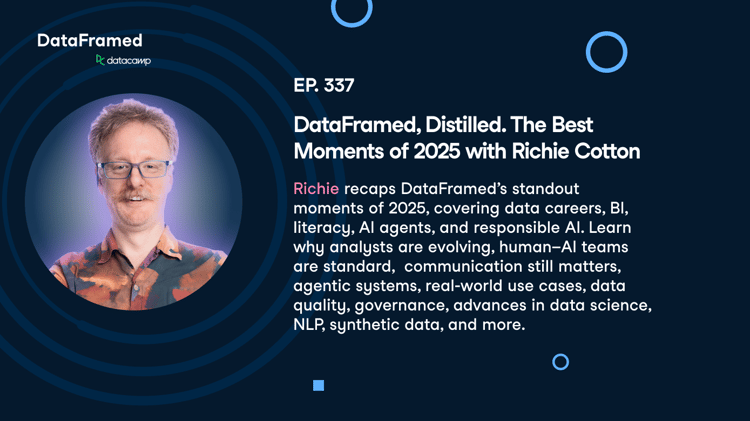
Richie helps individuals and organizations get better at using data and AI. He's been a data scientist since before it was called data science, and has written two books and created many DataCamp courses on the subject. He is a host of the DataFramed podcast, and runs DataCamp's webinar program.
Chat with AI Richie about every episode of DataFramed - all data champs welcome!
Key Quotes
There was this big prediction that because of ATMs, bank tellers would disappear. Because bank tellers, pre-ATMs, would distribute cash and take in deposits. And now you have a machine that can do that perfectly. And the actual number of bank tellers has increased since then, which has been this big mystery. The right story is that what bank tellers were then is not what bank tellers are today. Now they are customer relationship experts. They can tell you about new credit cards. They can deal with complex stuff. So the occupation has completely transformed.
Ben Zweig, CEO at Revelio Labs
Let's say you build an agentic system and you throw it against your enterprise data warehouse. You have two problems. One is somebody can name a table like Bob underscore table, and nobody knows what Bob underscore table is. So you need to have a meaning to it. In the traditional data world and the ML world, if your data quality is low, the downside is that one or a bunch of reports may show some erroneous stats, and you can go back and update it. In the agentic world, if your data quality is low, what you get is hallucinations.
Satesh Sonti, Principal Specialist Solutions Architect at AWS
If you go many, many years back, we went from assembly to Java to Python, and probably many programming languages in between. What basically happened is that the abstraction layer moved up and up and up, away from the machine. AI is just the next abstraction layer. For everyone, at those different stages, if they understood the underlying concepts, they actually did better moving from one abstraction layer to the other, compared to those who only knew how to write in the particular syntax of that programming language.
Martijn Theuwissen, COO and co-founder at DataCamp
Key Takeaways
Build durable skills (judgment, abstract thinking, communication, and coordination) alongside hands-on comfort with agentic tools. Learning takes effort, so keep enough domain expertise to check what AI produces.
Fix the foundations before you scale agents: clean data, clear metadata, and a portable semantic layer, because poor data quality shows up as hallucinations. Then map the process, use plain workflows where they are enough, and keep a human at the decisions that matter.
Expect analyst and developer roles to shift toward judgment. Less time goes on dashboards and hand-written code, and more on asking the right question, directing AI, and checking results, so learn the underlying concepts and consider a move toward data or AI engineering.
Transcript
Jonathan Cornelissen: AI can truly give you superpowers. That promise is now a reality. But those superpowers are currently unevenly distributed, with some employees becoming superhuman while others are still struggling. So the theme of today's Radar Conference is about how you make everyone a superhuman.
Nicole Immorlica: Wake up every day and remember, AI is an it, it's a thing.
It's not a human, and it's not us, and AI is not gonna change the world. We're gonna change the world.
Richie Cotton: Welcome to Data Framed. This is Richie. Radar is DataCamp's virtual conference series, and this episode of Data Framed presents the highlights from the latest event, Radar 11X. Every AI influencer talks about increasing your productivity with AI by tenfold, so we decided to take a leaf out of the This Is Spinal Tap movie and turn things up to 11.
We have panels discussing where humans fit into the new world of work, how to escape AI pilot purgatory, the secrets of upskilling your whole organization on AI, the new developer workflow, and responsible AI security and governance. Happy listening and happy learning
First, jobs. You've already heard from Nicole Immelka. This was the opening panel, and I started by asking everyone to post an emoji if they were worried about their job. There were lots of emojis posted. I was joined by four people who think about work for a living. Ben Zweig, the CEO at Revelio Labs, Nicole Immelka, who is a professor at Yale and also a senior resea... See more
Matt Jones: And I can tell you that all still have, um, skills shortages, all still looking for great talent in their organizations. I think what we're actually experiencing today is just more things are true at the same time. All the same challenges of getting great talent into your organization that we've always had, scarcity, people in the wrong locations or wrong p- wrong places, re-skilling, upskilling, and now we have this kind of transformatory force as well around thinking about, um, um, new ways of working.
My, my reason to be cheerful, it's not what you asked me to say, but anyway, reason to be cheerful in this space is that when we think about what's happening, um, in the world of work and some of, some roles being impacted by AI, it allows humans to retreat up the value chain. Now, that sounds like a negative, but actually, that's a real positive, right?
So moving away from the work that, um, was lower value and taking on higher value work, supervising agents and AI to, to do some of that lower value work. So that's my reason to be cheerful today.
Ben Zweig: There's this wonderful book came out, um, called We Are Not Machines by Sarah O'Connor about, you know, cataloging jobs where AI has made the job worse And in that book, she highlights a lot of the, um, a lot of the automation in the kind of blue-collar work and robotics.
So, you know, in that sense, people are acting as sort of the glue between different, different types of automation, and that's not that interesting. But in, in white-collar work, what we are seeing is that people are doing more coordination, more orchestration, and less execution on sort of menial, menial tasks.
As economists and thinkers, you know, we sometimes think about jobs as bundles of tasks, and, you know, if you think about it that way, and some tasks get automated, then you can say, all right, well, some of those get automated, and you fill in with the rest. And maybe those are the better tasks, maybe the worst tasks, you know, we're not really sure, so it could go in either direction.
But I think there, there's, there's a slight nuance to that where, you know, in addition to thinking of jobs as bundles of tasks, you, you know, as a worker, you are executing on tasks, but you're also orchestrating between tasks. You're also saying, "What comes first? What comes second? What depends on what? Who do I work with?"
And that orchestration part, you know, as the execution of tasks have become cheaper, that orchestration becomes much more important. So we are playing the role of orchestrators and coordinators and kind of managing the chaos, so we're seeing increasing returns to skills and leadership and management and just kind of running systems, dealing with systems thinking and complexity.
Nicole Immorlica: I actually have a very personal happy story, which is that my formal training is in theoretical computer science, which is basically math. And I guess you all have heard how, uh, AI solved the Navier-Stokes conjecture, which was one of the famous Clay Institute problems worth a million dollars to solve.
Just after grad school, I wrote a paper with a conjecture called the Matroid secretary conjecture with some co-authors, which, uh, it's not really important what it is, but it, it suggested that there should be an algorithm that gets a good s-- uh, constant factor of the optimal solution for this Matroid secretary problem, and in fact, an E factor where E is two point three, so on.
Twenty years, people were hammering away at this. The original paper just proved a, you know, super constant solution. People hammered and hammered away. They proved it for certain specific Matroid structures, and they managed to, uh, show like better, but super constant bounds. And then, like in the last month, a researcher I really respect who does fantastic work, uh, Sahil Singla at, at Georgia Tech, managed to solve this problem together with AI and get a constant of four.
And this still wasn't E, uh, but y- to then s-- uh, several other people followed up with and together with AI, improved it down to E. And I think this is a super successful story where these fantastic researchers were powered by AI to use their own skills still, but together with AI solve this problem, and the solution is beautiful and comprehensible, and it really advanced the state of the art, the...
what we know and what we understand about that particular problem, which has applications in, in market design and, and other such settings. So I was really excited about that.
Ben Zweig: Being good at coordinating, you know, across different workers, whether those workers are, you know, AI, you know, agents executing things or, or human beings executing on things, just doing that coordination.
Another thing I'll say on the technical side I think a couple years ago when we said AI, we really meant chatbots. And now when we say AI, we really mean agentic systems. And you know, I think the sentiment around chatbots is that anyone's grandma can use a chatbot. It, it, you don't have to be technically native.
But right now, for, for managing, you know, agentic systems, it actually is kind of technically complicated. Like, it's a little intimidating. You have to kind of know how to use the terminal. You know, there, there's, there's things that are just, like, a little scary about just, like, using, uh, you know, Cloud Code or Codex or OpenCloud or whatever it is.
Um, so just those hard skills are increasingly important. Being able to get ahead of those on the technical side, I, I think, I think that that is, that is a must-do in my opinion.
Richie Cotton: Two very different skills there, running meetings and being able to use the terminal. Those are the two. You know? Okay. Uh, if
Ben Zweig: you can do those two, you're, you're in good shape.
Margaret Beier: I wanna talk first about the use of the term soft skills, because we're changing that a little bit in my area of, uh, industrial organizational psychology, to think about durable skills. And durable skills are those skills that are actually durable across different jobs and occupations. And so they are things like running a meeting.
They're about interpersonal skills, relating to people at work, leading, educating, those kinds of things. Those are all things that actually right now, you know, you don't have agentic AI that's gonna replace that any time soon I don't think. I don't know, I'm not a engineer. Um, so I wanna get people to kind of think about that.
Soft skills I think gives them a little bit less of, you know, oh you... It's good to be technical. Well, what I think we're fi- finding out is that a lot of the technical stuff that's wrote and can be, you know, easily done by an algorithm, I think we're finding that, you know, some of these durable skills are a little bit more valuable.
Matt Jones: Yeah, I'm gonna pick three durable skills now, 'cause I too enjoy that. I think the, the enduring fact of the durable skills is kind of what's really interesting, and I wanna just talk about, like, how fast things are moving and agility in a second. But I think abstract thinking, the judgment, the ability to kind of innovate and ask questions, which I think, you know, there's two or three durable skills in there if we were to define them.
But that capability, that set of durable skills are gonna be really, really important. Because, um, if we just think back- The '23 or '24, um, how many prompt engineers were we trying to hire in the world, and how much money were they being paid by these organizations? And, and guess what? We don't need prompt engineers anymore because the technology moved on, and actually is kind of embedded in the technology itself.
So that just tells us that we need agility. Now, I'm sure those prompt engineers moved on to do, um, context engineering and other great things, right? And, uh, and so I think, um, uh, durable's the right word and, and abstract thinking judgment, uh, and those pieces are gonna be really important. By the way, I think never a better time, never, uh, never is the global enterprise more open to hearing people challenge how work is done.
You know, 10 years ago when I... 20 years ago, 30 years ago when I started my career, you know, you couldn't as a junior employee suggest, "Why don't we redesign this piece of work?" Now, that's actually something everyone wants to hear about. Like, is there a different way to do this in the agentic world? So, um, I think that's gonna be a really, really great outcome from, uh, from this, this moment in time.
Ben Zweig: Usually, you know, when, when work gets automated, that doesn't mean that jobs get automated. So, you know, we, we represented this idea of, you know, a job as a bundle of tasks. Um, and you know, we have some research that shows if you look at the, the total change in work in the economy. So if you look at all the tasks done in some time period, and you look at how that has morphed over time, how's that, how that has changed from one time period to another, and take the total composition of stuff done in the economy, of tasks done in the economy, um, that is gonna be some amount.
You know, there's gonna be some transformation over time. And the question is, how much of that happens within occupations, so the occupation's changing, and how much happens between occupations, by some occupations increasing and some decreasing? And we find that it's about 90% happens within occupations.
I- if we think about the, the bank tellers of, uh... You know, this is like the classic example that, you know, there was this big, uh, you know, prediction that because of ATMs, bank tellers would disappear. Because bank tellers pre-ATMs would, you know, distribute cash and, and take in deposits, and now you have a machine that can do that perfectly And, you know, the actual number of bank tellers has increased since then, which has been this big mystery.
And sometimes people say, "Oh, that's Jevons paradox. As the cost of this decreases, then the quantity actually increases because we can have a Chase Bank on every corner." I think that's not the right story. The right story is that what, what bank tellers were then is not what bank tellers are today. Now they are a, you know, customer relationship expert.
They can tell you about new credit cards. They can like, you know, deal with complex stuff. So the occupation has completely transformed, and it's arbitrary. You know, we happen to still call it bank tellers, but like, it could have happened that like the CEO of Chase Manhattan at the time had decided we're gonna call it, you know, customer relationship manager, and we'd be having a very different conversation right now.
But occupat-- uh, uh, my point is that occupations transform all the time. And whether, you know, whether we retain the same title or not It doesn't really matter that much, but we are, we're always adapting. And so, so I think, you know, we, we shouldn't be concerned about automation of entire occupations wholesale.
That's just not how automation works. That's not how technology, you know, um, percolates through the economy, and I don't think we should be worried.
Margaret Beier: Because what we know in psychology for sure is that learning is effortful. If you really want to learn something, it's gonna take a lot of cognitive attention, and it's effortful.
So, you know, if you're just using AI to do something, you're not actually probably learning. There's a difference between learning and performance, and I think you can use AI to generate materials, flashcards, things, tests for you to actually learn. But unless you're doing that, you're not really learning.
So I think those, those are some of the considerations that we think about, is just how people can organize their time and to engage in learning.
Richie Cotton: Very quickly, you got 30 seconds each on, like, what's one thing about AI that you wish everybody knew? Uh, Ben, do you wanna go first on this one?
Ben Zweig: I wanna maybe echo what I, what I said before, is, is that AI, just like other technologies, reconfigures work more than changes jobs wholesale.
I, I, I think that is, like, a, a thing that we should, we should remember and, and keep in mind that, you know, specifically as we think about how AI affects work, it is changing jobs rather than replacing them or even increasing the demand for certain jobs and decreasing the demand for other jobs. It is reconfiguring everything we do and all the time.
Margaret Beier: I'll just be very brief and say you still need to think. Like, it still requires you to actually think. It's a tool, but it doesn't take you out of the equation.
Matt Jones: I'm gonna try not to offend any academics here, but this, this version of AI, this version of AI, from a broad vocational application perspective, is still very new, right?
We got this in the enterprise in 2023. There are no 10 or 20-year experts on how to redesign work in an agentic world So we can all shape this. Everyone on this webinar, everyone in this panel, everyone in all organizations can shape this future still. It's not something that we have a blueprint for just yet.
So be excited and shape it, uh, and it's working for us.
Nicole Immorlica: I wish people would remember, uh, you know, wake up every day and remember AI isn't it, it's a thing. It's not, it's not a human and it's not us. And, uh, AI is not gonna change the world. We're gonna change the world.
Richie Cotton: Next, the gap between a great demo and something that works in production.
This session was hosted by Adel Nemi, who is a familiar voice to long-time Data Framed listeners. He spoke with Krishnan Hariharan, who is a CTO at Honeywell, Satishkumar Sonti, who is Principal Specialist Solutions Architect at AWS, and Laurent Gil, who is CEO at Cast AI.
Adel Nehme: I'm sure there's a pattern that many of us recognize here.
Uh, you've seen a cool AI use case at work, a team builds an AI pilot, the demo looks amazing, everyone gets excited, but then it never quite makes it into production. And a lot of companies start their journey with, uh, their AI journey with pilots, but very few of them turn them into something that delivers real business, uh, value.
Uh, so that gap between a promising demo and a real working system is what we're gonna be discussing today. So we're gonna dig into what it really takes to take an AI use case from pilot to production
Satesh Sonti: So a few weeks back, I was talking to one of the large, uh, telecom customer in US. Um, they have a very interesting use, uh, journey.
The use case is pretty common. Uh, most of you might be know, uh, aware of that, but their journey is unique to share. Um- They quickly understood that the technology is accessible to them and to their competition as well. It's the same technology. There's no difference in that. But their unique value prop is their data and their semantic information.
So that's what they started working on, and most of you might be already thinking about it. The semantic layer gives the groundedness accuracy and also controls the cost, right? So what they did is, most of their data is in data warehouse, and some of it is in transactional processing systems and some in business glossaries.
They started building markdown files to make it much, much more portable and loaded all those markdown files in a PostgreSQL. I, I got really surprised when I heard about PostgreSQL as the storage for semantic layer, which is a bit unconventional, but the reasoning given by, um, their platform architect was, was very interesting.
So they found for their ecosystem, Postgres is more portable. Mm-hmm. And all the data that they're feeding into their current semantic layer, they made it in such a way that tomorrow when AWS context comes or they go to a different technology, they can just port all these markdown files in no time So the key, uh, point I would like to share here is most of you might be building semantic layers and context layers.
Think portability. Don't lock into a specific technology which you cannot move, because this space is moving very, very fast. You'll be surprised, probably in a month or so, you may get, uh, some new thing that excites you and that may be necessary for you. So portability is the key here. Getting your data, particularly your metadata and semantics, grounded and ready is very, very important before you operate w- with agents at scale.
That- that's super, super probably priority zero. Should, should, uh, should for your... Let's say you build agentic system and you throw it against your enterprise data warehouse, you have two problems. One is somebody can name a table like Bob_table. Nobody knows what is Bob_table, right? So you need to have a meaning to it, and similarly, any attributes, they should have clear understanding on how that attribute can relate to other entities in your organization.
That makes your agent really, really powerful. So get your semantic layer up to date and accurate and have a continuous feed into it. That is one space. The second thing is data quality. In traditional data world and AI/ML world, if your data quality is low, the downside of it, probably one or a bunch of reports may show some erroneous, um, stats, and you can go back and update it.
In agentic world, if your data quality is low, what you get is hallucinations. The way you can mitigate hallucinations is to have high quality data and high quality semantic layer. Mm-hmm. Yeah. Work on these two aspects, um, that, that adds a lot of value for you in long run.
Krishnan Hariharan: Unfortunately, we've all been anchored to the chatbot, right?
We all-- Everybody thinks, "I'm gonna build a chatbot, put a RAG model, and it's gonna give me the answer." That's not the way to think about, uh, changing culture. Mm-hmm. Once you've defined your outcome, do the old fashioned off a process flow draw the process flow out and then truly decide do you need AI for this or a deterministic model is good enough, or even a, like a simple mathematical model is, is good enough.
Because sometimes we just go over and over and just wanna use AI for the sake of using AI, right? Mm-hmm. So that's one. And the second piece is that in the process flow, clearly identify what, where the human makes a decision. That's where you need to pull in the human. Everything else can be automated, and that's what agents are for, is to automate everything.
But the decision-making cannot be given to the agent because we're not there yet. We will get there. Mm-hmm. Companies will mature over the next few months, years to get there.
Satesh Sonti: I also want to touch upon the process improvements, right? Mm-hmm. Yeah. Uh, what I see is we all understand SDLC, software development life cycle.
Uh, the new way of building these applications is AIDLC, AI, AI-driven development life cycle. Mm-hmm. Yeah. So w- how it differs from software development life cycle is that every stage of your, um, build process, right, from requirement gathering, design, testing, deployment, right? All these phases can leverage AI, but you have the human gates for at every stage.
Mm-hmm. So that gives a, a process transformation on how you can accelerate the whole pipeline and you don't need to get scared of the technology. You have your gates, guardrails in place. Mm-hmm. At the same time, you can ride on the technology. So-
Adel Nehme: Mm-hmm ...
Satesh Sonti: transition from SDLC to AIDLC is something all organizations should consider and see how they can leverage the power of AI in more controlled way.
Laurent Gil: Met a CIO of one of the largest bank in Europe, really nice guy. Mm-hmm. And he told me, "At my bank, nobody use Claude. It's forbidden To use Claude because of GDPR, like sovereignty. And then the next day, I met the developer teams, and I asked them, "What are you guys using for coding?" And they said, "Well, of course, we use Claude.
Why? What do you mean?" Right. So, uh, that's a bad use case. And, and when that happen, then you have to go and repair it, but the repair c- have to come from the developer saying, "Hey, I need it. Sorry." Mm. It's our job. Uh, that's what I told the CIO. It's our job as executive, her job, to make sure that her developer are using the tools that they need to, uh, to their job.
It's not the job of the executive to prevent- Yeah ... 'cause then they swim against the current, and the other bank will do it instead of you. Okay, which model do you use? Well, often those projects stop because you run out of money, meaning- Mm ... you run out of budget for tokens, and it's a horrible thing. Like, think about this.
You are a developer. Like, it's the same as I'm telling you, "Hey, you have a laptop The battery only lasts one hour, and you can only charge once a day. So what do you do when you're a developer and you run out of token? You do this, and you stop working. Uh, this is why the project failed. Um, cost optimization for, uh, agents is essential.
Yeah. It's as essential or existential as using them. I'll give you the following. It's the statistics across hundreds of clients using c- coding, right? It's all the coding exercise. So we started to release those, uh, routers in May, first internally, and then to our clients. As of September 8, so about- Mm-hmm
two weeks ago, three weeks ago. Mm. 94% of... So, and, and this, uh, sorry, this router is completely autonomous, so you don't say where it goes. Mm-hmm. It decide on its own- Oh, wow ... which model to use and what is the inference. Uh, out of, uh, by, by September 8, 94% of the tokens were consumed by an open source or an open, uh, or an open weight model.
Only 4% went to Anthropic, and less than 1% went to OpenAI. When you, uh, have a normal accuracy, normal means n- in the 90 percentage, then the, the solution is always multi, uh, open source, open weight. Always, or, like, 94% is, means it's always. Mm-hmm. So, so that's... A- and when you do it, sorry, I w- I wanted to finish.
When you do it this way, your cost is around the, uh, the number today is 3.4 times lower-
Martijn Theuwissen: Interesting ...
Laurent Gil: than commercial model, meaning the cost of 94% open source of, uh, open weight is 3.4 times lower than the 4% remaining, uh, which goes to, uh, Anthropic. That's mind-blowing.
Adel Nehme: I wanna make sure that we have at least time for at least one audience, uh, question.
We'll see if we'll be able to add more. Uh, this one we haven't actually talked about it. So this is from Elon. He mentioned, like, "When do we know if our AI pilot is ready for production? What are the specific metrics, criteria such as having, uh, to make sure that a AI use case is ready for production?" So essentially kind of me- meta question here, how do you determine the ROI of an AI use case?
Krishna, uh, you, you mentioned this a bit, so I'll, I'll ask this question to you.
Krishnan Hariharan: Yeah. Um, if, if you're deciding the value of a agent at the time of production, you're already too late. I say go and deploy it, test in a test environment, take it to a customer, figure out the ROI, and then decide if it makes sense to go to production, not once you're getting ready to go to production.
Adel Nehme: So what's one, one final piece of advice that you have for making sure that your AI efforts are successful? Uh, Sivesh, I'll start with you. I'll,
Satesh Sonti: I'll keep it very, very short. Scale comes from, uh, reuse, not building many, many models, many, many, uh, offerings. Think with a reusability that gives you the scale, either building data products or building reusable prompt templates or reusable markdown files.
So always think scale is proportion to the reusability you built into your process, products, and all of that. So
Martijn Theuwissen: I, I would
Satesh Sonti: say consider that when you're building something. So scale comes from reusability. Krishnan? Yes.
Krishnan Hariharan: Scale comes from trying out 10 different things, because then you decide which one makes sense to implement.
Don't take one use case and just implement one agent. Do it three different ways, and then you know which one works best.
Adel Nehme: Okay. Amazing. And Laurent, your end?
Laurent Gil: It's all you can eat, and there is no speed limit. Go ahead.
Adel Nehme: Okay. So go fast, and, uh, go as fast as possible. Swim with the co- swim with the current, uh, as, as, uh, Laurent said.
And,
Laurent Gil: and it's all you can eat.
Adel Nehme: All you can eat. Uh- Go
Laurent Gil: ahead.
Adel Nehme: Use it as
Laurent Gil: much
Adel Nehme: as you want
Richie Cotton: So now to software engineering, which has already been heavily impacted by AI and forms a good bellwether for what's coming for the rest of us. My colleague Dan Denney, who is a senior software developer at DataCamp, talked to Joao Mora, who is CEO of CrewAI, and Ali Arsanjani, who is the senior director of applied AI engineering at Google.
Ali Arsanjani: They're kind of like where Tesla used to be in the early day- days where the full self-driving or supervised full self-driving wasn't quite there. This is, like, several years ago. Now it's, now it's good. You know, it's, it's better than the rest, uh, and I trust it to a large degree, but I keep my vigilance and my foot on the pedals.
And so from that perspective, if you look at the, you know, code development environments, you need a lot of harnessing. You need a lot of skills that have been vetted. So the perception that people have is that we'll just vibe code, and we'll just basically have something delivered. And what I find in a, in many cases, both in academia and in industry, is that then people have a hard time explaining what the heck was generated.
Joao Moura: It's funny because I, I love the analogy that Ali used for the Tesla, kind of like autopilots. I think that it's a such a smart one. I use a different one talking about how between the first car and the first proper seatbelt, there was 73 years between the two, and we are like, that's where we are in AI, right?
We don't have seatbelts just yet. We're, we got the car, and it kinda drives. We would, we'll figure out everything else along the way. In terms of stack, it's interesting because I think everyone wants to claim, like, they are the stack, right? Oh, we have everything included. It's one single platform. We do everything.
You don't need to worry. Just send the model. And I think there is kinda like a narrative coming from, like, the labs that is saying, like, AGI is gonna take care of you. You're not gonna have to create all these individual agents. Like, one big model is gonna figure out everything for you. But if you really look at, like, w- when I, when I go into someone that actually have a use case in production, like, running at scale, delivering results, and you say, like, "All right.
Let's look under the hood What is going on in there? It's so much more complex than kinda like what people are led to believe. Yeah, people talk about that, right? Like, oh, AI's gonna like, uh, we're not gonna need to work as much. I don't know about everyone out there, but like I, I'm working more than ever.
Like, and it's, it's insane. So it feels like the more AI you get, I, I think like people forget there's not a fixed amount of work that everyone agree with. You just get more work. If you're good with your work sooner, then there's more waiting for you, and I think the competitiveness of the market just push you to do more.
I mean, we definitely have more agents than you now in the company. Right. If you're thinking about the company as a whole, I wanna say like, uh, our company is like, what? 70-ish people now, uh, give it or take. Uh, we definitely are in the hundreds of agents by now, just like on a few are very specific on the use case, a few we promoted to our repository and we reuse them for many use cases.
So the ratio there is like, is definitely different. I gotta say, it's one fun story about this, and I don't wanna take too long, but one fun story about this. When we start the company, we're always like, uh, leaning into like selling to enterprises. So when start the company, I remember having this meeting with a huge, like it's a, a basically like a Global 100 company, right?
So it's an amazing company, and I went to meet with their C- CFO, and there was a bunch of executives in the room, and I showed them the platform and they loved it. And then their CFO asked me, uh, "How many people you have on the team?" And back then it was very early, like we had 12, and I was like, "Well, we have 12 people."
And I could see him rolling his eyes like He loved everything up to that point, and the second I said 12, he was like, "Ah, all right. Uh, this is not gonna go anywhere. Like, you're not gonna be able to use this," and all of that. And, and yeah, we didn't close the customer. But then, like, a few months later, like, I end up meeting another CEO from another company, and they asked me the same question, but this time I flip it around.
I was like, uh, we had, like, 20-something. I was like, "Oh, we have 20-something and 300 agents, and I wish we had less people." And the CEO freaked out. He was like, "That's it. That's what I want. I want that for us," and all that. I was like, it's so interesting how, like, uh, yeah- Yeah ... the industry changes.
Ali Arsanjani: The perception that we wanna get rid of people is, is, is a crazy misplaced perception, in my humble opinion.
You wa- you wanna, you wanna upscale, upscale, upskill people so that people are more productive in the use of their creative minds and energies of rather than just saying, "Oh, I wanna get rid of FTEs." That, I think, is a losing value proposition because at the end of the day, your people are actually your most valuable assets.
Do you need, uh, x number of people to get a traditional scope done? Uh, yes, you, you will have a percentage of X today that is going to be capable of performing tasks, uh, for running a specific type of business. Yes, you'll absolutely need less people. But the question is, to initiate market dominance, to essentially catapult your competitors, to basically make sure that you're growing and not just feeding into the hype of that moment, you need additional people, which might be the same number of people you originally started with and more, but using additional tools so that you can grow faster and see around corners.
So I think it's very, uh, misplaced, the fact that we just wanna, you know, look at the bottom line and cut costs.
Joao Moura: 1,000%. And I mean, you think, I think all these, all these people know, like, you don't win in business by playing defense, right? That's the thing. Like, if you're... And I, I, I have never been in a board meeting of our own company where people, all they wanna talk about is like, "Oh, how we're cutting costs with AI agents."
No. Like, that's, like, for granted. They wanna talk about how we're gonna win with AI, how we're gonna do more with these things. I agree. Like, I, I think, like, this is more of an opportunity. The same way that individually we are working more because we have AI, I think that also rings true for our companies.
You gotta kinda, like, go on offense.
Dan Denney: So there's this classic example of, like, the, the two pizza team, right? Like, you wanna make teams in the realm of, like, being able to order two pizzas to feed everybody. If we're talking right now and we're saying that teams are gonna get smaller, maybe we'll have more teams or, or more, same number of people, but teams might be smaller Expenses are gonna be different.
So you might have expensed two pizzas for everybody to eat before. What are we expensing now? And this one I think might be good to hear from both of you, like back and forth if we, if we could
Ali Arsanjani: Um, I, I guess, I guess the, the notion of the two pizza team and all came about with, uh, us trying to do, you know, rapid software development, standups, that mindset, which in a way is currently still valid, but at the same time, we need to consider that it's me and my agents. It-- They don't have pizza, they have pizza tokens.
So it's sort of like a two pizza team, and then there's a bunch of little minions who are gonna have pizza tokens. They need to be considered as part of the q- uh, uh, as part of the, the team as well, in my opinion, because they're consuming tokens, they're, uh, essentially expending resources, money, et cetera, and time, uh, and effort is expended there.
So I think the perception should be the combination of a person plus their personal, if you will, agents, plus the q- the group agent, because there will be a group agent. We have the notion of personal agents for long-running tasks, and the notion of your group or coworker agents, if you will, in your division that handles everyone, supports everyone, and that is a different kind of an agent that is personalized to a group rather than an in- individual.
So I think there are those elements of the paradigm that are going to shift. And I can talk a lot more about this, but I'll pause there.
Joao Moura: If you don't have any controls on this, you're in for the new shadow IT, right? And I think it's way actually more dangerous because shadow IT is something that you would only have in like in lead to large organizations because like, uh, the people would need to...
There is a volume in there, right? But now it's so easy to spin out artifacts, UIs, something that you deploy once, and, and like it's so easy to spin those, even presentations, right? That I can see the volume of these just increasing in a company your size. Like every minute I go, everyone has a presentation and 20 slides on it.
And like, it's very clear like AI built it, I have zero problems with that. But if you, if you're not watching out, you start to have like, becomes this very, uh, uh, what I would call like the, the, like disposable assets, right? And then you're, you're trying to find the presentation, and you have hundreds of them.
And like, "What is the presentation that I want?" Or trying to find an app, and like, "Where is the app that I want?" Or you're trying to find like a certain thing. So I, I think like if we don't start to have kind of like this idea of certain things needs to become canonical in a company, and that is all the way from the skills for the agents, for all those different things.
If there's no canonical set, it, it becomes very challenging to scale.
Richie Cotton: To close the day, DataCamp CEO Jonathan Cornelissen and COO Maarten Thoissen joined me to answer the top voted question from the audience. First up, the one I keep hearing, if AI makes us more productive, do companies just need fewer people?
Jonathan Cornelissen: Yeah, yeah. I think this is something a lot of people are, are kind of concerned about. Um, there's a lot of fear being created in the media. But like I think the important thing to realize is it is absolutely true to do the amount of work that we used to do, you'll need fewer people. However, that doesn't mean there's gonna be fewer jobs, 'cause we as humans are wired to always want more.
You will see more jobs for software engineers, 'cause the return on investment for, for a software engineer goes up. This is commonly referred to as Jevons Paradox. So when, when a new technology creates a higher efficiency, people tend to intuitively assume, "Oh, we're gonna need less of this."
Counterintuitively, it often means you're gonna end up with more of whatever gets more efficient. And in this case, it's the humans. Humans get more efficient by u- using AI. Now, all of this is predicated on you have to take this shift seriously, and you have to kind of think about what are the essential AI skills for my role, for my industry, um, and, and make sure you build AI fluency or you kind of learn how to build AI systems.
Uh, but if you do, the demand is kind of off the charts today. The cynical view is so- some of these layoffs were blamed on AI, where they were purely economical, uh, decisions. But it, it makes kind of the company look good to say, "Hey, we're doing this layoff because we're so good at AI." And in some cases, that was true.
I think in most cases that was just a, a convenient excuse. If you j- look at the job market, though, and, and we just put out a, a careers report, um There is actually a trend where the jobs that require AI skills are kind of growing very, very rapidly. Um, and we talked about some of those already here. Um, but data scientists, AI engineer, all of these jobs are actually, the job openings have increased quite a bit.
The opposite of what people expected to happen is actually happening, with one exception, um, and I saw some questions on this, uh, in earlier sessions. Uh, for junior roles it is tougher. Um, and so, so that's the one exception. But for anyone who has some years of experience, uh, the job market is actually heating up.
Um, and that's also what, what we're seeing with, with DataCamp. We're hiring for, uh, many technical roles and, and it's actually, uh, quite challenging to find really good AI engineers, for example, today.
Martijn Theuwissen: I actually don't know if anyone who has been fired who was high on the AI skill level, whether technical or non-technical in background.
Like, the people who are at the forefront of, like, understanding how to use AI in their role, I can't think of a single case of somebody that I know that has been terminated in their role, even when there were layers at their company. And I think that is because actually, like, they were the ones with the skill sets and people and companies realize, like, how valuable that is today, and that's the type of employees they wanna have in their organization because they know that's the future of, of the workforce.
I saw some questions coming in around like, okay, like will there be no more data analysts? Like if I'm a data analyst today, uh, today, like, okay, what do I do in terms of upskilling? Uh, so like first of all, I, I think companies will still need data analysts. Uh, but I do think like the expectations they'll have around the skillset is changing.
Uh, like as in many fields, like AI is being layered, uh, into the, into the data roles. So it's like not replacing them, but like you do have that like additional layer now. So if you plan to start a role as a data analyst today, like it, your expectation should be like, it's gonna be less time creating dashboards.
It's gonna be less time, like handwriting, uh, analysis code, and it's gonna be just more time thinking about like what's the right question to ask, like directing the AI tools you have available for yourself, like to produce the analysis, um, making sure you check the output and then getting or sharing the insights like, uh, from the, the, uh, uh, that lead to the decision.
So like judgment in the role will be more important. If I look at, at, uh, our own survey data, we actually see that those roles, like the role of the data engineer, the role of the, uh, AI engineer, like are definitely on the rise. Like there's a huge demand for people in that, uh, in that role. So data analysts, like just if you wanted to go into that career trajectory, like make sure you have that AI layer.
If you are in that career, like think about the upskilling, uh, and think about, uh, a data engineering or an AI engineering path.
Jonathan Cornelissen: Any new technology Can be used for good and can be used for bad, and that's true at a societal level, but it's true at an individual level as well. If you think about learning, for example, you can use AI to be lazy and to not understand things.
Or you can use AI to accelerate your learning. You can come to DataCamp, you can use our AI tutor, which is optimized for, for learning. Um, and so, so it's the same thing as with, uh, any kind of technological revolution. You can use it for good or bad. One thing I would stress in the context of, uh, kind of people who attend this and, and who are looking for, uh, a job change or anything like that, is to be aware of the change in expectations as well.
Like, if you're doing a case study for an interview or anything like that, and you can, you can prepare, you might think, "Hey, I can prepare the answers to this case study way faster." But just be, be aware that, like, the expectations of the quality of what you deliver also change because everybody knows you can use AI, and you should use AI.
Um, and I've, I've seen this kind of... I've experienced this firsthand doing lots of interviews for DataCamp, uh, we're hiring by the way, where, like, people do a good job delivering the case study, and three years ago it would've been good, but now that you can use AI, the bar has shifted. And so we expect people to do more and to have deeper insights.
Um, and so that's, that's kind of one, one thing I would, uh, stress, like expectations change as well. I would actually bet my career, and to some extent DataCamp is betting its future on AI skills being the thing to bet on, right? And what that means depends on kind of where you are on the, the, the spectrum in terms of technical skills.
But if you're in some kind of technical role, a data analyst, a data scientist, uh, a, a software engineering role, um, I would say, hey, try to get as many kind of AI engineering skills as possible. It's gonna make your value to the organization you're with or the organization you might join so much higher.
So for anyone with a technical background, really look at those AI engineering skills. Anyone who, who's not in a technical role and doesn't have ambitions to be in a technical role, I would also say bet on AI skills. Like, become an expert in Cloud CoWork because you can do whatever it is, like marketing, finance, you can do it so much more efficient if you're, if you're truly an expert in, in some of the new tools like Cloud CoWork, Cloud Codes, Codex.
Uh, it makes a huge difference Uh, so that's, that's the first thing I would say is like I would bet on AI skills as the, uh, kind of, uh, big career bet. I- if, if, if you're not willing to do that or you're not interested, I think a- all the human skills, human to human skills, uh, are, are at the top of the list in my mind.
So communication skills are essential, whatever the role is you're in. Um, and then, and then sales skills within communication skills are arguably the most important sales skills, uh, to get. So that, that, that would be the answer to, I think, what the actual question was. I
Martijn Theuwissen: think the answer in short is like concepts.
Uh, and, and I think that's, that that's always been true. Uh, like if you go many, many years back, like we went from like Assembly to then Java to Python and there are like probably many languages, programming languages in between. And what basically happened is like, okay, the abstraction layer like moved up and up and up and away from the machine.
And I think the way, the way to think about this is like AI is just the next abstraction layer. Um, uh, and-- But I also think that like for everyone, like at those different stages, like, uh, like if they understood the underlying concepts, they actually did better moving from like one abstraction layer to the other, uh, compared to those like who, who only knew how to write in the particular syntax of that like programming language, like, 'cause they were not flexible to, to move in between.
Um, so, um, yeah, what, what changes, what changes in coding and like now, now with AI is I think it's more like where does the time go to. Like you, I think you write less code, but you're actually gonna probably spend more time on deciding what to build because you can build more. Like you're gonna probably spend a bit more time on checking the output.
There's this new thing where you all of a sudden need to steer the model towards like, okay, what is possible, what is not possible, what are the constraints? Like what can it skip? Uh, that was not there before. Uh, so that's a whole new thing to learn. But, um, uh, I think if you wanna do that well, like it's actually really understa- important that you understand like those underlying concepts, like everything that's underneath there.
Um- Uh, because, well, if you don't, you're just gonna accept what the model produces, and that's, like, at least today, probably not the best state to be in. So, um, like, to, to answer Ellen's question, like, it's the, like, the, the understanding of the concepts is, uh, very valuable and more valuable than, okay. It will stay valuable even, like, when AI takes on the coding.
Jonathan Cornelissen: If I was in a research position today, I would really look at what's happening in open source and how can I, even if it's in a small way, how can I contribute to some of these open source projects, um, and, and contribute to the open source ecosystem? My personal bet is that open source will eventually win, uh, in the AI space, similar how kind of all software is really, uh, built on top of open source, uh, e- even if it's proprietary software.
Uh, I think the likely way this plays out is that eventually all AI systems will be built on, on open source, even if the systems themselves are, are proprietary. Um, and so if you're in a research position today, I would think about in my fields what's happening within open source AI and kind of at the intersection, and how can I find a way to contribute, not just out of ideology, but, but because I think it's incredibly powerful for your career.
Uh, if you imagine at some point open source will become the dominant way people use AI, you can really have a huge contribution to kind of your space.
Richie Cotton: That's a wrap on Radar Recap. If you want the full conversations, every session is available on demand, and I'll put the links in the show notes. Next Monday, I'm talking to the CEO and head of voice AI at Greenhouse about using AI in hiring.
Until then, thanks for listening.