Поделиться этим вебинаром
Закройте пробел в навыках работы с данными и ИИ
Мы — единственная платформа, специально созданная для развития навыков работы с данными и ИИ во всей вашей организации. Давайте рассмотрим программу, адаптированную под ваши потребности.
Заказать Демонстрацию Для Бизнеса[RADAR 11x] Closing & AMA
October 2026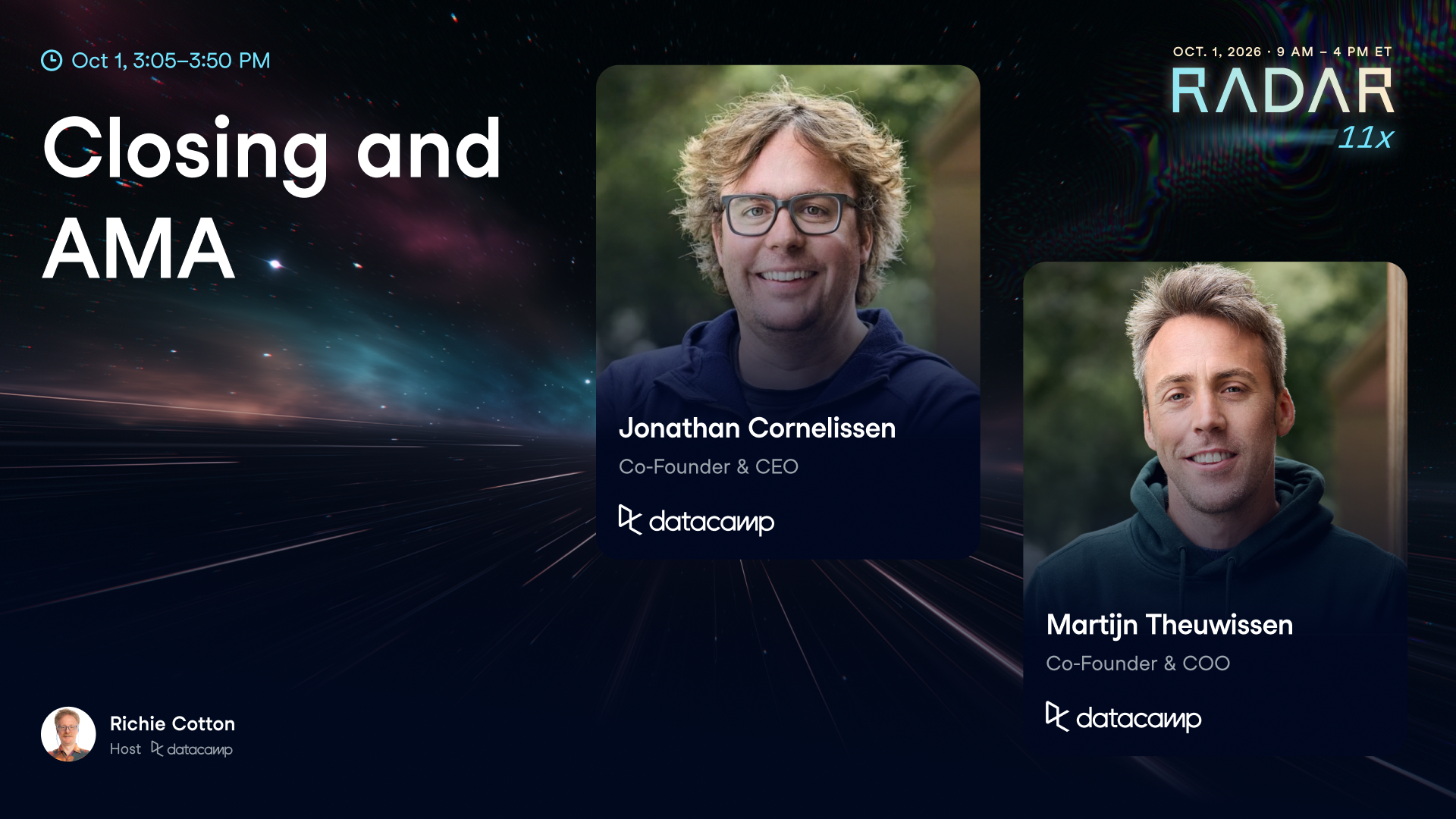
Ваши ведущие

Martijn Theuwissen
COO and Co-Founder at DataCamp

As the COO and co-founder of DataCamp, Martijn helps DataCamp’s enterprise clients with their data and digital transformation strategies, enabling them to make the most of DataCamp for Business’s offering, and helping them transform how their workforce uses data.

Jonathan Cornelissen
Co-founder and CEO of DataCamp
As the Co-founder & CEO of DataCamp, he helped grow DataCamp to upskill over 10M+ learners and 2800+ teams and enterprise clients. He is interested in everything related to data science, education, and entrepreneurship. He holds a Ph.D. in financial econometrics and was the original author of an R package for quantitative finance.
Summary
DataCamp closed RADAR 11x with an hour of unscripted questions, handed straight from the audience to the company's two co-founders.
Host Richie Cotton worked through a backlog of questions from earlier sessions before opening the floor to live submissions, and CEO Jonathan Cornelissen and COO Martijn Theuwissen answered without a shared script. The conversation covered the anxiety behind almost every AI headline of 2026: whether efficiency gains cost jobs, whether the data analyst role is disappearing, whether constant AI use dulls independent thinking, and what happens to junior hiring when one experienced engineer can now do the work of three. Cornelissen leaned on economic history and his own hiring pipeline for answers; Theuwissen leaned on client conversations inside regulated industries and DataCamp's own usage data. Both arrived at a similar instruction: stop treating AI fluency as optional, and start treating it as the baseline skill that determines who gets more responsibility, not less. They also previewed what's coming out of DataCamp itself, from a Claude-focused curriculum track to a technology effort aimed at scaling the AI Tutor far beyond its current course catalog. The session runs without polish, interruptions included, which is part of what makes it worth watching: these are the same uncertainties most people in data and AI roles are weighing privately, answered in real time by two people who have to make the same bets with their own company.
Key Takeaways
- Automation doesn't shrink the total amount of available work; it shifts where the return is highest, a dynamic Cornelissen ties to the Jevons paradox, where rising efficiency tends to increase demand for a resource rather than reduce it.
- Data analysts aren't being phased out, but the job increasingly rewards framing the right question and checking AI-generated output over writing analysis code by hand.
- Neither co-founder sees independent thinking eroding from AI use; both describe treating large language models as a sparring partner that sharpens judgment rather than replacing it.
- Understanding core programming concepts matters more, not less, now that AI can generate the code itself, because that understanding is what lets someone judge whether the output is actually right.
- DataCamp doesn't use fully automated AI systems in hiring, after internal testing turned up bias the company wasn't willing to accept.
- Recent tech layoffs are mostly about interest rates and cost-cutting rather than AI replacing workers, according to Cornelissen, though hiring for junior roles has genuinely tightened.
- DataCamp is building a dedicated Claude curriculum track alongside a separate Microsoft Copilot track, reflecting a gap between what people search for and what most organizations actually run day to day.
Deep Dives
Why Efficiency Doesn't Mean Fewer Jobs
Richie Cotton opened the AMA with a question drawn from earlier sessions: if a team can produce the same output with fewer people, don't jobs just disappear? Cornelissen answered with economics rather than reassurance. "It is absolutely true, to do the amount of work that we used to do, you'll need fewer people," he said. "However, that doesn't mean there's gonna be fewer jobs, because we as humans are wired to always want more." His argument rests on competitive pressure: if a company's rivals adopt AI and double their output, standing still isn't an option, so demand for the people who can direct that output tends to rise rather than fall. He named the pattern directly, describing a well-documented effect in economics where gains in efficiency tend to increase total demand for a resource instead of shrinking it, the opposite of the intuitive assumption that higher efficiency simply means needing less of something.
That logic extends to the headlines about mass layoffs across tech. Asked why so many companies have cut staff over the past two years, Cornelissen pointed first to interest rates: when borrowing gets expensive, tech companies cut costs, and "the cynical view is some of these layoffs were blamed on AI where they were purely economical decisions." A company that attributes a round of cuts to AI efficiency gains looks better in the press than one that admits it overhired during a cheap-money era. Theuwissen backed this up with his own observation rather than data: of people with strong AI skills, "I can't think of a single case of somebody that I know that has been terminated in their role even when there were layoffs at their company," he said, "because they were the ones with the skill sets" companies didn't want to lose.
The one place both co-founders conceded real contraction: entry-level hiring. Cornelissen was direct that junior roles have gotten harder to land, even as demand for experienced engineers, data scientists, and AI engineers climbs. DataCamp's own hiring reflects that gap: the company is actively recruiting for technical roles and, in Cornelissen's words, finding it "quite challenging to find really good AI engineers" today.
What AI Means for the Data Analyst Role
Several questions converged on one role: is the data analyst job disappearing? Theuwissen's answer separated the title from the function. "I think companies will still need data analysts," he said, "but I do think the expectations they'll have around the skill set is changing." AI is layering onto analyst work rather than replacing the person who does it, he argued, which shifts where analysts spend their time: less on building dashboards and writing analysis code by hand, more on framing the right question, directing AI tools to produce the analysis, checking the output, and communicating what it means for a decision. "Judgment in the role will be more important," he said.
Theuwissen also sketched two paths for an analyst thinking about where to go next. One leads toward data engineering: as AI makes it easier for anyone inside a company to run their own analysis, someone still has to build the infrastructure that analysis depends on, so data can be queried cleanly and safely across an organization. The other leads toward AI engineering itself, building the agents and tools other employees use. He pointed to DataCamp's own survey data as evidence that both paths are growing fast: "the role of the data engineer, the role of the AI engineer... are definitely on the rise."
Cotton, moderating, suggested the job title itself might fade even as the function persists, since tools are making basic data analysis accessible to people outside a dedicated data team. Cornelissen's response widened the lens beyond analytics specifically: what makes a product or an analysis succeed hasn't changed, he argued, since teams still need to understand the customer's actual problem before they build anything. What has changed is the speed of building, and the fact that modern AI systems behave less predictably than the deterministic software analysts used to write, which makes evaluating whether a system actually works its own skill, one he expects to matter as much as the analysis itself.
AI as a Thinking Partner, and the Skills Worth Betting a Career On
One audience question asked directly whether constant reliance on AI assistance erodes the capacity to think independently. Theuwissen pushed back on the premise using his own habits as the example. "I use AI more as a thinking partner," he said, describing it as "this intelligent sparring partner that's pretty much twenty-four seven available to me," useful for pulling data quickly, sketching mockups, and stress-testing ideas. His conclusion was that the practice raises the quality of his thinking rather than replacing it, and he noted, lightly, that Socrates made a version of the same complaint about writing itself.
Cornelissen agreed, with a caveat about intent: any new technology can be used to build a skill or to avoid building one, and the difference is the user's choice, not the technology. He pointed to DataCamp's own AI Tutor as an example built for the first use case, speeding up learning rather than substituting for it. He added a sharper warning for anyone job-hunting: interview expectations have already shifted because interviewers assume candidates use AI to prepare, which raises the bar for the depth of insight expected, not just the polish of the answer.
Asked what single human skill he'd bet his career on for the next decade, Cornelissen answered the question behind the question first. He said plainly that he is betting his own career, and to some extent DataCamp's future, on AI skills themselves: "I would actually bet my career... on AI skills being the thing to bet on," he said, extending that advice to technical and non-technical roles alike. Only after that did he name the durable human skill: communication, with sales specifically singled out as the most valuable form of it. "All the human skills, human-to-human skills, are at the top of the list in my mind," he said. "Communication skills are essential whatever role you're in."
Why Concepts Still Beat Syntax When AI Writes the Code
A developer in the audience asked a version of a question many engineers are sitting with: if AI can write the code, does understanding how it works underneath still matter? Theuwissen placed the shift in a longer history of programming abstraction, from assembly to Java to Python, where each new layer moved developers further from the machine without making the underlying concepts optional. "AI is just the next abstraction layer," he said, adding that engineers who understood the fundamentals beneath each previous shift adapted faster than those who had only memorized a particular language's syntax.
What changes with AI, in his view, is where a developer's time goes: less time typing code, more time deciding what to build, checking output, and steering a model toward the right constraints, a skill that didn't really exist before. Skipping the underlying concepts doesn't remove that work, it just removes the ability to do it well. "If you don't [understand the concepts], you're just gonna accept what the model produces," he said, "and that's... probably not the best state to be in."
Cornelissen extended the same idea to career trajectory rather than just skill-building. Software engineering used to be narrowly scoped: someone handed you requirements or an architecture, and you built your piece of it. Less time spent on the mechanical act of writing code creates room, and arguably an expectation, to spend that time on the adjacent parts of the job instead. "Learn about the adjacencies to your space," he said, pointing engineers toward data and infrastructure skills and product-minded people toward product development. For someone starting out, his advice split in two directions at once: still learn traditional fundamentals, because "you can vibe code all you want" but hit a ceiling fast without understanding what's happening underneath, and in parallel, go deep on whatever AI development tool you've chosen until you've mastered it.
Responsible AI: Hiring, Regulated Industries, and What's Next for DataCamp
A question about AI in hiring, performance reviews, and layoffs drew Cornelissen's most direct policy statement of the session. DataCamp, he said, does "not use systems like that" for recruiting, after testing some of the automated candidate-screening tools on the market and rejecting them. "We tested a few and we decided not to use them," he said, citing "concerns around the biases that some of them had." He drew a line between fully automated decision systems, which he considers genuinely risky, and AI used to support a human's judgment, like synthesizing notes across a long recruiting process so an interviewer remembers a candidate's strengths and weaknesses accurately across several conversations.
Theuwissen extended the same caution to regulated industries. Most of DataCamp's financial services clients already run on Microsoft's stack, he noted, which brings its own security posture, and they invest heavily in training staff on AI governance and ethics before expanding use elsewhere. Counter to the assumption that regulated sectors lag on adoption, he described DataCamp's financial clients as some of the company's most engaged customers for AI upskilling, driven by a shared recognition that the industry's workforce, almost entirely knowledge workers, will look different within a decade.
The session closed with Cornelissen previewing DataCamp's own roadmap. On curriculum, he pointed to usage data: "the number one search term on DataCamp today is Claude," prompting a new Claude fundamentals track alongside a developer-focused Agentic Engineering track, plus a separate Microsoft Copilot track reflecting a gap he's observed between what people search for and what their employers actually run day to day. On product, he described work underway to scale the AI Tutor well beyond its current course catalog, which covers only a fraction of DataCamp's library, with an audio-only mode and a widening subject range beyond data and AI, including cybersecurity, expected within the next six to nine months.
Связанные
webinar
Radar AI Edition 2024: Closing Session & AMA
Join DataCamp CEO and COO Jonathan Cornelissen & Martijn Theuwissen for closing words to cap off the day. Followed by an "ask me anything" with both of them.webinar
RADAR: The Analytics Edition - Closing Session & AMA
DataCamp CEO and COO Jonathan Cornelissen & Martijn Theuwissen share closing words to cap off the day. Including an "ask me anything" with both of them.webinar
Radar Data & AI Literacy Edition: Closing words & AMA
Join DataCamp CEO and COO, Jonathan Cornelissen & Martijn Theuwissen for closing words to cap off the day. Followed by an "ask me anything" with both of them.webinar
Closing Session & AMA
DataCamp CEO and COO Jonathan Cornelissen & Martijn Theuwissen share closing words to cap off the day. Including an "ask me anything" with both of them.webinar
Closing Remarks: Thriving in the AI Era & AMA
DataCamp CEO Jonathan Cornelissen shows you how to chart a path to AI success and thrive. Followed by an "ask me anything" with Jonathan and DataCamp COO Martijn Theuwissen.webinar