Fine-Tuning Your Own Llama 2 Model
In this session, we take a step-by-step approach to fine-tune a Llama 2 model on a custom dataset.

Maxime Labonne
Skapa ditt gratiskonto
Öva och håll koll på dina framsteg.
Fortsätt med GoogleGenom att fortsätta godkänner du vår användarvillkor, våra integritetspolicy och att dina uppgifter lagras i USA.Relaterat

Handledning
Fine-Tuning Llama 2 on Consumer Hardware: A Complete QLoRA Tutorial
Learn how to fine-tune Llama 2 on a free Google Colab GPU using QLoRA, PEFT, and the Hugging Face ecosystem to customize open-source LLMs for your use case.
 Abid Ali Awan · 12 min

Handledning
Fine-Tuning Llama 3 and Using It Locally: A Step-by-Step Guide
We'll fine-tune Llama 3 on a dataset of patient-doctor conversations, creating a model tailored for medical dialogue. After merging, converting, and quantizing the model, it will be ready for private local use via the Jan application.
Abid Ali Awan · 12 min
Handledning
Fine-tuning Llama 3.2 and Using It Locally: A Step-by-Step Guide
Learn how to access Llama 3.2 lightweight and vision models on Kaggle, fine-tune the model on a custom dataset using free GPUs, merge and export the model to the Hugging Face Hub, and convert the fine-tuned model to GGUF format so it can be used locally with the Jan application.
Abid Ali Awan · 14 min

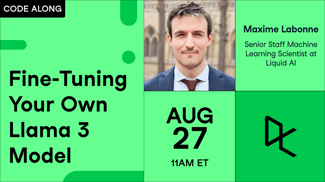
The advent of large language models has taken the AI world by storm. Outside of proprietary foundation models like GPT-4, open-source models are playing a pivotal role in driving the AI revolution forward, democratizing access for anyone looking to leverage these models in production. One of the biggest challenges in generating high-quality output from open-source models rests in fine-tuning, where we improve their outputs based on a series of instructions.
In this session, we take a step-by-step approach to fine-tune a Llama 2 model on a custom dataset. First, we build our own dataset using techniques to remove duplicates and analyze the number of tokens. Then, we fine-tune the Llama 2 model using state-of-the art techniques from the Axolotl library. Finally, we see how to run our fine-tuned model and evaluate its performance.
Key Takeaways:
Note: To participate in this code-along, you will need to have a valid Google Colab account. Get started here.
Additional Resources
Solution Notebook (dataset)
Solution Model
[SKILL TRACK] AI Fundamentals
[BLOG] Introduction to Meta AI’s LLaMA
[BLOG] Fine-Tuning LLaMA 2: A Step-by-Step Guide to Customizing the Large Language Model
[BLOG] Llama.cpp Tutorial: A Complete Guide to Efficient LLM Inference and Implementation