



Richie helps individuals and organizations get better at using data and AI. He's been a data scientist since before it was called data science, and has written two books and created many DataCamp courses on the subject. He is a host of the DataFramed podcast, and runs DataCamp's webinar program.
Chat with AI Richie about every episode of DataFramed - all data champs welcome!
Key Quotes
When you look at the definition of data literacy, reading is the most important characteristic because if you don't read it right, you can't do the others right. But the secret sauce to making data and analytics and data literacy initiatives succeed is communication. It 100 % is. So the first pillar of a data-driven culture is data fluency and the fluency to be able to talk the talk and have conversations without getting people to look at you like they are a deer in the headlights.
Some of the first steps of a change management within data and AI, is understanding what the true objective is. The objective is not to teach the data literacy course. The objective is to change people's behavior. That is hard, very hard. The key besides the right objective is what is your communication strategy around this? You can't just send people an email that says you have mandatory training. The moment you do that, you've lost. There needs to be messaging around it. People need to understand what's in it for them. They need to ensure that leaders truly buy in. They need to understand how much time this is going to take. All these things add up.
Key Takeaways
Implement literacy training in AI and data within your organization to ensure that all employees, not just specialists, are comfortable using these technologies, which can lead to smarter decision-making across various departments.
Encourage a culture of data and AI literacy by creating a community where employees can share best practices and success stories, fostering an environment of continuous learning and improvement.
Adopt a proof of value approach rather than proof of concept for AI initiatives, demonstrating tangible benefits and success stories to encourage wider adoption and integration within the organization.
Programdaki Bağlantılar
- Pre-order Jordan’s upcoming book - Data and AI Skills: Gain the Confidence You Need to Succeed
- Jordan’s Books
- DataCamp Webinar Featuring the Godparents of Data Literacy - Jordan Morrow and Valerie Logan
- Related Episode: Scaling Responsible AI Literacy with Uthman Ali, Global Head of Responsible AI at BP
Döküm
[00:00:00] Richie Cotton: Hey Jordan, welcome to the show.
[00:00:03] Jordan Morrow: Good to see you,
[00:00:03] Richie Cotton: my friend. In fact, welcome back. I should say. Yes. You've done this before. Absolutely. Always happy to chat. Nerdy things, let's party.
Wonderful. Yeah, so I'm, I was thinking, you've been talking about data literacy for, must be coming up a decade now almost.
So I'm curious, do you think we're making progress? Is the world getting more data literate or less data literate? I
[00:00:27] Jordan Morrow: I think the best answer for that is yes. In some instances, absolutely. We see organizations doing better and attacking it better, and then all of a sudden, COVID hit and I think critical thinking skills went out the door at times.
[00:00:43] And I do, but I do think there's a balance. And I, what I, what's interesting is when you study the trends and everything, I do think there is a, like a. Call almost like full circle. People are coming back to, we gotta be using the data. And I'm like, yes, we do. So I think it's a yes and no. I think in some areas 100% we see more effective use in data and understanding of how data feeds ai.
[00:01:05] And then in some cases, you, it's just shrug your shoulders and be like, okay, I can't worry about that.
[00:01:11] Richie Cotton: Yeah, that's true. We still got some work to do, but we're making progress in some areas. Yeah. Which is a good sign. Okay, so maybe we need some positive motivation here.
[00:01:18] So have you got some success stories then from maybe organizations or people using data?
[00:01:23] Jordan Morrow: Oh, a hundred percent. Get better. One of the first things I did in my day-to-day job, I am essentially Chief data AI officer. I'm senior vice president of data and AI transformation and. One of the very first things I put into place coming into the organization when I'm leading vision around AI and data was literacy training, because it wasn't gonna be any good if I build all these products and build these solutions and people aren't comfortable using them.
[00:01:49] And so we put in training on storytelling, making decisions, et. AI has advanced. We've opened up a community around AI where people are sharing best practices and you're just watching people take off. And it makes me happy. Number one, I don't have an army of AI specialists, so I need all the help I can get.
[00:02:07] And then you're just watching people pick it up. And what's so cool about that is the people succeeding are those who aren't data and AI professionals. They are, a learning and a developed person or marketing or this or change management. They're finding ways to build agents and to use data and to use AI to make smarter decisions.
[00:02:27] And that, that hits home for me because I'm a huge believer. Everybody has a seat at this table. They just need to understand what that seat looks like and develop skills around it. And so that's just at my organization. I've been an advisor to the US Army for years. I'll be back at the Pentagon next week teaching their thriving in areas around this.
[00:02:45] I went to Scotland to teach Scottish Fire and Rescue. They're thriving with this and I'm still invited the world over to speak on data ai. And so yeah, people should have a ton of hope because when you get to the meat of it and you turn the news off, there's a lot of good, and there's a lot of people trying, there's a lot of people putting effort to use AI and data into it, right?
[00:03:06] So there's definitely more room for hope than there is fear around these things.
[00:03:11] Richie Cotton: That's wonderful. And yeah, certainly I think like any organization where. They pick up on the idea, okay, maybe we should have data literacy throughout, they're gonna start thriving, like you mentioned. Yeah. Wonderful.
[00:03:21] You mentioned AI there and of course in the last few years, data literacy has been joined by AI literacy. Yeah. Do you wanna talk me through what's the
[00:03:27] Jordan Morrow: difference? What's super interesting to me is I remember when generative AI started, we're talking 2020 into 20 22, 20 23, and I'm thinking, did I just become obsolete because of data literacy?
[00:03:39] And the AI could do certain things and I had a very. Dear friend, she said, no, you just became more important. And as you take a step back, data literacy's definition, right? My definition is the ability to read, work with, analyze, communicate with data that can translate into AI literacy, right? The ability to read work with, analyze, and communicate with ai.
[00:03:59] Do we have, the way I call AI literacy, I really focus in on the prompting side of it, because most people with ai, it's prompt engineering and generative ai. And do you have the ability to prompt it work with that prompt, evaluate its response and then make a decision with it. And so what's very interesting though, there's, it's out in the news or out that it's AI literacy gaps that are hindering integration and success.
[00:04:26] So it, it's just like everything, right? You don't put a kid on a bike in the kid just bikes, right? You can't just put AI in front of someone and think it's gonna work. So data and AI literacy, they're siblings. You need to be doing them in parallel. We need to understand that the data that builds the AI needs to be good data.
[00:04:43] Data governance doesn't go away. Yes, the AI might be able to do analysis for us now, but you evaluate the data and what the analysis says. So I think they're just siblings. I think it's that constant evolution that has been happening with data literacy, that it is now data and AI with. Literacy.
[00:05:00] Richie Cotton: Wonderful.
[00:05:01] And I mean you made the point that like a lot of AI literacy, it's really about can you work with these chat tools? So can you Yeah. Find a good prompt, actually. Do you have any good prompt engineering tips I'm or always keen to learn? Absolutely.
[00:05:11] Jordan Morrow: The first one I give people, which is really funny, is when they're like I don't know what to ask.
[00:05:15] And I'm like, ask it that. Literally go into it and say, what do I ask you? And then see what it says and then just go. But then the one, number one thing that I would tell people with prompting. Be yourself. Don't try and force fit your thoughts into someone else's way. Take their ways. Make them your own and prompt it.
[00:05:33] And then some standard tips are the more clarity and less ambiguity you put in the prompt. You should expect better results when you get the results. If you don't know if it's real or a hallucination, ask it for it Sources. If you don't like the response that you got. Tell it and literally say, Hey ai, I asked you this.
[00:05:51] Your response was junk. I can't do anything with this. Please make it better. So I, you should be interacting with the engines that are there thinking about it, that it has democratized intelligence. And I think that is key for people to understand. That this is not like a Google search. This is democratized intelligence at your fingertips.
[00:06:11] So if you wanna learn how to play rugby or badminton, you want a recipe, you want travel, you want a new marketing campaign, you wanna analyze a product, just ask it. The key is evaluating the response to make sure it's real. And number two, do you know how to make a decision with what you receive? That's it.
[00:06:27] It's not rocket science. Rocket science went into building the model so that 99% of people who don't need to know that. Could just chat away.
[00:06:36] Richie Cotton: I like that. Certainly I really like the idea of telling it to site sources 'cause Yeah, you don't want making stuff up and then you believing something that's not true.
[00:06:43] 'cause it's just fabricated it. And yeah, the other thing about just talk in your own language kind of works really well. There's lots of guides. You are like, okay, you gotta use this kind of style of writing or whatever. It's it's probably not gonna give you an answer that for them.
[00:06:55] Yeah.
[00:06:56] Jordan Morrow: If you find your own way. That's great. It's even when I write a book or I give frameworks to people on, let's say, data storytelling, data-driven decision making, I want them to make it their own. Don't force yourself to use everything someone tells you. Find what works for you. Take notes, journal. I'm a huge journaler, and figure out what works for you so that then it is all about your relationship with the technology, not forcing yourself to use the technology.
[00:07:25] Richie Cotton: I like it. Okay that's the AI literacy side of things. Yeah. Data literacy slightly more complicated in terms of the skills you need to learn. I think so talk me through what are the skills you need to become data literate?
[00:07:35] Jordan Morrow: Yeah, so for me, I love to tell people you're already data literate.
[00:07:38] You just don't realize it. Here's my phone. I'm traveling next week. I use the weather app to understand what I'm packing. We're in September, so temperatures and storms and stuff, they vary. So I love telling people it's already a part of you. You just don't realize it. What's key though, is the business setting is different than using your phone.
[00:07:58] So if we go back to those four characteristics of reading, working with, analyzing and communicating. You know what I didn't say in there? Data science. I don't need you to learn statistics inside and out. You don't need to learn machine learning. You don't need to learn coding. Fundamentals. Yeah, talking about it.
[00:08:13] Oh, coding does this, but you don't have to learn all the technical. So for people, you're exactly right, it is not a one size fits all. So any organization that deploys a data literacy initiative and everybody takes the same workshop, you're in trouble, right? You want prescriptive plans. You wanna assess where people are.
[00:08:32] Executives don't have time to sit through a, five day, eight hour a day workshop. They probably only have an hour or two to learn everything they need to know about it. Then you have mid-level managers. They have to make leaders happy. To get their employees doing it, and then you have all the employees.
[00:08:48] So when you think about a data literacy initiative, it is truly an ongoing initiative to help your organization be more confident and comfortable with data. Don't force fit everyone into the same puzzle. If you are a data scientist, great. If you are an analyst, great a marketing manager, you name it.
[00:09:07] That's what you should be targeting is how does it fit into their world?
[00:09:11] Richie Cotton: Okay. I do love the idea that like, make sure that whatever you're learning about, it's gonna be relevant to your job and relevant to working with all the people around you. So yeah. Very good idea. So do you think there are any skill gaps around data literacy?
[00:09:23] What are we missing at the moment? I would say
[00:09:26] Jordan Morrow: yes because I think we, with, even with me, right? Data literacy became a buzzword. That shifted away from its end goal is to empower everybody with confidence around data, right? That's it. But it still misses things like change management. It still misses things like value driven metrics around it or value driven insight from it.
[00:09:47] So just like I can buy a data AI tool and just expect results, you can't just teach people to read work with, analyze and communicate with data and expect value. So I do think that a gap missing in data literacy initiatives is number one, what does the change management look around this? How do we teach people these principles and then get them to deploy actual use of those things?
[00:10:11] And number two, how do we then define value that is derived from it? Like we can't just say, did revenue increase? Because data is a part of a process. So I do think the other gap is. How do we really measure value around this? One that I created recently is with ai, I call it velocity to insight, right? How long would it have taken you as a human to build insight?
[00:10:35] Now, this is AI driven, but how long did it take you to deliver insight with ai? And that gap in the metric shows the more efficient way of doing it. But efficiency doesn't mean effectiveness, so I think that's why I get back to this value side. Is we can speed up effectiveness, we can have better visualizations, we can have more data, but in the end, if we're not using it and driving value, what good was it for?
[00:11:01] Richie Cotton: Absolutely. Yeah knowing everything is brilliant, but unless you are like getting some value from it, then yeah, it's not used. Okay. Maybe we'll talk about change management then. Yeah, I guess the first step is making sure that people actually care about data, that they want to learn about it.
[00:11:17] And there's a lot of people who are a bit hesitant about data or ai. So how do you overcome that first hurdle? Get people excited about it.
[00:11:23] Jordan Morrow: I think like some of the first steps of a change management within data ai, any of that is number one, understanding what the true objective is. And the objective is not to teach data literacy course.
[00:11:34] The objective is to change people's behavior. That is hard, right? That is very hard. So the key besides the right objective is what is your communication strategy around this? You can't just send people an email that says you have mandatory training. The moment you do that, you've lost. They, there needs to be messaging around it.
[00:11:54] They need to understand what's in it for them. They need to have, ensure that leaders truly buy in. They need to understand how much time this is gonna take. All these things add up. And so if you're not doing that communication properly, they can feel overwhelmed. And the moment you've got them feeling overwhelmed, when 90 to 99% of people aren't data professionals, do you really think they're gonna buy in fully?
[00:12:18] And the answer is no. The world is already overwhelming. And so that beginning piece of the objective and communication strategy and I maybe you add a third piece in, which is leadership buy-in. That's crucial. If you nail that, you can nail the program.
[00:12:34] Richie Cotton: I love the idea of just making sure people don't feel overwhelmed 'cause maybe there's essentially like you're gonna try and turn 'em into a data scientist, like you gotta do a PhD in your spare time. It's not really that at
[00:12:44] Jordan Morrow: all. It's not. And how many people, I ask this question when I'm speaking sometimes. How many of you don't have a busy job that gets people to laugh?
[00:12:52] Everybody is busy. So the moment you say, Hey, you're now gonna take part of this initiative, this is why leadership buy-in matters. Let's say they're working 40, 50 hours a week and you're telling them you have to dedicate four hours. That's 44 to 54. They don't wanna do that. So you have to then let them know, no, we're gonna carve time out.
[00:13:10] Your deliverables are gonna shift a little. That matters because people already are overwhelmed in the world. Adding another initiative is not necessarily the way to do it.
[00:13:20] Richie Cotton: Yeah. So I think that leadership buy-in is incredibly important. Do you have a sense of who needs to be like accountable for this?
[00:13:26] Who needs to be running these data literacy or AI literacy programs? Is it your chief data officer, your CEO? Is it someone in l and d? Who's it need to be?
[00:13:34] Jordan Morrow: I would say yes to all that. Now, I know that's not a good answer. I, the other answer I share often is also not the greatest answer, but it is, it's, it depends, right?
[00:13:45] So an organization that doesn't have a chief data or chief analytics officer, that type of role, your CEO has to own this on top of it. Even if you have a chief data off Chief data officer, your CEO still needs to own this because if. It is viewed as some separate thing over here and not a direct part of the business strategy.
[00:14:08] Good luck. People have deliverables, people have targets, people have goals and things they have to achieve. And if they do not see this as fully bought in from the C-suite and leadership, good luck. But to your point, then it cascades to who actually owns the program. A lot of time it will be l and d because it is a learning and development sort of program.
[00:14:29] It has to be done in partnership with that C-suite, with the executive team without executives really bought in good luck is one of the best terms I could use for 'em.
[00:14:40] Richie Cotton: Yeah, certainly if your CEO is never making use of data or at least never publicly making use of data Yep. The decisions then you you got a bit of a problem there.
[00:14:49] Yeah. Okay the other thing you mentioned around the change management is around finding time to learn. 'cause everyone's busy. Do you have any tips of it, just like. Scheduling time to learn, like making sure it does actually take place.
[00:14:59] Jordan Morrow: Yeah, so one of the keys to this side of the change is letting people know it's not gonna be 20 hours of your week.
[00:15:06] It's literally one to four hours a week is I would say the max would be four. And that's pushing it right? One to two hours a week of learning spread out over 8, 12, 16 weeks, depends on how long the program is, what you're learning, et cetera. You've gotta make them understand it's bite size and it's manageable and it's not gonna overwhelm your day-to-day work.
[00:15:27] And I think that's always one of those ways of looking at things is how do we make this bite-size manageable within the framework of what we're doing? And so I think that's the key is in that communication plan is helping people realize this isn't going to be, like you said, you've gotta learn a PhD on the job.
[00:15:45] First off, you don't need a PhD, but number two. It's only one to four hours a week, and like I said, when leadership truly buys in, they will make sure that your time is available for success.
[00:15:57] Richie Cotton: Absolutely. I like that. Yeah, certainly you do like your 15, 20 minutes every day after lunch or that's it. Hour and Friday.
[00:16:03] Jordan Morrow: Yeah. AI has become such a great tool to optimize things. Use AI to optimize your calendar. One of the things that you can do in parallel to a data literacy initiative. Use one of the generative models to say, look at my calendar. Where did I waste time? What meetings were effective? What ones weren't?
[00:16:22] Look at the notes because then it might be you find you have five extra hours a week because these meetings didn't need to be done in a meeting. They could have been done asynchronously, poof. Five hours, right? And so that is part of, this is a lot of work that we do. We need to reevaluate in the age of AI to make sure it's the appropriate work we're doing.
[00:16:45] Richie Cotton: That's a very good point. A lot of this sort of the joy of AI at the moment is about okay, we can automate things. We can, outsource our lives to, to technology. But this involves a lot of process re-engineering. Yes. So talk us through what processes should you be changing?
[00:16:57] How do you go about doing that?
[00:16:59] Jordan Morrow: I would quite literally, now again, this comes from don't overwhelm yourself. I would put every process in the organization on the table. Now if you're in a 50, a hundred thousand person organization, that's huge. That's why you start bite size and you start within your group and you say, I wanna evaluate these three processes using ai, evaluate efficiencies, evaluate where improvements can be made.
[00:17:22] Are there routine things that can be automated or built with agents? Because what you're gonna find is, and I hate to say it this way, a lot of work done at organizations is inefficient. We know that number two. A lot of work could probably be kicked out, but because it's something people do and they're comfortable, wonderful.
[00:17:39] Good, I'm glad you do it, but you gotta separate yourself a little bit from this. So I am all about full reevaluation of all processes, but don't try and do it overnight. You're just gonna overwhelm yourself and bring yourself out. Understand that it is a three, five year process if you're a large organization to do this.
[00:17:58] But just start small. Find one process, evaluate it. Oh, we found 20 minutes here. Another one. Holy cow. We can get rid of this one. Another one. Oh, that's an hour time saved. Who doesn't want time saved?
[00:18:10] Richie Cotton: Yeah, I like that. It sounds magical. Saving time. You have free time to do stuff. Okay may, maybe let's work through an example.
[00:18:16] So you got this process, you wanted to save some time. You didn't even mention AI or technology in there. I think to begin with it was just like, okay, let's find out how we can do this process better. Yeah. Yeah. Do you wanna walk us through what
[00:18:26] Jordan Morrow: this involve? I'll show you a direct thing that, that I did at my day-to-day job, not my speaking stuff.
[00:18:32] They had a Microsoft Excel report, so all the publicly traded clients the company had, people would supply information, they'd put it into an Excel file that would take time. And then you, in order to understand the Excel file, you have to know who you're looking for slide across. It was the perfect use case for a generative model that I trained.
[00:18:51] So what I did is I took a look and I said, okay, let's look at all the publicly traded companies that I can get information on. Poof. I took all that downloaded and you could either do this, scraping the web, downloading reports. I took earnings releases and annual reports. That was one mode of training I put into it.
[00:19:08] The second mode of training I put is I said, yes, model. You can go to the web to get information. Boom. Second, third mode of training was yes, use your general knowledge from the LLM done, trained that model, and now they have a user interface. They just sit with it instead of having people having to supply information.
[00:19:25] They can go right in, ask questions, get information. They can literally use this Richie in a QBR meeting or in a meeting with a client on the spot and say, they're talking about this. How can gimme strategies to overcome this? Type it right in. Have notes taking it, put it in. Boom, there's your response.
[00:19:42] Went from a manual process of having to review every client, et cetera, to here's the use case for a generative model. Straightforward. Go have fun.
[00:19:53] Richie Cotton: That's brilliant because I know from speaking to colleagues, the quarterly business review meetings, it's like you put together an epic slide deck trying to work out what the customer's gonna care about this quarter, and then it's really tedious, it's time consuming, and most of the slides don't actually get used 'cause the customer doesn't care that much about something and it's just exciting
[00:20:10] Jordan Morrow: metrics.
[00:20:11] Right? And versus a real strategic, A QBR should be a very strategic conversation. And when you use AI's power. You could say, tell me all the obstacles they've been going through for the last year. Oh my gosh, now I have a list. Tell me solutions to each one. Create roadmaps, create strategies and milestones.
[00:20:28] It's all there. Make sure you study it, obviously, because you've gotta be knowledgeable on it. There it is. And so then it is not just some simple PowerPoint not simple, massive PowerPoints. You're having strategic conversations with what they're trying to achieve.
[00:20:43] Richie Cotton: I really like that. And what do you think the measure for success is then?
[00:20:46] Like what constitutes a successful AI initiative in this? Oh,
[00:20:49] Jordan Morrow: it's super interesting you brought that up. I did a post, I think just this week a lot. There was a whole MIT article that was like 95% of corporate generative AI fail. But when you dig into it, no they don't. That was just a catchy headline.
[00:21:03] When you dug into it, you found 40%, I think it is 40% of the organizations had invested in enterprise wide licensing, but 90% of people were using ai. That is a big discrepancy. So they might not have your license. They're using their own. So this undercurrent of AI success is happening right under the nose of C-Suite members?
[00:21:22] Yes. Big massive projects might be failing, but why are you trying to tackle everything so massively when all you need to do is teach people how to use it well? So I find that to be super interesting when you're looking at these projects. Don't look at the big thing. Number two, please do not try and fit ROI of AI into old methodologies of trying to figure out return on investment.
[00:21:46] It doesn't fit because it is a different world. So I just started this week releasing new metrics that I'm generating and creating and building around how do you measure value from ai. The one I released this week was velocity of insight, right? Because. Using AI can generate insight quickly. So you'd compare the measures and say, had I done this and you scale it, it is a math formula.
[00:22:08] It would've taken me X amount. So my velocity was really low in generative ai, it only took this fraction of amount. So velocity goes up. So you're like, that is a direct correlation in saying, here's the metric, here's the numbers. Our insight is coming through so much faster. The key though then is what are you doing with that insight?
[00:22:26] And if you're not doing anything with it, all you did was generate an idea. But if you're making decisions with it, even more impactful.
[00:22:33] Richie Cotton: That's really interesting because I guess at the C-suite level, you generally think about, okay, we're making more money somehow, so you've got increased revenue, or we're saving costs, or something that's like really top line.
[00:22:42] Yeah. But actually. The stuff that's gonna be more meaningful to your success is gonna be like micro targets, I guess more related to work. So you mentioned like velocity to insight. It's gonna be things like, yeah. I guess can you measure productivity gains? Some
[00:22:54] Jordan Morrow: a hundred percent. That abso that one is a direct, but we also have to remember that is it truly, just 'cause you're faster doesn't mean there's a true productivity game there.
[00:23:05] So we have to be cautious that just because you're more efficient doesn't mean you're more effective. It just means you sped things up. So we do see in places where true productivity gains happen, and you should measure it. Cost savings. Did this mean that you got in front of 20 more clients because you did this, and how many of the direct revenue attribution?
[00:23:24] A hundred percent. But we do have to make sure that there is actual value coming from it, not just we sped up processes that weren't effective anyway. The other side that I think that. You can measure from productivity is, and this is a metric I'm gonna share next week, it's cognitive load reduction, meaning people are overwhelmed and busy, they're burning out all over the place.
[00:23:44] Can we use AI to get rid of some of that cognitive load and free their minds up to be more creative? I think that is a direct benefit because a happier employee obviously is gonna be a better employee.
[00:23:55] Richie Cotton: Absolutely. So you mentioned like the difference between efficiency and effectiveness. And actually I've gotta tell a story 'cause a hiking buddy of mine was saying his wife complained to him that he's efficient but not effective.
[00:24:05] And he was asking why that was and he said, you need to get the chi changed on the car. So he took me from our Valentine's date at the restaurant next to the tire change place. So efficient but not effective. And yeah I think he's, why he
[00:24:17] Jordan Morrow: probably thought it was super effective. Hey, two birds with one stone tires fixed Valentine's Day date we're good.
[00:24:23] Richie Cotton: Yeah all done. It makes perfect sense to me, but yeah, his his wife didn't think so. So yeah I like that you gotta focus on effectiveness rather than just pure efficiency metrics. Alright. Okay. I guess related to this, do you have any more tips for just making sure that if you've got like a data literacy initiative or you've got an AI literacy initiative, it's gonna run smoothly?
[00:24:40] Like, how do you start going to scale these things out?
[00:24:43] Jordan Morrow: I think you need to I don't like calling it proof of concept anymore. POCs can be built but don't have any value. So I call it proof of value. So what I would say is twofold. Number one, you focus in your data literacy, AI literacy initiatives.
[00:24:58] With objectives towards tangible value in the organization. Meaning what are we trying to achieve with this? Is it market growth? Whatever it could be. You need a tangible use case around this, and that's the second side. So you're not building a proof of concept. Build a small proof of value that you can then sell throughout the organization and say, see here, look at this work, this group has saved X amount of time.
[00:25:22] They've made four extra decisions and they closed 10 more sales. Because of the data literacy initiative. But number two is you can't just focus on the ether. Oh, it's theoretical. No, you need to have tangible use cases. So when you do data it's that whole adage of when you're in mathematics in school, where will I ever use this In real life, if you ever have someone asking in your data literacy initiative, where will I ever use this?
[00:25:49] You're family. It needs to be built in an applicable manner. I read data better to do X, Y, ZI analyze data to find better insight. I communicate better because of this. Those are tangible outcomes. Don't just teach, Hey, if you analyze this way, and they're like, I don't know where I'd ever apply that. Then the program is missing the mark.
[00:26:11] Richie Cotton: Okay. I like the idea of having good comebacks. Gordon, can you talk us through an example then of why data literacy is gonna help you just in real life, maybe in the outside of the work situation? Oh,
[00:26:18] Jordan Morrow: absolutely. When you take a look at, let's say, buying a home, right? There's metrics everywhere everybody's trying to sell.
[00:26:25] When you use your own data literacy to buy a house. It is perfectly easy to just sit there and not try and study the data, not investigate the home, not investigate mortgage rates and all this, and taking a look at your finances. And then you might get caught in a situation that hurts you financially.
[00:26:41] But if you take the time to really analyze it, find out your finances, your mortgage rates, what will payments look like if I do X, Y, Z? What does that is just a data-driven decision where. That's not that difficult, but you might not look at it as data literacy. It is data literacy. It's helping you make a decision.
[00:26:58] I'll use a personal example for my life. I was running an ultra marathon once where I struggled so hard. I don't know if I ever wanted to quit a race more in my life. I think I was probably thinking Miss a cutoff. Miss a cutoff. I never did, so I just kept going and I finished the race and didn't truly understand.
[00:27:18] Why I struggled so much until after the fact. It was probably 90 to a hundred degrees. It's in July. I was dehydrated. Even with all I was consuming, I was not hydrated enough. So climbing in the mountain, this is one of the hardest 50 Ks in the world and it's here in Utah. And one of my favorite races, I was not hydrated enough.
[00:27:38] I was crushed. Guess how much? Water. I've gotta remember the metric, but it was a straight metric point that kind of, I think, illuminated this for me. Not to be gross, but guess how much sweat loss it said I had.
[00:27:51] Richie Cotton: Oh man, it is gonna be like liters per hour or something that it was like
[00:27:55] Jordan Morrow: two over two gallons maybe.
[00:27:57] It was nuts. And even though I'm consuming liquids throughout the race, it wasn't enough. You're exposed at times. The climbing is super difficult and after the fact you're like, oh, okay, I get it now. That was just personal data illuminating, so that if I ever did that race again, my hydration strategy before the race could be much different.
[00:28:19] Richie Cotton: Okay. Two guns. That's like modern eight liters. That's a lot of swear that is really gross. It was
[00:28:24] Jordan Morrow: so bad. Thanks me. I didn't pass out or anything.
[00:28:27] Richie Cotton: No, I say everything about that story was, it started off with, I'm running an ultra marathon. It went downhill from there. It was like with the heat and the mountains.
[00:28:35] I'm like, that's just a crazy maneuver. Yeah, absolutely. And,
[00:28:39] Jordan Morrow: and hey, but I finished and in fact you finished when I got to the last massive summit over 11,000 feet above sea level, I think it was, or 10,000. Either way, I started to have a good race. Started to just join. I'm chatting with people.
[00:28:53] 'cause mentally I'm, I know I had run it before. I knew what was ahead of me. And so there I am in just a much better head space. And so that's a personal data point that once I hit that last peak, knowing what was ahead of me, that personal data point, you're like, okay, life is good.
[00:29:10] Richie Cotton: Yeah. So I guess even if you're not running ultramarathon, then like just.
[00:29:13] Or buying a house. They're like shopping. You're gonna use data at some point in that. Traveling? Yeah.
[00:29:18] Jordan Morrow: Can I share a bad story Once? Oh,
[00:29:20] Richie Cotton: go on.
[00:29:21] Jordan Morrow: I traveled to Finland at the end of November and did not pack very well. How cold is Finland? At the end of November, it's frozen, and so there I am without a proper coat and I remember thinking, ah, I'll be fine.
[00:29:37] I'm good. No, it was freezing. And here's the dumb part. I didn't make a good data-driven decision. I bought my wife a nice coat while we were there. I could have bought me one and I didn't. So there you go. Poor data-driven decision making right there.
[00:29:50] Richie Cotton: Okay. Yeah. It's a very simple, like one data point the temperature and Yep.
[00:29:55] It's gonna affect your decision. Okay. I like that. That's about as simple as it gets. Yes. Alright. So I feel like we got distracted. We were talking, oh, we were talking about running data literacy programs. Yeah. Air literacy programs. Yeah. At work. So you've got some good comebacks now for if someone says, what's the point of this?
[00:30:10] But so you mentioned showing proof of value. Yeah. Does that depend on which part of your organization you are trying this in? I, I presume it's gonna be different for like sales or, yeah,
[00:30:20] Jordan Morrow: absolutely. It could, let's say you're an HR department, you're starting to implement data and AI into the processes of hires.
[00:30:27] Can you measure the skills that you bring in? Create almost like a, a skills landscape, seeing where your gaps are, seeing predictions around which gap you need to fill. That's the HR side, and that's actually a cost driven center if you think about it. 'cause you're paying employees, so you're losing money.
[00:30:44] Every employee you bring into a degree, and then you've got your investment side or your finance side, and they're trying to figure out revenue side of things and cost savings. And then you've got sales and their data and AI literacy could be directly related to how many clients they close and targets that they're hitting.
[00:30:59] So yeah, I think you said it well. It depends on where in the organization you're operating and then how do you wanna measure it, and how do you create that value.
[00:31:07] Richie Cotton: Okay. Yeah, so I love that. A lot of this is just about being able to understand like, how close are you to hitting your targets?
[00:31:13] And that's like a real okay, everyone should really be able to do this and you're gonna have to use stage at some point for that. Yep. Okay. Wonderful. So I guess the other side to this is around the cultural change aspects. We touched on this a bit before, but do you have any tips for how to, like, where you can have like good leverage for changing culture?
[00:31:29] Like how are you gonna make this happen?
[00:31:31] Jordan Morrow: Yeah, I've got six pillars of a data-driven culture. The first one might be the most important. I call when you look at the definition of data literacy, reading is the most important characteristic to me because if you don't read it right, you can't do the others, right?
[00:31:43] But the secret sauce to making data and analytics and data literacy initiatives succeed is communication. It a hundred percent is. The first pillar of a data-driven culture is data fluency and the fluency to be able to talk the talk, have conversations without. Getting people to look at you like they have deer in the headlights, right?
[00:32:03] Another pillar of that is twofold. Number one, making sure the culture understands we're not changing you into a data scientist, something super technical. We're just trying to weave the DNA of data-driven decisions as a part of what we are. Part of that means helping the culture understand that the gut feel and intuition still matters.
[00:32:24] So often we sit here and it doesn't matter. There are people think, oh, you're getting rid of my intuition, my experience. No, we're not. Those are personal data points. We're combining that with the data to make smarter decisions. When how many people really pushed back against the internet when it started to thrive, how many people really pushed back against the personal computer automobile?
[00:32:44] Yes, there was hesitancy to these changes, the smartphone but now they're just ubiquitous in our life. I think that's how we need to view data and AI is, it's not to supersede us. It's another thing in our arsenal, if you will, to make better decisions.
[00:32:59] Richie Cotton: Okay. Yeah. I like that. Is dealing with the pushback and, this is always gonna be naysay is of anything, stupid new cars are, my horse all day instead.
[00:33:06] Yep. Yeah.
[00:33:07] Jordan Morrow: Henry Ford is quoted as saying, and whether he said it or not, it's like, if I listened to people, I, they would've wanted me to build a faster horse. You can't build a faster horse, but you can build an automobile. Right now. The pushback for a little while was electric cars. Now they're dotting everywhere.
[00:33:21] You know what I mean? So it's, there is a natural evolution to these things, and part of it is just helping people realize that what does their seat at the table look like? And helping them develop the skills to succeed in that.
[00:33:33] Richie Cotton: Absolutely. And just talking about sort of cultural change, I always feel like there are two big leverage points for changing stuff is that one is like onboarding and the other ones are meetings.
[00:33:41] Yeah. Actually, do you wanna talk through, like how might you use data training as part of your onboarding?
[00:33:46] Jordan Morrow: I think it just needs to be a part of it, right? When a person is onboarded to an organization or switches roles, you get a whole list of training that is mandatory. Watch this video, fill out this form.
[00:33:57] Why don't we just make data learning a part of that? Quite literally, because you know the organization, and let's add AI in there, is investing in data and it's investing in ai. And the moment you just stick it in front of someone, they're not just gonna automatically succeed. And so they need to be prepared appropriately.
[00:34:15] And that doesn't mean teaching them where to point and click in a tool like Click or Tableau, it literally means teaching them how to use data to make better decisions. Click and Tableau are just channels for that, right? Excel is a channel for that. So I'm a hundred percent with you, Richie. Why is it not a part of onboarding when it should be.
[00:34:35] Richie Cotton: Okay. Yeah. Big fan of making that a widespread and so the other one was meetings. I think like everyone wants to learn how to do meetings better. Do you have a sense of how you can bring data or AI into meetings?
[00:34:45] Jordan Morrow: Oh, AI should be a meeting enhancer through and through. If I'm sitting here and I'm like, okay, I could have done it for this podcast, now you and I know each other, right?
[00:34:54] But imagine someone I've never met with provides me information for the podcast. I could literally go right into generative AI and say, these are the key elements. You already know me 'cause I use you all the time. What are the highlights I should bring forward with this? If I'm meeting with an internal meeting where it's a strategy discussion, okay, I'm going to go use generative AI and say, how do I make this more effective so that it's not an hour of people's time, and they walk away saying, what are we doing?
[00:35:20] They walk away saying, I know my call to action and I know my key takeaways. Another one is clients. We talked about the qbr. The other side of this that I think matters greatly for a data-driven culture and culture in general is when negative meetings need to happen. Performance reviews. It could be reduction in staff.
[00:35:39] These are difficult conversations. I'm gonna use a real world example of ai. My wife is a teacher and she had a student that did not do the work and was like, doesn't that work count? And she used generative AI to come up with a nice kind response to this student. She teaches at the junior high level, and her coworkers were like, you should just like copy and paste this as and put it on your wall.
[00:36:02] Because it's gonna do a very good job. It doesn't have empathy and compassion, but it can simulate it very well. She created this email for a more difficult conversation. She can then go in and modify it, make it more personable, and it helped to strategize a conversation that wasn't as strong, wasn't as easy to have.
[00:36:19] We should be doing that. Reduction in force can absolutely have damaging effects on a culture. And if you're saying this is what the data told me, how many people are gonna like data going forward? So there's ways to use this to strategize meetings to make them more impactful.
[00:36:36] Richie Cotton: I do like that idea of.
[00:36:38] Helping you write difficult things? Certainly. I mean it, yeah, the reduction force idea. That's gonna be a hard conversation, whatever, having a difficult conversation with someone who's not performing. But also, I guess even like for salespeople, like planning how to go about having a conversation, future conversation with the customer.
[00:36:54] Jordan Morrow: One, one thing a salesperson they're gonna get hit with like obstacles. Let's say I'm trying to sell to you, Richie. And I'm like and the web, you're all over the web. I'm like, okay. I've gotta sell a product to Richie. This is my personality. This is the stuff on the web. Tell me what potential obstacles in my sales presentation Richie might bring forward.
[00:37:14] Now, obviously, not all organizations have a lot of information, but a lot do. Why are you not going out there and using it to say, tell me the latest market trends that can affect this industry. They might push against this. It could be like, this company just announced they're going through a large ERP shift, it's probably not the right time to sell to them.
[00:37:33] You literally can use it to negotiations, obstacles, overcoming them, and if you're not, I just wanna say why
[00:37:39] Richie Cotton: absolutely. Yeah. There are so many great uses. I'm sure like anytime you're having an interaction with another person, practice on air first and it's it's gonna work well
[00:37:47] Jordan Morrow: and you can use voice conversation with it.
[00:37:48] I remember waiting for a meeting once. Using Gemini's voice, AirPod in my ear, having a conversation about AI with it.
[00:37:58] Richie Cotton: Nice. Okay, so I guess the one big fear of AI is that if you use it too much, you become reliant on it, your skills are gonna atrophy. Is that something thats a real worry or not?
[00:38:07] Jordan Morrow: Yeah, I worry about it quite a bit. I'm writing my fifth book right now. It comes out in March next year, close to the manuscript being done. I do and it's not just AI and I hope people realize. Our brains, I think, have been atrophying with social media for a while. This is not new. I think AI can make it worse and maybe even exponentially worse because like our cognitive muscles need to work out just like our physical muscles.
[00:38:31] You go to the gym, what happens when you stop going? Your muscles get weaker, your body has issues, et cetera, et cetera. What do you think is gonna happen if we're not critically thinking? We're not bringing the human element, we're not analyzing. I absolutely think it hinders us. That being said, it's all in the approach.
[00:38:49] I use it to write. I use a deep research function to write me white papers that I can then learn from, right? That takes away two months of having to find websites and all that to 10 to 15 minutes. But then I need to be the one who goes in and reads it. I look at the sources. I like that article. I don't like that one.
[00:39:04] I'm pulling this in. So it can be just like going to a gym can bring enhancements, like the right equipment can build this muscle different. A better bike can help you be more efficient. Allow AI to strengthen cognitive muscles rather than weaken them. This is, I have a term for this. It's called we're engineering intelligence or engineered intelligence data, plus AI plus IQ plus EQ equals engineered intelligence.
[00:39:31] The human has to be a part of it. I do worry that we're gonna weaken it more. Social media was already causing that. And so I do fear it. I absolutely do. Okay. Ugh.
[00:39:40] Richie Cotton: I blame the podcast. Yeah. Terrible.
[00:39:44] Jordan Morrow: Yeah. Podcast. It's all your fault.
[00:39:46] Richie Cotton: Yeah. No. Okay. I do like the idea that you still gotta exercise your brain even in the face of social media and AI that, can help you do stuff without really turning your brain on.
[00:39:55] Go on talk me through what are your tips for expanding your brain? Then for me,
[00:39:59] Jordan Morrow: just be human. I and much to my wife's consternation, I probably buy one to four books a week. That's not good. I could be addicted to other things, much worse than that, but I'm addicted to buying books.
[00:40:10] The key for me is it doesn't take a ton of effort. 15 to 30 minutes a day. That's it. And everybody, I don't care if you say you can't, to everybody can find 15 to 30 minutes a day of prompting and evaluating prompts. Getting better at prompting of reading books to get better at understanding data communication.
[00:40:28] 15 to 30 minutes a day. But the key to this is be consistent and create a routine, right? Just going to the gym. If I only work out two to three days a month, but I have killer days, that's like going like this, right? That's momentary greatness versus being good consistently. Don't have moments of greatness with AI where you spend a whole week studying it and then forget for three months.
[00:40:52] Instead, focus in on those incremental 15 to 30 minutes a day study practice. I journal a lot, writing notes, writing my thoughts. You know what one that my wife and I did to help our cognitive side? We bought adult coloring books like meaning, very detailed coloring pictures. You can get apps that do it. I don't recommend the apps.
[00:41:12] I want you to buy colored pencils. I have one. I love tattoos, and it's got a hundred different tattoos that are very detailed that I can just go in and color, turn on a movie, turn on a show, and you're flexing your creativity muscles that quickly, right? I'm not telling you to go buy some Transformers coloring book, but buy the ones.
[00:41:29] If you just go into Amazon and say coloring books for adults to use. Boom. Then you can bid a coloring book. There are so many things to do and, but it doesn't require a lot of time. Just going and exercising 30 minutes a day. That's great. 30 minutes a day of using your brain and exercising.
[00:41:47] Richie Cotton: I like that.
[00:41:47] Yeah. Use your brain for 30 minutes day. Also, the clothing book idea is really interesting and I was just thinking, I think my favorite book of yours is the one you wrote with Chandra Donaldson. Oh yeah. It's a children's book. Children. It's got Greek pictures
[00:41:58] Jordan Morrow: in there. Yeah, absolutely. And the artist did such excellent work and for me, you're nailing it with the children's side of this.
[00:42:04] Children are the best data literacy detectives around. Do you know why? They're constantly curious. They're very creative and they critically think, meaning they're trying to figure things out. We become adults. We see something on social media, but oh, it must be true. Or we get in routines at work. When was the last time we were like children?
[00:42:24] And I know that sounds funny. I'm all about trying to be a kid at heart and having fun and hey, there's a topic I wanna learn. Don't turn your brain off. One and I don't know if I read this somewhere, but a mark of intelligence to me. You can have competing thoughts in your brain that contradict what you think is right and you're comfortable with it.
[00:42:45] And then you make decisions off it. It doesn't take much to work on your cognitive skills, but we're so distracted and our focus is so weak right now. I, again, it's not just AI that does it. There's so many things that do it that it, it's just block 30 minutes a day. I'm not telling you to get off social media totally, but instead of doom scrolling for 30 minutes, maybe pick up a new book.
[00:43:08] Richie Cotton: Absolutely. That's wonderful. I advice is spend 30 minutes thinking. I like it. Pick up a new book. Easy. Listen to it. Listen to it. Listen to an educational podcast. Listen podcast. Nice. Alright just to wrap up I always want new people to learn from. So do you have anyone who's worked that you are interested in?
[00:43:25] Who should I be for or Absolutely two
[00:43:27] Jordan Morrow: people. Sadie St. Lawrence is a friend of mine. I highly recommend her on LinkedIn, her Instagram. She focuses in a targeted area in a lot of areas, but one area that I love that she focuses on is consciousness with AI advancing the way it is.
[00:43:43] Anyone who tells me, oh, it'll never achieve consciousness, couldn't they have said that about little humans 2 million years ago? And and guess what conversation I had with AI One. Are we defining consciousness inappropriately, or not inappropriately, but incorrectly? So Sadie St. Lawrence would be number one.
[00:44:01] Jepson Taylor would be number two. His startup on AI is inventing new math. It is inventing algorithms that are more powerful than what humans can do. And I think that unleashes engineered intelligence in a very good way if we use it right. Sadie, St. Lawrence, Jepson Taylor, two people to follow and listen to.
[00:44:21] Richie Cotton: Wonderful. So actually Sadie St. Lawrence was she was a previous radar guest absolutely. Yeah. People have to go back and check out the recordings Absolutely. On the team website. She's nice. Jepson, I don't know. So I'll definitely. Oh, you got her.
[00:44:31] Jordan Morrow: He is, he lives not far from me, but in, in no exaggeration, one of the smartest AI minds on the planet.
[00:44:38] And when you start to see what he's doing, you're like, and I love it because I think there's so many positive benefits that could come.
[00:44:46] Richie Cotton: Wonderful. Alright. Definitely want to check out. Okay. Thank you so much for your time, Jordan. Absolutely. Always good to see you, my friend. I hope you're great.
[00:44:53] Likewise.
[00:00:00] Richie Cotton: Hey Jordan, welcome to the show.
[00:00:03] Jordan Morrow: Good to see you,
[00:00:03] Richie Cotton: my friend. In fact, welcome back. I should say. Yes. You've done this before. Absolutely. Always happy to chat. Nerdy things, let's party.
Wonderful. Yeah, so I'm, I was thinking, you've been talking about data literacy for, must be coming up a decade now almost.
So I'm curious, do you think we're making progress? Is the world getting more data literate or less data literate? I
[00:00:27] Jordan Morrow: I think the best answer for that is yes. In some instances, absolutely. We see organizations doing better and attacking it better, and then all of a sudden, COVID hit and I think critical thinking skills went out the door at times.
[00:00:43] And I do, but I do think there's a balance. And I, what I, what's interesting is when you study the trends and everything, I do think there is a, like a. Call almost like full circle. People are coming back to, we gotta be using the data. And I'm like, yes, we do. So I think it's a yes and no. I think in some areas 100% we see more effective use in data and understanding of how data feeds ai.
[00:01:05] And then in some cases, you, it's just shrug your shoulders and be like, okay, I can't worry about that.
[00:01:11] Richie Cotton: Yeah, that's true. We still got some work to do, but we're making progress in some areas. Yeah. Which is

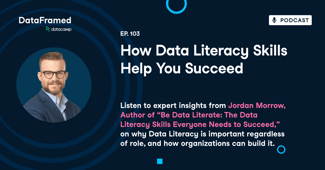

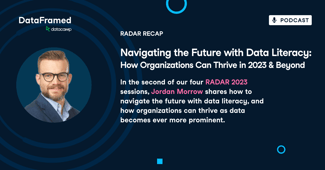

Jordan Morrow is Senior Vice President of Data & AI Transformation at AgileOne, he's also known as the Godfather of Data Literacy, and is the author of Be Data Literate: The Data Literacy Skills Everyone Needs to Succeed. Jordan has been a fierce advocate for data literacy throughout his career, including helping the United Nations understand and utilize data literacy effectively.