

课程
面向开发者的 AI 辅助编码
1 小时 30 分钟
11.6K
实践并学习路径你的进步。
使用 Google 继续AI models are great at generating text, writing code, and solving complex problems. But not every task needs a large language model to think through a problem and generate a lengthy response. Sometimes, all we need is a quick and accurate decision.
For example, an AI agent might need to decide whether to search the web, a customer support system might need to route a ticket, or a financial application might need to classify a transaction. These are small decisions, but when you are making thousands of them every day, speed and cost really matter.
This is where AI decision models come in. Instead of generating lengthy responses, they return structured classifications, probability scores, and predefined choices.
They are fast, affordable, and becoming increasingly accurate. Even smaller open-weight models are now competing with proprietary alternatives.
In this article, I'll explore 10 of the best open-weight and proprietary AI decision models in 2026.
To decide the rankings, I've compared results from Artificial Analysis, Jev Decision Index, and JevBench. I've also considered inference speed, pricing, multimodal capabilities, and how easy each model is to deploy.
Since these benchmarks use different testing methods, the rankings are not based on a single score. Instead, I've focused on models that offer a good balance of accuracy, speed, affordability, and practical usability, whether you are building a small application, running models locally, or deploying AI at enterprise scale.
AI decision models are designed to make quick decisions instead of generating long explanations. You give them an input, ask a question, and they return a structured answer with confidence scores.
For example, imagine you have a customer support application. You can ask a decision model to classify incoming messages as Billing, Technical Support, or General Inquiry. It will pick the most relevant category and return a confidence score for each option.
The interesting part is that modern decision models can work zero-shot. You do not need to train a separate model for every task. Just provide some text, define what you want the model to decide, and get your result. Some models can even work with images and videos.
So, why are they becoming so popular?
And this is what makes decision models so exciting. You no longer need to rely on a large reasoning model for every little task. A decision model can handle routine classification, scoring, and routing, while a more powerful model can step in when something needs deeper analysis.
In this article, we rank the best proprietary and open-source AI decision models based on their performance across multiple benchmarks, including accuracy, latency, cost, and real-world decision-making capabilities.
Mammoth-1 is an open-weight 27B decision model developed by Base Labs, the research team at Baseten. It was built by fine-tuning Qwen3.5-27B specifically for structured decision-making rather than text generation.
The model was trained on 6.21 million decision examples, covering classification, reasoning, safety, expert evaluations, and situations where the model should admit uncertainty. Its training combines cross-entropy loss with a calibration objective to produce more reliable probability estimates.
One of its key innovations is block-bidirectional attention, which allows the model to evaluate questions alongside their available answer options. Combined with shared-prefix caching, this enables Mammoth-1 to process multiple questions about the same input efficiently without generating lengthy responses.
It supports Choice, Yes/No, and Score decisions, returning probabilities for predefined answers. The model is available under the MIT license and can be deployed locally or accessed through Baseten's System One-compatible API.
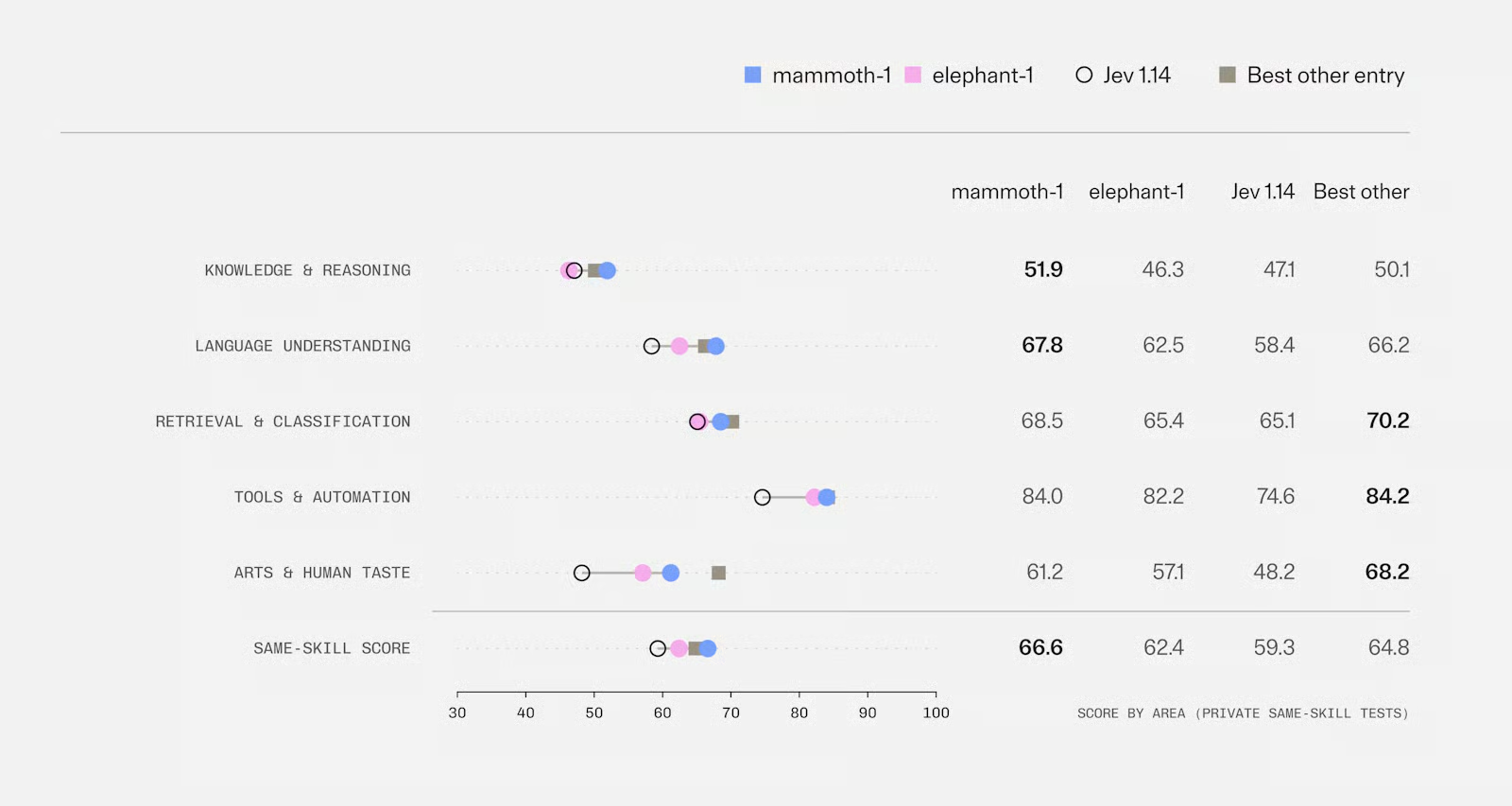
Source: Mammoth-1
Benchmark performance: Mammoth-1 ranked #1 out of 208 models on Jev Decision Index 0.4, scoring 71.24 and outperforming Perplexity Decider V1.2 at 69.42. It also scored 65.9 on Base Labs' replication of the Artificial Analysis Decision Index, ahead of Liquid AI d1-ultra at 65.0.
Liquid AI d1-ultra is a proprietary multimodal decision model. It was developed using a larger open-weight foundation model, extensive architecture customizations, and Liquid AI's specialized decision-model training pipeline.
Unlike conventional generative models, d1-ultra processes text and images in a single forward pass and returns probability-based decisions without generating output tokens.
A major focus during development was probability calibration. Liquid AI identified that many decision models produce overconfident predictions, so the team specifically trained d1-ultra to generate more reliable confidence estimates.
It supports three decision types: Choice, Yes/No, and Score. The model can process multiple questions, handle multimodal inputs, and make complex decisions involving tool selection, knowledge retrieval, and visual inspection.
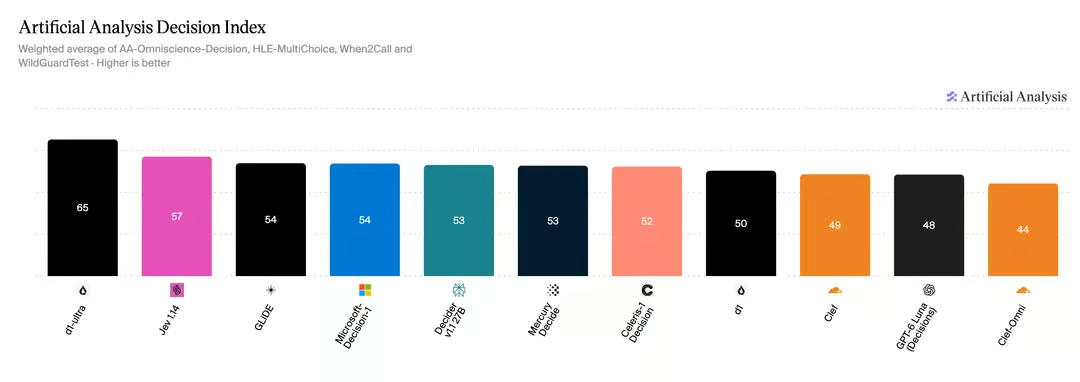
Source: d1-ultra
Benchmark performance: The d1-ultra led the Artificial Analysis Decision Index, outperforming competing decision models by at least eight points. It also achieved 92.6% accuracy on When2Call, demonstrating strong tool-selection capabilities.
Perplexity Decider V1.2 is an open-weight 27B decision model built on the Qwen3.8-27B backbone. Unlike traditional language models that generate responses token by token, Decider produces structured classifications, scores, and probabilities directly.
The model builds on Decider V1.1 with improved training data, including additional decision-making datasets and carefully separated benchmark training splits.
Perplexity also combined several trained checkpoints through weight averaging to improve overall performance.
One of its biggest improvements is joint question processing. Instead of processing the same input separately for each question, Decider V1.2 evaluates multiple related questions in a shared sequence, reducing repeated computation.
The model supports text and images, up to 255 answer options, calibrated probabilities, and optimized batch inference using FlashAttention and CUDA graphs.
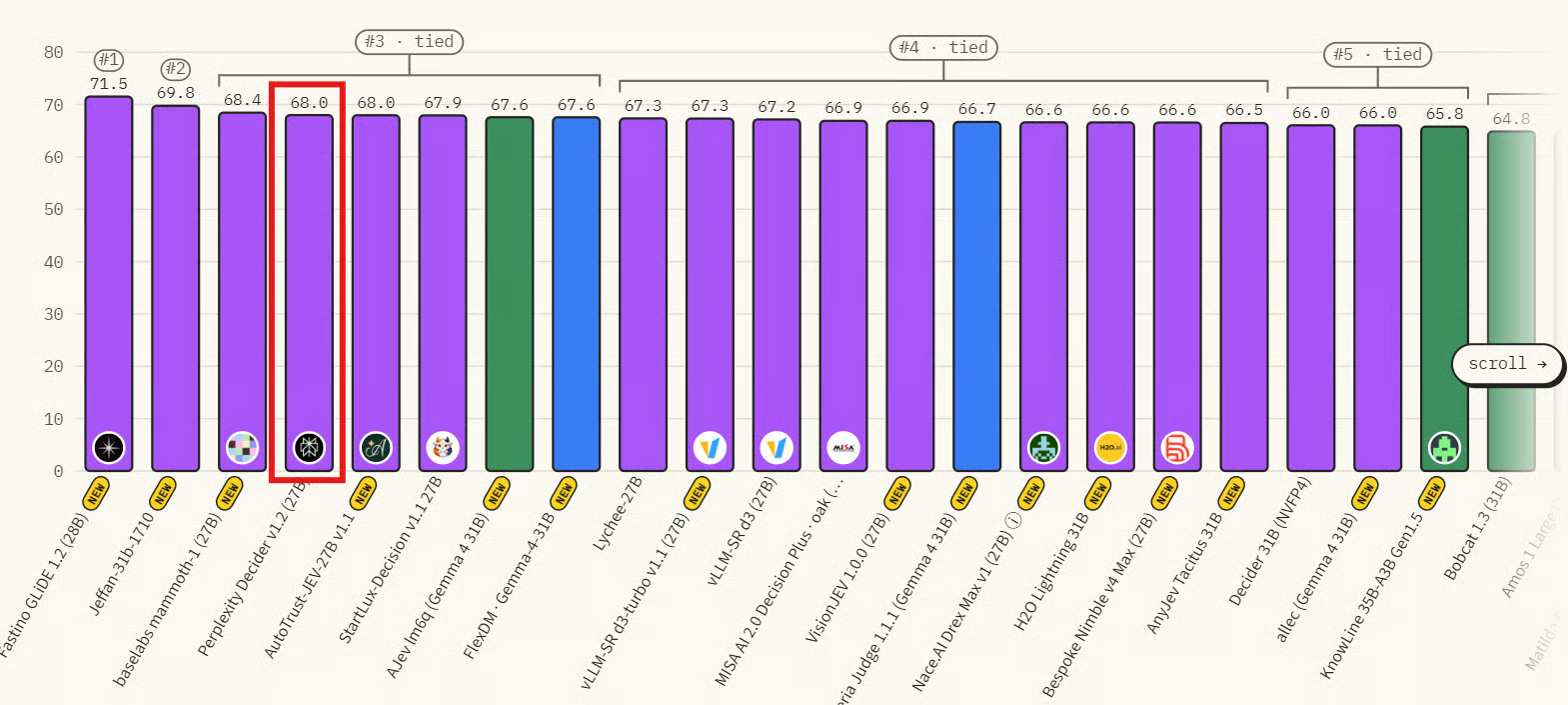
Source: Jev Decision Index
Benchmark performance: It achieved 68 on the public Jev Decision Index evaluation and 77.43 on its vision evaluation, improving on its predecessor in both categories.
D3 Turbo is an open-weight multimodal decision model developed by the vLLM Semantic Router project. It contains 26.09B parameters, including a 460M-parameter vision encoder, and uses a Qwen3.5-based architecture adapted for structured decision-making.
Rather than generating text, D3 Turbo uses specialized answer readouts to produce probabilities for predefined questions.
Its architecture allows it to read an input once and answer multiple questions without repeatedly processing the entire input.
The model supports text, images, and videos, along with five decision types: Choice, Yes/No, Score, Box, and Track. The last two allow developers to locate objects in images and track them throughout videos.
Another major feature is its long-context support of up to 131K tokens. It also becomes increasingly efficient when processing multiple questions about the same input. In the project's testing, it was 15.5 times faster than D3 Flash when answering 255 questions about one image.
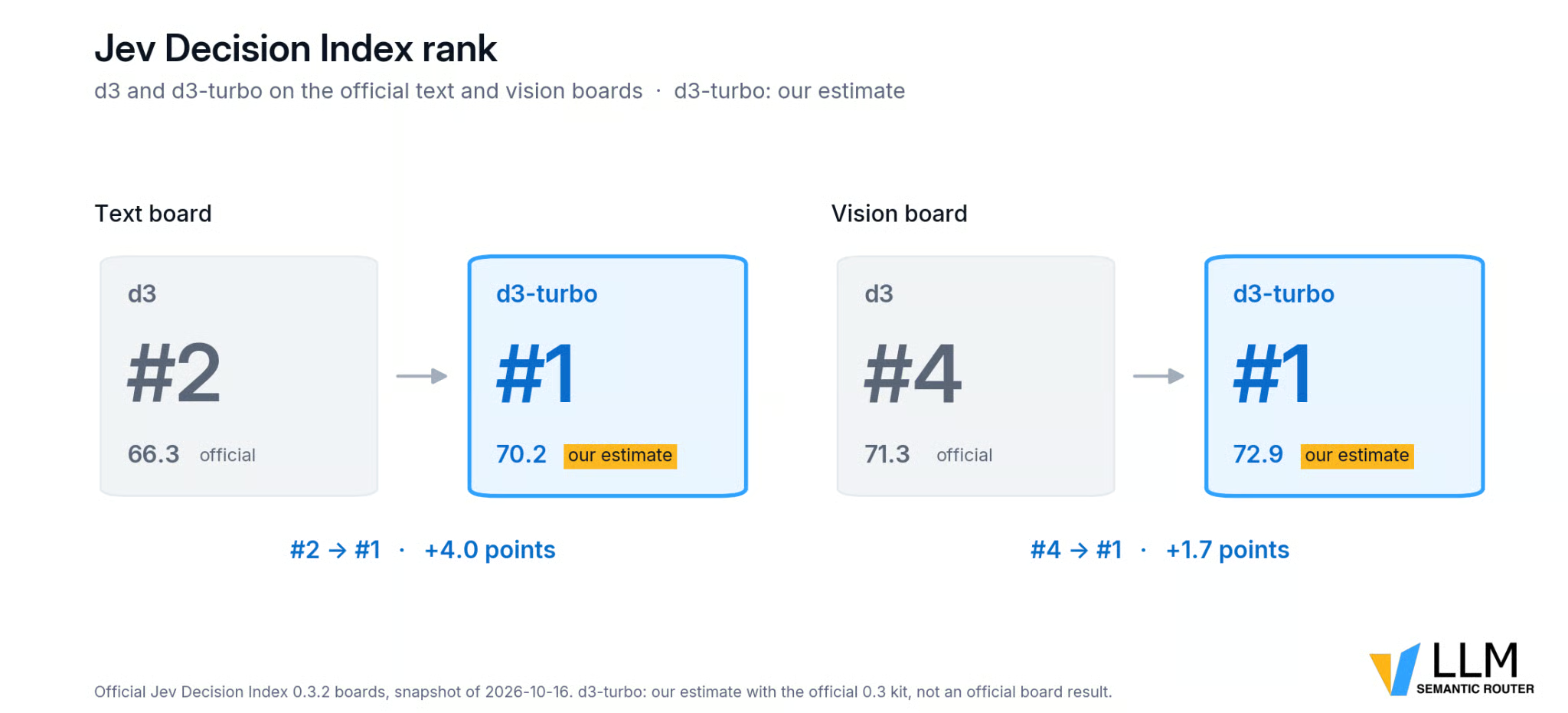
Source: vllm-sr/d3-turbo
Benchmark performance: D3 Turbo achieved estimated scores of 70.2 on the Jev Decision Index text evaluation and 72.9 on vision. These are project-reported estimates rather than official leaderboard results.
Elephant-1 is an open-weight 9B decision model developed by Base Labs, Baseten's research team. It was built by post-training Qwen3.5-9B specifically for fast, calibrated decision-making.
One of its architectural improvements is block-bidirectional attention, which allows selected attention layers to consider information from both directions rather than relying entirely on traditional causal attention.
The model was trained using a large collection of decision-making examples and a full fine-tuning approach.
Its vision encoder was frozen during training, while the language components were optimized to produce probability distributions over predefined answers.
Elephant-1 can answer multiple questions using a shared input-processing pass, reducing repeated computation. It supports structured choices, probability scores, and yes/no decisions, with a maximum sequence length of 16,384 tokens.
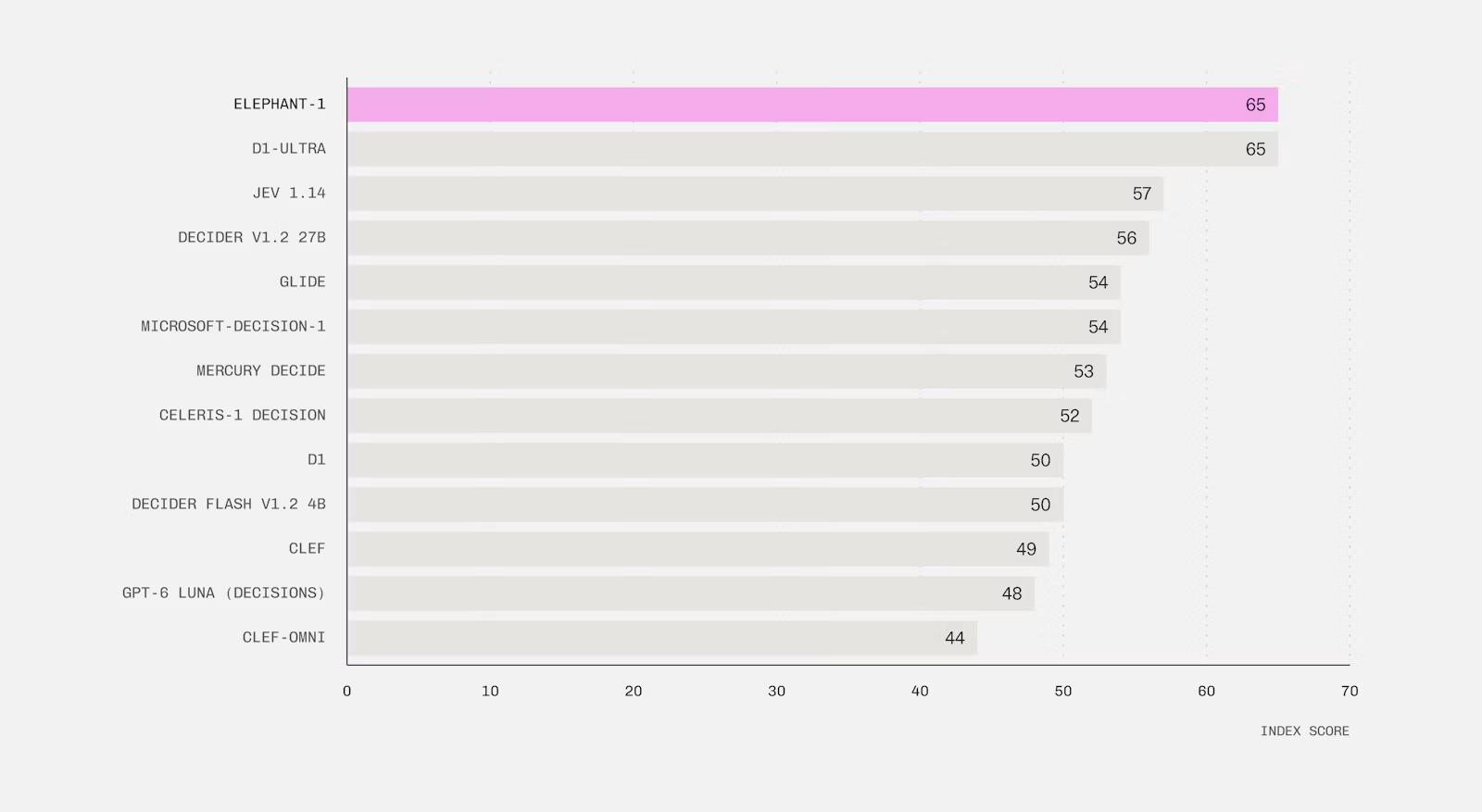
Source: Mammoth-1 and Elephant-1
Benchmark performance: Elephant-1 scored 62.65 on Jev Decision Index 0.4, tying for eighth place among 208 evaluated models and ranking as the strongest model under 15B parameters in Base Labs' published comparison. It also achieved 65.2 on the team's replication of the Artificial Analysis Decision Index, approximately matching Liquid AI d1-ultra.
TypeSafe Jev 1.14 is a proprietary System One decision model designed specifically for software automation rather than text generation.
TypeSafe developed Jev using a specialized model architecture, an optimized parallel sampling system, and a training method called Reinforcement Learning for Calibrated Decisions (RLCD).
This approach focuses on producing accurate decisions with useful confidence estimates rather than generating lengthy explanations.
Jev accepts application state and predefined questions, returning structured Choice, Score, and Yes/No results with associated probabilities. It can process multiple questions in parallel, making it suitable for classification, routing, ranking, and automated verification.
Version 1.14 introduces improvements in multilingual performance, experimental image support, longer-context processing, and a new Box decision type for locating objects in images.
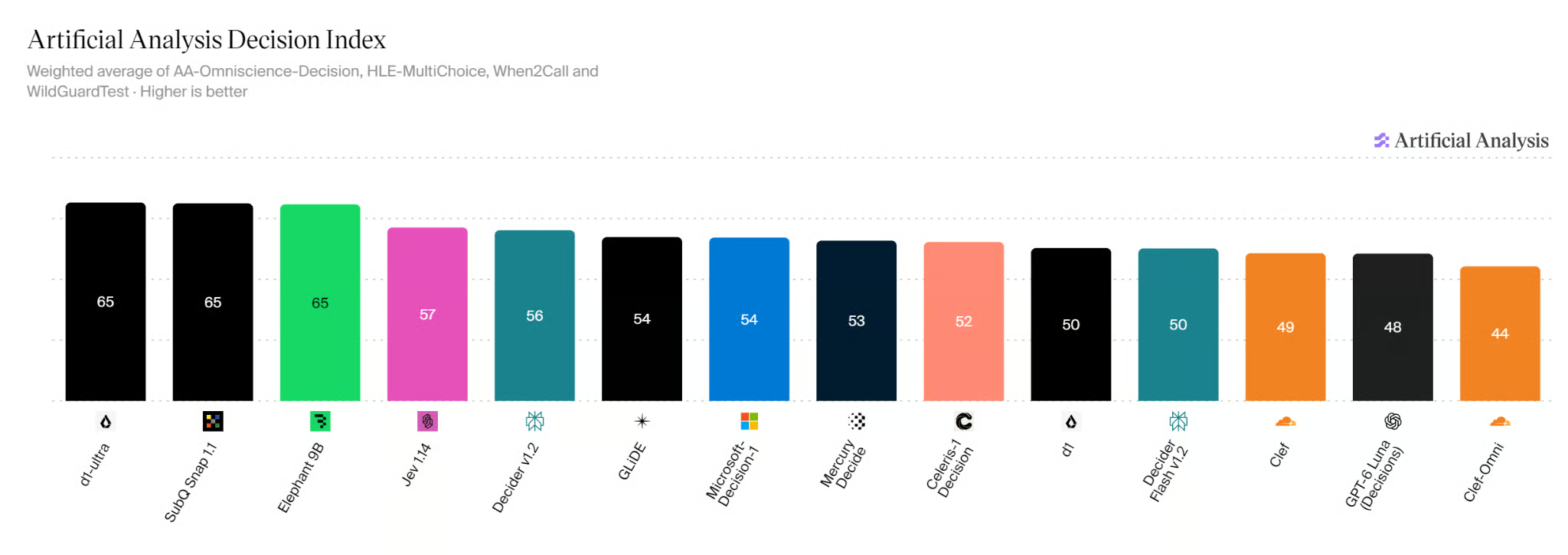
Source: Artificial Analysis Decision Index
Benchmark performance: Jev 1.14 has been reported among the leading models on the Artificial Analysis Decision Index, with particularly strong performance in low-latency structured decisions. Its newer image and bounding-box capabilities remain experimental rather than production-certified.
Fastino GLiDE, short for Generalized Lightweight Decision Engine, is a proprietary decision model developed by Fastino Labs.
Unlike conventional single-pass decision models, GLiDE introduces adaptive thinking, allocating additional computation when a decision requires more reasoning.
The model first evaluates the available options and calculates an initial probability distribution. If the result is uncertain, it performs additional reasoning before producing its final decision.
Straightforward classification tasks remain fast, while complicated decisions receive more computational attention.
This approach helps GLiDE handle arithmetic, code tracing, tool selection, conflicting evidence, and decisions involving multiple constraints.
The model supports a 40K-token context window and follows the System One API format. It returns a selected answer, confidence information, and probabilities for the available options.
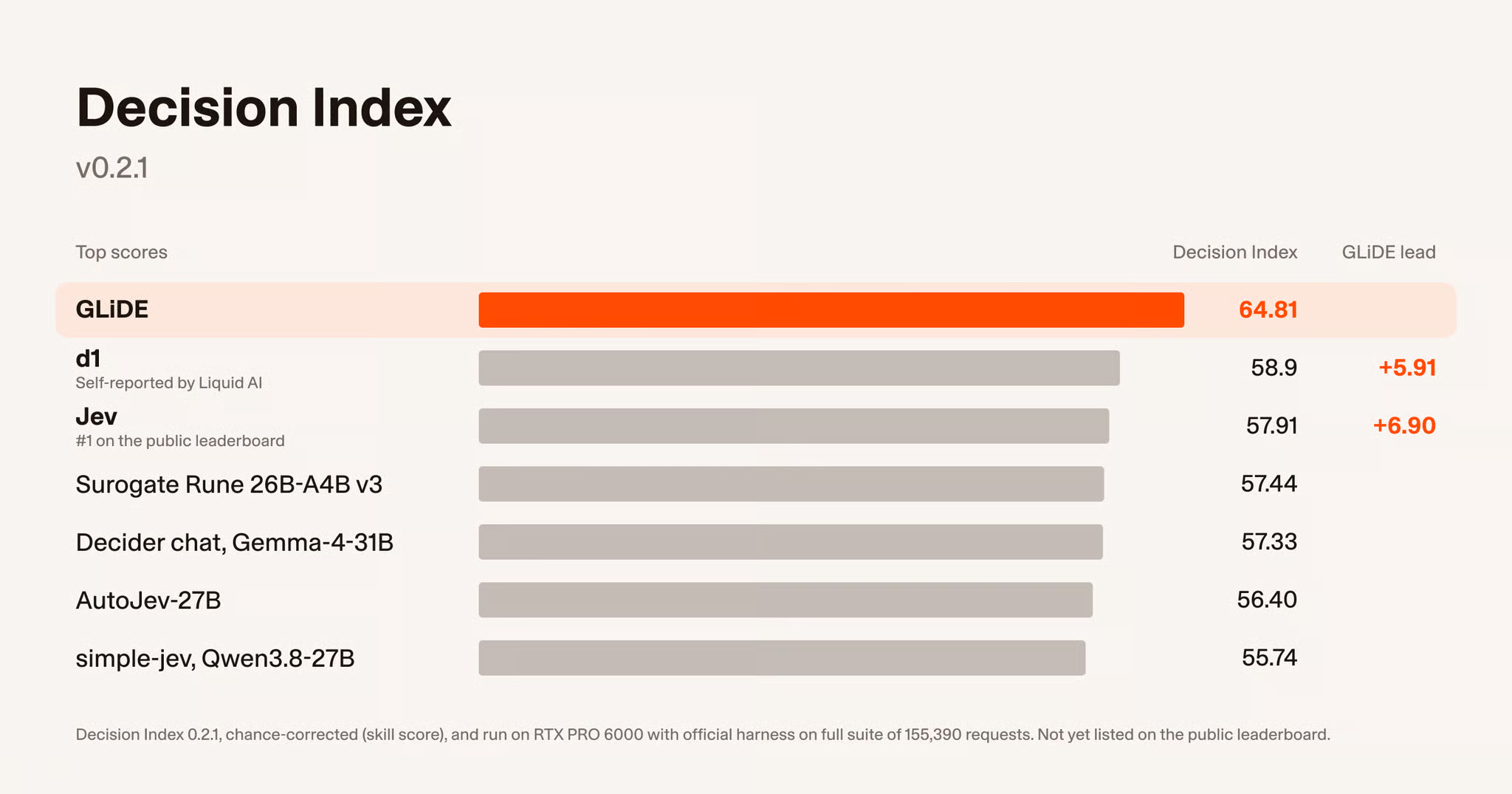
Benchmark performance: GLiDE achieved 64.81 on Decision Index 0.2.1 using Fastino's evaluation with the official scorer, compared with Jev's published score of 57.91.
It outperformed Jev on 31 of 38 individual benchmarks and achieved 83.5 in Tools and Automation. The results were published by Fastino rather than recorded as an official public leaderboard submission.
SubQ Snap is a proprietary multimodal decision model developed by Subquadratic. It focuses on one of the biggest limitations of existing decision models: processing extremely long inputs while maintaining fast inference.
The model builds on Subquadratic's research into Subquadratic Sparse Attention (SSA), an attention mechanism designed to reduce the computational cost of processing long sequences.
Instead of calculating every possible relationship between tokens, SSA focuses computation on the relationships that matter.
SubQ Snap supports context windows of up to 384K tokens, allowing it to evaluate entire codebases, lengthy documents, agent histories, and multiple files without repeatedly dividing them into smaller chunks.
It also supports text and images, returning structured decisions rather than generated explanations.
The company reports that Snap can process 100K tokens and return a decision in approximately one second. Its API costs $0.05 per million input tokens, with no output-token charges.
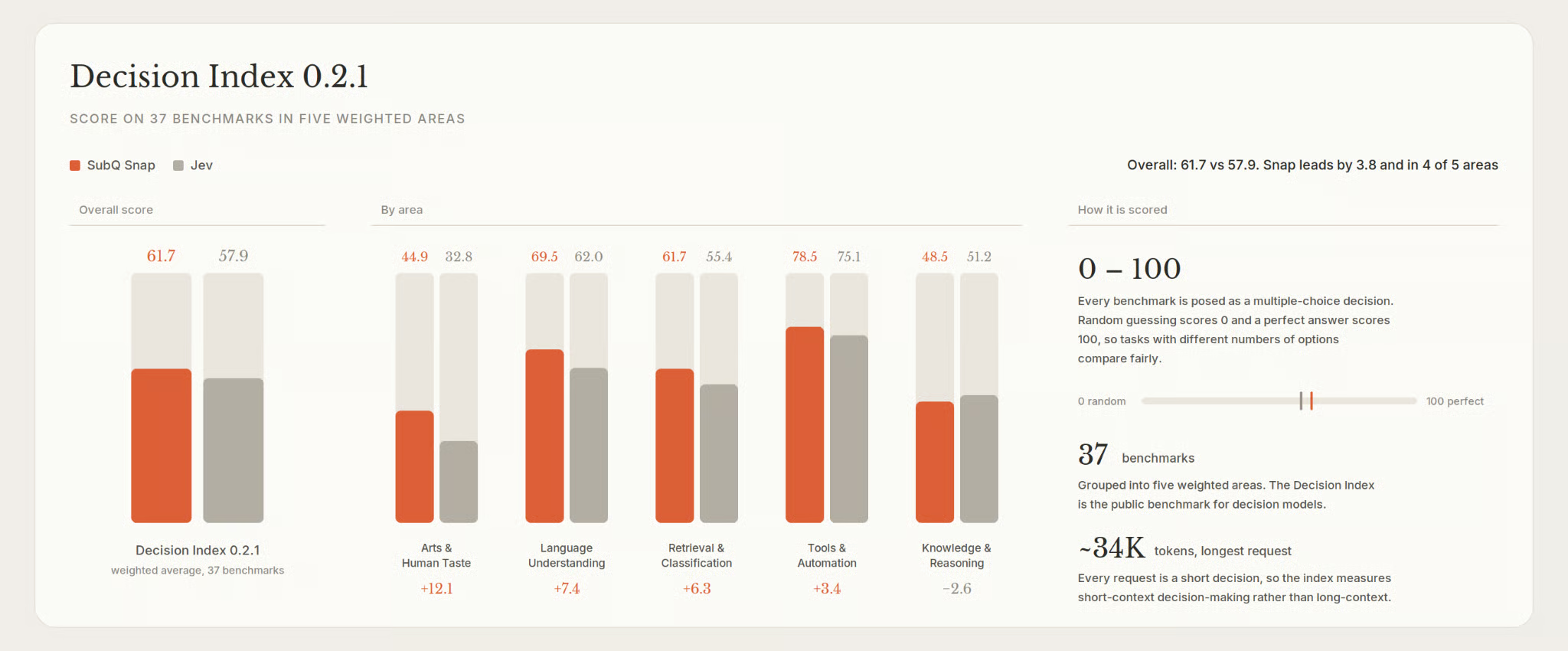
Source: Subquadratic
Benchmark performance: SubQ Snap scored 61.7 on Decision Index 0.2.1, compared with Jev's 57.9. It also achieved 82.9% accuracy on the 13-task Nimble benchmark and 74.0 on Decision LCR, compared with Jev's 48.0 using chunking.
Microsoft-Decision-1 is a proprietary decision-scoring model introduced by Microsoft. It was developed by post-training Qwen3.5-9B to perform fast, structured decisions using a single inference pass.
The model accepts predefined answer options and produces calibrated probability scores for each one, eliminating the need to generate and parse natural-language responses.
It supports yes/no decisions, multiple-choice questions, numerical ratings, and rubric-based evaluation.
Microsoft designed it for tasks such as model routing, agent workflow control, response verification, incident classification, and recommendation systems.
Microsoft-Decision-1 is available through Microsoft Foundry and OpenRouter, with API pricing of $0.042 per million input tokens and no output-token charges.
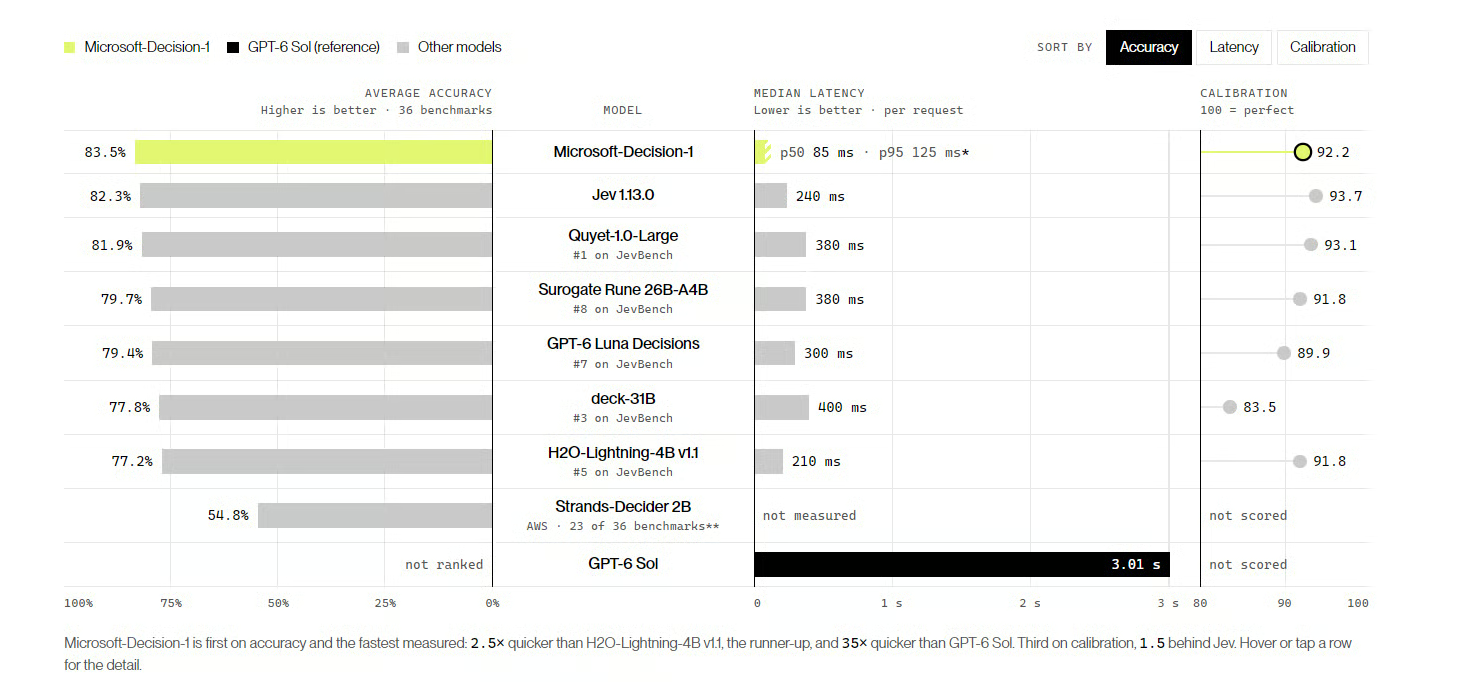
Source: Microsoft-Decision-1
Benchmark performance: Microsoft reported that Decision-1 achieved the highest accuracy in its internal comparison covering 36 benchmarks and nearly 150,000 questions held out from training.
It was also the fastest model in that evaluation, running 2.5 times faster than H2O-Lightning-4B v1.1 and 35 times faster than GPT-6 Sol under Microsoft's test setup.
H2O-Lightning-31B is an open-weight 31B-parameter decision model developed by H2O.ai and released in October 2026. It is built on Google's Gemma 4 31B instruction-tuned model and further trained for structured decision-making.
Unlike conventional language models, Lightning processes a record and a set of predefined questions, returning probabilities for the available answers rather than generating lengthy responses.
The model supports three decision types: Choice, Yes/No, and Score. It also handles multimodal inputs, including images, screenshots, documents, and charts, with a context window of approximately 131K tokens.
Its weights can be downloaded and deployed locally, and H2O provides serving scripts for decision-model evaluation.
However, the 31B version uses the H2O Model Non-Commercial Licence v1.1, which restricts commercial and production use.
Source: h2oai/h2o-lightning-31b
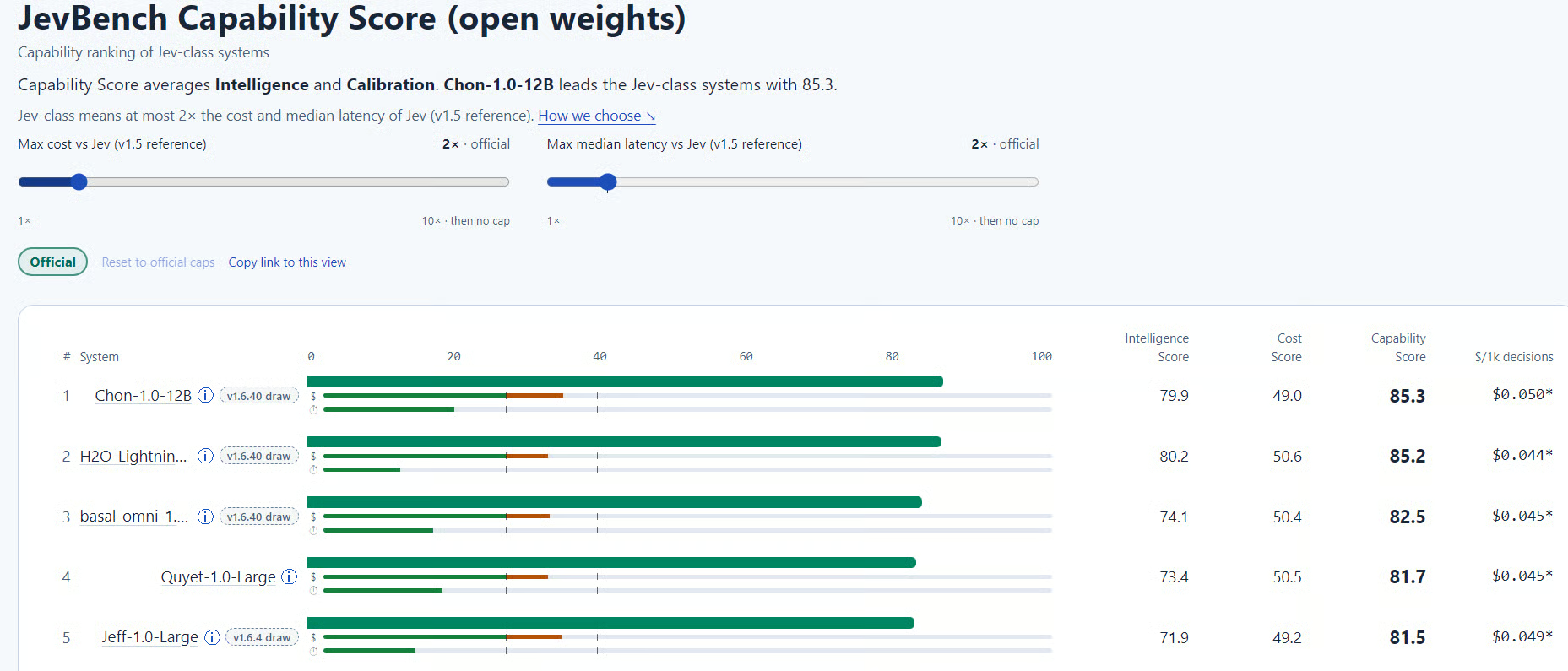
Benchmark performance: H2O-Lightning-31B has a reported Decision Index score of approximately 66.7. It ranks 2nd on JevBench, although its ranking depends on the benchmark version and scoring methodology.
The table below compares the top AI decision models based on their API pricing, inference latency, supported modalities, and key strengths.
|
Model |
Availability |
Input price / 1M tokens |
Median latency |
Modality |
Key strength |
|
Mammoth-1 (27B) |
Open-weight |
~$0.05* |
220 ms |
Text |
Accuracy and calibration |
|
Liquid d1-ultra |
Proprietary |
$0.042 |
230 ms |
Text, Image |
Tool routing |
|
Perplexity Decider V1.2 |
Open-weight |
$0.020 |
144 ms |
Text, Image |
Affordable inference |
|
D3 Turbo (27B) |
Open-weight |
$0.100 |
190 ms |
Text, Image, Video |
Multimodal decisions |
|
Elephant-1 (9B) |
Open-weight |
~$0.02* |
114 ms |
Text |
Small-model efficiency |
|
Jev 1.14 |
Proprietary |
$0.042 |
220 ms |
Text, Image |
Low latency |
|
Fastino GLiDE |
Proprietary |
$0.150 |
360 ms |
Text |
Adaptive reasoning |
|
SubQ Snap |
Proprietary |
$0.050 |
470 ms |
Text, Image |
Long-context processing |
|
Microsoft-Decision-1 |
Proprietary |
$0.042 |
460 ms |
Text |
Decision routing |
|
H2O-Lightning-31B |
Open-weight |
~$0.09* |
63 ms |
Text, Image |
Local inference |
Prices are USD per million input tokens.
*Estimated rates, not official paid API prices.
Latencies are previously reported measurements from different testing environments and are not directly comparable.
Almost every day, a new AI decision model is released that outperforms the previous ones. The space is moving incredibly fast, and the rankings will likely change again soon.
That is why I focused on models that offer more than just impressive benchmark scores.
Some are designed for enterprise applications, others are affordable enough for startups and small businesses, and several are open-weight models that you can run locally on your own hardware.
I think we are entering a new wave of AI where decision models will play a much bigger role in everyday applications. Instead of sending every request to an expensive reasoning model, we can use lightweight decision models to handle routine tasks like classification, routing, scoring, and verification at a fraction of the cost.
And when a decision model is uncertain, the system can use its confidence scores to route the request to a more capable reasoning model for deeper analysis, explanations, or a detailed report.
This way, we get the best of both worlds: fast and affordable decisions for everyday tasks, with powerful reasoning available when needed.
For me, that is the real potential of decision models.
It is not just about replacing larger AI models, but about building smarter, faster, and more cost-effective AI systems that know when to make a quick decision and when to think deeper.
Top DataCamp Courses
课程
课程
实践并学习路径你的进步。
使用 Google 继续博客
Abid Ali Awan
7分钟
博客
Bexruz (Bex) Tuychiev
15分钟
博客
Abid Ali Awan
9分钟
博客
Rajesh Kumar
15分钟
博客
Abid Ali Awan
8分钟
教程
Vaibhav Mehra
15分钟


