Datageletterdheid is tegenwoordig de norm, maar de meeste organisaties hebben dit nog niet op schaal opgebouwd.
In onze enquête uit 2026 onder 500+ leiders van grote organisaties in de VS en het VK, uitgevoerd met YouGov, was de boodschap consistent: de verwachtingen voor datageletterdheid op de werkvloer zijn hoog, maar de paraatheid van enterprises blijft achter.
De vaardigheidskloof in datageletterdheid draait niet om geavanceerde data science-specialisten. Het gaat erom of medewerkers in alle functies data met vertrouwen kunnen interpreteren, bevragen en toepassen in echte beslissingen.
We verkennen de bredere trends achter deze kloof, inclusief definities en benchmarks, in ons volledige overzicht van data- en AI-geletterdheid in 2026.
Wat is de vaardigheidskloof in datageletterdheid?
De vaardigheidskloof in datageletterdheid verwijst naar de kloof tussen het belang dat leiders hechten aan datageletterdheid en het daadwerkelijke vermogen van medewerkers om effectief met data te werken.
Datageletterdheid op de werkvloer omvat:
- Dashboards en visualisaties interpreteren
- Correlatie van causaliteit onderscheiden
- Datakwaliteit beoordelen
- Analyse omzetten in beslissingen
- Inzichten helder communiceren
Het is niet beperkt tot analisten. Nu data in elke functie wordt ingebed, van HR tot marketing en operations, wordt basisgeletterdheid een vereiste voor de hele werkvloer. Toch blijft de capaciteit achter.
Datageletterdheid wordt verwacht, maar niet opgebouwd
De statistieken over datageletterdheid in 2026 laten een opvallend patroon zien:
- 88% van de leiders zegt dat basisdatageletterdheid belangrijk is voor het dagelijkse werk
- 76% zegt dat medewerkers toegang hebben tot leermiddelen voor data
- 89% meldt dat ze een vorm van datatraining aanbieden
En toch tegelijk:
- 60% meldt een kloof in datavaardigheden
- Slechts 42% biedt basisdatageletterdheid op schaal aan
- Maar 35% heeft een volwassen, organisatiebrede upskilling-programma
De kern van de kloof is dat er training is, maar de capaciteiten ontbreken. Er gaat dus iets mis in het midden.
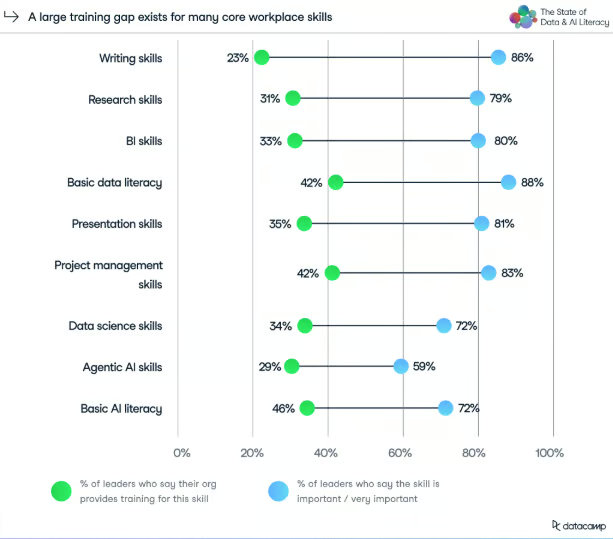
Waar de kloof in datageletterdheid zichtbaar wordt
De kloof is niet primair technisch—leiders zien keer op keer knelpunten in fundamentele gebieden:
1. Data omzetten in beslissingen
Als datageletterdheid zwak is, lijdt de kwaliteit van beslissingen daaronder. Leiders noemen de grootste risico's van onvoldoende datavaardigheden:
- 35% noemt onnauwkeurige besluitvorming
- 32% noemt trage besluitvorming
- 23% noemt verminderde productiviteit
- 28% noemt gebrek aan innovatie
Dit sluit aan bij hoe leiders het kernprobleem omschrijven: medewerkers kunnen rapporten genereren, maar vinden het lastig te interpreteren wat de data daadwerkelijk betekent of hoeveel vertrouwen ze erin moeten stellen.
Daarentegen zegt 54% dat sterke datageletterdheid leidt tot snellere besluitvorming, en 49% dat het de nauwkeurigheid van beslissingen verbetert. Het verschil tussen capaciteit en kloof is direct zichtbaar in uitvoeringssnelheid en bedrijfsperformance.
2. Inzichten helder communiceren
Hoewel leiders besluitvorming en interpretatievaardigheden unaniem als cruciaal beoordelen—met 80%+ die data-gedreven besluitvorming en het interpreteren van dashboards als (zeer) belangrijk ziet—melden ze aanhoudende uitdagingen bij het omzetten van analyse naar actie.
Dit zie je terug in prestatie-uitkomsten: 76% zegt dat medewerkers met sterke datageletterdheidsvaardigheden beter presteren dan degenen zonder.
Het probleem is niet de toegang tot dashboards. Het gaat erom of medewerkers kunnen:
- Signaal van ruis onderscheiden
- Data verbinden met de bedrijfscontext
- Gevolgen helder communiceren
Zonder die capaciteit blijven inzichten steken in de rapportagefase.
3. Vertrouwen en datakwaliteitsproblemen
Kloofjes in datageletterdheid brengen ook operationeel risico met zich mee. Zo ziet 22% van de leiders beveiligingsincidenten als een belangrijk risico dat samenhangt met gebrekkige datavaardigheden.
Als medewerkers datakwaliteit, governancekaders of verantwoord datagebruik niet begrijpen, gebruiken ze data verkeerd of vermijden ze het helemaal. Beide uitkomsten beperken waardecreatie.
Waarom training in datageletterdheid de kloof niet dicht
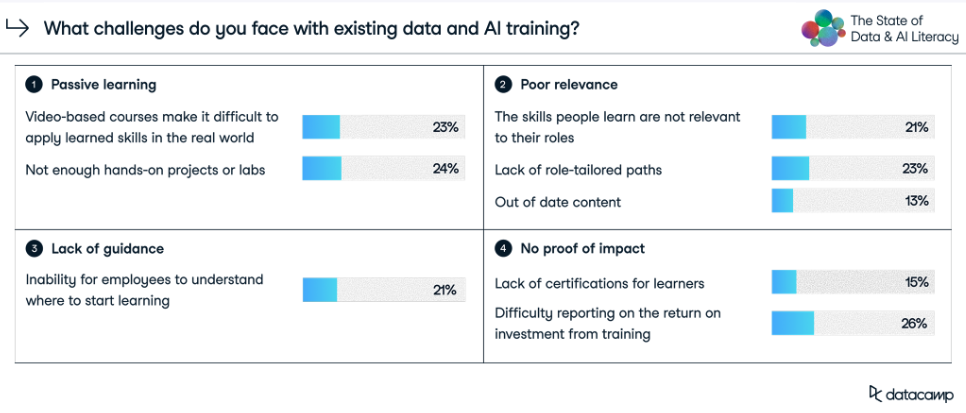
De meeste organisaties zeggen dat ze datatraining aanbieden, maar leiders noemen bekende structurele problemen:
- 23% zegt dat leerpaden niet op rollen zijn afgestemd
- 24% meldt onvoldoende praktijkopdrachten of labs
- 26% heeft moeite om de ROI van training te meten
- 21% zegt dat medewerkers niet weten waar ze moeten beginnen
Ondertussen noemt 35% tijdsdruk als de grootste belemmering voor het verbeteren van datavaardigheden op de werkvloer. Het probleem is niet bewustzijn; traditionele trainingsmodellen zijn simpelweg niet ontworpen om brede, geborgde capaciteiten op te bouwen in een hele organisatie.
De zakelijke gevolgen van de kloof in datageletterdheid
De vaardigheidskloof in datageletterdheid is niet alleen een HR-probleem; het is een organisatiebrede prestatiekwestie.
Leiders melden dat onvoldoende datavaardigheden bijdragen aan:
- Onnauwkeurige besluitvorming
- Langzamere besluitcycli
- Minder innovatie,
- Onvermogen om gelijke tred te houden met concurrenten
Het concurrentievoordeel van datageletterdheid is duidelijk, maar de organisatiebrede investering vaak niet. De volledige uiteenzetting van prestatie- en ROI-bevindingen is beschikbaar in het 2026 State of Data & AI Literacy Report.
Wat er echt nodig is om de kloof in datageletterdheid te dichten
Organisaties die meetbare vooruitgang boeken, delen gemeenschappelijke kenmerken. Effectieve programma's voor datageletterdheid zijn:
- Werkvloerbreed, niet beperkt tot analisten
- Rolrelevant, gekoppeld aan echte beslissingen
- Hands-on, gericht op toegepaste praktijk
- Geborgd over tijd, geen eenmalige workshops
- Meetbaar, met duidelijke vaardigheidsbenchmarks
De vaardigheidskloof in datageletterdheid dichten betekent toegepaste oordeelsvorming op schaal opbouwen, niet alleen steeds meer content aanbieden.
De kloof in datageletterdheid in de praktijk dichten
Sommige organisaties zijn al overgestapt van gefragmenteerde training naar gestructureerde capaciteitsopbouw. Zo bouwde Bayer een meerlaagse Data Academy om de basis digitale en AI-vaardigheden organisatiebreed te versterken. Meer dan 90% van de lerenden meldde na afloop innovatieve ideeën of verbeterde processen te hebben ontwikkeld.
Evenzo nam Shifta een proactieve stap: zorgen dat de hele organisatie klaar is om met vertrouwen met AI te werken, toen AI steeds centraler werd in hun producten en diensten.
Deze voorbeelden bevestigen een consistent patroon: gestructureerd, toegepast leren vertaalt zich in meetbare capaciteit.
Hoe DataCamp enterprise-datageletterdheid ondersteunt
Het DataCamp for Business-platform is ontworpen om voorbij passieve training te gaan, richting toegepaste capaciteitsopbouw. Met rolgebaseerde leerpaden, hands-on oefeningen, vaardigheidsassessments en meetbare benchmarks kunnen organisaties basisdatageletterdheid opbouwen bij zowel technische als niet-technische teams.
Als je wilt overstappen van gefragmenteerde datatraining naar werkvloerbrede capaciteit, neem contact op om te zien hoe DataCamp for Business programma's voor datageletterdheid ondersteunt.
Van basisvereiste naar concurrentievoordeel
Datageletterdheid is niet langer optioneel. Het staat naast schrijven en projectmanagement als een fundamentele vaardigheid op de werkvloer.
Toch missen de meeste enterprises nog de gestructureerde systemen om dit consequent op te bouwen. Organisaties die datageletterdheid als basisvereiste behandelen en er dienovereenkomstig in investeren, zien veel vaker snellere beslissingen, sterkere innovatie en blijvende prestatieverbeteringen.