La culture des données est devenue un prérequis, mais la plupart des organisations ne l’ont pas encore développée à grande échelle.
Dans notre enquête 2026 auprès de plus de 500 dirigeants d’entreprises aux États‑Unis et au Royaume‑Uni, menée avec YouGov, le message est clair : les attentes en matière de culture des données au travail sont élevées, mais la préparation des entreprises ne suit pas.
Le déficit de compétences en culture des données ne concerne pas les profils d’experts en data science. Il s’agit avant tout de savoir si les collaborateurs, toutes fonctions confondues, peuvent interpréter, questionner et appliquer les données avec assurance dans des décisions réelles.
Nous analysons les tendances de fond derrière ce déficit, avec définitions et points de repère, dans notre vue d’ensemble 2026 de la culture des données et de l’IA.
Qu’est‑ce que le déficit de culture des données ?
Le déficit de culture des données désigne l’écart entre l’importance accordée par les dirigeants à cette compétence et la capacité réelle des employés à travailler efficacement avec les données.
La culture des données au travail inclut :
- Interpréter des tableaux de bord et des visualisations
- Distinguer corrélation et causalité
- Évaluer la qualité des données
- Transformer l’analyse en décisions
- Communiquer clairement les enseignements
Elle ne se limite pas aux analystes. À mesure que les données s’intègrent à toutes les fonctions, des RH au marketing en passant par les opérations, un socle commun devient indispensable à l’échelle de la main‑d’œuvre. Or les compétences n’ont pas encore suivi.
La culture des données est attendue, mais rarement ancrée
Les statistiques 2026 sur la culture des données révèlent un schéma frappant :
- 88 % des dirigeants jugent la culture des données de base importante au quotidien
- 76 % indiquent que les employés ont accès à des ressources d’apprentissage sur les données
- 89 % déclarent proposer une forme de formation aux données
Et pourtant, dans le même temps :
- 60 % constatent un déficit de compétences en données
- Seuls 42 % dispensent à grande échelle une formation fondamentale à la culture des données
- À peine 35 % disposent d’un programme de montée en compétences mûr et transverse
Le décalage est net : la formation existe, mais les compétences n’y sont pas. C’est qu’entre les deux, quelque chose ne fonctionne pas.
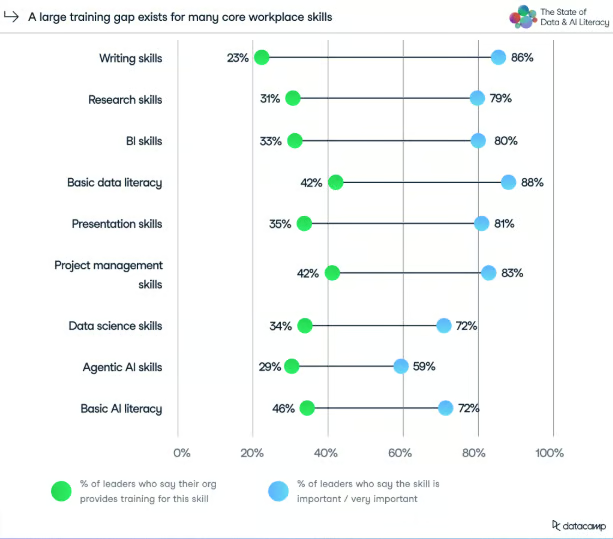
Où le déficit de culture des données se manifeste
Le problème n’est pas d’abord technique : les dirigeants pointent des défaillances sur les fondamentaux :
1. Transformer les données en décisions
Quand la culture des données est faible, la qualité des décisions se dégrade. Les dirigeants identifient les principaux risques liés à des compétences insuffisantes :
- 35 % évoquent des décisions imprécises
- 32 % évoquent une lenteur dans la prise de décision
- 23 % évoquent une baisse de productivité
- 28 % évoquent un manque d’innovation
Cela rejoint le constat principal : les équipes savent produire des rapports, mais peinent à interpréter ce que signifient réellement les données ou le degré de confiance à leur accorder.
À l’inverse, quand la culture des données est solide, 54 % observent une prise de décision plus rapide et 49 % une meilleure précision des décisions. L’écart de capacité se traduit directement par une exécution plus rapide et de meilleures performances business.
2. Communiquer clairement les enseignements
Même si la très grande majorité des dirigeants classent la prise de décision et l’interprétation parmi les compétences critiques — plus de 80 % jugent essentielles la décision basée sur les données et l’interprétation de tableaux de bord — ils constatent des difficultés persistantes à convertir l’analyse en action.
Cela se reflète dans la performance : 76 % estiment que les collaborateurs dotés d’une forte culture des données surperforment les autres.
Le problème n’est pas l’accès aux tableaux de bord, mais la capacité des employés à :
- Distinguer le signal du bruit
- Relier les données au contexte business
- Communiquer clairement les implications
Sans cette capacité, les insights restent bloqués au stade du reporting.
3. Problèmes de confiance et de qualité des données
Les lacunes de culture des données créent aussi des risques opérationnels. Par exemple, 22 % des dirigeants citent des incidents de sécurité parmi les risques clés associés à de faibles compétences en données.
Quand les équipes ne maîtrisent pas la qualité des données, les cadres de gouvernance ou les pratiques responsables, elles font un mauvais usage des données — ou n’en font pas du tout. Dans les deux cas, la création de valeur en pâtit.
Pourquoi la formation à la culture des données ne comble pas l’écart
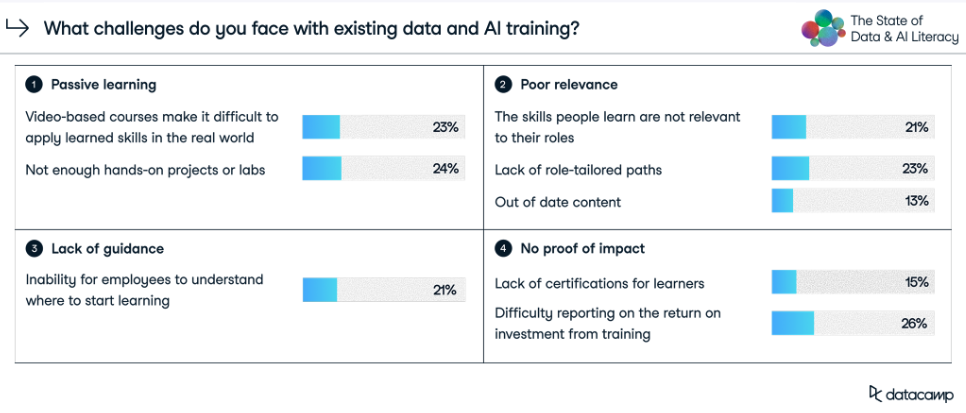
La plupart des organisations déclarent proposer des formations aux données, mais les dirigeants pointent des freins structurels bien connus :
- 23 % estiment que les parcours d’apprentissage ne sont pas adaptés aux rôles
- 24 % évoquent un manque de projets ou de labs pratiques
- 26 % peinent à mesurer le ROI de la formation
- 21 % indiquent que les employés ne savent pas par où commencer
Par ailleurs, 35 % citent le manque de temps comme principal obstacle à l’amélioration des compétences data. Le problème n’est pas la sensibilisation ; c’est que les modèles de formation traditionnels ne sont pas conçus pour développer des capacités larges et renforcées à l’échelle de toute l’entreprise.
Les conséquences business du déficit de culture des données
Le déficit de culture des données n’est pas qu’un sujet RH ; c’est un enjeu de performance organisationnelle.
Les dirigeants rapportent que des compétences insuffisantes en données contribuent à :
- Des décisions inexactes
- Des cycles de décision plus lents
- Une innovation en recul
- Une difficulté à suivre le rythme des concurrents
L’avantage concurrentiel d’une solide culture des données est évident, mais l’investissement à l’échelle de l’entreprise l’est moins. L’analyse complète des performances et du ROI est disponible dans le rapport 2026 sur l’état de la culture des données et de l’IA.
Ce qu’il faut vraiment pour combler le déficit
Les organisations qui progressent de manière mesurable partagent des points communs. Les programmes efficaces de culture des données sont :
- Transverses à la main‑d’œuvre, pas réservés aux analystes
- Pertinents par rôle, ancrés dans des décisions réelles
- Pratiques, centrés sur l’application
- Renforcés dans la durée, pas en ateliers ponctuels
- Mesurables, avec des repères de compétences clairs
Combler le déficit de culture des données, c’est développer un jugement appliqué à grande échelle, pas seulement ajouter toujours plus de contenus.
Combler le déficit de culture des données, concrètement
Certaines organisations sont déjà passées d’actions de formation éparses à un développement structuré des capacités. Par exemple, Bayer a bâti une Data Academy à plusieurs niveaux pour renforcer les bases en culture numérique et IA à l’échelle de l’entreprise. Plus de 90 % des apprenants ont déclaré avoir développé des idées innovantes ou amélioré des processus après la formation.
De même, à mesure que l’IA est devenue centrale pour ses produits et services, Shifta a pris les devants : s’assurer que toute l’organisation est prête à travailler avec l’IA en toute confiance.
Ces exemples confirment une constante : un apprentissage structuré et appliqué se traduit par des compétences mesurables.
Comment DataCamp soutient la culture des données en entreprise
La plateforme DataCamp for Business est conçue pour aller au‑delà de la formation passive et développer de vraies capacités appliquées. Grâce à des parcours d’apprentissage par rôle, des exercices pratiques, des évaluations de compétences et des repères mesurables, les organisations peuvent bâtir une culture des données fondamentale au sein d’équipes techniques comme non techniques.
Si vous cherchez à passer de formations éparses à une capacité transverse à l’échelle de la main‑d’œuvre, contactez‑nous pour découvrir comment DataCamp for Business accompagne les programmes de culture des données en entreprise.
Du prérequis à l’avantage concurrentiel
La culture des données n’est plus optionnelle. Elle se hisse au niveau de l’expression écrite et de la gestion de projet comme compétence fondamentale au travail.
Pourtant, la plupart des entreprises n’ont pas encore les systèmes structurés pour la développer de manière continue. Celles qui la considèrent comme un prérequis et investissent en conséquence ont bien plus de chances d’accélérer leurs décisions, de stimuler l’innovation et d’obtenir des gains de performance durables.