课程
面向开发者的 AI 辅助编码
1 小时 30 分钟
11.1K
Anthropic released Claude Opus 5.5 on September 22, 2026, pitching it as Fable-level performance at a lower price. Three weeks later, Google made Gemini 4 Argon generally available through the Gemini API, Google Cloud, and the Gemini app, after a limited first rollout to cyber defenders.
The pairing is direct. Google's launch benchmark table puts Opus 5.5 in the column next to Argon, and from December 1, 2026, the two flagships carry identical API list prices. Until then, Argon sells at an introductory discount, so the question for most teams is less about cost and more about which kind of work each model does better.
Gemini 4 Argon is Google DeepMind's frontier reasoning model, generally available in October 2026 through the Gemini API, Google Cloud, and the Gemini app.
Its selling point is depth on long, multi-step work: with long decode, Argon can think and write through a single very long trajectory, and Google aims it at coding, finance, legal, cybersecurity, and science.
Our Gemini 4 Argon guide covers the announcement, and our Argon vs GPT-6 Astra comparison sets it against OpenAI's flagship.
Claude Opus 5.5 is Anthropic's flagship model, released in September 2026 as the first model in the Claude 5.5 family.
Anthropic positions it as Claude Fable 5.1-level performance at a lower cost, with the biggest gains on long, sprawling coding jobs such as codebase-wide migrations, plus clearer writing than Opus 5.
Our Claude Opus 5.5 guide covers the launch in detail.
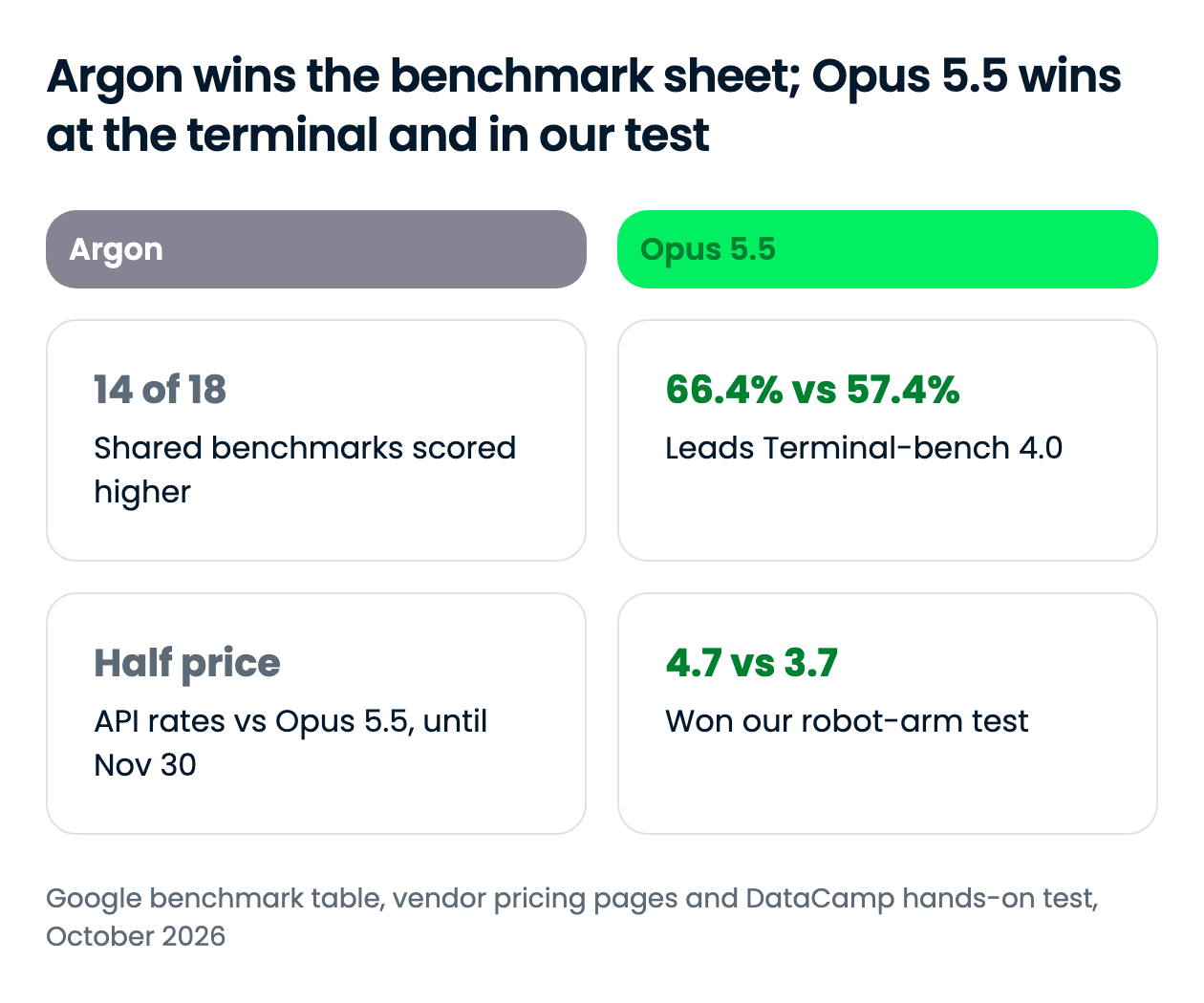 Gemini 4 Argon scores higher than Claude Opus 5.5 on 14 of the 18 benchmarks where Google's table has a score for both, but the four rows Opus 5.5 wins include the terminal-based coding work many developers buy a flagship for.
The summary below puts the deciding differences side by side; each dimension section that follows has the details.
| Feature | Gemini 4 Argon | Claude Opus 5.5 |
|---|---|---|
| Developer and release | Google DeepMind, generally available October 2026 | Anthropic, September 22, 2026 |
| Google's benchmark table (18 shared rows) | Higher on 14 | Higher on 4 |
| Agentic coding | Leads DeepSWE v1.1 and Vibe Code Bench | Scores higher than Argon on Terminal-bench 4.0, FrontierSWE v2 and PostTrainBench |
| Knowledge work | Leads all four knowledge-work rows | Trails on all four |
| Long context | Leads GraphWalks at every length | Falls further behind beyond 256K tokens |
| Context window | 1,048,576 tokens | 1M tokens |
| Max output | 65,536 tokens by default; up to 1,048,576 with long decode | 128K tokens |
| Reasoning control | Thinking levels: low, medium, high | Adaptive thinking, always on; default effort medium |
| API list price | Half of Opus 5.5's until November 30, 2026, then the same | Unchanged |
| Our hands-on test | Clipped through obstacles | No obstacle contact; our pick |
Opus 5.5 leads the terminal-heavy coding benchmarks, while Argon leads on long-horizon software engineering.
The clearest gap is Terminal-bench 4.0, where Opus 5.5 scores 66.4% to Argon's 57.4%, and Anthropic's own table reports the same Opus number, so the lead does not depend on whose harness you trust.
| Benchmark | Gemini 4 Argon | Claude Opus 5.5 | Notes |
|---|---|---|---|
| Terminal-bench 4.0 | 57.4% | 66.4% | Multi-step tasks in a command line |
| FrontierSWE v2 | 55.0% | 62.3% | Google-reported |
| PostTrainBench | 45.3% | 49.3% | ML engineering |
| DeepSWE v1.1 | 77.9% | 74.2% | Long-horizon software engineering |
| Vibe Code Bench | 91.9% | 90.3% | Effectively tied |
Argon's DeepSWE lead fits Google's own account of using it for large refactors, such as splitting browser feature code out of Chromium, and the two models are effectively tied on Vibe Code Bench.
Anthropic also reports FrontierCode v1.1 and CursorBench 4.0 for Opus 5.5, but Google did not publish Argon scores on either, so they cannot settle the comparison.
Two caveats apply to every table in this section:
For agent loops that live in a terminal, Opus 5.5 is the stronger pick, and our hands-on test below points the same way.
Argon leads every knowledge-work row in Google's table, and the gap is widest on legal work: Harvey's Legal Agent Benchmark gives Argon 19.6% against 3.8% for Opus 5.5.
| Benchmark | Gemini 4 Argon | Claude Opus 5.5 | Notes |
|---|---|---|---|
| Vals Index | 68.9% | 67.0% | Finance, coding, legal and tax work |
| AutomationBench | 51.3% | 42.5% | Anthropic reports 40.0% for Opus 5.5 (run by Zapier without fallback models) |
| Vals Finance Agent v2 | 65.4% | 58.6% | Multi-step financial research |
| Harvey's Legal Agent Benchmark | 19.6% | 3.8% | Legal research and drafting |
The Vals Index lead is narrow, but the finance and automation gaps are not. Anthropic counters with GDPval-AA v2.1, where Opus 5.5 posts 1846 Elo, though Google did not report Argon on it. For legal and financial research agents, Argon is the better bet.
Argon holds up much better on very long inputs: on GraphWalks between 256K and 1M tokens, it scores 84.2% to Opus 5.5's 66.8%, a gap that barely exists below 128K, where both stay high.
| Benchmark | Gemini 4 Argon | Claude Opus 5.5 | Notes |
|---|---|---|---|
| GraphWalks, up to 128K (BFS, F1) | 99.7% | 90.6% | Both strong |
| GraphWalks, 256K to 1M (BFS, F1) | 84.2% | 66.8% | Long-context reasoning |
| LVBench | 91.7% | 83.7% | Long video understanding |
| Chartography | 71.6% | 66.3% | Anthropic reports 89.0% with tools, a different setting |
The output side cuts the other way. Opus 5.5 writes up to its full output limit out of the box, while Argon's larger budget needs long decode and its continuation protocol.
For reading huge documents or videos, pick Argon; for long single-pass outputs without extra setup, Opus 5.5 is simpler.
Argon leads the science rows except one, with its biggest margin on LABBench 2 (88.8% to 73.1%).
It also leads RiemannBench, while Opus 5.5 wins Terminal-Bench Science 0.1, the agentic research benchmark run in a terminal.
| Benchmark | Gemini 4 Argon | Claude Opus 5.5 | Notes |
|---|---|---|---|
| LABBench 2 | 88.8% | 73.1% | Lab research tasks |
| RiemannBench | 76.0% | 69.6% | Mathematics |
| Terminal-Bench Science 0.1 | 57.6% | 63.3% | Anthropic reports 58.7% for Opus 5.5 |
| CWE-bench v1 | 68.0% | 67.0% | Vulnerability remediation; effectively tied |
| Agent's Last Exam (pass rate) | 39.5% | 38.2% | Computer use; effectively tied |
The pattern matches the coding split: Argon is stronger at reasoning over a problem, and Opus 5.5 is stronger at carrying it out step by step in a terminal.
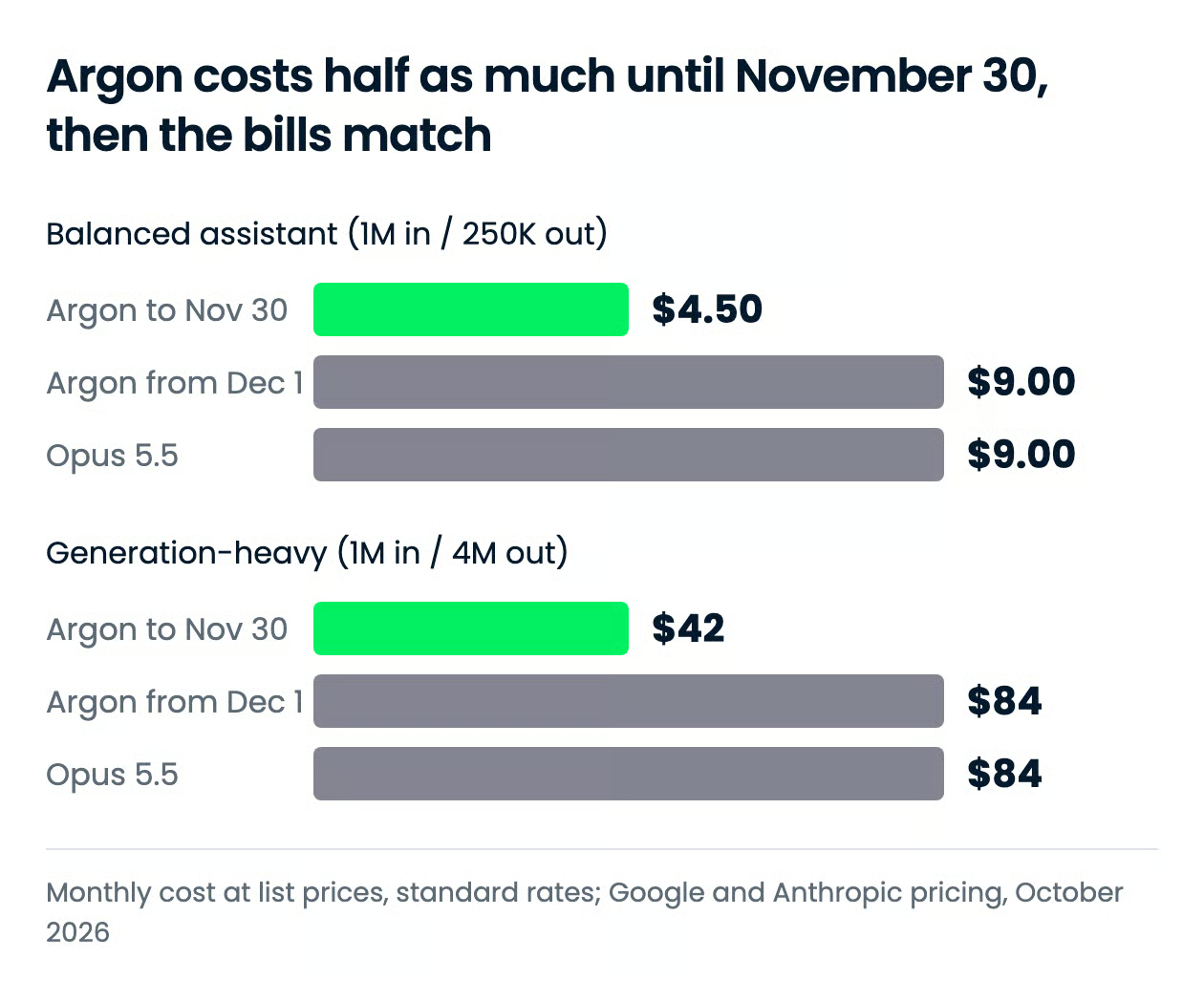
Argon is exactly half the price of Opus 5.5 on every published rate until November 30, 2026, and from December 1 the two list prices are identical, so the discount is a time-limited deal rather than a structural advantage.
The rates below are per 1M tokens, with Argon's introductory and standard prices in separate columns.
| Rate | Gemini 4 Argon (to Nov 30, 2026) | Gemini 4 Argon (from Dec 1, 2026) | Claude Opus 5.5 |
|---|---|---|---|
| Input, per 1M tokens | $2.00 | $4.00 | $4.00 |
| Output, per 1M tokens | $10.00 | $20.00 | $20.00 |
| Cached input read, per 1M tokens | $0.10 | $0.20 | $0.20 |
| Cache write, per 1M tokens | Not applicable (implicit caching only) | Not applicable (implicit caching only) | $5.00 (5-minute), $8.00 (1-hour) |
Google bills Argon's thinking tokens at the output rate, and Opus 5.5 always thinks because its thinking cannot be switched off, so on both models a long reasoning run lands on the expensive side of the bill.
Two extras apply only to Opus 5.5: Anthropic's Batch API halves its input and output rates, and fast mode in Claude Code and the Claude Platform costs $8 / $40 for up to 2.5x speed.
Because Argon's rates are a flat multiple of Opus 5.5's, two workload shapes are enough to show the effect, priced as (volume ÷ 1M) × rate, summed across input and output.
| Workload (monthly) | Gemini 4 Argon (to Nov 30) | Gemini 4 Argon (from Dec 1) | Claude Opus 5.5 | Argon saving to Nov 30 |
|---|---|---|---|---|
| Balanced assistant: 1M in / 250K out | $4.50 | $9.00 | $9.00 | $4.50 (50%) |
| Generation-heavy: 1M in / 4M out | $42 | $84 | $84 | $42 (50%) |
The percentage is the same on both rows because every rate halves, so the dollar saving simply scales with volume.
A cache-heavy agent loop is where the models could diverge, since Opus 5.5 charges for cache writes and Argon caches implicitly, but neither vendor publishes enough to price that shape like-for-like.
Google and Anthropic have not published token counts for a shared workload, so treat these totals as a rate comparison rather than a bill.
Benchmark tables from two vendors only go so far, so I ran one build task against both models with an identical prompt and identical tooling.
The task: a single-file web page that animates a three-link robot arm visiting five targets in order on a plane with rectangular obstacles. Each target gets 4 seconds (3 to move, 1 to hold), the links must keep their exact lengths, no part of the arm may touch an obstacle at any moment, and a status list must report whether the arm's tip actually reached each target. No build step, no dependencies, no network.
The scene hides two traps:
The prompt mentions neither, so noticing them is the point. The task probes Google's claim that Argon brings major improvements in spatial reasoning, mathematical precision, and visual coding.
Both ran in OpenCode with a pinned tool surface (file read, write and edit only), one attempt each, fresh session, prompt delivered byte-for-byte. My first attempt ran both at high effort, and Argon spent its whole default 65,536-token output budget reasoning and never wrote the file, so I reran both at medium. Medium is Anthropic's default for Opus 5.5 and the second of its five effort levels, while for Argon it is the middle of three.
Here is what Opus 5.5 produced:
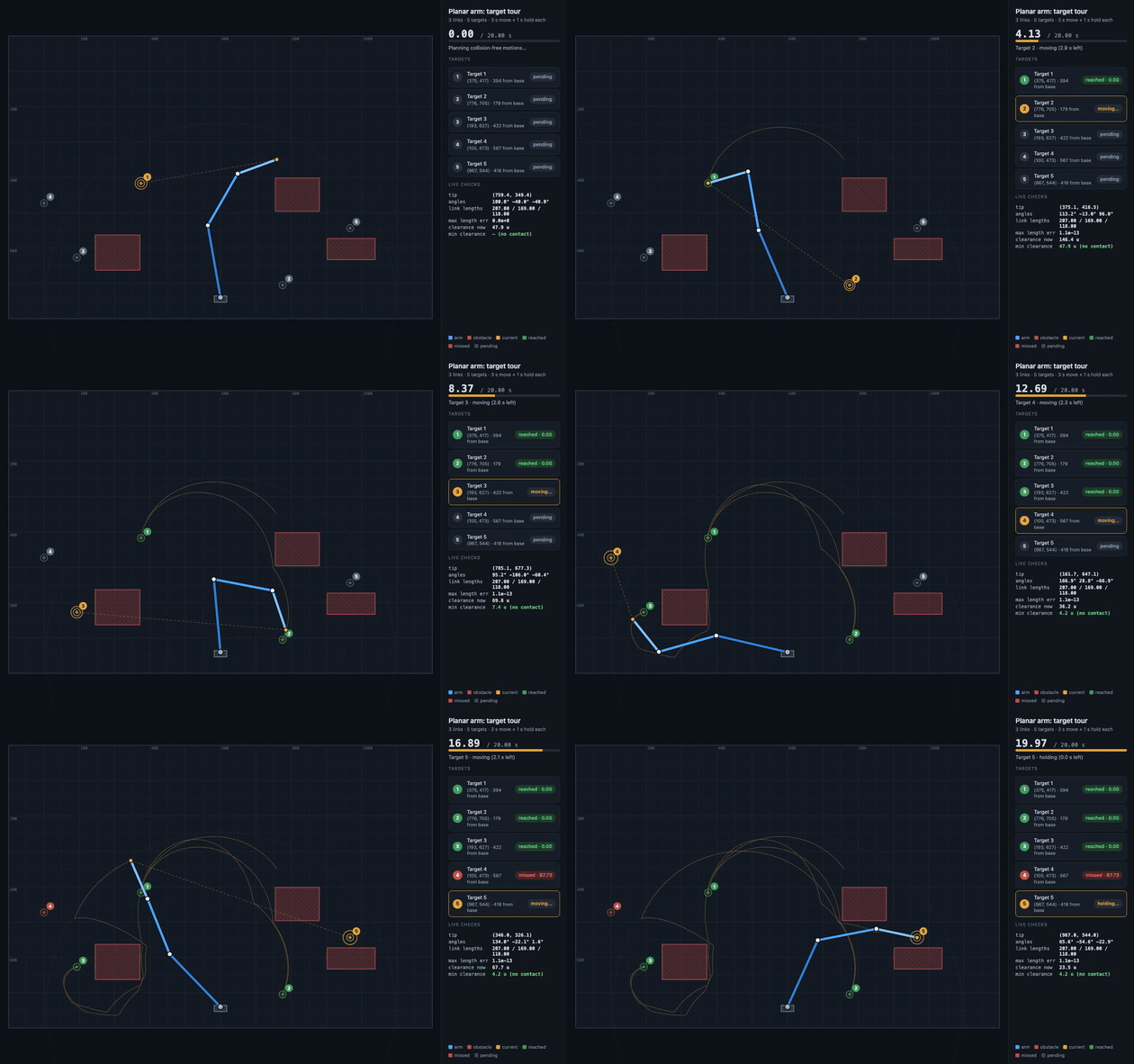
And here is Gemini 4 Argon:
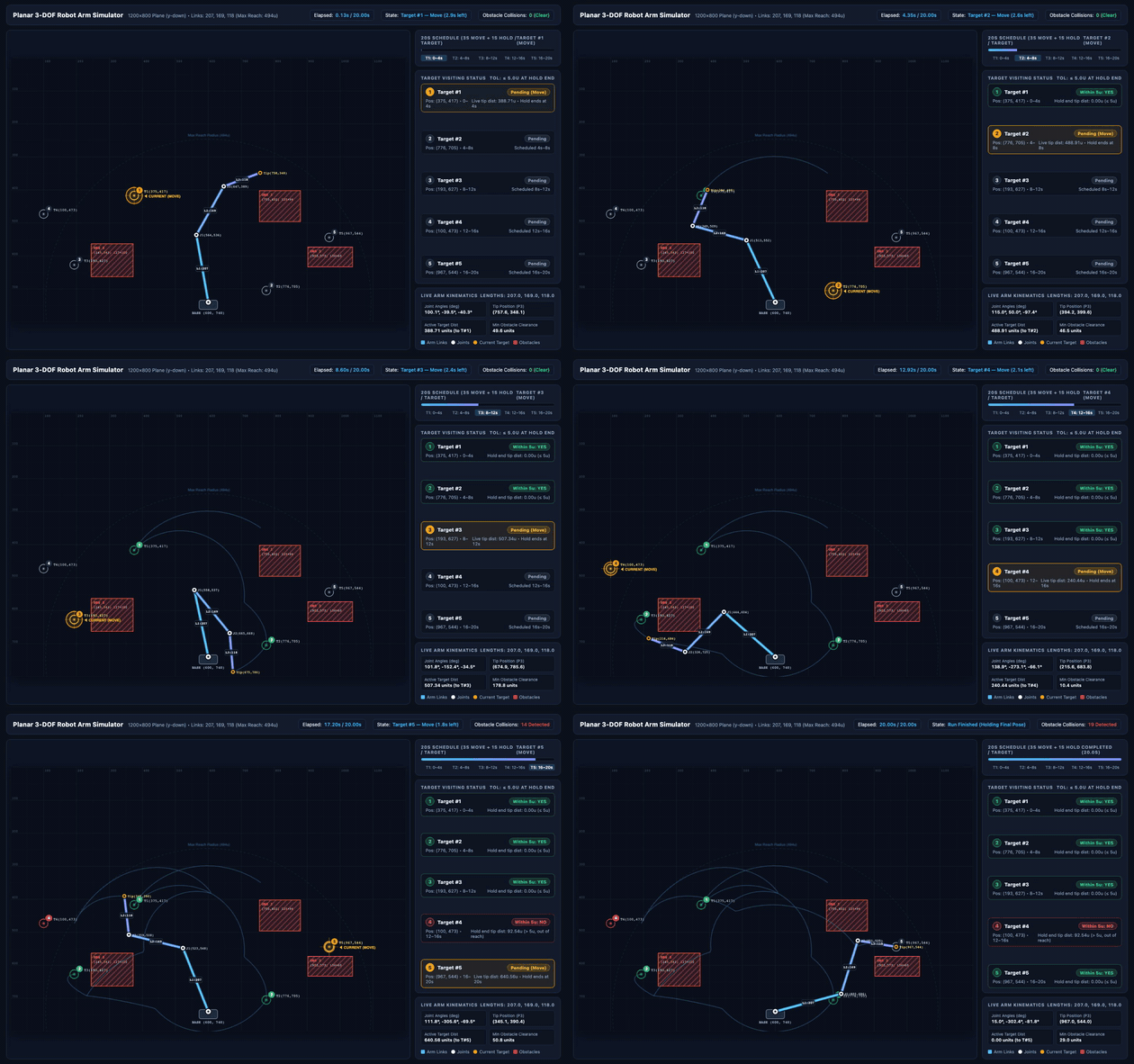
The main findings:
I scored both on physical honesty, motion quality, and scene legibility and layout. Motion was a 4 for both; the rows where they differ:
| Measure | Gemini 4 Argon (medium) | Claude Opus 5.5 (medium) |
|---|---|---|
| Cost of this run (USD) | $0.72 | $1.09 |
| Output tokens (incl. reasoning) | 58,115 | 40,532 |
| Physical honesty (primary discriminator) | 3 | 5 |
| Scene legibility & layout | 4 | 5 |
| Rubric score (mean of three axes) | 3.7 | 4.7 |
Argon's run was cheaper despite producing more output tokens, because of its introductory rates.
Claude Opus 5.5 wins this test, and the result cuts against Google's spatial-reasoning pitch rather than for it: Argon handled the detour it had planned for, then let the arm pass through obstacles later in the run. Opus 5.5 is the one I would trust to keep a constraint for the whole run.
This is one run of one task at medium effort, and Argon at high effort would need a long decode to finish, which this harness does not set up.
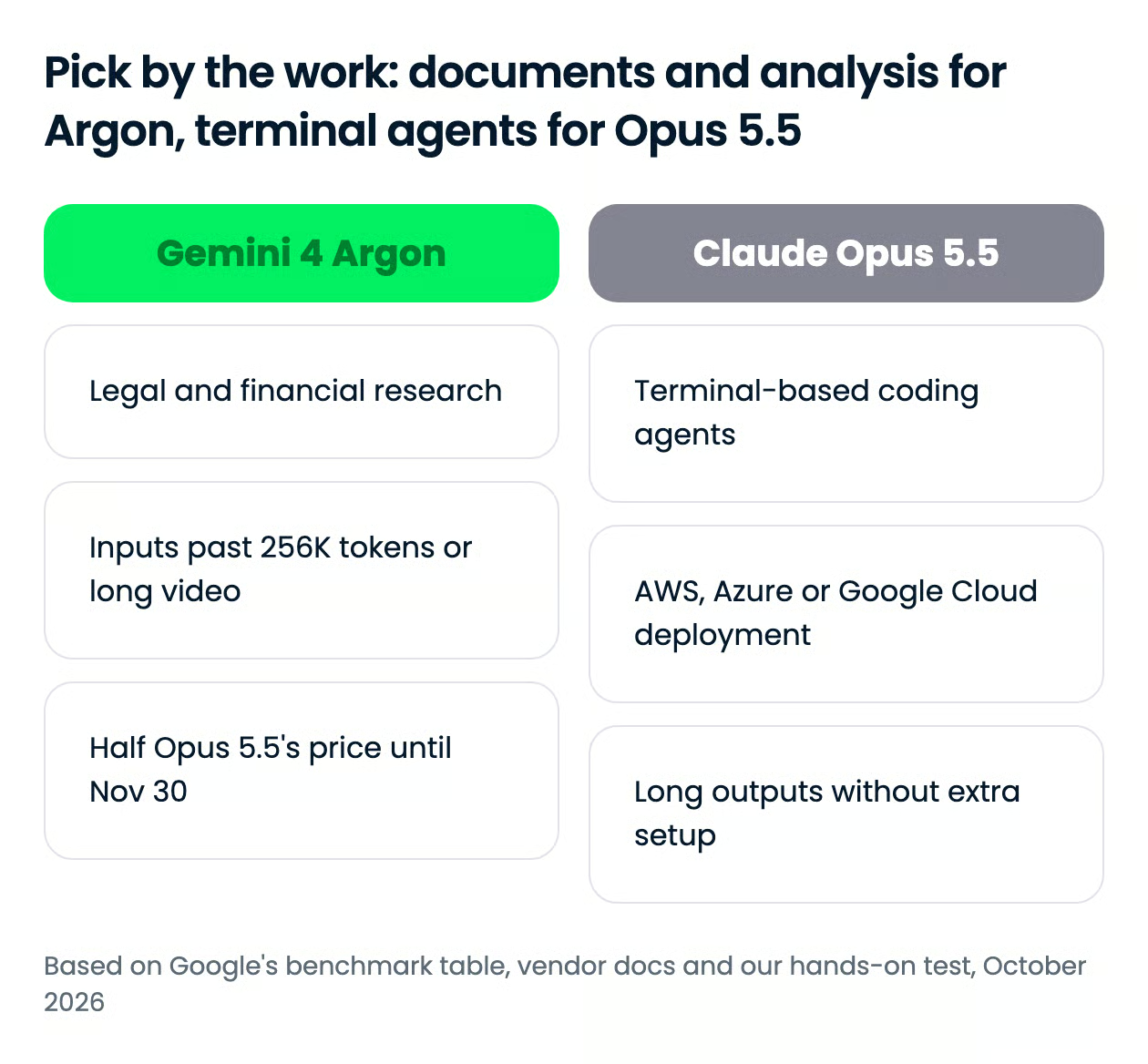
The deciding question is whether your work is mostly reading and reasoning over material, where Argon leads, or mostly acting on it step by step, where Opus 5.5 leads. Price only tips the choice until November 30, 2026.
| Surface | Gemini 4 Argon | Claude Opus 5.5 |
|---|---|---|
| Consumer app | Gemini app and AI Mode in Search (Google AI Pro and Ultra) | Claude apps (Pro, Max, Team, Enterprise) |
| First-party API | Gemini API, paid tier (Google AI Studio) | Claude Platform |
| Cloud platforms | Google Cloud Vertex AI | Amazon Bedrock, Google Cloud Vertex AI, Azure AI Foundry |
| Coding agents | Google Antigravity (Google AI Ultra), GitHub Copilot | Claude Code, Cursor, GitHub Copilot |
| Third-party routers | OpenRouter | OpenRouter |
| API model ID | gemini-4-argon |
claude-opus-5-5 |
The biggest difference is reach: Opus 5.5 is listed on all three major clouds and in Cursor, while Argon was not listed in the Cursor or Gemini CLI docs as of October 14, 2026. On the first-party APIs, the model IDs are gemini-4-argon and claude-opus-5-5.
The quickest way to try both is OpenRouter, which lists them as google/gemini-4-argon and anthropic/claude-opus-5.5 behind one OpenAI-compatible endpoint, so switching models is a one-string change:
from openai import OpenAI

client = OpenAI(base_url="https://openrouter.ai/api/v1", api_key="YOUR_OPENROUTER_KEY")

response = client.chat.completions.create(
    model="google/gemini-4-argon",  # swap for "anthropic/claude-opus-5.5"
    messages=[{"role": "user", "content": "Review this contract clause for liability risks: ..."}],
)
print(response.choices[0].message.content)
For direct access, use Google's Gemini API or Anthropic's Claude Platform with the model IDs above. Our Opus 5.5 guide and Gemini CLI vs Claude Code comparison cover the surrounding tools.
If your work is reading, analysing and drafting across large piles of material, especially legal and financial work, use Gemini 4 Argon, and lock in the introductory price while it lasts. If your work is agents running code in a terminal, or anything where a rule has to hold for the whole run, use Claude Opus 5.5.
What I find most interesting is the gap between Google's benchmark sheet and our hands-on run. Argon wins most of the table, yet in a spatial task built around Google's own claims it handled the planned detour and then broke the rule it was tracking, while Opus 5.5 simply never did. Benchmarks measure peak ability; a constraint-keeping test measures whether that ability holds to the end.
To build with either model, our Introduction to Claude Models course covers the Anthropic API, and Practical AI with Google Gemini and NotebookLM covers Google's side.
Top DataCamp Courses
课程
学习路径
学习路径
博客
Derrick Mwiti
10分钟
博客
Derrick Mwiti
9分钟
博客
Josef Waples
8分钟
博客
Khalid Abdelaty
11分钟
博客
Tom Farnschläder
11分钟
博客
Matt Crabtree
14分钟