Per capire quali competenze in ambito dati e IA contano di più, abbiamo intervistato oltre 500 leader di aziende negli Stati Uniti e nel Regno Unito (in collaborazione con YouGov) chiedendo di classificare l'importanza di specifiche capacità relative a dati e IA.
I risultati rivelano un chiaro schema e un framework pratico per sviluppare l'alfabetizzazione su IA e dati a livello enterprise.
Per definizioni più ampie e benchmark aziendali, consulta la nostra panoramica completa del 2026.
Un framework a 4 livelli per l'alfabetizzazione su IA e dati nel 2026
I dati suggeriscono che la capacità dell'azienda si articola in quattro livelli distinti e che non tutte le competenze hanno lo stesso peso.
Livello 1: Competenze fondamentali di decisione e interpretazione (massimo valore per l'azienda)
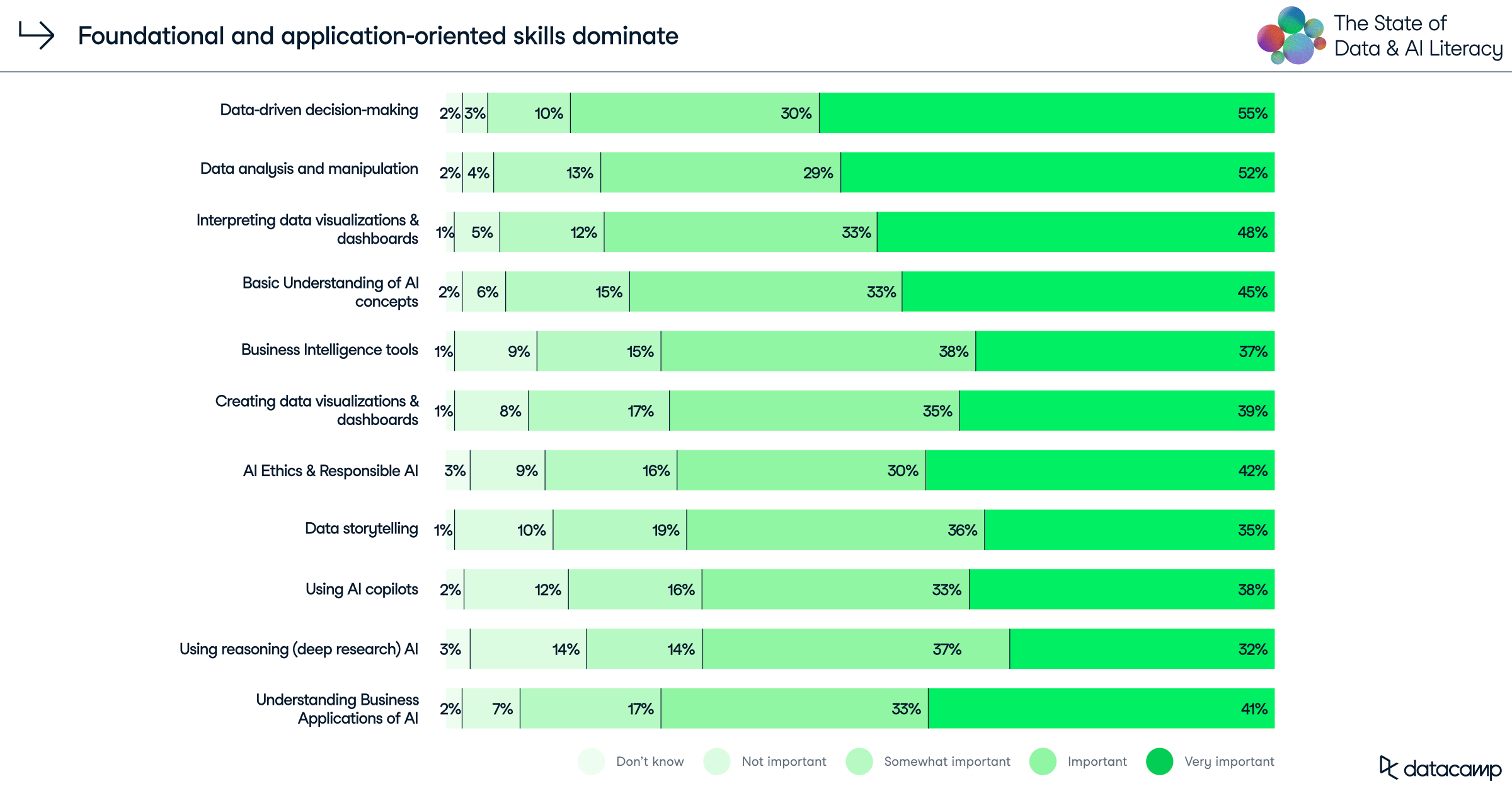
Queste sono le competenze valutate in modo più coerente dalle organizzazioni, con la seguente quota di leader che le giudicano "importanti" o "molto importanti":
- Decisioni basate sui dati — 85%
- Interpretare visualizzazioni dei dati e dashboard — 82%
- Analisi e manipolazione dei dati — 81%
- Strumenti di Business Intelligence — 75%
- Creare visualizzazioni dei dati — 72%
- Data storytelling — 71%
Non si tratta di competenze altamente tecniche; sono capacità di interpretazione e giudizio, e determinano se i dati influiscono davvero sulle decisioni o restano intrappolati nei report.
Considera queste competenze il cuore di qualsiasi framework efficace di alfabetizzazione su IA o dati.
Livello 2: Padronanza di base dell'IA e uso responsabile (rapidamente lo standard minimo)
Le aspettative sull'alfabetizzazione in IA stanno crescendo rapidamente. I leader hanno valutato le seguenti competenze di IA come "importanti" o "molto importanti":
- Comprensione di base dei concetti di IA — 78%
- Comprendere le applicazioni di business dell'IA — 74%
- Etica dell'IA e IA responsabile — 72%
- Utilizzo di copiloti di IA — 70%
Questo livello riflette un punto chiave: l'alfabetizzazione sull'IA in azienda non riguarda più la sperimentazione, ma l'uso applicato e responsabile. Qualsiasi framework moderno di alfabetizzazione sull'IA deve quindi includere sia l'utilizzo sia la governance.
Livello 3: Basi tecniche core (dipendono dal ruolo)
Le seguenti competenze restano "importanti" o "molto importanti" per i leader, ma non sono aspettative universali:
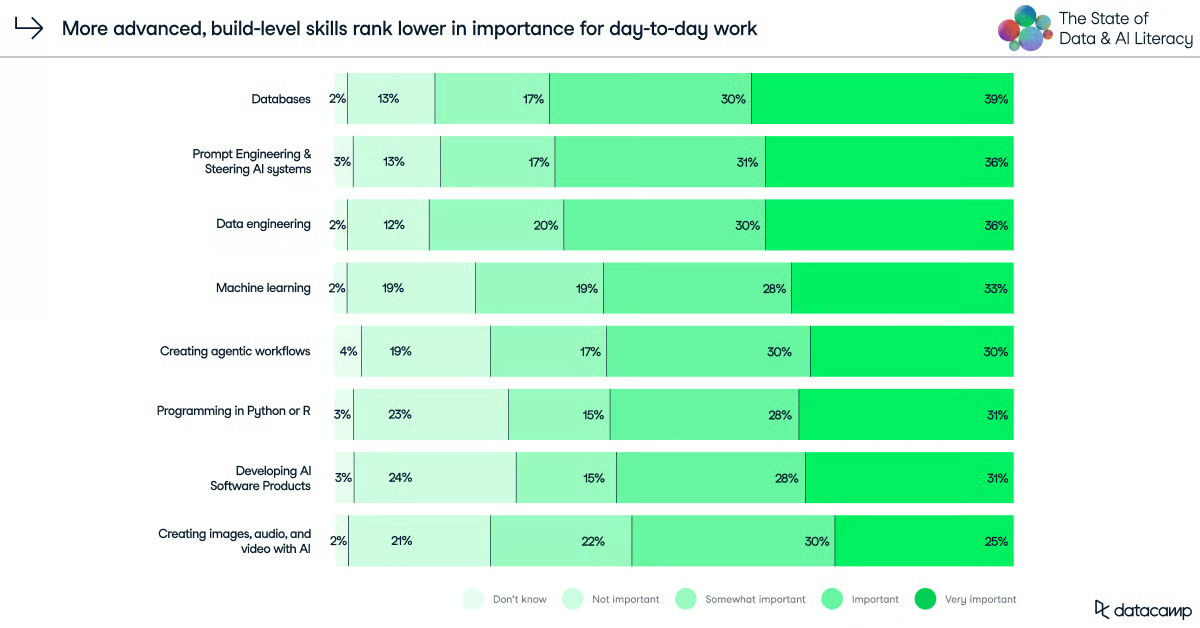
- Database — 69%
- Data engineering — 66%
- Programmazione in Python o R — 59%
Ovviamente queste competenze sono cruciali per ruoli specifici, ma non sono requisiti a livello aziendale. Questa distinzione è importante: i leader sanno che non tutti i dipendenti devono costruire sistemi. Tuttavia, la maggior parte deve saperli interpretare e applicare.
Livello 4: Competenze avanzate ed emergenti di sviluppo IA
Queste competenze sono strategicamente importanti ma richieste a un numero minore di ruoli. Anche in questo caso, le seguenti percentuali rappresentano la quota di leader che le hanno valutate "importanti" o "molto importanti" per il lavoro quotidiano:
- Machine learning — 61%
- Sviluppo di prodotti software di IA — 60%
- Creazione di workflow agentici — 59%
- Prompt engineering e guida dei sistemi di IA — 67%
- Uso di IA a ragionamento profondo — 69%
Rappresentano capacità d'avanguardia certamente preziose, ma non la base dell'alfabetizzazione sull'IA per l'intera forza lavoro.
Cosa significa per i leader aziendali
Le competenze più importanti in dati e IA nel 2026 non sono profondamente tecniche, ma interpretative, applicate e guidate dal giudizio. Questo ha implicazioni dirette su come le organizzazioni progettano i programmi di upskilling.
Molte iniziative di formazione sull'IA si concentrano molto su strumenti o coding, ma le competenze meglio classificate dai leader sono:
- Prendere decisioni
- Interpretazione
- Comunicazione
- Uso responsabile
Sono queste le competenze che determinano se l'IA migliora le performance o amplifica il rischio.
La classifica completa e i confronti tra aziende sono disponibili nel Rapporto 2026 sullo stato dell'alfabetizzazione in dati e IA.
Perché la maggior parte dei framework sbaglia
Nel 2026, il 60% dei leader segnala un gap di competenze sui dati e il 59% un gap di competenze sull'IA.
Molte iniziative aziendali di formazione su dati o IA puntano molto sull'abilitazione tecnica, dotando gli specialisti di strumenti per costruire o distribuire sistemi di IA. Questi investimenti sono fondamentali, soprattutto per i ruoli tecnici.
Tuttavia, il gap di competenze emerge quando l'alfabetizzazione fondamentale, diffusa nella forza lavoro, non cresce di pari passo con la capacità tecnica. Le organizzazioni continuano a sotto-investire in temi come:
- Padronanza di base estesa a tutta la forza lavoro
- Data storytelling
- Decision science
- Alfabetizzazione applicata sull'IA
I sistemi di IA possono essere costruiti centralmente, ma il valore si realizza in modo pervasivo. Senza un'ampia padronanza interpretativa, il ritorno sugli investimenti tecnici è limitato.
Progettare un framework pratico di alfabetizzazione su IA e dati
Sulla base dei risultati del 2026, un framework efficace per l'azienda dovrebbe:
- Partire dalle competenze di decisione e interpretazione
- Aggiungere la padronanza di base dell'IA e l'uso responsabile
- Differenziare i percorsi tecnici specifici per ruolo
- Rafforzare le competenze nel tempo con pratica applicata
- Misurare la progressione delle competenze e l'impatto sul business
Questo approccio a livelli è in linea con il modo in cui i leader valutano l'importanza e con il modo in cui si materializzano i miglioramenti di performance.
Dalle competenze alle performance
I leader associano una forte alfabetizzazione su dati e IA a risultati misurabili:
- Il 54% segnala decisioni più rapide grazie all'alfabetizzazione sui dati e il 49% una maggiore accuratezza decisionale
- Il 48% segnala decisioni più rapide grazie all'alfabetizzazione sull'IA e il 46% una maggiore capacità di innovazione
Questi miglioramenti non derivano da competenze isolate; nascono da sistemi di capacità integrati.
DataCamp for Business è progettato attorno a un modello di capacità a livelli, dalle decisioni e interpretazioni dei dati fondamentali fino alla specializzazione avanzata in IA.
Attraverso percorsi di apprendimento basati sui ruoli, progetti pratici e benchmarking delle competenze, le organizzazioni possono costruire un framework pratico di alfabetizzazione su IA e dati allineato alle priorità aziendali.
Se stai valutando come strutturare su larga scala l'alfabetizzazione su IA e dati, scopri come DataCamp for Business supporta l'upskilling aziendale.