To understand which data and AI skills matter most, we surveyed 500+ US and UK enterprise leaders (in partnership with YouGov) and asked them to rank the importance of specific data and AI capabilities.
The results reveal a clear pattern and a practical framework for building enterprise AI and data literacy.
For broader definitions and enterprise benchmarks, see our full 2026 overview.
A 4-layer AI and data literacy framework for 2026
The data suggests that enterprise capability falls into four distinct layers, and not all skills carry equal weight.
Layer 1: Foundational decision and interpretation skills (highest enterprise value)
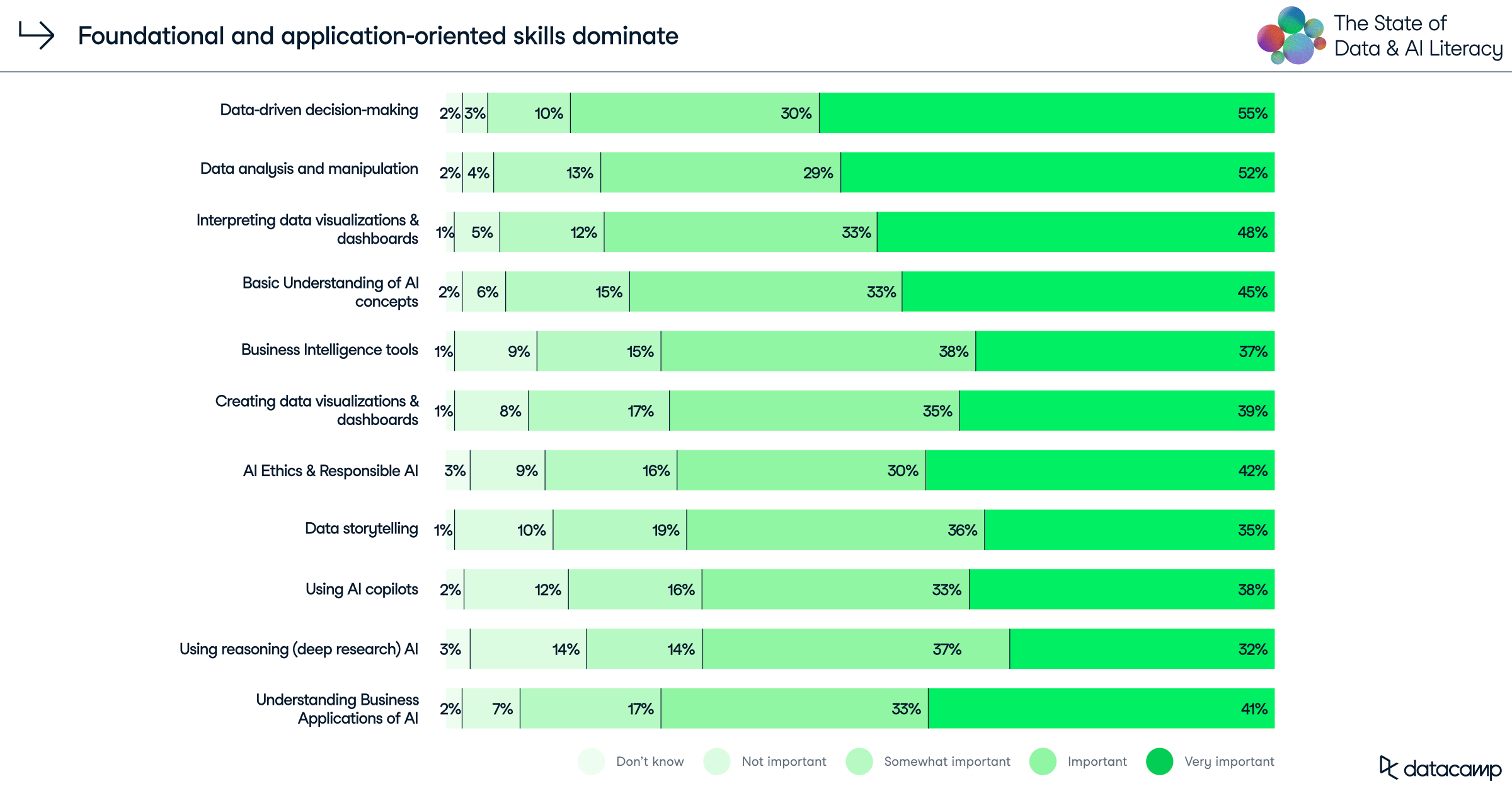
These are the most consistently ranked skills across organizations, with the following share of leaders ranking the skills “important” or “very important”:
- Data-driven decision making — 85%
- Interpreting data visualizations & dashboards — 82%
- Data analysis and manipulation — 81%
- Business Intelligence tools — 75%
- Creating data visualizations — 72%
- Data storytelling — 71%
These are not highly technical skills; they are interpretive, judgment-based capabilities, and they determine whether data actually influences decisions or remains trapped in reports.
Consider these skills the core of any effective AI or data literacy framework.
Layer 2: Foundational AI fluency and responsible use (rapidly becoming baseline)
AI literacy expectations are rising quickly. Leaders ranked the following AI skills as “important” or “very important”:
- Basic understanding of AI concepts — 78%
- Understanding business applications of AI — 74%
- AI ethics & responsible AI — 72%
- Using AI copilots — 70%
This layer reflects something important: AI literacy in the workplace is no longer about experimentation but rather responsible, applied use. Any modern AI literacy framework must therefore include both usage and governance.
Layer 3: Core technical foundations (role-dependent)
The following skills remain “important” or “very important” for leaders, but are not universal expectations:
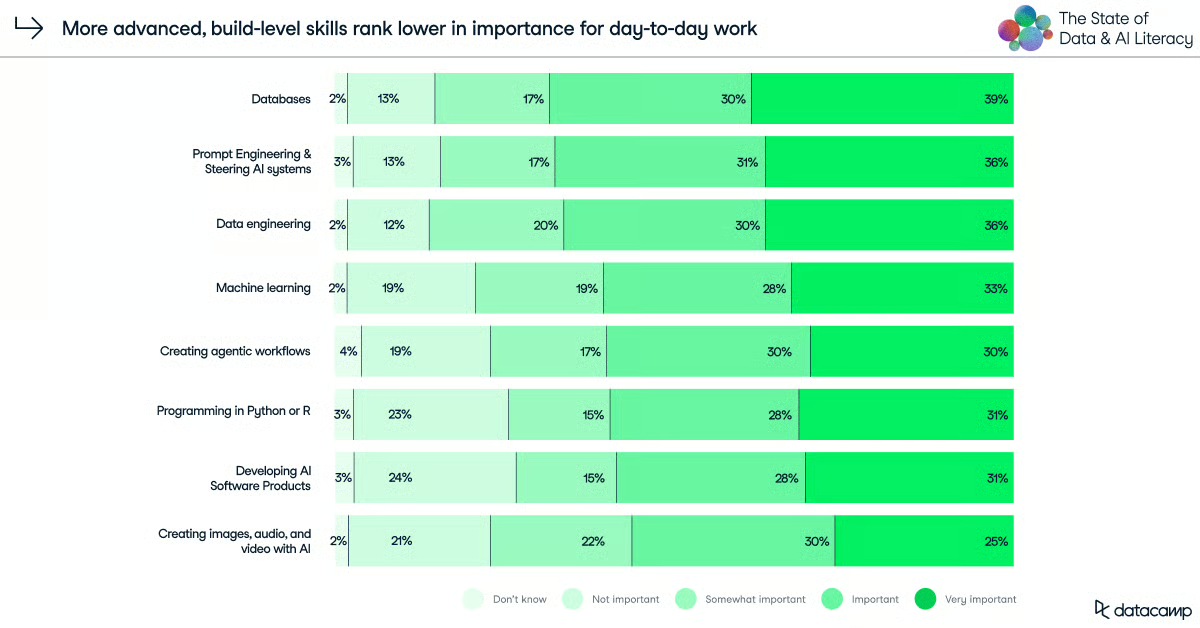
- Databases — 69%
- Data engineering — 66%
- Programming in Python or R — 59%
Of course, these skills are critical for specific roles, but they’re not enterprise-wide requirements. This distinction matters, as leaders see that not every employee needs to build systems. However, most do need to interpret and apply them.
Layer 4: Advanced and emerging AI development skills
These skills are strategically important but expected of fewer roles. Again, the following percentages represent the share of leaders that rated them as “important” or “very important” to day-to-day work:
- Machine learning — 61%
- Developing AI software products — 60%
- Creating agentic workflows — 59%
- Prompt engineering & steering AI systems — 67%
- Using deep reasoning AI — 69%
They represent frontier capabilities which are certainly valuable, but not the foundation of workforce-wide AI literacy.
What this means for enterprise leaders
The most important AI and data skills in 2026 are not deeply technical, but interpretive, applied, and judgment-driven. This has direct implications for how organizations design upskilling programs.
Many AI training initiatives focus heavily on tools or coding, but the highest-ranked skills across leaders are:
- Decision-making
- Interpretation
- Communication
- Responsible use
These are the skills that determine whether AI improves performance or amplifies risk.
The full ranked breakdown and enterprise comparisons are available in the 2026 State of Data & AI Literacy Report.
Why most frameworks get this wrong
In 2026, 60% of leaders report a data skills gap, and 59% report an AI skills gap.
Many enterprise data or AI training initiatives focus heavily on technical enablement, equipping specialists to build or deploy AI systems. Those investments are critical, especially for technical roles.
However, the skills gap emerges when foundational, workforce-wide literacy does not scale alongside technical capability. Organizations continually under-invest in topics like:
- Workforce-wide foundational fluency
- Data storytelling
- Decision science
- Applied AI literacy
AI systems can be built centrally, but the fact is that value is realized pervasively. Without broad interpretive fluency, the return on technical investment is constrained.
Designing a practical AI and data literacy framework
Based on the 2026 findings, an effective enterprise framework should:
- Start with decision-making and interpretation skills
- Layer in foundational AI fluency and responsible use
- Differentiate role-specific technical paths
- Reinforce skills over time with applied practice
- Measure skill progression and business impact
This layered approach aligns with how leaders rank importance and how performance gains materialize.
From skills to performance
Leaders associate strong data and AI literacy with measurable outcomes:
- 54% report faster decision-making from data literacy, and 49% report improved decision accuracy
- 48% report faster decision-making from AI literacy, and 46% report stronger innovation
These gains do not come from isolated skills; they come from integrated capability systems.
DataCamp for Business is designed around a layered capability model, from foundational decision-making and data interpretation to advanced AI specialization.
Through role-based learning paths, hands-on projects, and skill benchmarking, organizations can build a practical AI and data literacy framework aligned to enterprise priorities.
If you’re evaluating how to structure AI and data literacy at scale, explore how DataCamp for Business supports enterprise upskilling.