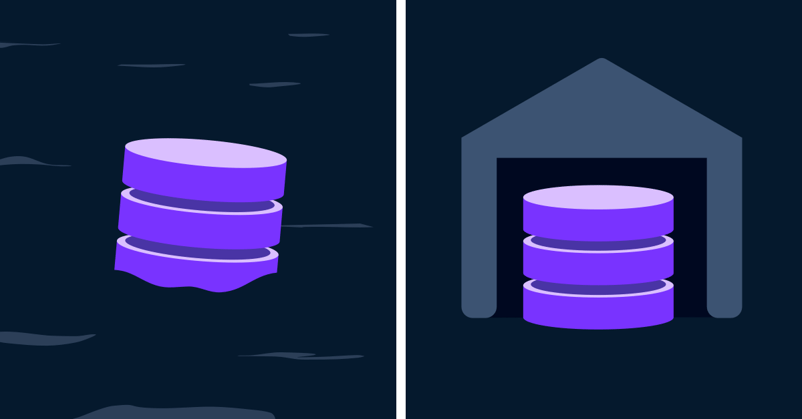
When it comes to storing big data, the two most popular options are data lakes and data warehouses. Data warehouses are used for analyzing archived structured data, while data lakes are used to store big data of all structures.
In this post, we’ll unpack the differences between the two. The below table breaks down their differences into five categories.
| | Data Lake | Data Warehouse |
|---|
| Type of data | Unstructured and structured data from various company data sources | Historical data that has been structured to fit a relational database schema |
| Purpose | Cost-effective big data storage | Analytics for business decisions |
| Users | Data scientists and engineers | Data analysts and business analysts |
| Tasks | Storing data and big data analytics, like deep learning and real-time analytics | Typically read-only queries for aggregating and summarizing data |
| Size | Stores all data that might be used—can take up petabytes! | Only stores data relevant to analysis |
Type of data
Cleaning data is a key data skill because data naturally comes in messy and imperfect forms. Raw data that hasn’t been cleaned is called unstructured data—which comprises most of the data in the world, like photos, chat logs, and PDF files. Unstructured data that has been cleaned to fit a schema, organized into tables and defined by data types and relationships, is called structured data. This is the fundamental difference between lakes and warehouses.
Data lakes store data from a wide variety of sources like IoT devices, real-time social media streams, user data, and web application transactions. Sometimes this data is structured, but often, it’s quite messy because data is being ingested straight from the data source. Data warehouses, on the other hand, contain historical data that have been cleaned to fit a relational schema.
Purpose
Data lakes are used for cost-effective storage of large amounts of data from many sources. Allowing data of any structure reduces cost because data is more flexible and scalable as the data doesn’t need to fit a specific schema. However, structured data is easier to analyze because it’s cleaner and has a uniform schema to query from. By restricting data to a schema, data warehouses are very efficient for analyzing historical data for specific data decisions.
You may notice that data lakes and data warehouses complement each other in a data workflow. Ingested company data will be stored immediately into a data lake. If a specific business question comes up, a portion of the data deemed relevant is extracted from the lake, cleaned, and exported into a data warehouse.
Users
Data lakes and data warehouses are useful for different users. Data analysts and business analysts often work within data warehouses containing explicitly pertinent data that has been processed for their work. Data warehouses require a lower level of programming and data science knowledge to use.
Data lakes are set up and maintained by data engineers who integrate them into data pipelines. Data scientists work more closely with data lakes as they contain data of a wider and more current scope.
Tasks
Data engineers use data lakes to store incoming data. However, data lakes aren’t only limited to storage. Remember, unstructured data is more flexible and scalable, which is oftentimes better for big data analytics. Big data analytics can be run on data lakes using services such as Apache Spark and Hadoop. This is especially true for deep learning, which requires scalability in the increasing amount of training data.
Data warehouses are typically set to read-only for analyst users, who are primarily reading and aggregating data for insights. Since data is already clean and archival, there is usually no need to insert or update data.
Size
It should be no surprise that data lakes are much bigger in size because they retain all data that might be relevant to a company. Data lakes are often petabytes in size—that's 1,000 terabytes! Data warehouses are much more selective on what data is stored.
Conclusion
When you’re deciding between a data lake or data warehouse, go through these categories and see which best fits your use case. If you’re interested in a deeper dive into their differences or learning how to design data warehouses, check out our Database Design course!
Don’t forget that sometimes you need a combination of both storage solutions. This is especially true when building data pipelines. You can see this in action in our Introduction to Data Engineering and Building Data Engineering Pipelines in Python courses.


 Sai Krupa Reddy · 12 min

 Tim Lu · 13 min

 Jacob Moody · 1 min


When it comes to storing big data, the two most popular options are data lakes and data warehouses. Data warehouses are used for analyzing archived structured data, while data lakes are used to store big data of all structures.
In this post, we’ll unpack the differences between the two. The below table breaks down their differences into five categories.
Type of data
Cleaning data is a key data skill because data naturally comes in messy and imperfect forms. Raw data that hasn’t been cleaned is called unstructured data—which comprises most of the data in the world, like photos, chat logs, and PDF files. Unstructured data that has been cleaned to fit a schema, organized into tables and defined by data types and relationships, is called structured data. This is the fundamental difference between lakes and warehouses.
Data lakes store data from a wide variety of sources like IoT devices, real-time social media streams, user data, and web application transactions. Sometimes this data is structured, but often, it’s quite messy because data is being ingested straight from the data source. Data warehouses, on the other hand, contain historical data that have been cleaned to fit a relational schema.
Purpose
Data lakes are used for cost-effective storage of large amounts of data from many sources. Allowing data of any structure reduces cost because data is more flexible and scalable as the data doesn’t need to fit a specific schema. However, structured data is easier to analyze because it’s cleaner and has a uniform schema to query from. By restricting data to a schema, data warehouses are very efficient for analyzing historical data for specific data decisions.
You may notice that data lakes and data warehouses complement each other in a data workflow. Ingested company data will be stored immediately into a data lake. If a specific business question comes up, a portion of the data deemed relevant is extracted from the lake, cleaned, and exported into a data warehouse.
Users
Data lakes and data warehouses are useful for different users. Data analysts and business analysts often work within data warehouses containing explicitly pertinent data that has been processed for their work. Data warehouses require a lower level of programming and data science knowledge to use.
Data lakes are set up and maintained by data engineers who integrate them into data pipelines. Data scientists work more closely with data lakes as they contain data of a wider and more current scope.
Tasks
Data engineers use data lakes to store incoming data. However, data lakes aren’t only limited to storage. Remember, unstructured data is more flexible and scalable, which is oftentimes better for big data analytics. Big data analytics can be run on data lakes using services such as Apache Spark and Hadoop. This is especially true for deep learning, which requires scalability in the increasing amount of training data.
Data warehouses are typically set to read-only for analyst users, who are primarily reading and aggregating data for insights. Since data is already clean and archival, there is usually no need to insert or update data.
Size
It should be no surprise that data lakes are much bigger in size because they retain all data that might be relevant to a company. Data lakes are often petabytes in size—that's 1,000 terabytes! Data warehouses are much more selective on what data is stored.
Conclusion
When you’re deciding between a data lake or data warehouse, go through these categories and see which best fits your use case. If you’re interested in a deeper dive into their differences or learning how to design data warehouses, check out our Database Design course!
Don’t forget that sometimes you need a combination of both storage solutions. This is especially true when building data pipelines. You can see this in action in our Introduction to Data Engineering and Building Data Engineering Pipelines in Python courses.