
Our biggest-ever sale. 60% off AI & data skills
Buy Now

Öva och håll koll på dina framsteg.
Fortsätt med GoogleGenom att fortsätta godkänner du vår användarvillkor, våra integritetspolicy och att dina uppgifter lagras i USA.This guide will explore the transformative impact of data academies, detailing their benefits, and offering a comprehensive roadmap to establish one within your company. Dive in and discover how to turn data potential into data proficiency.
Over the past decade, the data and digital revolutions have reshaped the organizational landscape, leading to significant investments in data science initiatives, data collection, and infrastructure. However, it is only in recent years that a stronger emphasis has been placed on training programs to boost data literacy.
Despite these efforts, the data literacy skill gap remains a critical issue. The DataCamp Data Literacy Report highlights that business leaders face numerous challenges in upskilling or reskilling their employees. These obstacles include aligning training with business needs, fostering engagement, and ensuring access to relevant, high-quality learning resources.
All these challenges underscore a crucial point: while the demand for data skills is skyrocketing, there is a significant mismatch between what businesses need and the current levels of data literacy and training. Consequently, the immense potential value of data often remains untapped due to a lack of necessary skills, a supportive culture, and the right mindset within organizations.
To bridge this gap, organizations must undergo a transformative shift in their approach to data. This involves not only rethinking budgetary and resource allocations but also fostering a supportive organizational culture that prioritizes people at the heart of data transformation. By embracing this holistic approach, companies can cultivate the skills, mindset, and culture needed to fully leverage data's potential.
In this context, in-house data analytics academies can make a big difference in boosting data literacy. Below, you can find some key features of data analytics academies:
The first step in launching a successful data analytics training initiative is assessing your team's current skill levels to identify gaps and determine specific training needs. Conducting a comprehensive skills assessment allows organizations to understand the proficiency levels of their employees in data analytics and related technologies.
This evaluation can be achieved through surveys, interviews, and practical assessments to gauge knowledge, expertise, and familiarity with various data analytics tools and techniques. You can also use DataCamp’s data maturity assessment to understand where your team, department, and organization are located on the data maturity spectrum.
Understanding your team’s current skill set allows you to customize training programs effectively. By focusing on areas that require improvement, you ensure that your training is relevant, targeted, and impactful. Collaboration with your data analytics academy partner, such as DataCamp, can facilitate this process. Our expert teams can help you tailor existing learning tracks or create new ones to meet your organization's specific needs.
Establishing clear metrics and methods to measure the success of your training program is crucial. Define key performance indicators (KPIs) and objectives that align with your business goals, such as enhanced analytical skills, increased productivity, or improved decision-making capabilities. These metrics will help you track progress and demonstrate the impact of your training efforts.
At DataCamp, we understand the complexities of building a data analytics academy and are here to support you every step of the way. We offer a wealth of resources, including blogs, webinars, and use cases, specifically designed for business leaders. Explore our resource page and dedicated materials to kickstart your data literacy journey today:
Data academies offer a definitive solution for companies aiming to enhance data literacy in a flexible, personalized, and cost-effective manner. Cultivating a data-driven mindset brings significant advantages to your organization. Here are some key benefits of implementing a data analytics academy:
Building data literacy goes beyond enhancing technical skills; it fosters a culture of continuous learning and professional development. By engaging your workforce with new data analytics tools and methodologies, you can significantly boost employee motivation and retention. This approach not only prepares your organization to swiftly adapt to technological advancements and market changes but also creates a more dynamic and innovative work environment.
Data is information, and information is power. Cultivating a data-driven culture ensures that decision-making processes across all levels of your company, from web design and marketing strategies to daily operations and hiring, are grounded in data and analysis. This shift leads to more informed, strategic, and effective decisions that drive business success.
Manual, repetitive tasks have traditionally consumed significant time and resources. With a data-literate workforce, many of these processes can be automated, increasing efficiency and freeing up employees to focus on higher-value initiatives. For instance, Rolls-Royce partnered with DataCamp to deliver a digital technology training program, enhancing data literacy and adopting Power BI across the organization. This initiative allowed Rolls-Royce’s engineering team to automate data handling processes, accelerating them by a factor of 100 and enabling the team to concentrate on more strategic tasks.
Aligning your data literacy program with your organization's business goals is crucial for achieving tangible results. Allianz provides a compelling example. During the pandemic, Allianz collaborated with DataCamp to develop a scalable, cost-effective data analytics training solution tailored to various target groups and insurance-focused use cases. This partnership not only met the company’s education needs but also supported its strategic objectives. For more insights into this successful collaboration, check out our detailed Allianz case study.
Investing in a data analytics academy can transform your organization, driving engagement, efficiency, and strategic decision-making. Embrace this opportunity to unlock the full potential of data within your business.
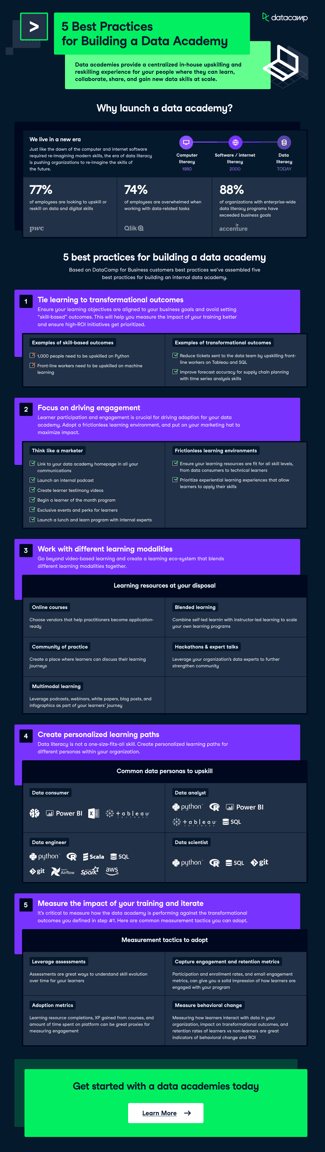
If you're convinced about the value of establishing a data analytics academy within your company, the next step is to select the right partner. With numerous options available and the market continuously expanding, it’s essential to make an informed choice. Here are five core values that any successful data academy should embody:
Data literacy is not a one-size-fits-all concept. Each individual in your organization has unique data needs based on their role and skill level. A successful data analytics academy should offer personalized learning experiences tailored to these specific needs, ensuring that every employee can benefit and grow from the program.
Aligning your data literacy program with your organization's business goals is crucial. Identify the key business challenges your organization faces and determine how data literacy can address them. A data analytics academy should design learning paths that directly support your company’s objectives, ensuring that the training is both relevant and impactful.
Developing data literacy is about more than just acquiring skills; it’s about fostering a cultural shift toward a data-informed mindset. This requires ongoing communication and engagement. A data analytics academy should keep learners informed about the importance of data literacy, how it benefits their roles, and the program's progress. It should also promote interactive learning experiences, provide forums for knowledge sharing, and recognize or reward progress to maintain high levels of engagement.
Effective learning goes beyond individual skills. Online learning can often be isolating, so fostering a sense of community is vital. A successful data analytics academy should create communities of practice where learners can collaborate, share insights, and support each other, enhancing both the learning experience and the application of new skills.
Effective learning begins and ends with assessment. A data analytics academy should have well-defined assessments to measure your organization’s strengths and skill gaps before, during, and after the learning program. This ensures continuous improvement and demonstrates the tangible benefits of the training.
With these principles in mind, DataCamp for Business stands out as an ideal data analytics academy partner. Our mission is to democratize data and AI skills for everyone. Since our inception in 2013, we have upskilled more than 14 million learners globally, including organizations from diverse sectors such as governments, universities, businesses, and NGOs.
More than ten years later, we keep working hard to offer the best education to our learners. The accumulated experience has allowed us to understand the motivations of the different types of customers who want to learn data science. As a result, we’re offering a service that can be customized and tailored to the specific needs of our users.
That’s why we launched DataCamp for Business, a solution especially designed to meet the needs of companies of all kinds and sizes.
If you’re planning a data analytics academy for your organization to upskill employees, we are here to help. With DataCamp for Business, you can expect the following:
Building a data analytics academy for your company is a smart move for bridging the skill gap, fostering a culture of continuous learning, and achieving a competitive advantage in today's data-driven business landscape.
Data literacy is a fundamental component of success in modern business. Successfully building this in your organization will lead to better outcomes for your business and your customers and will empower employees to drive more value in their daily responsibilities.
Contact DataCamp today to get a demo and discover why 80% of the Fortune 1000 choose DataCamp.

I am a freelance data analyst, collaborating with companies and organisations worldwide in data science projects. I am also a data science instructor with 2+ experience. I regularly write data-science-related articles in English and Spanish, some of which have been published on established websites such as DataCamp, Towards Data Science and Analytics Vidhya As a data scientist with a background in political science and law, my goal is to work at the interplay of public policy, law and technology, leveraging the power of ideas to advance innovative solutions and narratives that can help us address urgent challenges, namely the climate crisis. I consider myself a self-taught person, a constant learner, and a firm supporter of multidisciplinary. It is never too late to learn new things.
blogg
 DataCamp Team• 4 min

blogg
 Kevin Babitz• 6 min

blogg
 Javier Canales Luna• 11 min



In today's competitive business landscape, data is the lifeblood of innovation and strategic advantage. Organizations across sectors—be it government, education, corporate, or non-profit—are harnessing the power of data to drive insights, refine decision-making, and elevate customer experiences.
The demand for data-savvy talent is at an all-time high, yet the skills gap in data literacy is a persistent challenge. Enter data analytics academies: these in-house, centralized hubs are designed to upskill and reskill your workforce, fostering a culture of continuous learning and collaboration. By equipping employees with critical data skills, these academies play a pivotal role in closing the data literacy gap and building robust data capabilities within your organization.
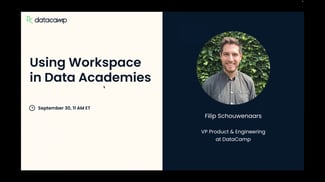
You can learn about Building an in-house data academy in our separate webinar.