Kursus
Bekerja dengan OpenAI Responses API
3 Hr
2.7K
Note: OpenAI released GPT-6 Astra on September 3, 2026, and GPT-6 Sol and Luna on September, 23, 2026.
GPT-5.6 is a three-model series that today is launching into a limited preview coordinated with the U.S. government.
It's not yet available for wide use, but there's still plenty of capability news to dig into, especially around coding, biology, and cybersecurity, which we will get into.
If you want to go back in time with OpenAI model news, we have a record of write-ups for every release: GPT-5.5 Instant, GPT-5.3 Instant, and GPT-5.2.
And if you want to compare GPT-5.6 to the latest available models, we have articles for that, too: Gemini 3.1 Pro, Claude Opus 5, Claude Mythos 5, Claude Fable 5.
GPT-5.6 is OpenAI's newest model generation. It's actually a family of three models, and (finally) there's a new naming convention.
In the new system, the number is the generation (5.6), and the name is the capability tier (Sol, Terra, Luna). One advantage I imagine of the new convention is that each tier can advance on its own schedule, and it will be less confusing. "Instant" wasn't the best name to mean the latest underlying model.
Sol is the flagship and the strongest, most capable model in the series. It's the tier OpenAI leads with on every benchmark in the release, and it's the only model that unlocks the new max reasoning effort and ultra mode (more on both below).
Sol is also where the cybersecurity and biology gains are most pronounced. Sol is the model to use if you want the highest ceiling on hard, multi-step problems and don't mind paying the most per token.
We compared it against Anthropic's and SpaceXAI's new flagship models, Claude Opus 5 and Grok 4.6.
Terra is the balanced, everyday-work model. You can think of it as the default. Terra has competitive performance with GPT-5.5 while being about 2x cheaper. This might be something we keep seeing going forward: roughly last-generation flagship quality at a mid-tier price.
Luna is the fast, affordable tier. It's aimed at high-volume, latency-sensitive, or budget-conscious workloads. As the benchmark table below will show, "cheapest" doesn't necessarily mean "weakest" on every task. That's worth mentioning so you don't overlook it.
In sum:
This update also brings new ways to dial up reasoning, plus broad capability gains in a few specific domains.
GPT-5.6 introduces two new control:
max reasoning effort: a new reasoning-effort setting that gives Sol the most time to think on a problem.
ultra mode: this one is more interesting. Instead of a single agent working a task, ultra uses subagents.
If you look at the benchmarks below, you'll see ultra shows up as its own line ("GPT-5.6 Sol Ultra"), and it posts the top score.
GPT-5.6 Sol sets a new state of the art on Terminal-Bench 2.1, which came out about six weeks ago. The newest version of Terminal-Bench tests command-line workflows that need iteration and tool coordination. We'll get into the actual numbers in the benchmark section.
This is a lesser known benchmark test: GeneBench v1. It evaluates long-horizon genomics and quantitative-biology analyses. We see from the release that GPT-5.6 Sol gets stronger results than GPT-5.5 while using fewer tokens.
OpenAI calls GPT-5.6 Sol its most capable model yet for cybersecurity, and it the company dedicates a lot of time in the release to this idea. Sol shifts performance-efficiency frontier on long-horizon security tasks, including vulnerability research and exploitation. The release tells us about more successes more lesser-known benchmark tests:
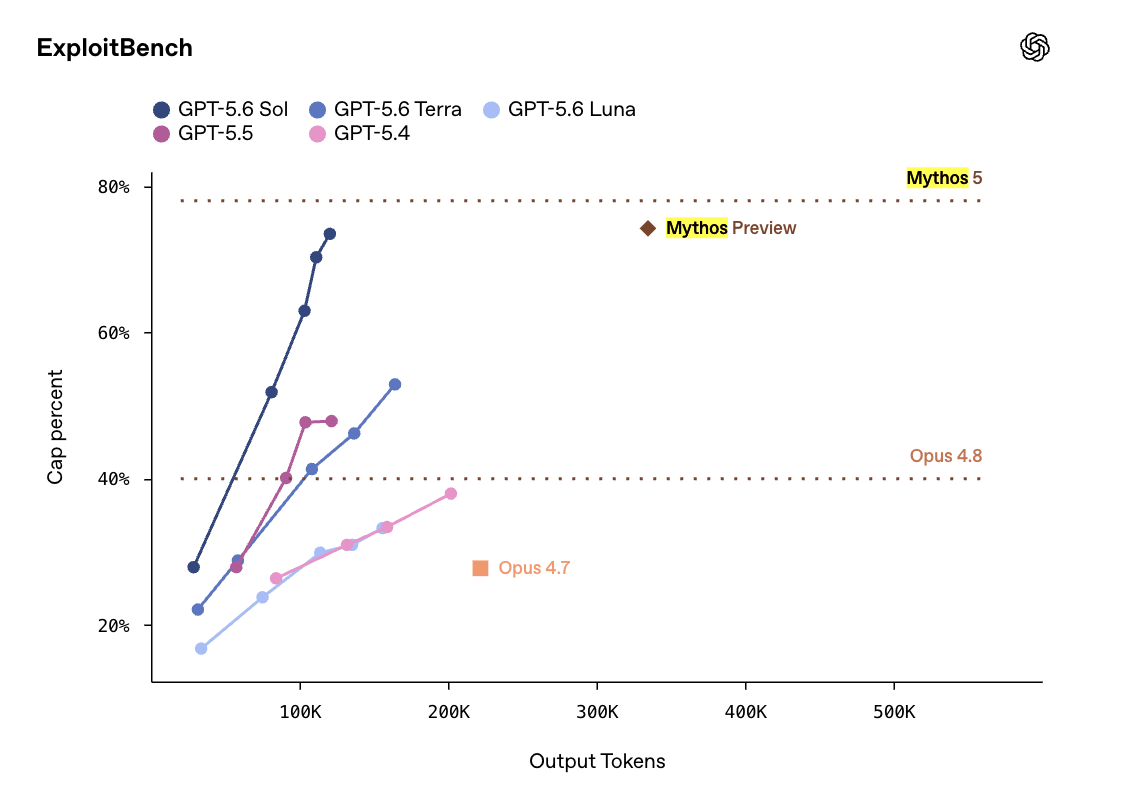
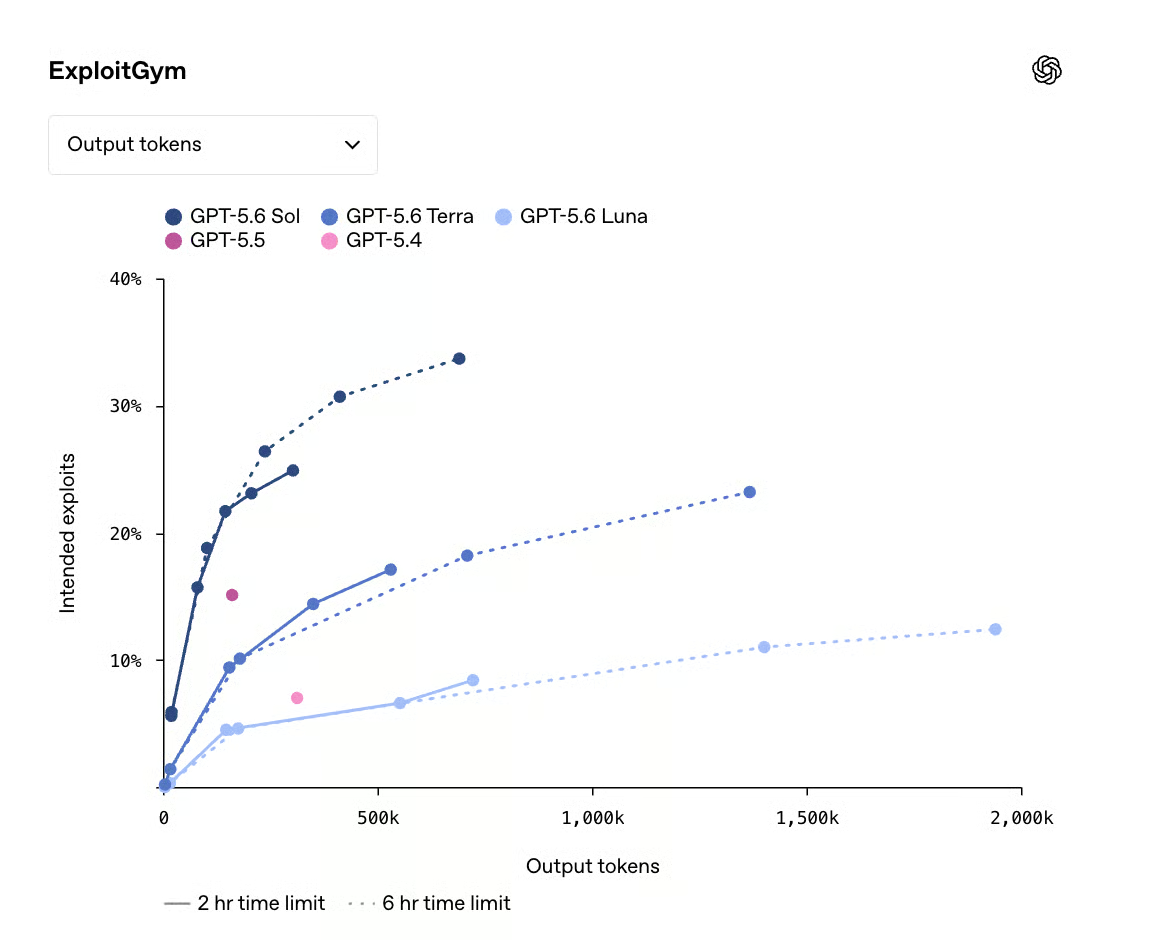
The headline benchmark success story is the result on Terminal-Bench 2.1, which I mentioned earlier. Here's how the models stack up, sorted from highest to lowest score:
| Model | Terminal-Bench 2.1 |
|---|---|
| GPT-5.6 Sol Ultra | 91.9% |
| GPT-5.6 Sol | 88.8% |
| GPT-5.5 | 88.0% |
| GPT-5.6 Luna | 84.3% |
| Claude Mythos 5 | 84.3% |
| Claude Fable 5 | 83.4% |
| GPT-5.6 Terra | 82.5% |
| Claude Opus 4.8 | 78.9% |
| Gemini 3.1 Pro Preview | 70.7% |
A few things stand out:
ultra mode makes a difference. GPT-5.6 Sol Ultra (91.9%) sits clearly above plain Sol (88.8%), which is the cleanest evidence that the subagent approach works, at least here.
The tier ordering doesn't track this single benchmark perfectly. Notice that GPT-5.6 Luna actually scores above GPT-5.6 Terra, even though Terra is positioned as the higher tier. And Terra lands below GPT-5.5 (88.0%) on this test, despite OpenAI describing Terra as "competitive with GPT-5.5" overall. I think the learning is this: Tiers are about the intelligence/speed/cost balance across many tasks, averaged out; it's not a guarantee on any one benchmark.
Here's where GPT-5.6 diverges most from a normal model launch. Rather than testing the model ourselves (more on why we can't below), the most newsworthy part of this release is how it's being shipped.
OpenAI's argument is that no single safeguard holds up against determined or adaptive misuse, so it stacks several. Across the GPT-5.6 preview, the layers include:
OpenAI is upfront that, especially during the preview, this means some requests may be blocked or refused, and others may simply take longer because generation paused for review. It also acknowledges safeguards may occasionally trip on legitimate dual-use work, where defensive and offensive activity can look similar at first.
To harden all of this, OpenAI says it threw an unusual amount of compute at safety: over 700,000 A100-equivalent GPU hours of automated red-teaming aimed at finding universal jailbreaks, attacks that generalize across many prompts and contexts rather than working in one narrow setting. That was paired with third-party human expert red-teaming, which continues through the preview, plus a rapid-response process to reproduce and patch newly discovered jailbreaks and fold them into future testing.
OpenAI says it previewed GPT-5.6's plans and capabilities to the U.S. government ahead of launch, and that at the government's request, it's starting with a limited preview for a small group of trusted partners.
This makes this the second time in a month the U.S. government has reached into a frontier model launch because two weeks ago, a U.S. export-control directive forced Anthropic to pull Claude Fable 5 and Mythos 5 offline for every customer worldwide.
My read: OpenAI was watching what happened to Anthropic and choosing to hand over the keys up front rather than get a model yanked after it's already shipped.
In our usual model write-ups, this is where we'd put the new model through its paces, hands-on, on reasoning, web search, and a high-stakes prompt or two. We can't do that here yet. GPT-5.6 is in a limited preview restricted to a small set of trusted partners, so it isn't generally available to test.
During the preview, GPT-5.6 models are available through the API and Codex to a select group of trusted partners and organizations. OpenAI says it plans to make them more broadly available across ChatGPT, Codex, and the API soon.
GPT-5.6 is priced per 1M tokens across the three tiers:
| Model | Input (per 1M tokens) | Output (per 1M tokens) |
|---|---|---|
| GPT-5.6 Sol | $5.00 | $30.00 |
| GPT-5.6 Terra | $2.50 | $15.00 |
| GPT-5.6 Luna | $1.00 | $6.00 |
A few pricing details worth knowing:
OpenAI also says it's launching GPT-5.6 Sol on Cerebras at up to 750 tokens per second in July, with access initially limited to select customers as capacity expands. That's aimed squarely at latency-sensitive work, where waiting on a frontier model is the bottleneck.
GPT-5.6 has some good things: a cleaner three-tier family, two new ways to push reasoning (max and ultra), and gains in coding, biology, and cybersecurity.
Still, the model is currently a closed preview, so no one independent can verify any of it yet. The story OpenAI tells, that GPT-5.6 is "so capable we had to coordinate with the government" feels a bit like the most flattering possible marketing. But at the same time, that doesn't make it false, and we should appreciate all caution around cybersecurity.
For now, the honest summary is: the numbers look strong, the access is narrow, and the real test, literally, comes when the models go broadly available. Subscibe to our newsletter, and we will keep you up to date.
Learn with DataCamp
Kursus
Kursus
Kursus
blogs
Josef Waples
15 mnt
blogs
Tom Farnschläder
15 mnt
blogs
Tom Farnschläder
14 mnt
blogs
Derrick Mwiti
8 mnt
blogs
Josef Waples
7 mnt
blogs
Alex Olteanu
8 mnt