
One week. 700+ courses for $0. No credit card needed.
Start Now

Öva och håll koll på dina framsteg.
Fortsätt med GoogleGenom att fortsätta godkänner du vår användarvillkor, våra integritetspolicy och att dina uppgifter lagras i USA.Data-driven decision-making is the process of using data to inform and guide business decisions. It involves collecting, analyzing, and interpreting data to gain insights that can be used to drive strategic actions.
This approach allows businesses to move away from making decisions based on intuition or experience alone and instead rely on business data as well.
Implementing this process requires a systematic approach and a shift in organizational culture.
To begin this process in your organization, you'll have to follow these steps:
Firstly, you need to identify specific business objectives that align with your company's overall goals. This step will help you determine what kind of data you need and how it should be collected.
Each department will have different objectives, and this affects what data is needed.
For example:
After identifying the objectives, the next step is to collect relevant data. This includes both internal and external sources of data.
Internal data can be gathered from various departments within the organization through tools like customer relationship management (CRM) systems, enterprise resource planning (ERP) systems, and financial software.
External data can be obtained from market research reports, social media analytics, or other industry benchmarks.
Here's my take on this:
If you're having trouble collecting data, always look for ways to automate the process before things scale beyond your control. You could also consider outsourcing data collection to specialized agencies.
Once the data is collected, it needs to be analyzed to gain insights. This process involves using techniques like statistical analysis, data mining, and predictive modeling techniques to identify patterns and trends.
The goal of data analysis is to transform raw data into actionable information that can guide decision-making.
To enable your business to analyze data, you'll need some basic data analytics tools such as:
These are some of the common tools used by data analysts, data scientists, and data engineers.
For further analysis, you can also explore deeper through use of machine learning and data science.
Here’s a quick summary of what data science is:
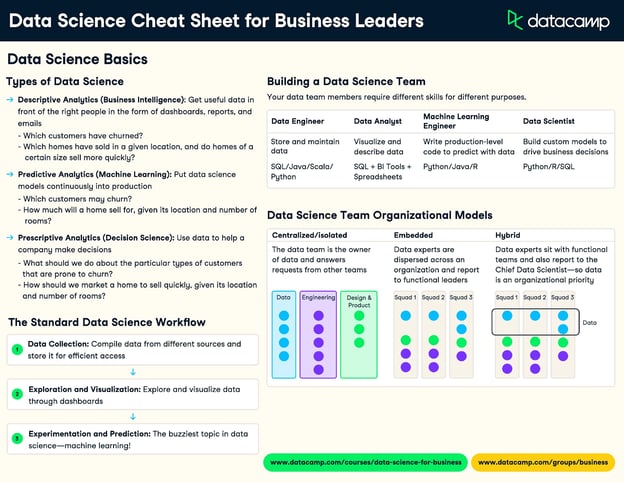
DataCamp’s data science cheat sheet for business leaders
For non-technical staff, you'll need to include no-code tools that are more user-friendly, like:
For a workforce to be data-ready, have your employees/associates gain new skills with DataCamp for Business, where top data skills and tools are tailored to your organization's needs. This includes unlimited access to our entire catalog, including our top Python, SQL, R, Tableau, Power BI, Alteryx, Azure, and ChatGPT courses.
CTA: Get your demo here.
After analyzing the data, the next step is to use these insights to make informed decisions. The data is typically presented in a dashboard format to better understand the context of the analysis.
To make a better business decision, you will require a good combination of business acumen and reliable data analysis.
As described in this quote below:
“Data is a tool for enhancing intuition.” —Hilary Mason, data scientist and founder of Fast Forward Labs
For example, when a trendline shows a decline in customer satisfaction over time, this could prompt the company to investigate potential issues and make improvements to retain customers.
Other possible actions could involve changing business strategies, reallocating resources, or implementing new processes.
To truly know how impactful using data to make decisions is, we will have to explore the common benefits it brings.
Here are some of the key advantages:
All the abovementioned benefits have brought about so much value to organizations out there, in business, education and even healthcare.
Below are some examples of how the successful implementation of a data-driven effort has brought about improvement.
In business, Walmart has been known to use data collected from their customer’s online and in-store activities. This data is then analyzed to better understand their customer base. As such an action was implemented to create personalized shopping experiences.
For example, when a purchase is made, other relevant products will be recommended to the customer for a more personalized experience.
Walmart employees are also provided a shared dashboard to assess items purchased against demographics and behaviors to find purchase patterns. These are all excellent implementations of a data-driven approach to making decisions.
A study was published in 2022 by the Massachusetts Institute of Technology and the University of California at Los Angeles, highlighted that higher education has lagged behind business, industry, and government in its attempt to implement data-driven decision making.
According to a Chronicle survey of college officials conducted in 2023, 97 percent of institutions say they need to better use data and analytics in making decisions, with only 51% of surveyed institutions hiring new staff emphasizing data analysis skills.
However, the education sector isn't left behind in this large potential of harnessing data.
Laurel Public Schools in Montana have implemented a data-driven approach to raising reading literacy rates in their students. In collaboration with Regional Educational Labs (RELL) Northwest, the literacy leadership teams at Laurel created a rubric to point out any previously undetected problems of practice.
Without the use of the rubric system to collect essential data about the teaching methods, students' scores, and teacher feedback, the education team would have had a hard time identifying areas that needed improvement.
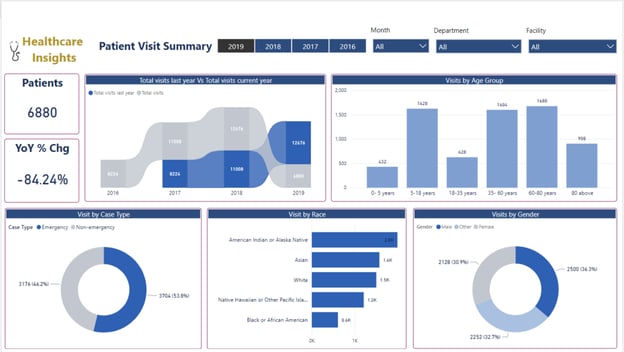
The healthcare industry is one of the slowest-growing sectors in terms of data collection and analysis. However, with advancements in technology and more tools for collecting useful data, data-driven decision-making has become an essential aspect of improving patient care and outcomes.
For example, in an emergency department (ED) in a hospital in New York, a real-time predictive model was used to plan staffing. This involved the analysis of past historical data records. The result of the implementation was to prevent understaffing or overburdening staff in the emergency room. We explore how AI in healthcare is changing the landscape in a separate article.
While the benefits of data-driven decision-making are clear, implementing this approach is not without its challenges.
These are some potential hurdles you will need to be aware of:
As we explored in the State of Data & AI Literacy Report 2024, only 35% of the business leaders we surveyed said their organizations had data training available to all employees. Such a stat shows how the adoption of data-driven decision-making can be impeded by having inadequate training for employees.
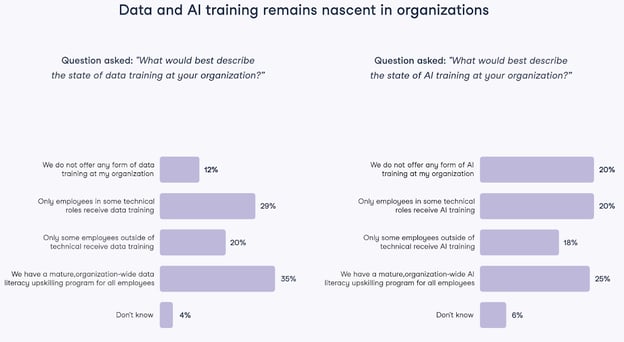
Stats from the State of Data & AI Literacy Report
As technology continues to advance, data-driven decision-making will become even more prevalent in various industries.
Here are some potential future trends in this field:
We’ve seen how data-driven decision-making is the process of using data to inform and guide business decisions. It's a powerful tool that can significantly improve operations across various industries.
Despite challenges like data quality and cultural resistance, fostering a data-centric culture and investing in robust data infrastructure are crucial. Future trends such as AI integration and real-time analytics will further enhance decision-making capabilities, making it crucial for organizations to invest in reskilling and upskilling today.
Equip your team with the necessary skills through DataCamp for Business. Schedule a demo today and drive your organization’s success with informed, strategic decisions.
Data culture refers to an organizational environment where data is not only valued but is also readily accessible and used consistently to drive decision-making processes.
The goals of data-driven decision-making are to improve efficiency, reducing and mitigate risks, provide better customer experiences, creating better and more innovative products, and increasing accountability.
The limitations are having bad quality data, over-reliance on data alone without business domain knowledge, privacy concerns, and resistance to adopt new data technologies.
A data-driven mindset is a strategic approach where decisions and actions are guided by data analysis and interpretation rather than personal opinion or intuition.
A leader should look at the overall trend of their data and identify areas to work on. They should follow up with the right action plan based on the needs of the issue that arised.

I'm Austin, a blogger and tech writer with years of experience both as a data scientist and a data analyst in healthcare. Starting my tech journey with a background in biology, I now help others make the same transition through my tech blog. My passion for technology has led me to my writing contributions to dozens of SaaS companies, inspiring others and sharing my experiences.

blogg
 Kevin Babitz• 7 min

blogg
 Joyce Chiu• 10 min

blogg
 Vinita Silaparasetty• 15 min


Data has become the lifeblood of modern business, with the volume of data expected to grow to more than 180 zettabytes by 2025. It flows through every department, from marketing to operations, finance to human resources. By tapping into this wealth of information, companies can make more informed choices, reduce risks, and identify new opportunities for growth.
But how exactly does data-driven decision-making impact, and why is it so crucial?