Data & AI Trends and Predictions 2026
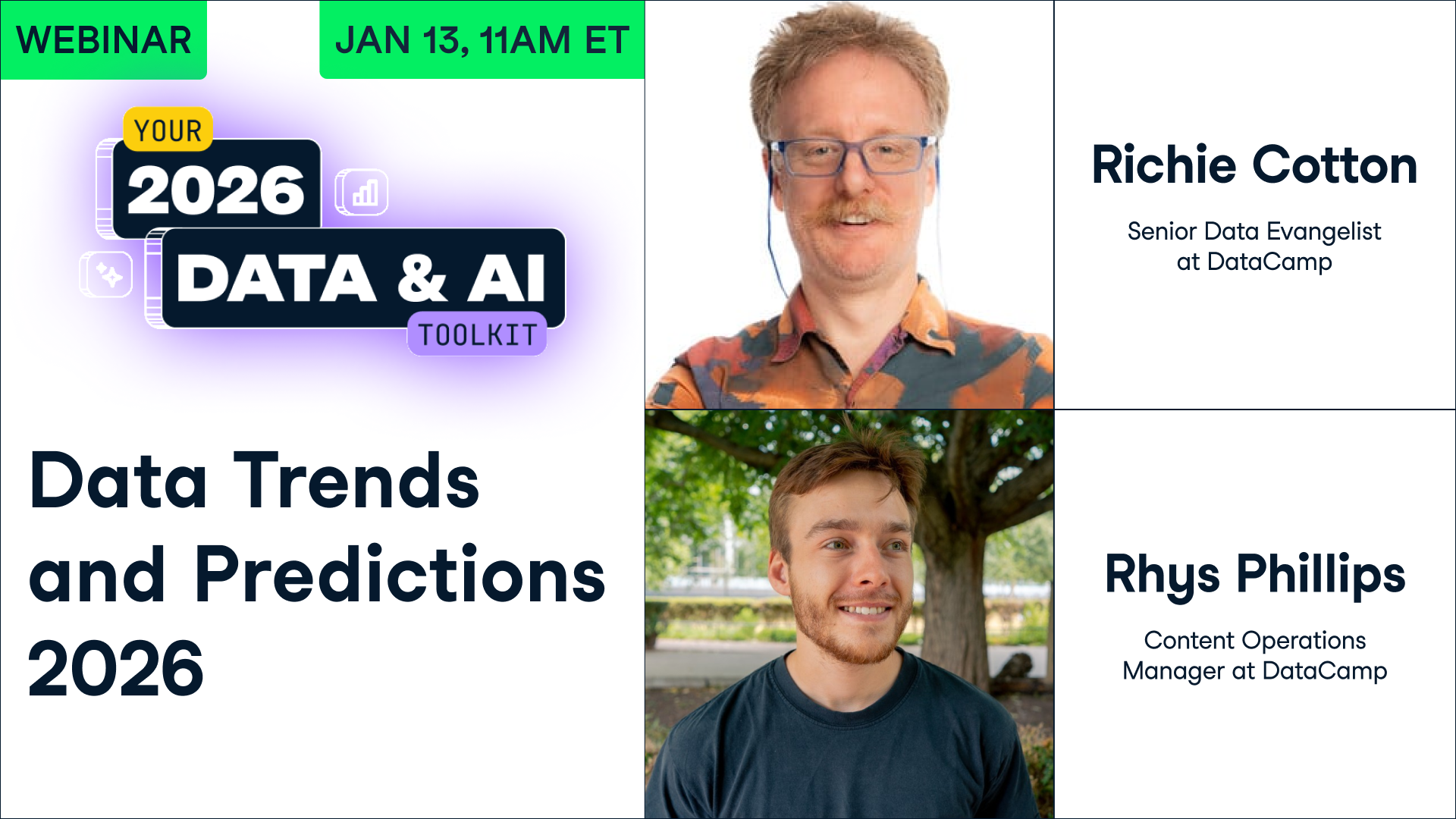
Vos présentateurs

Richie Cotton
Senior Data Evangelist chez DataCamp

Richie helps individuals and organizations get better at using data and AI. He's been a data scientist since before it was called data science, and has written two books and created many DataCamp courses on the subject. He is a host of the DataFramed podcast, and runs DataCamp's webinar program.
Chat with AI Richie about every episode of DataFramed - all data champs welcome!

Rhys Phillips
Marketing Manager at DataCamp

Rhys Phillips is an experienced, multi-disciplinary marketing professional with a background spanning photo and video production, social media, live events, design, paid advertising, and brand building. He currently leads content operations and Markeing at DataCamp, where he helps shape and scale creative workflows that connect storytelling with business impact. Previously, Rhys held senior content roles at recruitment-tech start-up cord and worked as a freelance photographer and videographer, building a versatile skill set across the full spectrum of marketing and creative execution.
Session Resources
Summary
Data Trends and Predictions 2026 is a session designed for data enthusiasts and professionals eager to understand the evolving field of AI and data science. The session explores the current state and future predictions of AI integration in various sectors. It reviews past predictions, highlighting the rapid adoption of AI in white-collar jobs and the importance of product experience over model superiority. The discussion covers the emergence of AI agents, the mainstreaming of video generation, and the evolving roles within data teams. Key predictions for 2026 include improvements in junior hiring, the rise of AI personal shoppers and tutors, and the shift in software development towards AI app builders. The session emphasizes the need for continuous learning due to the fast-paced technological advancements and the importance of quality control in AI-generated content.
Key Takeaways:
- AI adoption in white-collar jobs has become widespread, with a focus on product experience.
- AI agents and video generation are now mainstream, impacting various industries.
- Junior hiring is expected to improve as AI-native skills become more prevalent.
- AI personal shoppers and tutors are predicted to revolutionize retail and education.
- Continuous learning is essential due to rapid technological changes.
In-Depth Analysis
AI Adoption and Product Experience
AI adoption has become common in white-collar jobs, with a significant shift towards prioritizing product experience over merely having superior AI models. Richie noted, "Almost every company has got the message that AI is important." This trend reflects the necessity for AI tools to be not only functional but also user-friendly and integrated into everyday workflows. Companies like Google and Anthropic have differentiated themselves by focusing on specific use cases, such as business productivity and creative tools. The session highlighted that the real challenge now lies in creating AI products that offer tangible benefits and user-friendly experiences.
AI Agents and Video Generation
AI agents have gained significant traction, becoming a popular topic in webinars and social media. These agents are now capable of performing tasks autonomously, marking a shift towards more practical applications. Video generation has also reached a point where distinguishing between real and AI-generated content is challenging. Richie mentioned, "We've got longer form video, has arrived," indicating the technological advancements in this area. However, the rise of deepfakes presents ethical challenges, emphasizing the need for responsible use and regulation of AI-generated content.
Junior Hiring and AI-Native Skills
The session predicts an improvement in junior hiring as AI-native skills become more prevalent. Rhys highlighted the potential for young professionals to adapt quickly to AI technologies, stating, "Young people can become AI native more easily." This shift is driven by the increasing integration of AI in various job roles, requiring new entrants to possess a foundational understanding of AI tools and applications. Companies are encouraged to invest in reskilling programs to bridge the skills gap and ensure their workforce remains competitive in an AI-driven market.
AI Personal Shoppers and Tutors
The concept of AI personal shoppers and tutors is set to transform retail and education. AI-driven shopping agents are expected to simplify the purchasing process, offering personalized recommendations and smooth transactions. In education, AI tutors provide customized learning experiences, adapting to individual needs and preferences. Rhys Phillips noted the effectiveness of one-to-one tutoring, which AI can replicate at scale. These developments promise to enhance user experiences, making shopping and learning more efficient and personalized to individual requirements.
Continuous Learning and Quality Control
The rapid pace of technological advancements necessitates continuous learning and adaptation. The session emphasized the importance of reskilling and upskilling to keep pace with evolving AI capabilities. Quality control in AI-generated content is also essential, as highlighted by the term "slop," referring to low-quality AI content. Ensuring the reliability and accuracy of AI outputs requires strong governance and ethical considerations. As AI becomes more integrated into daily operations, maintaining high standards of quality and trustworthiness will be vital for organizations to succeed.