Terlepas dari investasi agresif dalam alat, platform, dan eksperimen AI, sebagian besar perusahaan belum melihat imbal hasil yang kuat.
Dalam survei kami tahun 2026 terhadap 500+ pemimpin perusahaan di AS dan Inggris, bekerja sama dengan YouGov:
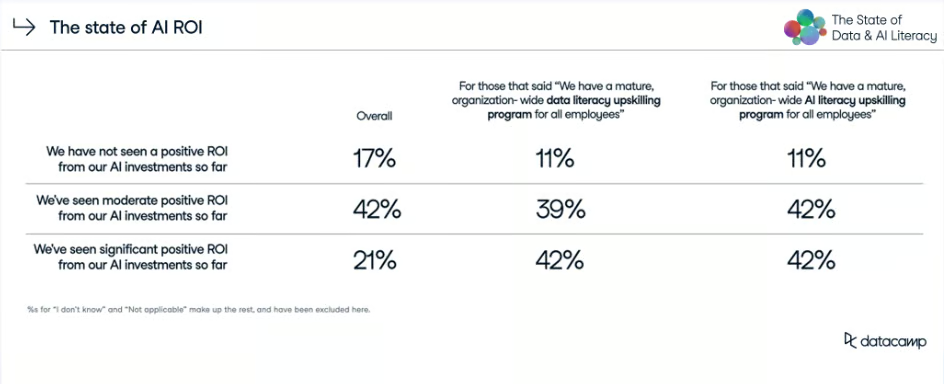
- 21% melaporkan ROI positif yang signifikan dari AI
- 42% melaporkan ROI moderat
- 17% melaporkan tidak ada ROI positif
Pertanyaannya bukan apakah organisasi berinvestasi dalam AI, melainkan mengapa ROI AI sangat bervariasi di berbagai perusahaan. Jawabannya mengarah pada kapabilitas tenaga kerja.
Kesenjangan dalam ROI AI mencerminkan perbedaan yang lebih dalam dalam kesiapan perusahaan. Gambaran umum 2026 kami menguraikan bagaimana literasi AI, literasi data, dan kematangan upskilling membentuk hasil kinerja di seluruh organisasi.
Kesenjangan ROI AI
Temuan paling mencolok dalam data adalah ini: Di antara organisasi dengan program upskilling literasi data atau AI yang matang dan berskala organisasi, laporan ROI AI positif yang signifikan hampir dua kali lipat.
- ROI AI signifikan naik dari 21% secara keseluruhan menjadi 42%
- Laporan tanpa ROI positif turun dari 17% menjadi 11%
Dengan kata lain, perusahaan yang memadukan investasi AI dengan pengembangan kapabilitas tenaga kerja yang terstruktur hampir dua kali lebih mungkin melihat imbal hasil yang kuat.
Alat AI saja tidak menciptakan ROI. Kapabilitas tenaga kerja yang melakukannya.
Mengapa alat AI tidak otomatis menghasilkan ROI
ROI AI bukan semata fungsi dari kecanggihan alat. ROI bergantung pada apakah karyawan mampu:
- Mengidentifikasi use case yang tepat
- Menerapkan alat AI ke alur kerja nyata
- Mengevaluasi keluaran secara kritis
- Menerjemahkan wawasan menjadi keputusan
- Mengukur dampak bisnis
Tanpa literasi data dan AI yang mendasar di tempat kerja, alat AI dapat meningkatkan kecepatan, tetapi tidak selalu ketepatan atau kejelasan. Dan dalam beberapa kasus, risikonya justru meningkat. Para pemimpin mengidentifikasi risiko utama yang terkait dengan keterampilan AI yang tidak memadai:
- 32% menyebut pengambilan keputusan yang tidak akurat
- 25% menyebut pengambilan keputusan yang lambat
- 27% menyebut ketidakmampuan mengikuti laju pesaing
- 16% menyebut insiden keamanan
Intinya: Ketika kapabilitas tenaga kerja tertinggal dari adopsi alat, ROI akan terdampak.
Efek pengganda kapabilitas
Saat literasi data dan AI kuat, manfaatnya berlipat ganda. Para pemimpin mengaitkan keterampilan AI dengan:
- Pengambilan keputusan lebih cepat (48%)
- Inovasi yang lebih kuat (46%)
- Pengambilan keputusan yang lebih akurat (41%)
Dari sisi ekspektasi produktivitas, peningkatan efisiensi yang paling umum diharapkan dari adopsi AI berada pada kisaran 10–20%, meskipun banyak yang mengantisipasi kenaikan di atas 20%. Imbal hasil ini bergantung pada kemampuan karyawan menggunakan AI secara efektif—bukan sekadar memiliki akses.
Dengan kata lain, AI adalah pengganda, tetapi yang digandakan adalah kapabilitas. Jika kapabilitas rendah, imbal hasil tetap rendah.
Mengapa pelatihan AI sering gagal meningkatkan ROI
Sebagian besar organisasi menawarkan setidaknya sebagian pelatihan AI:
- 77% melaporkan menyediakan beberapa bentuk pelatihan AI
- 68% mengatakan karyawan memiliki akses ke sumber belajar AI
Namun hanya 35% yang melaporkan memiliki program upskilling matang berskala tenaga kerja.
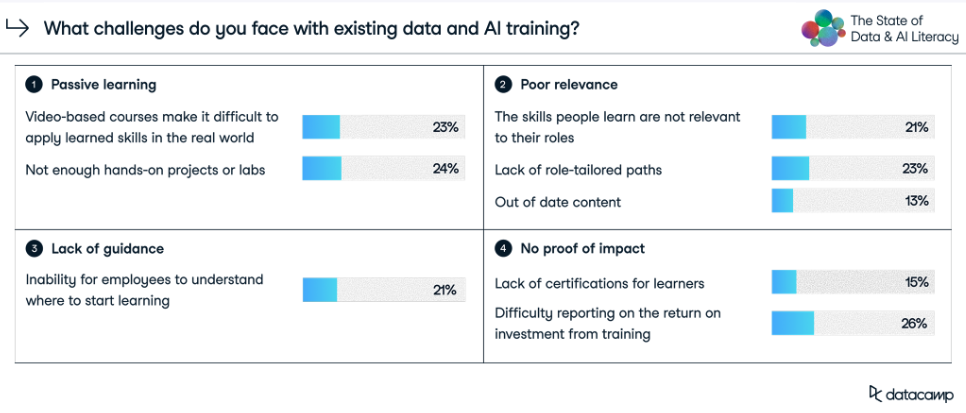
Para pemimpin yang memang menyediakan sebagian pelatihan (terutama yang daring dan mandiri) menyebut tantangan umum, termasuk:
- 24% mengatakan tidak cukup proyek atau lab praktik langsung
- 23% mengatakan jalur pembelajaran tidak disesuaikan dengan peran
- 26% kesulitan mengukur ROI dari pelatihan
Jika pelatihan bersifat pasif, terfragmentasi, atau terputus dari alur kerja nyata, hal itu tidak akan berujung pada ROI AI yang terukur. Pengembangan kapabilitas yang terstruktur adalah pembeda utamanya.
Uraian lengkap temuan ROI dan pelatihan tersedia dalam Laporan State of Data & AI Literacy 2026.
Apa yang dilakukan berbeda oleh organisasi dengan ROI tinggi
Organisasi yang melaporkan ROI AI yang kuat memiliki beberapa karakteristik bersama:
- Mereka berinvestasi dalam literasi data dan AI di seluruh perusahaan, bukan hanya pelatihan untuk tim teknis
- Mereka menanamkan pembelajaran ke dalam alur kerja nyata
- Mereka memperkuat keterampilan secara berkelanjutan
- Mereka mengukur perkembangan kapabilitas
- Mereka menyelaraskan inisiatif AI dengan use case bisnis
Bagi mereka yang memimpin, ROI AI bukan kebetulan; ROI dirancang melalui pembangunan kapabilitas yang dibutuhkan.
Bukti dalam praktik
Pertimbangkan Data Academy tingkat perusahaan milik Bayer, yang menstrukturkan literasi AI dan data dasar di berbagai peran, dari kefasihan digital umum hingga praktisi tingkat lanjut. Lebih dari 90% pembelajar melaporkan mengembangkan ide inovatif atau proses yang lebih baik setelah menyelesaikan pelatihan.
Demikian pula, Rolls-Royce menerapkan program upskilling spesifik peran yang secara signifikan mempercepat proses penanganan data, dalam beberapa kasus meningkatkan kecepatan hingga 100x.
Dalam kedua kasus, ROI AI mengikuti pembangunan kapabilitas yang terstruktur—bukan sebaliknya.
Dari adopsi AI ke imbal hasil AI
Percakapan di tingkat perusahaan sedang bergeser. Strategi AI awal berfokus pada eksperimen dan penerapan; kini fokus beralih ke imbal hasil dari investasi AI.
Data 2026 menunjukkan pola yang jelas: Organisasi yang memperlakukan kapabilitas tenaga kerja sebagai infrastruktur inti, bukan renungan belakangan, jauh lebih mungkin melihat ROI AI yang bermakna.
Bagi para pemimpin perusahaan yang mengevaluasi investasi AI, pertanyaan kritisnya bukan lagi “Alat AI mana yang harus kami adopsi?” Melainkan “Apakah tenaga kerja kami siap menggunakannya secara efektif?”
Bagaimana DataCamp mendukung ROI AI
DataCamp for Business dirancang untuk membangun literasi data dan AI yang terstruktur serta relevan dengan peran, yang mendorong imbal hasil terukur.
Melalui pembelajaran praktik langsung, personalisasi bertenaga AI, asesmen keterampilan, dan tolok ukur di seluruh tenaga kerja, organisasi dapat beralih dari eksperimen AI yang terfragmentasi ke pembangunan kapabilitas yang berkelanjutan.
Jika Anda sedang mengevaluasi cara meningkatkan ROI dari investasi AI di seluruh organisasi, hubungi kami agar kami dapat menunjukkan bagaimana DataCamp for Business mendukung upskilling AI di tingkat perusahaan. Jika Anda ingin melihat bagaimana pembelajaran terstruktur dan terapan mendukung ROI AI, jelajahi beberapa kursus literasi data dan AI kami yang paling populer:

