Cursus
AI-agents bouwen met Google ADK
1 Hr
7.5K
If you've ever tried to build a voice assistant, you’ll know how clunky the traditional pipeline is. You record the user's voice, transcribe it with an STT model, send that text to an LLM, wait for a response, and then run it through a TTS engine.
By the time your user hears an answer, several seconds of awkward silence have passed. It is less of a conversation and more of a slow request-and-response cycle.
The Gemini Live API changes this flow by letting you stream audio and video continuously over a stateful WebSocket connection. Because the model processes and outputs audio natively, it can react immediately, adapt to natural vocal nuances, and even handle interruptions (barge-in) mid-sentence.
In this tutorial, I will show you how to build a Real-Time AI Travel Concierge using the code-first Google Agent Development Kit (ADK). We'll equip our agent with Google Search for live destination weather lookups, connect it to a mock flight database, and spin up a local developer interface to test how it handles real-time dialogue and tool calling.
If you are new to the ecosystem, I recommend starting with the Building AI Agents with Google ADK course to establish your foundational knowledge.
What you will achieve:
Prerequisites:
At its core, the Gemini Live API is a developer tool from Google that allows you to build real-time voice and vision interactions with Gemini models. Instead of waiting for turn-based text responses, it enables continuous, natural conversation between a user and an AI agent.
Technically, the Gemini Live API is designed for bidirectional, real-time streaming. Unlike standard HTTP REST APIs that use stateless request-response cycles, the Live API relies on a stateful, persistent WebSocket (WSS) connection. Through this open channel, the client streams raw audio, video (transmitted as image frames at ~1 FPS), and text, while the model streams back immediate, native audio and text.
Because real-time streaming involves a continuous, full-duplex connection, the billing model differs from standard static text APIs. Google offers both a generous free tier for prototyping in Google AI Studio and a production-ready paid tier on Vertex AI.
The model gemini-3.1-flash-live-preview is billed per million tokens or converted
directly into a duration-based metric for audio and video media:
|
Metric |
Free Tier (Google AI Studio) |
Paid Tier (Vertex AI) |
|
Input Price (Text) |
Free |
$0.75 per 1M tokens |
|
Input Price (Audio) |
Free |
$3.00 per 1M tokens (or $0.005 / minute) |
|
Input Price (Image/Video) |
Free |
$1.00 per 1M tokens (or $0.002 / minute) |
|
Output Price (Text) |
Free |
$4.50 per 1M tokens |
|
Output Price (Audio) |
Free |
$12.00 per 1M tokens (or $0.018 / minute) |
|
Grounding with Google Search |
Free (Rate limited) |
First 5,000 prompts/month free, then $14 per 1,000 queries |
If you are prototyping, I highly recommend testing for free in Google AI Studio, which provides generous access subject to rate limits.
When you are ready to scale, you can transition your project to Vertex AI for production Pay-as-you-go provisioning, which provides guaranteed throughput and enterprise-grade SLAs.
As a developer, you have a few architectural choices when implementing the Live API. Because it relies on WebSockets, how you route the connection matters for latency and security.
While you can write raw WebSocket code, the easiest way to start is by using Google’s GenAI SDK or the Agent Development Kit (ADK).
For enterprise production, the ecosystem has rapidly evolved to support WebRTC integrations. Platforms like LiveKit, Pipecat by Daily, Twilio, and Voximplant offer robust infrastructure to handle network jitter, echo cancellation, and real-time audio routing directly into the Gemini Live API.
Let's put this into practice. We are going to build an AI Travel Concierge.
This agent will use the Gemini Live API to converse with users over voice, but more importantly, it will have access to custom Python functions to look up real-time flight statuses mid-conversation.
We will use the Google Agent Development Kit (ADK) and the powerful gemini-3.1-flash-live-preview model, which is optimized for both standard text turns and real-time WebSocket streaming.
First, you need to set up a Python virtual environment and install the required ADK package. Run these commands in your terminal:
# Create and activate a virtual environment
python3 -m venv .venv
source .venv/bin/activate
# Install the Agent Development Kit
pip install google-adk
Next, configure your environment variables so the ADK can securely authenticate with your Google Cloud project:
export GOOGLE_CLOUD_PROJECT="your-project-id"
export GOOGLE_CLOUD_LOCATION="us-central1"
If you are using a Gemini API Key from Google AI Studio instead, create a .env file in your root folder:
GEMINI_API_KEY=your_google_ai_studio_api_keyCreate a file named agent.py in your project directory. The ADK is designed to automatically detect and run the root_agent variable. In this code, we will define a custom Python function to check flight statuses, and then we will pass it directly into the agent's toolbelt. Initialize the agent directory:
mkdir voice_assistant
touch voice_assistant/__init__.py
touch voice_assistant/agent.py
Expose the agent package inside voice_assistant/__init__.py:
from . import agentOpen voice_assistant/agent.py and write the travel agent configuration. In the code below, we define a standard Python function check_flight_status.
In Google ADK, any Python function with proper type hints and a docstring is automatically converted into an agent tool. The LLM uses the docstring description and parameters to determine when and how to call the function.
Leveraging Gemini 3.1 Flash Live Preview To support both interaction modes in the ADK development server—standard text chat (which uses standard REST generateContent endpoints) and the real-time bidirectional WebSocket microphone interface—we explicitly set the model to gemini-3.1-flash-live-preview.
Unlike older streaming-only models, which return a 404 Not Found when triggered over standard HTTP REST requests, gemini-3.1-flash-live-preview natively supports both standard REST content generation and stateful WebSocket streaming.
from google.adk.agents.llm_agent import Agent
from google.adk.tools import google_search
def check_flight_status(flight_no: str) -> str:
   """Check the real-time flight status (e.g. delays, gate info, cancellations).
   Args:
       flight_no: The flight number to look up (e.g., AA120, DL450, UA990).
   """
   flight_no = flight_no.upper().strip()
   if "AA120" in flight_no:
       return "Flight AA120 to Paris is currently delayed by 45 minutes due to air traffic control. New departure time: 3:15 PM. Gate status: B22."
   elif "DL450" in flight_no:
       return "Flight DL450 to London is on time. Gate status: Boarding now at Gate C10."
   elif "UA990" in flight_no:
       return "Flight UA990 to Tokyo is cancelled due to adverse weather conditions at the destination. Passengers are advised to rebook at the counter."
   else:
       return f"Flight {flight_no} is currently scheduled on time. No delay reports found in the flight database."
# Define the root agent with search grounding and custom database flight checks
root_agent = Agent(
   model='gemini-3.1-flash-live-preview',
   name='root_agent',
   description='A real-time AI Travel Concierge with flight tracking and search grounding.',
   instruction=(
       'You are an expert AI Travel Concierge. You assist users with real-time flight status checkups, '
       'destination recommendations, and general travel planning. '
       'Always answer professionally and conversationally. '
       'Use the check_flight_status tool when a user asks about a specific flight status. '
       'Use Google Search to look up weather, transit conditions, or travel advisories at destinations.'
   ),
   tools=[google_search, check_flight_status],
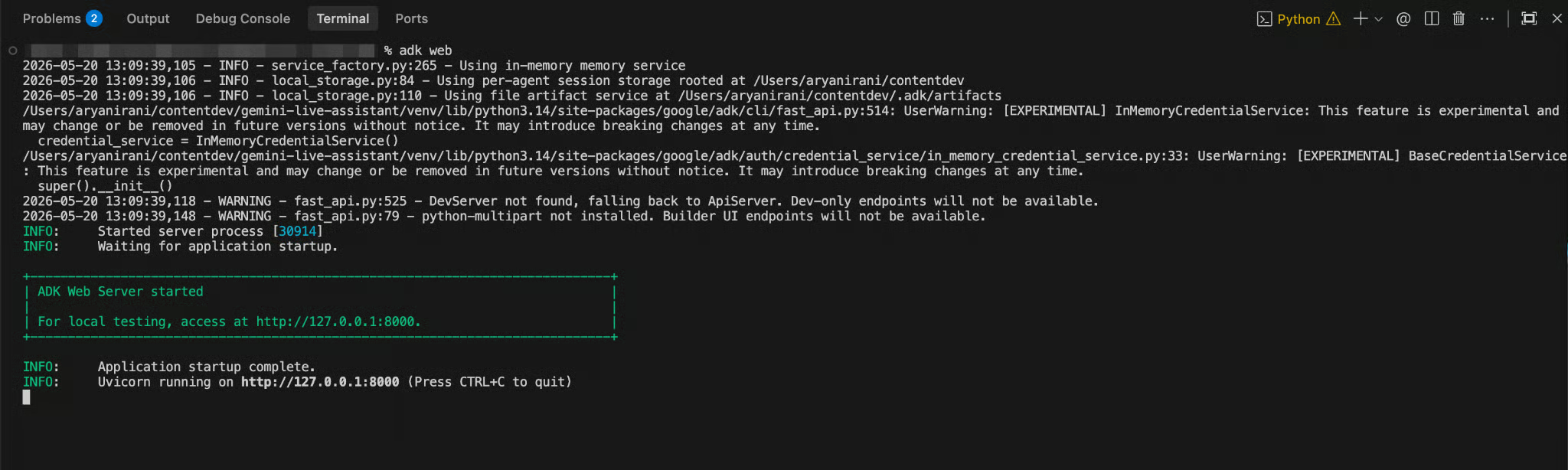
)The ADK includes a built-in development server and Web UI. This lets you test your agent locally without writing any frontend code. Start the web server from your workspace:
.venv/bin/adk web .You should see output indicating the server has started:
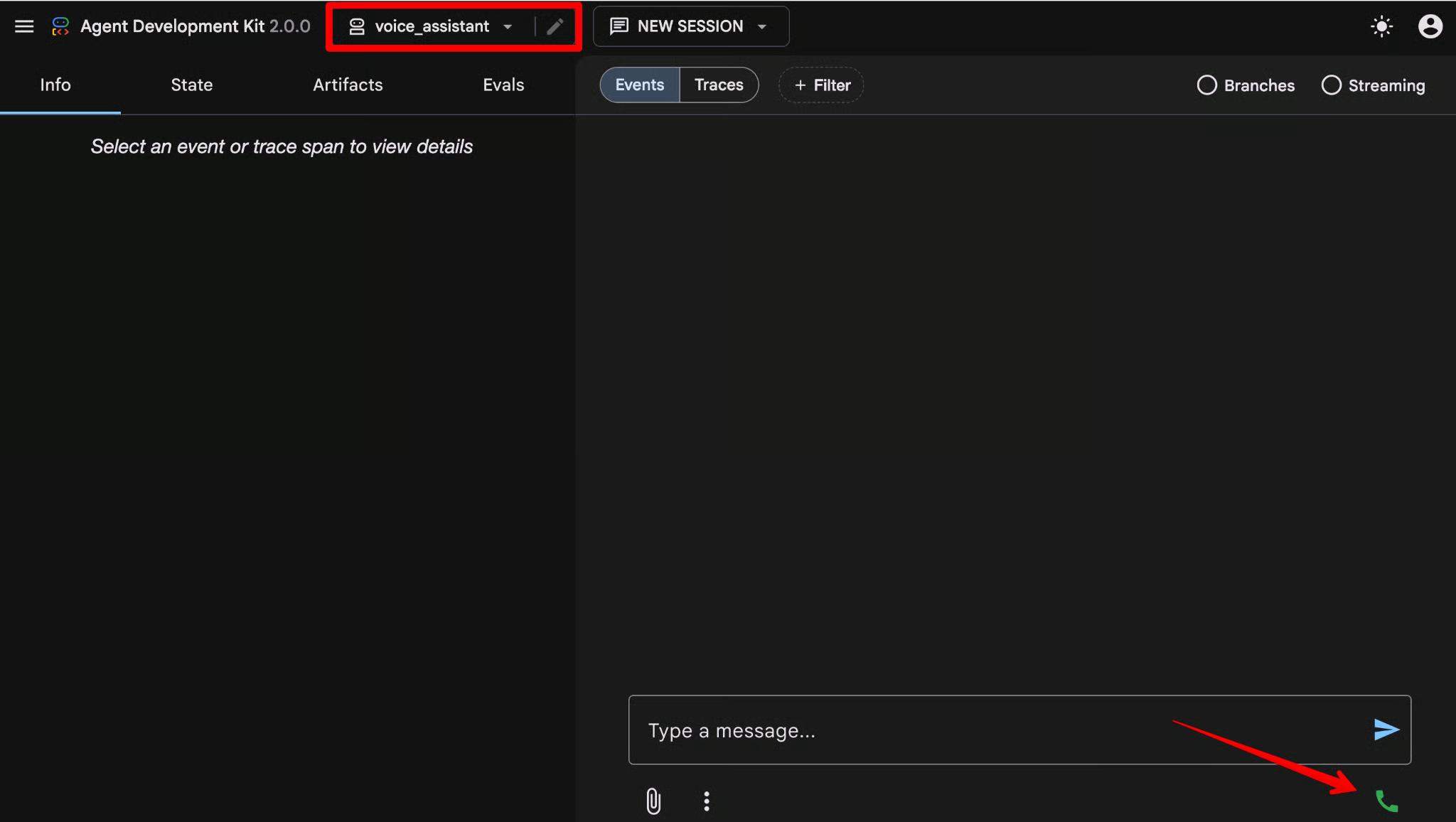
Select root_agent from the application list to open the chat interface.
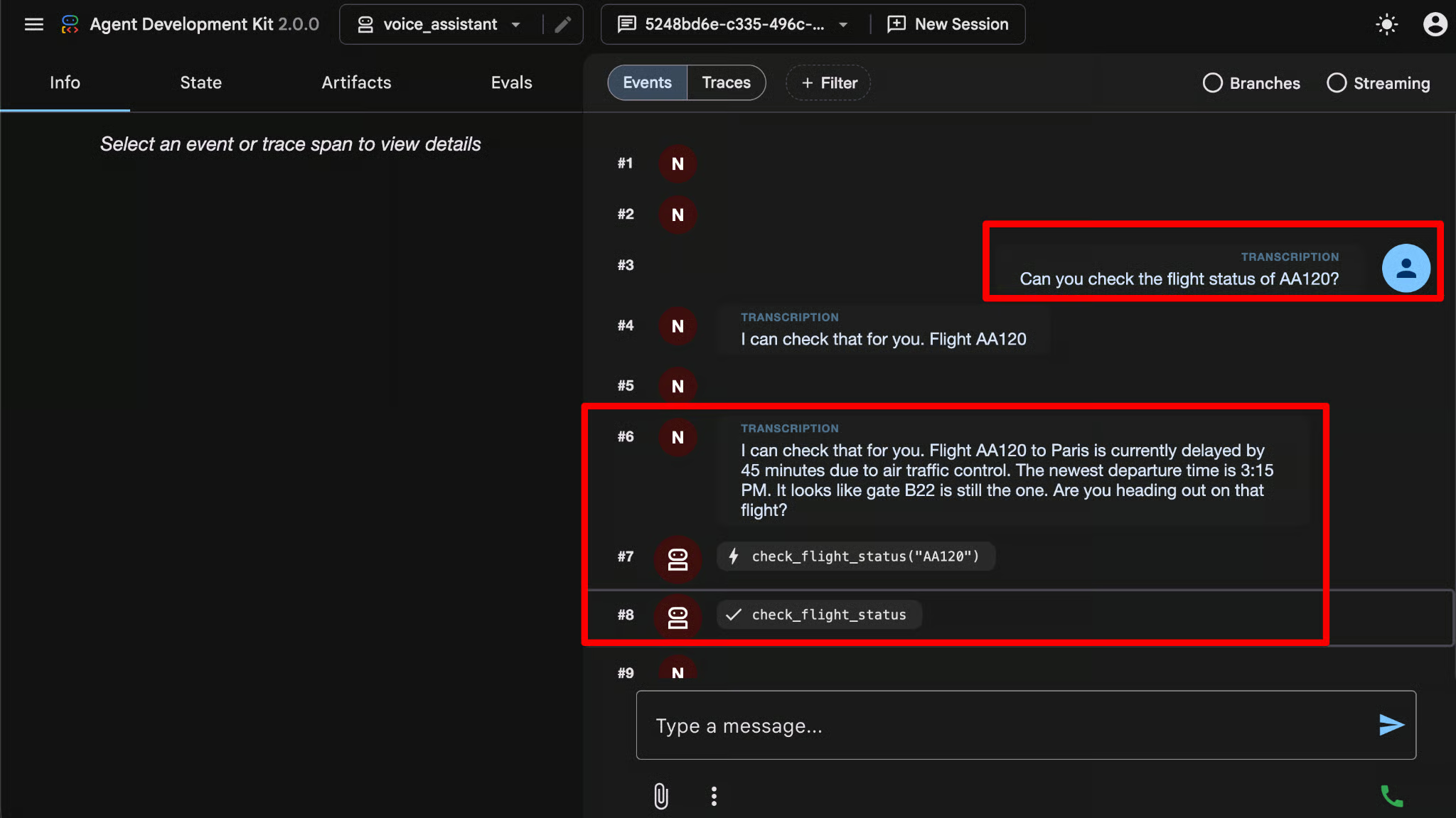
4. Speak into your microphone: Can you check the status of flight AA120? The agent will parse your request, recognize that it needs database information, trigger the custom check_flight_status Python function, and display the JSON tool call outcome before speaking the response back to you.
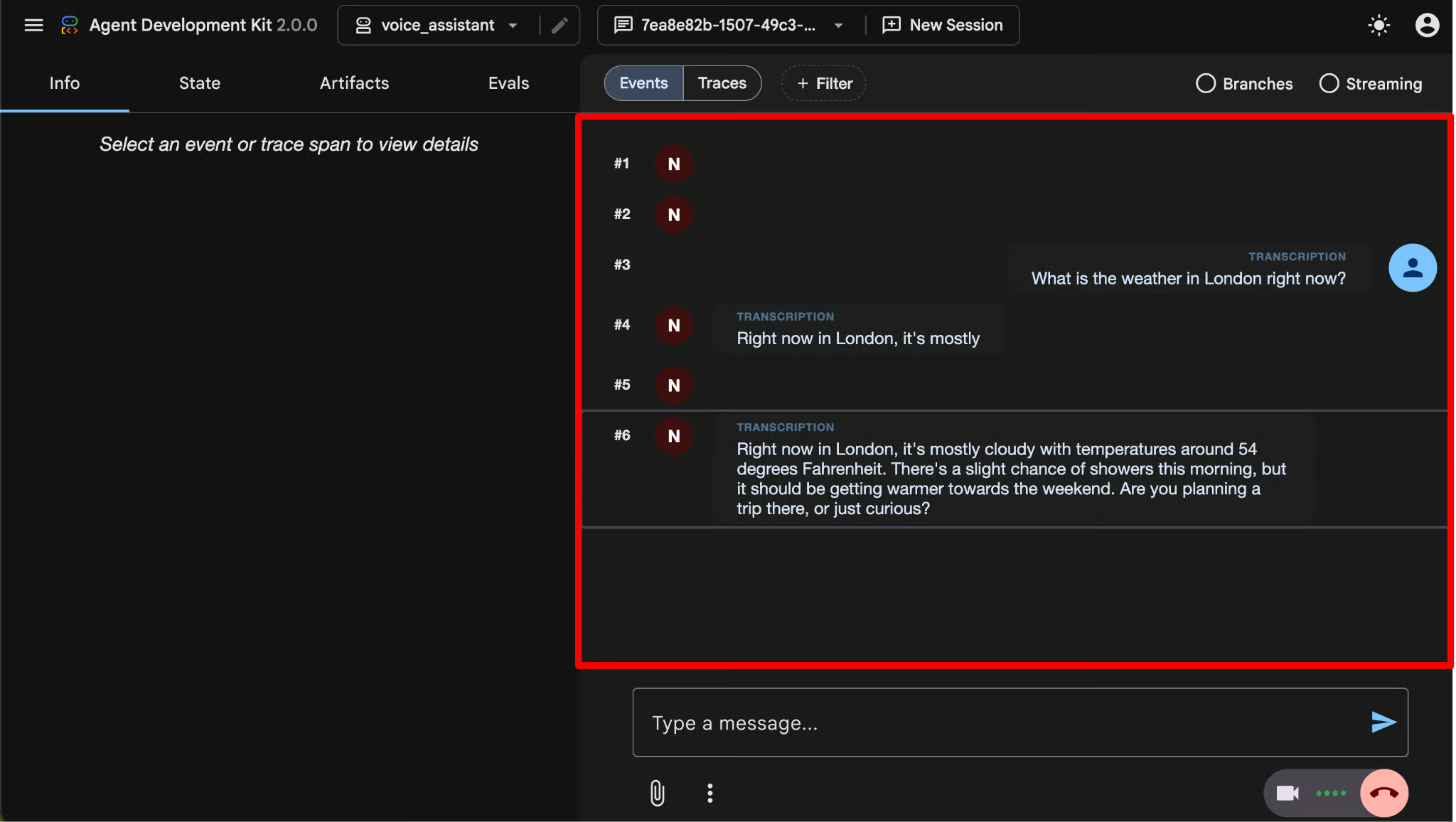
5. Testing Google Search Grounding: Next, ask the concierge a destination weather question: What is the weather in London right now? The agent will activate the built-in google_search tool, crawl the web, and synthesize the live conditions into its audio output.
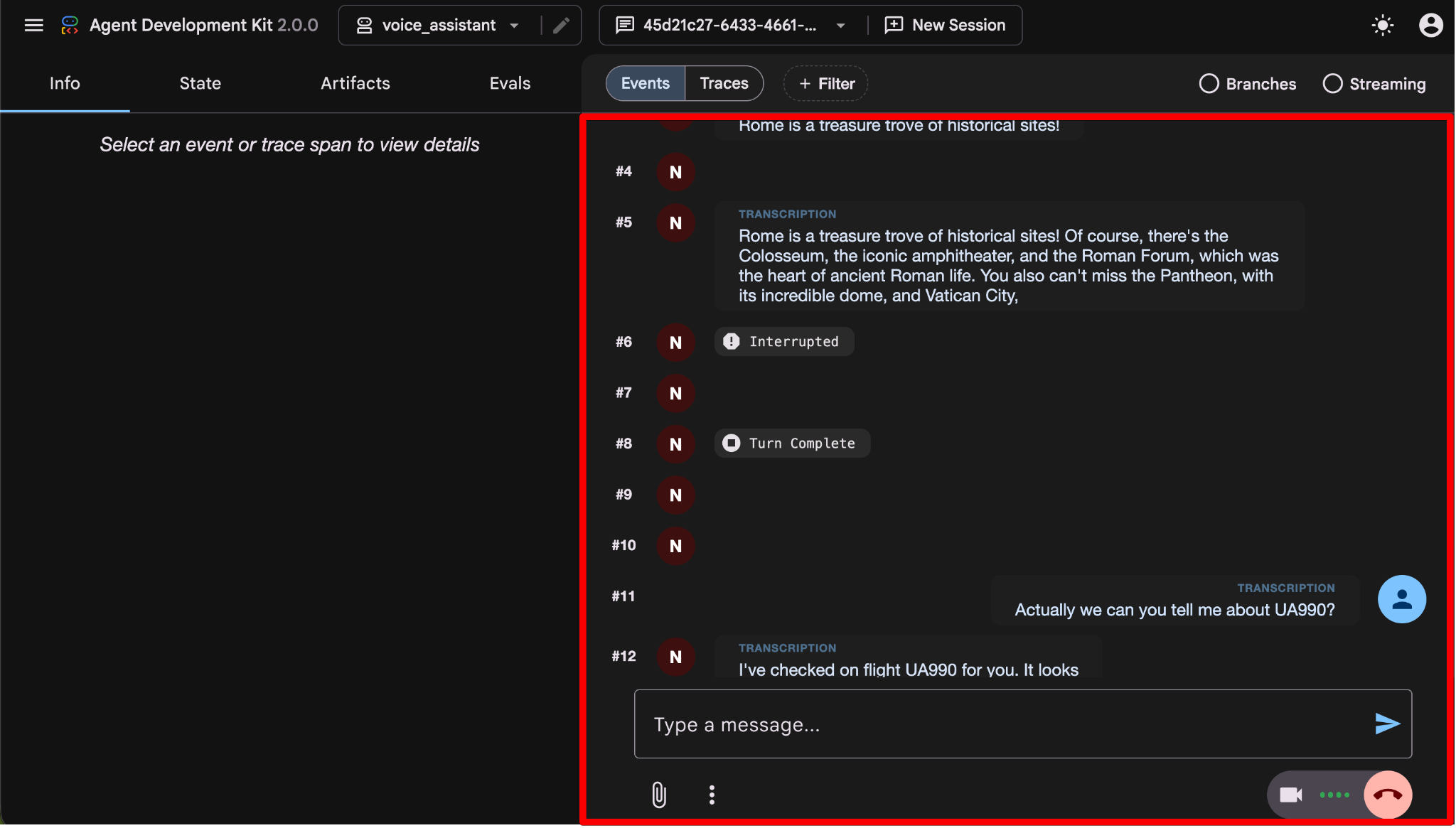
6. Testing the Barge-in Feature: Ask a broad question like: Tell me about the best historical sites to visit in Rome. As the agent begins listing spots, speak over it loudly: Actually, wait! Check flight UA990 instead!. The agent will immediately stop its speech stream, interrupt the Rome details, run the custom flight tracker tool, and announce that flight UA990 has been canceled. This showcases the low-latency, full-duplex nature of the Live API connection.
Building real-time voice applications introduces unique requirements around prompt architecture, network state management, audio ingestion, and resource scaling. Below are key best practices derived from official developer guidelines.
To get the best performance out of Gemini Live, structure your system instructions (SIs) in a strict hierarchy: Persona, Conversational Rules, and Guardrails.
When exposing tools to the Live API:
Native audio tokens accumulate rapidly, approximately 25 tokens per second of conversation. For long-running voice sessions, this can quickly fill the context window and increase latency.
ContextWindowCompressionConfig in your connection settings to drop older history once a threshold is reached:from google.genai import types
live_config = types.LiveConnectConfig(
context_window_compression=types.ContextWindowCompressionConfig(
trigger_tokens=100_000,
sliding_window=types.SlidingWindow(target_tokens=4_000),
),
)Note: Context compression will cause old conversation history to be lost.
Real-time mobile connections are prone to packet loss and temporary disconnections. Instead of starting a brand new conversation state from scratch, implement transparent session resumption:
SessionResumptionConfig(transparent=True).session_resumption_update events from the server and store the new_handle.server-reported last_consumed_client_message_index to prune the buffer).The transition from turn-based, text-only LLMs to low-latency, multimodal streaming represents a paradigm shift in how we build human-computer interfaces. By processing audio and video natively through stateful WebSocket connections, the Gemini Live API allows us to build agentic experiences that feel less like static software programs and more like fluid human interactions.
Throughout this guide, we explored the inner architecture of Gemini Live, examined pricing models, and built a fully functional AI Travel Concierge utilizing the Google Agent Development Kit (ADK). We witnessed how ADK maps standard Python functions into active agent tools, giving our voice assistant access to both broad web-based search grounding and private internal database lookups.
Now that you have the fundamentals of real-time voice agents down, consider extending your AI Travel Concierge:
Ready to build more advanced conversational workflows? Check out DataCamp’s AI Agent Fundamentals skill track to deepen your knowledge of agentic architectures, tool use, and generative AI deployments.
Top DataCamp Courses
Cursus
Cursus
Leerpad
Tutorial
Abid Ali Awan
10 min
Tutorial
Abid Ali Awan
12 min
Tutorial
Bexruz (Bex) Tuychiev
12 min
Tutorial
François Aubry
12 min
Tutorial
Natasha Al-Khatib
8 min
Tutorial
François Aubry
15 min