

课程
ChatGPT 进阶
1 小时
33.4K
实践并学习路径你的进步。
使用 Google 继续GPT-6 Astra launched in early September as OpenAI’s new flagship, and everything since has been about bringing its capability down to cheaper tiers. Sol and Luna, and then also GPT-6.1 Sol all then arrived in late September. Terra was the last tier still on GPT-5.6, so we've been expecting an update. Now, that update has arrived: Terra matches Astra on Agents’ Last Exam at one-tenth the price per token; GPT 6.1 Terra has $1 per million input tokens and $5 per million output tokens.
Below, we cover the benchmarks, how Terra compares with Sol and Astra, pricing, and access.
Pricing and availability last checked .
GPT-6.1 Terra is the latest model in OpenAI's Terra line, which sits below Sol and Astra on capability and well below them on cost. It replaces GPT-5.6 Terra.
OpenAI tells us that Terra is for communication and computer-based jobs. Basically, things that fill a workday. This is intentionally broad: OpenAI gives as examples everything from interpreting technical drawings and editing videos to reading invoices and entering those invoices into software.
Another way to think about it: Terra is built for high-volume, repetitive work where a cheaper model that is good enough beats an expensive one that is slightly better.
All the figures below come from OpenAI's announcement. We have not reproduced them, and several are reported as comparisons rather than raw scores.
At only medium reasoning effort, GPT-6.1 Terra scores 15 percentage points higher than GPT-5.6 Terra on Agents' Last Exam, which is a benchmark of professional tasks such as turning architectural drawings into a 3D model. It also scores higher at one-third the cost.
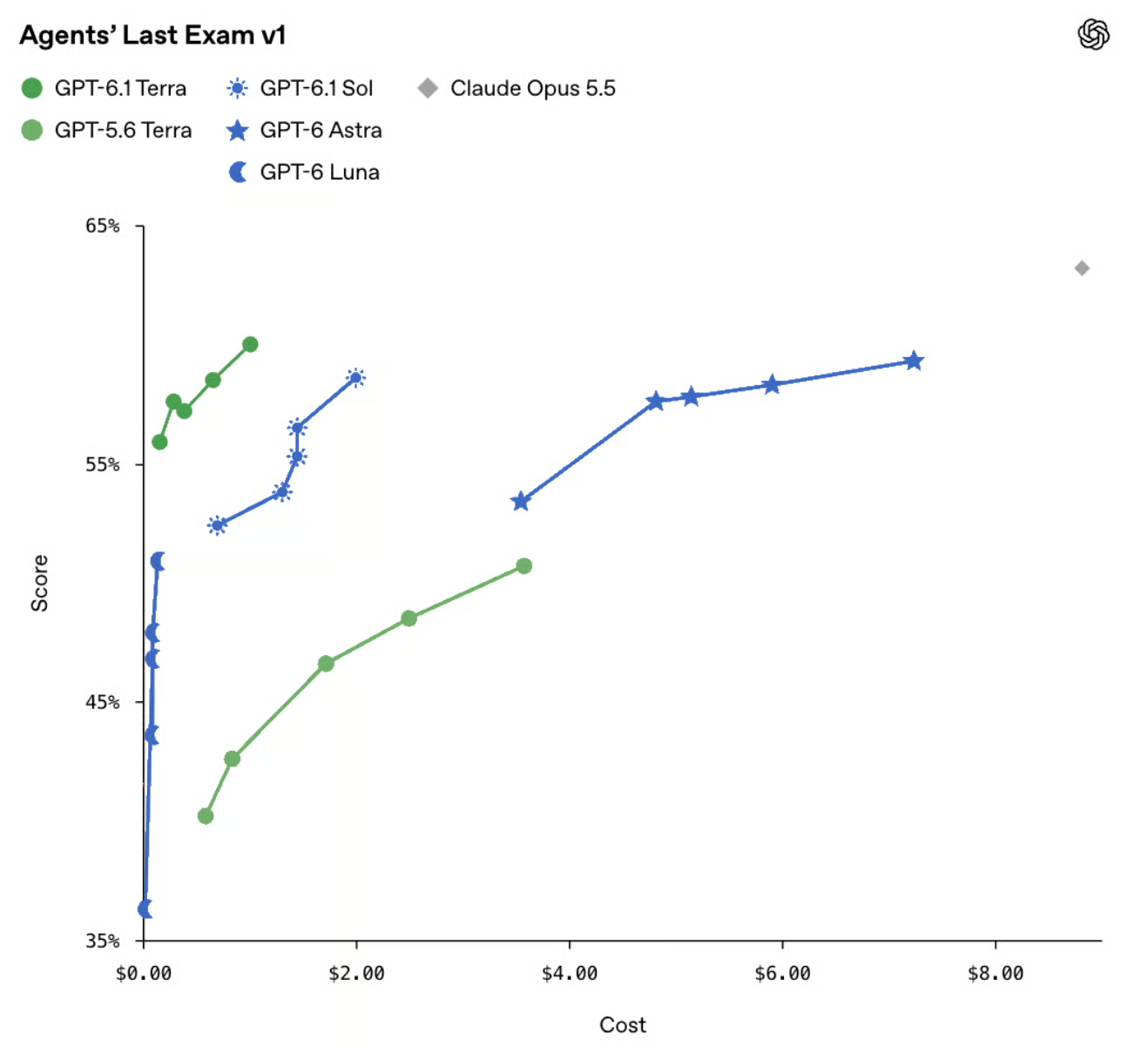
Also at medium effort, on OSWorld 2.1, which tests agents operating desktop apps across multistep tasks, 6.1 Terra beats 5.6 Terra's best score at a fraction of the cost per task.
At max effort, compared with Claude Opus 5.5, Terra is apparently over three times as token-efficient and one-fourth the price per token. Taken together, this is 9x lower cost per task. This is from OpenAI's announcement. I found this comparison a little artificial or selective. Opus is on the premium tier, so a big cost ratio is easy to produce.
On MMMU-Pro, a visual reasoning benchmark, GPT-6.1 Terra outperforms GPT-5.6 Terra at every reasoning setting. The better comparison is against GPT-6 Astra and GPT-6.1 Sol, where it nearly matches and at lower cost.
On OpenAI's internal benchmark of prompts designed to trigger errors, the error rate at low reasoning effort fell from 53.6%, which was GPT-5.6 Terra's score, to now 16.7%.
At max effort, the error rate dropped to 4.3%, which OpenAI says nearly matches GPT-6 Astra and GPT-6.1 Sol.
Terminal-Bench 4.0 tests coding agents working from the command line. GPT-6.1 Terra solves half of the tasks. For reference, GPT-5.6 Terra solved about 20%.
On Terminal-Bench-Science 0.1, which covers research tasks such as tracking cell divisions in a time-lapse video, Terra at max effort beats GPT-6.1 Sol at lower cost. It comes within five points of Claude Opus 5.5 at under one-fifth of the estimated cost.
| Benchmark | Setting | GPT-6.1 Terra result, per OpenAI |
|---|---|---|
| Agents' Last Exam | Medium effort | 15 points above GPT-5.6 Terra; on par with GPT-6 Astra |
| MMMU-Pro | All settings | Above GPT-5.6 Terra; close to GPT-6 Astra and GPT-6.1 Sol |
| OSWorld 2.1 | Medium effort | Above GPT-5.6 Terra's best score |
| Internal error-inducing prompts | Low / max effort | 16.7% / 4.3% error rate (GPT-5.6 Terra: 53.6% at low) |
| Terminal-Bench 4.0 | Max effort | 50.3% (GPT-5.6 Terra: 21.5%) |
| Terminal-Bench-Science 0.1 | Max effort | Above GPT-6.1 Sol; within 5 points of Claude Opus 5.5 |
GPT-6.1 Sol and GPT-6 Astra remain the better choice for the most complex coding tasks. That said, Terra closes much of the gap on visual and computer-use benchmarks.
The trade-off is cost and speed. Terra is half the API price of GPT-6.1 Sol and one-tenth of GPT-6 Astra's price per token, and it completes Agents' Last Exam tasks over three times faster than either.
In ChatGPT Work and Codex, OpenAI says the same plan allowance covers substantially more tasks with Terra than with Sol or Astra.
Verdict: Based on OpenAI's numbers, Terra looks like the default for high-volume document, form and computer-use work. Still use Sol or Astra when the task is hard enough that a better answer is worth several times the cost (complex software engineering).
In the API, the model ID is gpt-6.1-terra. Standard pricing is $1 per million input tokens, $0.05 per million cached input tokens, and $5 per million output tokens.
In ChatGPT, it is available to all Plus, Pro, Enterprise, and Edu users in ChatGPT Work and Codex. The announcement doesn't mention the free tier, and rollouts can take a while to reach every account.
If you already call OpenAI models from code, switching is a one-line change. Here is a minimal call with the OpenAI Python SDK:
from openai import OpenAI

client = OpenAI()

response = client.responses.create(
    model="gpt-6.1-terra",
    input="Summarize this invoice and list the line items: ..."
)

print(response.output_text)
If you are new to calling models from Python, our Working with the OpenAI API course covers the basics, from authentication to building simple applications.
OpenAI says GPT-6.1 Terra meets the Critical threshold in cybersecurity under its Preparedness Framework, and keeps the protections developed for GPT-6 Astra. In plain terms, OpenAI treats it as capable enough in cybersecurity to need the same safeguards as its most capable model.
On alignment, OpenAI reports that Terra is more likely than GPT-5.6 Terra to stay within the scope of a task and to tell users about its limitations and blockers. It also showed strong resistance in OpenAI's prompt-injection tests, which matters more for a model meant to read invoices and operate apps. The details are in the GPT-6.1 Terra system card.
GPT-6.1 Terra is a cheaper, faster model that OpenAI says lands close to its frontier models on visual reasoning and computer use. The factuality and coding gains over GPT-5.6 Terra are large on paper. Five months is a long time in AI.
Learn with DataCamp
课程
课程
实践并学习路径你的进步。
使用 Google 继续博客
Matt Crabtree
14分钟
博客
Josef Waples
8分钟
博客
Tom Farnschläder
15分钟
博客
Matt Crabtree
12分钟
博客
Josef Waples
15分钟
博客
Josef Waples
13分钟


