
As a consequence, organizations are building internal data science skill academies to accelerate their data fluency and embed learning in the flow of work. This infographic will present 5 best practices for building data academies learned from DataCamp for Business customers.
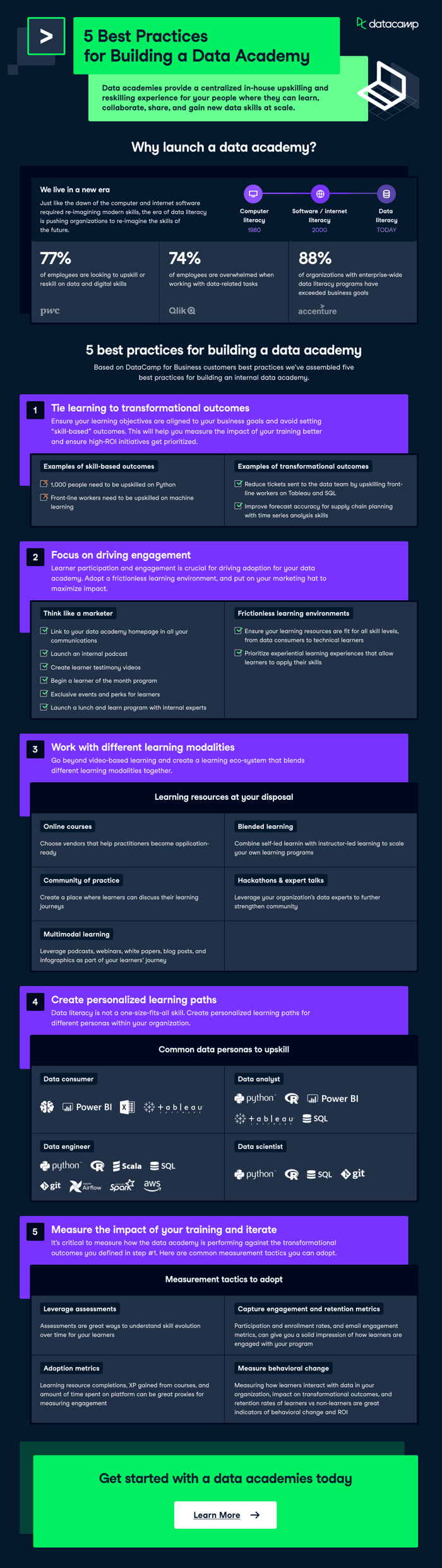
5 best practices for building a data academy
1. Tie learning to transformational outcomes
Ensure your learning objectives are aligned to your business goals and avoid setting “skill-based” outcomes. This will help you measure the impact of your training better and ensure high-ROI initiatives get prioritized.
|
Examples of skill-based outcomes |
Examples of transformational outcomes |
|
1,000 people need to be upskilled in Python |
Reduce tickets sent to the data team by upskilling frontline workers on Tableau and SQL |
|
Front-line workers need to be upskilled in machine learning |
Improve forecast accuracy for supply chain planning with time series analysis skills |
2. Focus on driving engagement
Learner participation and engagement are crucial for driving adoption for your data academy. Adopt a frictionless learning environment, and put on your marketing hat to maximize impact. Here are some tactics you can adopt:
- Link to your data academy homepage in all your communications
- Launch an internal podcast
- Create learner testimony videos
- Begin a learner of the month program
- Exclusive events and perks for learners
- Launch a lunch and learn program with internal experts
- Ensure your learning resources are fit for all skill levels, from data consumers to technical learners
- Prioritize experiential learning experiences that allow learners to apply their skills
3. Work with different learning modalities
Go beyond video-based learning and create a learning eco-system that blends different learning modalities together. Learning modalities include:
- Online courses: Choose vendors that help practitioners become application-ready
- Community of practice: Create a place where learners can discuss their learning journeys
- Multimodal learning: Leverage podcasts, webinars, white papers, blog posts, and infographics as part of your learner's journey
- Blended learning: Combine self-led learnin with instructor-led learning to scale your own learning programs
- Hackathons & expert talks: Leverage your organization's data experts to further strengthen community
4. Create personalized learning paths
Data literacy is not a one-size-fits-all skill. Create personalized learning paths for different personas within your organization. Learn more about data personas in this white paper.
5. Measure the impact of your training and iterate
It’s critical to measure how the data academy is performing against the transformational outcomes you defined in step #1. Here are common measurement tactics you can adopt.
- Assessments: Assessments are great ways to understand skill evolution over time for your learners
- Adoption: Learning resource completions, XP gained from courses, and amount of time spent on the platform can be great proxies for measuring engagement
- Engagement and retention metrics: Participation and enrollment rates, and email engagement metrics, can give you a solid impression of how learners are engaged with your program.
- Behavioral change: Measuring how learners interact with data in your organization, impact on transformational outcomes, and retention rates of learners vs. non-learners are great indicators of behavioral change and ROI


Data science skills are becoming increasingly needed as organizations try to thrive in the data-driven age. According to a PwC survey of more than 32,000 workers, 77% of employees are looking for opportunities to reskill on digital and data skills amidst higher concerns of automation and the need to work with automated systems. You can learn more about building an in-house data academy with our separate webinar.