

What Is Operator?
Operator is OpenAI’s first AI agent, designed to autonomously perform tasks on the web. An AI agent is a system that can take instructions, reason through them, and execute actions without constant human oversight.
Unlike traditional automation tools that rely on predefined APIs or rigid workflows, Operator interacts directly with websites, mimicking human actions like clicking, typing, and scrolling. Its primary goal is to simplify digital tasks that might otherwise require manual effort or technical expertise.
This makes it well-suited for everyday activities like managing reservations or filling out forms, as well as for more complex, multi-step workflows. Here’s an example of using Operator:
Operator uses a virtual browser to navigate websites. This virtual environment enables it to interact with graphical user interfaces (GUIs) like a human user would. Instead of requiring websites to have specialized APIs, Operator interprets the visual layout of a webpage, clicks buttons, types in fields, and scrolls through content.
Operator relies on plain-language instructions to understand what users need. Once the task is set, it processes the instructions, breaks them into actionable steps, and executes them while providing feedback to the user. Operator can also ask for clarification or confirmations for critical actions, such as submitting a form or completing a payment, ensuring greater control over its output.
What Is Computer-Using Agent (CUA)?
The Computer-Using Agent (CUA) is the core technology powering Operator. Combining GPT-4o’s vision capabilities with advanced reasoning through reinforcement learning, CUA is trained to interact with graphical user interfaces—the buttons, menus, and text fields people see on a screen.
Perception
CUA begins by processing raw pixel data from screenshots of the screen. It uses this visual information to identify key interface elements such as buttons, input fields, and navigation menus.
Reasoning
Once the visual data is analyzed, CUA applies chain-of-thought reasoning to plan its actions. By integrating current and past screenshots, it evaluates its observations, breaks tasks into smaller steps, and adapts dynamically to challenges. For example, if a pop-up appears during a task (like the ad we’ve seen in the example above), CUA can adjust its approach and find a way to continue, much like a human user would.
Action
CUA uses virtual mouse and keyboard inputs to perform actions such as clicking, typing, scrolling, and submitting forms. This functionality enables it to execute tasks autonomously, whether it’s selecting an item from a dropdown menu or navigating through a multi-step form.
For critical actions—such as making payments or logging into accounts—CUA seeks user confirmation before proceeding, ensuring users maintain control over sensitive operations.
CUA Benchmarks
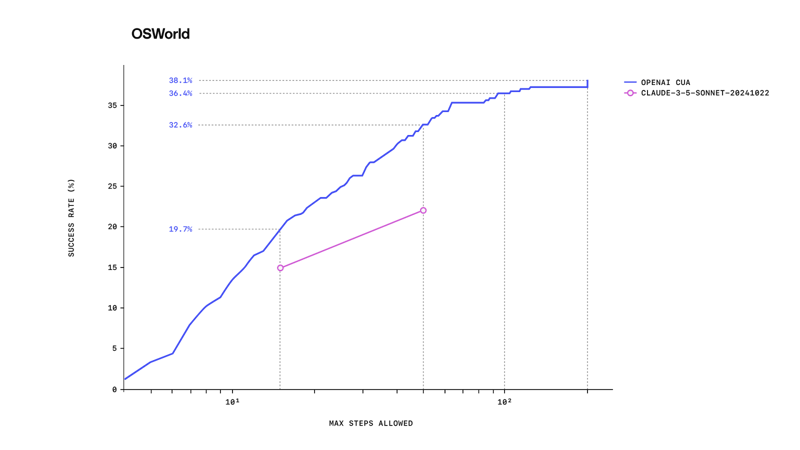
CUA has achieved state-of-the-art (SOTA) performance on several benchmarks:

FAQs
Can OpenAI Operator handle more than one task at the same time?
Yes, Operator is designed to manage multiple tasks simultaneously. You can have separate conversations for each task, and Operator executes in parallel. For example, you can have Operator order groceries on Instacart while also making a booking on Booking.com.
Is OpenAI Operator an AI agent?
Yes, OpenAI Operator is an AI agent designed to autonomously perform tasks for you. It interacts with websites by navigating, clicking, and filling out forms, allowing you to automate activities. Learn more about AI agents with our blog post: Understanding AI Agents: The Future of Autonomous Systems.
How does Operator work?
Powered by the Computer-Using Agent (CUA) model, Operator interacts with web pages by viewing screenshots and performing mouse and keyboard actions. It can self-correct or request user help when needed.
Who can use Operator right now, and how can they get started?
Operator is available to Pro users in the U.S. If you have a Pro subscription, you can visit operator.chatgpt.com to start. Try describing a task, and Operator will handle it.
What are the current limitations of Operator?
Because Operator is still a research preview, it might struggle with complex tasks like creating slideshows or managing calendars.
Will Operator be available on mobile devices?
There is no confirmation yet about mobile support for Operator, but its ability to interact with web interfaces could make it adaptable to mobile platforms in the future as the technology develops.
How does Operator compare to voice assistants like Siri or Google Assistant?
Operator focuses on web-based tasks and directly interacting with websites, while traditional voice assistants typically rely on predefined app integrations or APIs. Operator’s ability to mimic human actions like clicking and scrolling sets it apart in terms of versatility for complex online tasks.
Can Operator handle websites that use CAPTCHA or advanced security features?
Operator currently relies on user input for tasks involving CAPTCHAs or sensitive logins. It does not bypass these systems automatically but can navigate workflows once such barriers are resolved.

I’m an editor and writer covering AI blogs, tutorials, and news, ensuring everything fits a strong content strategy and SEO best practices. I’ve written data science courses on Python, statistics, probability, and data visualization. I’ve also published an award-winning novel and spend my free time on screenwriting and film directing.

Autor
Josef Waples
I'm a data science editor with contributions to research articles in scientific journals. I'm especially interested in linear algebra, statistics, R, and the like.







OpenAI recently announced Operator, an AI agent designed to handle web-based tasks on its own. It can handle tasks like booking a table or shopping online, simplifying digital interactions for everyday tasks.
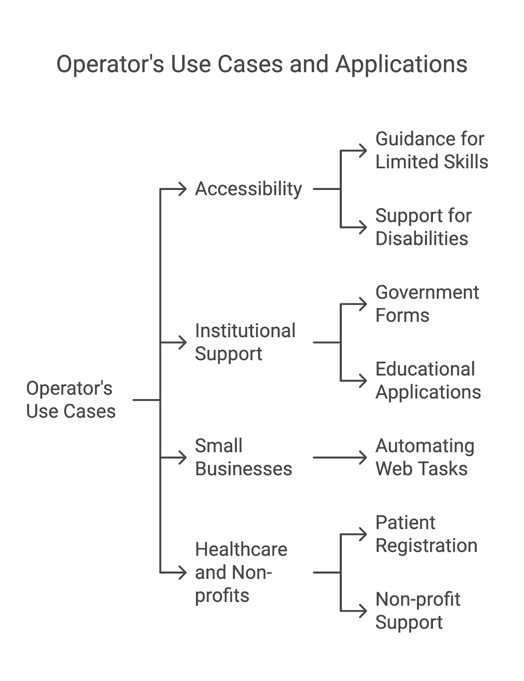
However, we think its potential goes beyond convenience—it could empower people who lack computer skills by enabling them to complete tasks like filling out forms or navigating complex websites with ease.
Additionally, with further integration of voice commands, it could provide a more accessible solution for individuals with disabilities, such as those with visual impairments.
Operator enters a competitive field that includes Anthropic’s computer-use capabilities and Google’s Project Mariner. One difference is that Anthropic’s tools require programming knowledge (for now), whereas Operator allows users to provide instructions in plain language, making it more accessible.
In this blog, we’ll explain what Operator is, explore its core technology (CUA), outline its use cases and limitations, and discuss where it fits within the broader context of AI agents. We’ve also created this one-minute video for a quick overview: