
Hoppa till huvudinnehållet

AI Engineering vs Data Science: Which Career Path Offers Better Long-Term Opportunities?

Compare AI engineering versus data science careers. To choose the right path for you, factor in the job demand, salaries offered, and learning opportunities.
26 juli 2026  · 12 min läsa

Utforska med AI

Öppna i ChatGPTÖppna i ClaudeÖppna i Perplexity

Technology jobs continue to reshape entire industries. Two of the most-discussed paths right now are AI engineering and data science. 

Both promise real impact, solid pay, constant learning, and more than meets the eye. They overlap considerably, yet they pull you toward different kinds of problems and day-to-day work. 

In this article, I’ll examine their key differences in terms of three factors: job opportunities, salary offers, and learning paths. If you're new to either field, you can also explore DataCamp's AI engineering and data science courses to start building the skills employers look for. Keep reading to learn which career path offers a better route for you.

TL;DR

  • AI engineering focuses on building, deploying, and maintaining AI systems used in real-world applications.
  • Data science focuses on analyzing data to uncover insights and support better business decisions.
  • Both careers are in high demand, but AI engineering is growing especially fast as more organizations adopt generative AI.
  • AI engineering roles often offer higher salaries, while data science provides strong long-term opportunities across many industries.
  • Choose AI engineering if you enjoy building AI products and solving technical challenges. Choose data science if you prefer finding patterns in data and turning them into actionable insights.
  • No matter which path you choose, hands-on projects, continuous learning, and practical experience will help you grow your career.

Understanding AI Engineering vs Data Science

AI engineering and data science are two of the fastest-growing career paths in tech. While both leverage data and machine learning, they serve different purposes, from building production-ready AI systems to uncovering insights that drive business decisions.

The table below compares AI engineering and data science based on job overview, core responsibilities, and key skills. 

Career Path

Job Overview

Roles & Responsibilities

Key Skills

AI Engineering

Builds, deploys, and maintains production-ready AI systems

• Design and train AI/ML models

• Fine-tune models with domain data

• Deploy and monitor AI systems

• Build data pipelines and ML infrastructure

• Optimize performance, latency, and costs

• Python programming

• PyTorch & TensorFlow

• MLOps & CI/CD

• Cloud platforms (AWS, Azure, GCP)

• Deep learning

• Math & statistics

Data Science

Analyzes data to generate insights and support business decisions

• Clean and analyze data

• Build predictive models

• Perform forecasting and A/B testing

• Visualize and communicate insights

• Support data-driven decision-making

• Python, R & SQL

• Statistical analysis

• Machine learning

• Data visualization

• Business storytelling

• Domain expertise

We'll then take a closer look at each career path to help you understand where they overlap and what sets them apart.

AI engineering

Artificial intelligence (AI) engineering focuses on building and maintaining AI systems at scale. Production-grade systems run reliably and handle edge cases. Typical roles include AI engineer, machine learning (ML) engineer, applied scientist, and MLOps engineer. Increasingly, roles are centered on generative AI and LLMs.

That’s why it’s best to learn AI from scratch. Once mastered, AI engineers design and train models, then fine-tune them on domain data and wire them into applications. They monitor performance and track cost and latency. They build data pipelines, choose infrastructure, and tackle model deployment and monitoring. 

The work relies on machine learning techniques, such as supervised and unsupervised learning. Deep learning architectures include CNNs, RNNs, Transformers, and more. Modern serving patterns range from batch processing to online inference and A/B testing. The goal isn't just a great model but a great system that real users can trust.

Key skills required

  • Strong programming skills, especially in Python. R appears in analytics-heavy teams, and sometimes Java, C++, or Go for performance-critical components
  • Deep learning frameworks, like PyTorch and TensorFlow, plus scikit-learn for classic ML
  • MLOps fundamentals. model packaging, CI/CD for ML, feature stores, experiment tracking, containerization, orchestration, and monitoring.
  • Cloud fluency across AWS, GCP, or Azure. Understanding GPUs and cost-performance trade-offs
  • Solid math and statistics, linear algebra, probability, optimization, and an intuition for bias-variance, overfitting, and evaluation metrics

AI engineering blends research knowledge with the software engineering discipline. Take the leap to ace the AI engineering interviews and screenings to get the job.

Data science

Data science turns raw data into insight and decisions. Data scientists research, analyze, model, and communicate. They frame questions with stakeholders, explore data, build predictive or descriptive models, and translate results into actions. Think pricing insights or data forecasting.

Roles include data scientist, decision scientist, research scientist, analytics engineer, and quant-style finance positions. Work ranges from experimentation like A/B tests to time-series forecasting to feature engineering and model interpretation.

Key skills required

  • Data wrangling and analysis – with Python and/or R, and strong SQL for working with warehouses and lakes.
  • Statistical thinking – hypothesis testing, causal inference, forecasting, and experimental design
  • Machine learning – for predictive modeling and classification, plus knowing when simpler models do the job better 
  • Data visualization and storytelling – so insights actually change decisions. Tools might be Matplotlib, Seaborn, Plotly, or BI platforms
  • Domain understanding – knowing which patterns matter in retail versus healthcare versus fintech makes a huge difference

Data science fits people who like asking why, finding patterns, persuading with evidence, and making informed decisions.

AI Engineering vs Data Science: Comparing Job Demand, Salaries, and Learning Paths

AI engineering and data science share many technical foundations. However, they differ in career opportunities, earning potential, and the skills you'll need to succeed. 

That said, here's how they compare across the areas that matter most:

Job growth and demand

Demand is strong for both fields. However, the growth patterns differ.

The U.S. Bureau of Labor Statistics projects very fast growth for data scientists. About 35% from 2022 to 2032 (much faster than average) is driven by organizations relying on data for decisions and automation across functions.
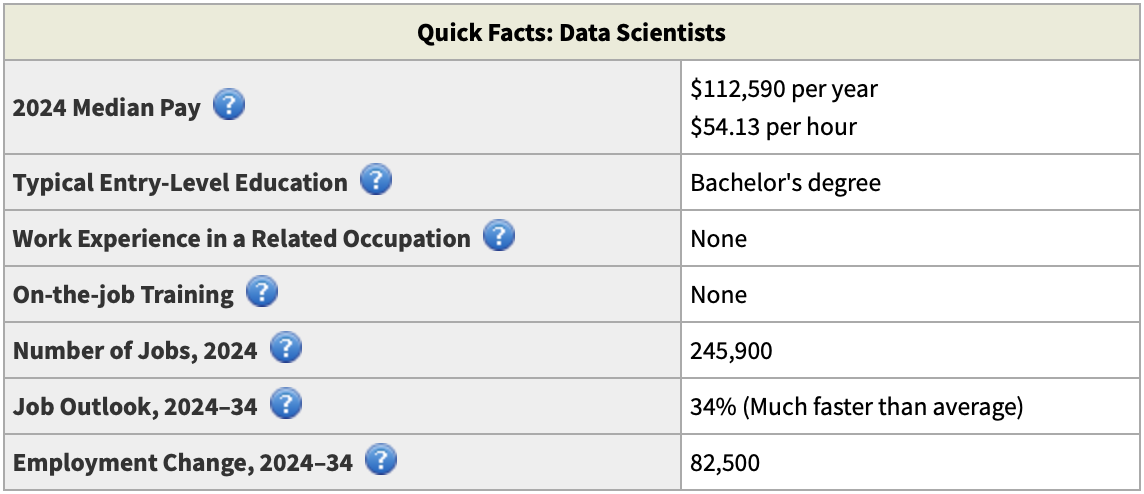
Quick facts and figures about Data Scientists

Image source

AI engineering roles often get grouped under software development and ML-focused titles. Software developers overall are projected to grow about 25% from 2022 to 2032.
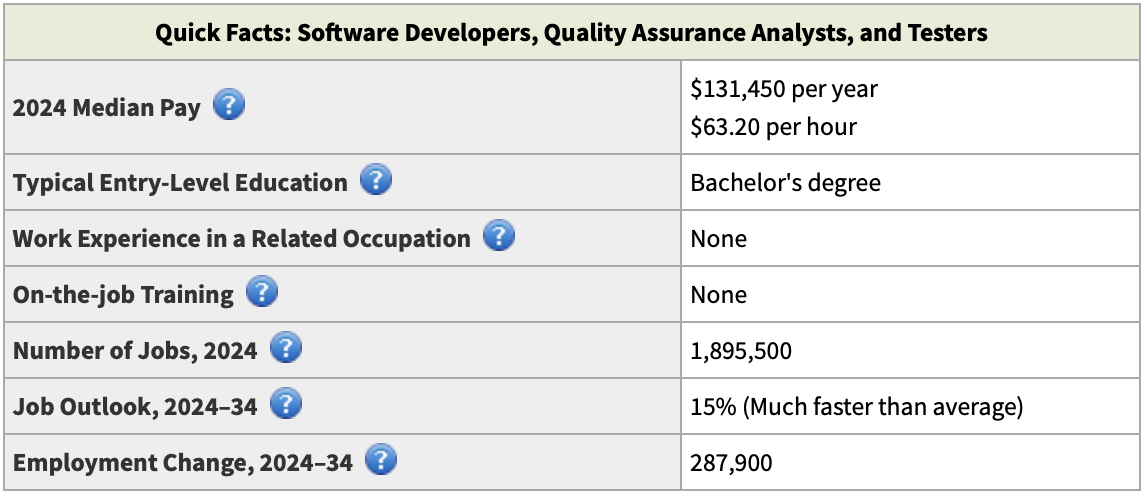
Quick facts and figures about Software Developers, Quality Assurance Analysts, and Testers

Image source

Broader signals suggest AI-specific roles are growing even faster. In its Future of Jobs Report 2023, the World Economic Forum (WEF) identified AI and machine learning specialists as among the fastest-growing occupations, projecting around 40% employment growth between 2023 and 2027 as organizations accelerate AI adoption across industries.

Data science remains a steady market. AI engineering is on a steep upswing, fueled by generative AI and the push to deploy models into real products.

Industry applications

Both fields cut across industries:

  • Finance uses fraud detection, credit scoring, algorithmic trading, risk models, and personalized offers. 
  • Healthcare relies on clinical decision support, triage, medical imaging, patient risk prediction, and operations optimization. 
  • Tech and SaaS companies build search, recommendations, ranking, ads, content moderation, and customer analytics. 
  • Retail and logistics need demand forecasting, inventory optimization, dynamic pricing, and route planning. 
  • Manufacturing and energy sectors use predictive maintenance, anomaly detection, quality control, and grid optimization.

Rawad Baroud, CEO of ZeroGPT, stresses the importance of building AI systems that businesses can rely on. He believes that as more companies adopt generative AI, the demand for professionals who can develop, deploy, and maintain reliable AI solutions will continue to grow.

Baroud says,

As businesses integrate generative AI into customer support, content creation, and internal operations, success depends on more than model accuracy. Organizations need AI professionals who can build trustworthy systems, validate outputs, and continuously improve performance as real-world demands evolve.

Rawad BaroudCEO of ZeroGPT

As gen AI matures, more teams are building natural language interfaces over data. They are automating content workflow and augmenting knowledge-heavy tasks. 

Data science often leads with questions and metrics. Meanwhile, AI engineering leads with systems and reliability. The lines blur in modern teams.

2. Salary prospects and career advancement

Salary comparisons

Compensation depends on location, industry, experience, and your company's stage. A few reliable anchors:

The BLS lists the 2023 median annual wage for data scientists at $108,020. Software developers, a common proxy category for AI/ML engineering paths, show a 2023 median of $132,930.

Aggregated salary sites often show higher average salaries for ML/AI engineering roles than for generalist data science roles. This is especially true at mid- to senior levels and in big tech hubs. For up-to-date market snapshots:
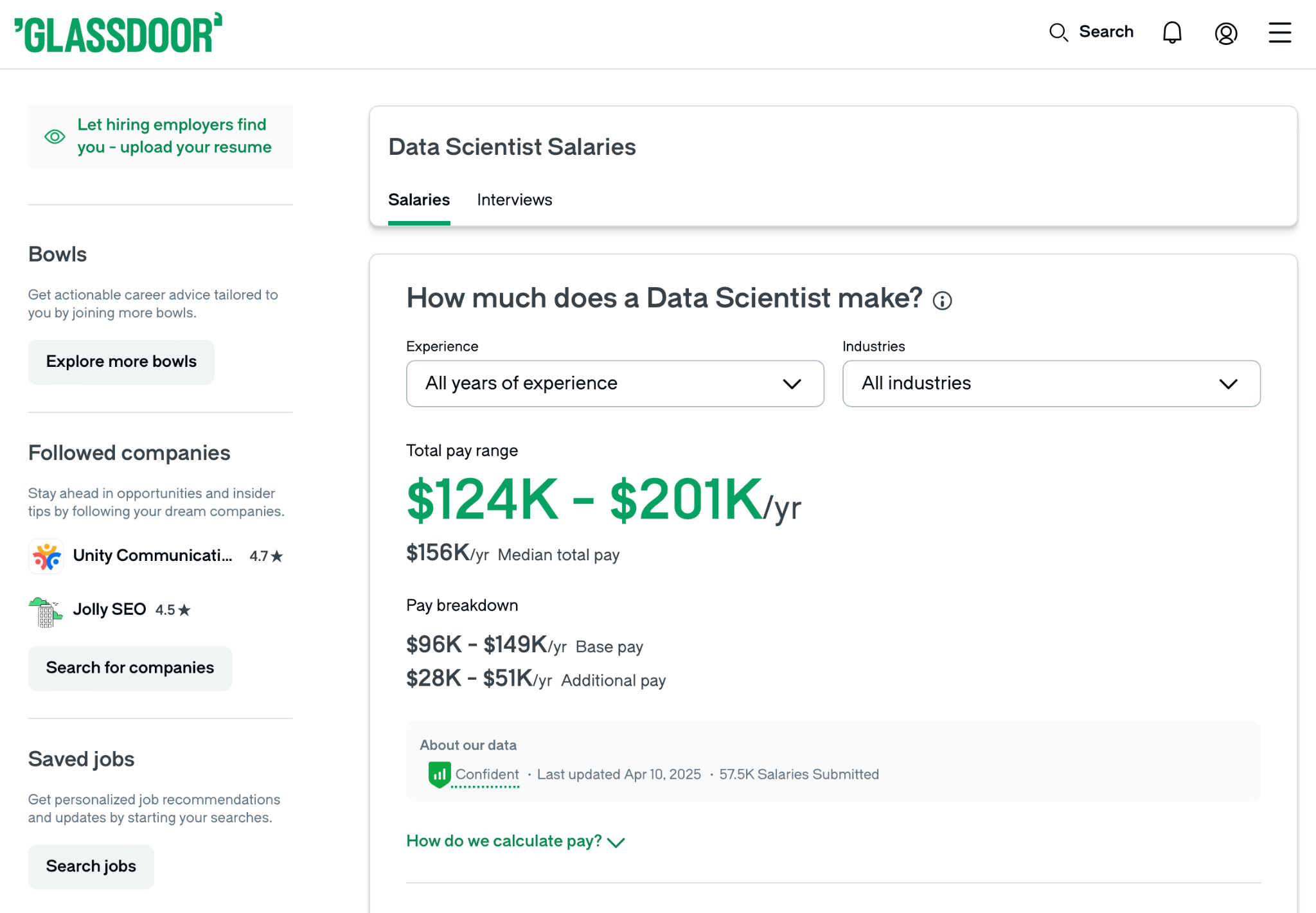
The range of salaries for Data Scientists in the U.S. as per Glassdoor

Image source

At the time of writing, salary estimates show:

Expect premiums for advanced ML (deep learning, LLMs) and strong software engineering. Regulated industries like finance and healthcare pay more because risk and compliance matter. High-cost hubs, such as the San Francisco Bay Area and New York, command higher salaries, though remote work is broadening access. Many AI professionals also compare countries with low cost of living when deciding where to build long-term remote careers. 

Career growth and advancement

Both tracks have healthy career ladders.

  • AI engineering – ML/AI Engineer to Senior/Staff/Principal Engineer to AI Architect or Applied Science Lead to Head of ML/AI Platform to Director/VP of AI
  • Data science – Data Scientist to Senior/Staff/Principal to Analytics/Science Manager to Head of Data Science to Director/VP of Data to Chief Data Officer
  • Hybrids exist, too – ML Product Manager, Research Engineer, or roles owning an AI platform across many teams

Gregor Emmian, Deputy Chief Digital Growth Officer at Rise, believes that career growth in AI depends on continuously building both technical expertise and business impact. 

He notes that professionals who can combine strong AI skills with the ability to solve real business problems are often the ones who advance the fastest.

Emmian says,

The highest-paying AI roles don't just require technical knowledge. They require the ability to turn AI into measurable business value. Professionals who adapt to new technologies and understand how AI supports business goals will have the strongest long-term career prospects.

Gregor EmmianDeputy Chief Digital Growth Officer at Rise

Whether you choose AI engineering or data science, professionals who keep building their skills and solving real business challenges are best positioned for long-term career growth.

3. Education and learning pathways

You can break in from multiple angles. A typical route includes a bachelor's degree in computer science, statistics, math, engineering, or a related field. 

Many professionals add a master's in data science, ML/AI, or analytics, especially for more research-heavy roles. Plenty of successful folks are self-taught through projects and focused practice. 

I recommend checking out the DataCamp courses and resources below:

Useful certifications for AI engineering:

If you're building a career in AI engineering, start with DataCamp's Associate AI Engineer for Developers certification to build practical AI engineering skills. You can also explore the AI Engineering with LangChain skill track to learn how to build and deploy LLM-powered applications, or browse DataCamp's AI courses to strengthen your machine learning, deep learning, and MLOps skills.

Once you've built a solid foundation, you can pursue vendor-specific certifications such as:

  • AWS Certified Machine Learning – Specialty
  • Google Professional Machine Learning Engineer
  • Microsoft Azure AI Engineer Associate

Useful certifications for data science:

If you're pursuing a career in data science, DataCamp's Associate Data Scientist certification is a great way to validate your practical skills. You can also follow the Data Scientist with Python career track or explore DataCamp's Data Science courses to build a strong foundation in data analysis, machine learning, statistics, and data visualization.
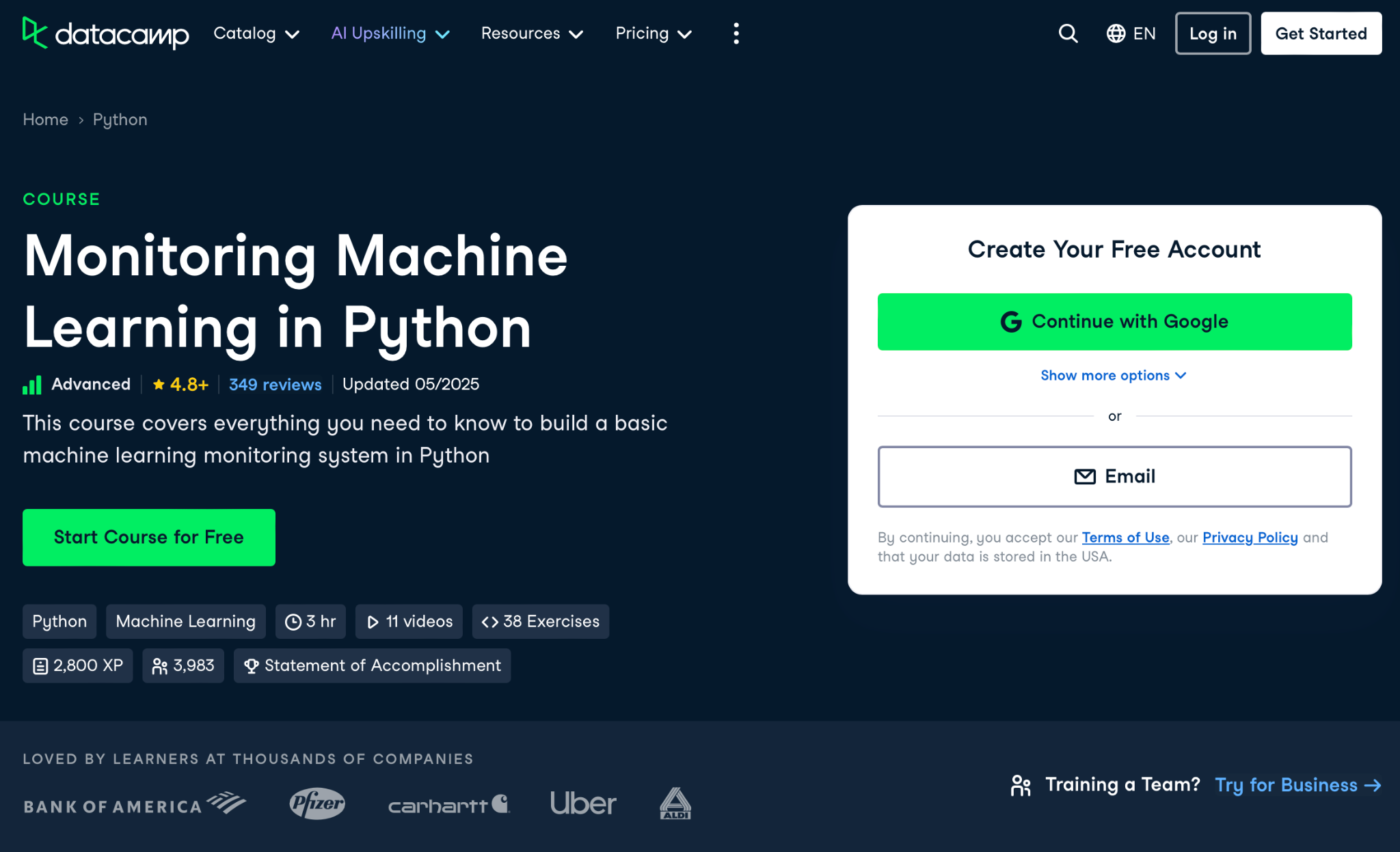
Course on Monitoring Machine Learning in Python offered by Datacamp

You can further enhance your credentials with vendor-specific certifications, such as:

  • Microsoft Azure Data Scientist Associate (DP-100)

Hiring managers still weigh your portfolio and impact more than a badge.

Daniel Apke, Founder of Land Portal, encourages aspiring AI professionals to focus on building practical skills alongside formal education. 

He believes that employers value candidates who can demonstrate real-world problem-solving through projects, regardless of how they learned the skills.

Apke shares,

A degree or certification can open doors, but a strong portfolio often gets you through them. Building projects that solve real problems shows employers you can apply what you've learned and create value from day one.

Daniel ApkeFounder of Land Portal

Start with hands-on courses and small projects. Build a recommendation model or analyze a real dataset and share the story.

Data Science vs AI Engineering: Challenges and Considerations

Both fields evolve fast. That keeps the work interesting. But you'll be learning constantly.

  • Tooling churn: New frameworks and patterns arrive quickly. Stick to core concepts (statistics, optimization, software design, etc.), so you're not starting from scratch each time tools change.
  • Data quality and access: Expect missing values and governance hurdles. Communicating with data owners and setting good standards is half the battle.
  • Production complexity: AI engineers who ship models to production must grapple with drift, monitoring, incident response, and cost control. It can feel like running a marathon at sprint pace unless you invest in good MLOps.
  • Ethics and regulation: Fairness and privacy matter. The EU’s AI Act is a clear sign that governance is here to stay, with a risk-based approach to AI systems and tighter rules for high-risk use cases. If you'd like to learn more, explore DataCamp's guide to the EU AI Act and its AI Ethics resources.
  • Work-life balance: Deadlines and launches can compress timelines. In AI engineering, on-call rotations for production systems aren't unusual. In data science, juggling stakeholder requests and model validation cycles can be mentally taxing. Teams that plan well and measure impact tend to keep a better balance.

Join communities and share knowledge. The best people stay curious and steady rather than frantic.

AI Engineering vs Data Science: Side-by-Side Comparison

Before you decide which path to pursue, here's a quick comparison of AI engineering and data science across the factors covered in this article.

Category

AI Engineering

Data Science

Primary focus

Building, deploying, and maintaining AI systems

Analyzing data to generate insights and support business decisions

Typical work

Developing AI applications, training models, managing MLOps, and optimizing production systems

Cleaning and analyzing data, building predictive models, and communicating insights

Core skills

Python, deep learning, MLOps, cloud platforms, software engineering

Python, R, SQL, statistics, machine learning, and data visualization

Job demand

Rapidly growing as organizations invest in generative AI and production AI systems

Strong and steady demand across industries that rely on data-driven decision-making

Salary potential

Often higher, particularly for experienced AI and machine learning engineers

Competitive salaries with strong long-term career prospects

Learning path

AI engineering, machine learning, deep learning, MLOps, and cloud computing

Statistics, data analysis, machine learning, SQL, and business storytelling

Best suited for

People who enjoy building scalable AI products and solving technical challenges

People who enjoy finding patterns in data and turning them into actionable insights

Long-term outlook

Excellent, driven by rapid AI adoption and advances in generative AI

Excellent, supported by continued demand for data-driven decision-making across industries

AI Engineering vs Data Science: Which Career Path Is Right for You?

AI engineering and data science both offer strong long-term career opportunities. The best choice depends on your interests and the kind of problems you want to solve.

  • If you enjoy building AI applications, deploying machine learning models, and working on production systems, AI engineering is likely the better fit. 
  • If you're more interested in analyzing data, uncovering insights, and helping organizations make smarter decisions, data science may be the right path.

Whichever you choose, you'll be entering a fast-growing field where continuous learning matters. Build practical skills, work on real projects, and stay curious. Those habits will help you succeed whether you're developing AI systems or turning data into actionable insights.

If you've decided that AI engineering is the right path for you, start with DataCamp's Associate AI Engineer for Developers certification or the AI Engineering with LangChain skill track. If data science is a better fit, explore the Data Scientist with Python career track or earn the Associate Data Scientist certification. Each learning path is designed to help you build practical skills, complete real-world projects, and prepare for your next career move.


Brooke Webber's photo
Author
Brooke Webber
LinkedIn
Ämnen

Top DataCamp Courses

track

Associate Data Scientist i Python

90 timmar
Lär dig datavetenskap i Python, från datamanipulering till maskininlärning. Det här spåret ger dig de färdigheter som behövs för att lyckas som data scientist!
Se detaljerRight Arrow
Starta Kursen
Se merRight Arrow
Släkt

blog

DataCamp vs DeepLearning.AI: Which Should You Choose in 2026?

Compare DataCamp and DeepLearning.AI in 2026. Discover which platform offers the best hands-on learning experience for data science and AI skills.
Matt Crabtree's photo

Matt Crabtree

6 min

blog

How to Become an AI Engineer

A guide to starting your journey in one of the most popular, in-demand, and lucrative roles in data science
Javier Canales Luna's photo

Javier Canales Luna

15 min

blog

FAQs About Learning AI: Paths, Time, and Jobs in 2026

Straight answers to the questions people ask about learning AI in 2026: how long it takes, whether you need to code, and the jobs it leads to.
Tom Farnschläder's photo

Tom Farnschläder

14 min

blog

Data Scientist vs Data Engineer

The differences between data engineers and data scientists explained: responsibilities, tools, languages, job outlook, salary, etc.
Karlijn Willems's photo

Karlijn Willems

11 min

blog

The Best AI Courses to Take in 2026

DataCamp's Associate AI Engineer track takes the top spot — here's the full ranking of 17 AI courses for 2026, evaluated on hands-on rigor, curriculum recency, and student outcomes.
Josef Waples's photo

Josef Waples

6 min

blog

7 Artificial Intelligence (AI) Jobs You Can Pursue in 2026

Explore the top 7 AI careers in 2026, from cutting-edge research to hands-on engineering.

Nahla Davies

15 min

Se MerSe Mer