
Our biggest-ever sale. 60% off AI & data skills
Buy Now

Öva och håll koll på dina framsteg.
Fortsätt med GoogleGenom att fortsätta godkänner du vår användarvillkor, våra integritetspolicy och att dina uppgifter lagras i USA.Let's begin by providing background information about AWS for complete beginners. If you're more advanced, feel free to skip this section!
Amazon Web Services (AWS) is the leading cloud computing platform, offering a suite of services that allow companies and individuals to build, deploy, and manage applications globally. Launched in 2006, AWS provides over 200 fully featured services, including compute, storage, networking, machine learning, analytics, and more. These services eliminate the need for physical infrastructure, making developing scalable solutions easier and more cost-effective.
AWS is widely adopted by all types of industries, including healthcare, finance, retail, and entertainment. Whether enabling real-time streaming for Netflix or powering data analysis for NASA, AWS powers most modern cloud computing.
More specifically, some of the most common AWS use cases are the following:
The popularity of AWS comes from its features and advantages, like the following:
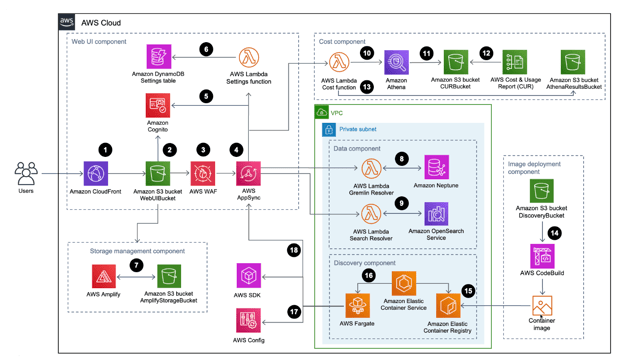
Example architecture diagram showing different AWS core services and how they interact with each other in a cloud application. Image source: AWS
If you’re considering learning AWS, you likely have a specific career or role in mind. However, understanding the broader range of career paths AWS can unlock might inspire you to explore new possibilities!
So, let’s break down the primary types of AWS users and how they use its services:
AWS provides developers with tools to build, deploy, and test applications. Services like AWS CodePipeline streamline CI/CD workflows, while AWS Lambda enables serverless application development, allowing developers to run code without managing servers. These capabilities make AWS a go-to platform for creating scalable applications.
Data engineers rely on AWS to process and manage huge amounts of data. With services like AWS Glue for ETL processes, Amazon S3 for scalable storage, and Amazon Redshift for data warehousing, they can efficiently build and optimize data pipelines, enabling data integration and processing.
AWS helps data scientists and analysts extract insights and create predictive models. Tools like Amazon Athena allow for serverless querying of large datasets, while Amazon SageMaker simplifies machine learning workflows, from model training to deployment. For big data processing, Amazon EMR is a popular choice.
DevOps engineers use AWS to automate and manage infrastructure. Tools like AWS CloudFormation enable infrastructure-as-code, Elastic Beanstalk simplifies application deployment, and Amazon CloudWatch monitors resources for optimal performance and uptime.
AWS offers tools for IT professionals to manage cloud environments. They use services like AWS Identity and Access Management (IAM) for secure access control and AWS Auto Scaling to maintain performance during peak usage.
Learning AWS doesn’t require you to be an expert in all things tech, but having a solid foundation in some areas can make the journey smoother. Here are some skills that are good to cultivate before or along with AWS:
AWS includes hundreds of services, and you’ll often encounter situations where you need to find the best solution for a specific problem. This happened to me essentially in all my jobs! Developing strong problem-solving skills will help you:
AWS is continuously evolving, with new services and features being released regularly. A curious mindset and a willingness to explore will keep you up to date. Reading the documentation, experimenting with free-tier services, and staying informed about updates are all important for learning AWS.
Small configurations in AWS, like setting permissions in IAM or defining security group rules, can have significant impacts. Paying close attention to these details is important for security, functionality, and efficiency in your deployments.
Finally, we arrive at the core of this blog post: the roadmap will take you from zero to hero in your AWS learning path.
Learning AWS can seem overwhelming, but breaking it down into manageable steps will help you stay focused and make steady progress. We all have different goals, so feel free to modify this roadmap based on your specific needs.
Understanding the fundamentals of cloud computing is essential before diving into AWS.
As I’ve mentioned before, AWS offers hundreds of services, but focusing on the core ones gives you a solid foundation.
Once you’re comfortable with core services, dive into managing and deploying scalable and secure infrastructure.
Security and monitoring are critical skills for managing cloud resources effectively.
In my opinion, this is where things get interesting. AWS offers services specifically for different roles and industries. You don’t need to be an expert on everything! Only dive into the ones most relevant to your goals. Here are some examples:
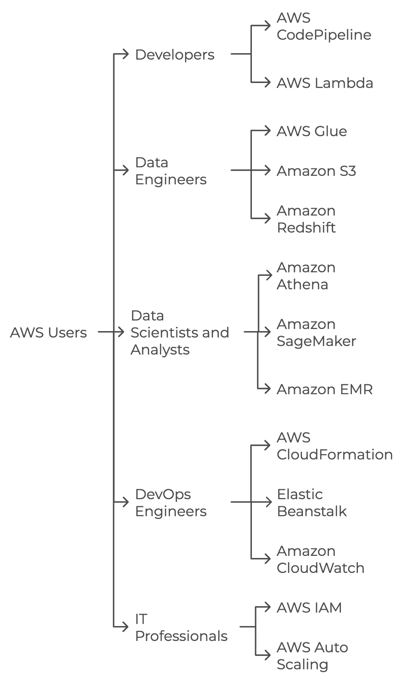
AWS services to focus on depending on your role. Image by Author
Now, the most important part of the roadmap is experimenting with projects. The best way to solidify your knowledge is by applying it to real-world scenarios.
|
Project idea |
Description |
Roles |
|
Scalable web application |
Build a dynamic website using EC2, S3, and Elastic Load Balancing (ELB) with Auto Scaling. |
Developers, Cloud Engineers |
|
Data pipeline |
Set up an ETL pipeline using AWS Glue to transform data and load it into Amazon Redshift. |
Data Engineers, Data Scientists |
|
Serverless backend |
Create a backend using API Gateway, AWS Lambda, and DynamoDB for a scalable architecture. |
Backend Developers, Serverless Architects |
|
Static website hosting |
Host a static website on S3 with CloudFront for caching and fast delivery. |
Web Developers, Cloud Architects |
|
Machine learning workflow |
Train and deploy a machine learning model using Amazon SageMaker, visualize results in QuickSight. |
Data Scientists, Machine Learning Engineers |
|
Log analysis dashboard |
Use CloudWatch Logs, Elasticsearch Service (OpenSearch), and Kibana to analyze application logs. |
DevOps Engineers, Site Reliability Engineers (SREs) |
|
IoT solution |
Build an IoT pipeline with AWS IoT Core, process data with Lambda, and visualize in Timestream. |
IoT Developers, Data Engineers |
|
Disaster recovery setup |
Create a disaster recovery architecture with S3 for backups, CloudFormation, and Route 53. |
IT Administrators, Cloud Security Engineers |
|
Video streaming platform |
Build a video streaming service using CloudFront and Elastic Transcoder. |
Media Engineers, Cloud Engineers |
|
Chatbot with Lex |
Develop a conversational chatbot using Amazon Lex, integrate with Lambda, and deploy via API Gateway. |
AI Developers, Conversational AI Engineers |
The following table summarizes the steps and offers a suggested timeline. Assuming no previous knowledge, this roadmap would allow you to learn AWS in around 12 weeks. Of course, the timeline depends on your availability and commitment. Feel free to tailor it to your specific needs!
|
Week |
Step |
Focus |
Activities |
|
Weeks 1–2 |
Get Familiar with Cloud Computing Concepts |
Understand cloud basics: IaaS, PaaS, SaaS, and AWS’s role in cloud computing. |
|
|
Weeks 3–4 |
Explore AWS Core Services |
Learn about compute (EC2, Lambda), storage (S3, EBS), and databases (RDS, DynamoDB). |
|
|
Weeks 5–6 |
Learn How to Deploy and Manage Infrastructure |
Focus on networking (VPCs, Route 53), load balancing, and auto-scaling. |
|
|
Weeks 7–8 |
Master Security and Monitoring |
Learn IAM, CloudTrail, and CloudWatch to secure and monitor your AWS environment. |
|
|
Weeks 9–10 |
Explore Specialized Services |
Deep dive into services based on career goals: machine learning, analytics, or serverless apps. |
|
|
Weeks 11+ |
Work on Real-World Projects |
Apply your knowledge to real-world scenarios to reinforce learning and build a portfolio. |
|
We have a clear roadmap now, but building expertise in AWS requires access to reliable learning resources. Here are my top recommendations:
Online platforms like DataCamp offer structured courses, hands-on labs, and real-world projects. Some excellent options include:
Books provide in-depth explanations and serve as excellent reference materials:
Once you’re ready, AWS provides official training and certifications to validate your skills. Some popular certifications include:
Official courses and exam details are available on the AWS Training and Certification page. For a comprehensive overview, see our blog post on AWS certifications.
Learning AWS can be exciting, but it’s easy to fall into common pitfalls that can slow your progress. Here’s my list of things to watch out for—and tips to avoid them:
AWS has hundreds of services, and it’s tempting to dive into exciting ones like SageMaker or Athena immediately. However, skipping foundational concepts can leave you confused and struggling later on.
Attempting to master everything can lead to burnout or a lack of focus.
AWS offers a generous Free Tier to help you experiment without incurring costs. Skipping this opportunity can lead to theoretical learning with no practical application.
AWS official documentation is one of the most detailed and up-to-date resources available, but many learners avoid it because it can feel overwhelming.
Sometimes, we just want to learn how to create interesting applications. However, AWS operates on a pay-as-you-go model, and it’s easy to rack up unexpected costs if you’re not careful. This is particularly common in professional settings, not just when learning.
I know this is not as exciting, but neglecting security—such as using overly permissive IAM policies or exposing sensitive data in S3—can lead to vulnerabilities. Again, this is common in a job setting, not so much when just learning.
Learning AWS opens up endless possibilities in the world of cloud computing. Whether you're a beginner exploring cloud concepts or an experienced professional looking to specialize in advanced AWS services, the key is to approach learning step by step.
Start with compute, storage, and networking basics, then move on to infrastructure management, security, and specialized tools.
Hands-on practice is important! Use the AWS Free Tier to experiment. Equally important is staying curious and continually exploring new services.
DataCamp courses provide an excellent foundation for structured learning and guided practice. From the Introduction to AWS for beginners to the comprehensive AWS Cloud Practitioner CLF-C02 Track, you’ll find resources for your skill level and career goals.
The time it takes to learn AWS depends on your prior experience and goals. For beginners, gaining a foundational understanding might take 2–3 months of part-time study. Mastering advanced topics and preparing for certifications could take 6–12 months. Consistent practice and hands-on experience are key to learning AWS effectively.
While basic coding knowledge is helpful, it’s not mandatory to start learning AWS. Many AWS services can be managed through the AWS Management Console without writing code. However, understanding a programming language like Python or Java is beneficial for automating tasks, working with Lambda, or interacting with AWS SDKs.
The AWS Free Tier provides free access to many AWS services for a limited amount of usage each month, often for the first 12 months. However, exceeding these limits or using non-free-tier services can result in charges. Always monitor your usage in the AWS Billing Dashboard to avoid unexpected costs.
This depends on your career goals and the tools used in your target industry or company. AWS is the most widely adopted cloud provider, making it a great starting point. However, the knowledge you gain is often transferable to other providers like Azure and GCP, as the fundamental cloud concepts are similar.
Yes, you can learn AWS without aiming for certifications. Certifications validate your skills and can enhance your resume, but they’re not mandatory for learning or applying AWS knowledge. Focus on building hands-on experience and real-world projects to demonstrate your expertise effectively.

Thalia Barrera is a Senior Data Science Editor at DataCamp with a master’s in Computer Science and over a decade of experience in software and data engineering. Thalia enjoys simplifying tech concepts for engineers and data scientists through blog posts, tutorials, and video courses.

blogg
 Maria Eugenia Inzaugarat• 15 min

blogg
 Thalia Barrera• 15 min

blogg
 Adel Nehme• 15 min
Learn more about AWS with these courses!
Kurs
Bemästra AWS molnteknik med praktiskt lärande och tillämpningar i AWS-ekosystemet.
Kurs
Lär dig AWS Boto och hur du använder molnteknik för att effektivisera ditt dataflöde.
Öva och håll koll på dina framsteg.
Fortsätt med GoogleGenom att fortsätta godkänner du vår användarvillkor, våra integritetspolicy och att dina uppgifter lagras i USA.


Learning AWS is one of the best ways to advance your career in tech. As the most widely used cloud provider, AWS is likely a prerequisite for many roles you aspire to. Even if your dream company uses a different cloud provider, the knowledge you gain from learning AWS is always transferable.
You may be eager to learn AWS from scratch, or perhaps you already use it at your job but haven't taken the time to understand the fundamentals. I faced a similar situation a few years ago—thrown into the deep end without knowing how to swim. While I learned a lot during that time, there's nothing quite like following a structured roadmap to master a new skill.
In this guide, I will share a roadmap for learning AWS and resources to help you get started!